Maths · Algebra
Viewing as
Teacher view: every answer and mark scheme set out in full.
Sequences and the nth Term
Continuing sequences, finding the nth term of linear and quadratic sequences, and testing whether a number is in a sequence.
Learning Objectives
- 1Recognise and continue linear, geometric and special sequences, and describe them using term-to-term rules.
- 2Find the nth term of a linear sequence and use it to find terms or test whether a number is in a sequence.
- 3Use sequences in context, such as matchstick patterns.
- 4Find the nth term of a quadratic sequence (Higher tier).
Patterns that follow a rule
A sequence is a list of numbers that follows a rule. You can describe the rule in two ways: a term-to-term rule that tells you how to get from one term to the next, and a position-to-term rule, the nth term, that gives any term directly from its position. The nth term is far more powerful, because it lets you find the 100th term without writing out the first 99.
Describing sequences
Each number in a sequence is called a term, and the first term is the one in position 1.
-
Term-to-term rule
It says how to get from one term to the next. The sequence 5, 8, 11, 14 has the rule "add 3".
-
Position-to-term rule
The nth term is a formula using \(n\), the position. If the nth term is \(3n + 2\), the 10th term is \(3 \times 10 + 2 = 32\).
-
Arithmetic and geometric
An arithmetic sequence goes up or down by the same amount each time, called the common difference. A geometric sequence is multiplied by the same number each time, such as 3, 6, 12, 24, which doubles.
-
Special sequences
Square numbers 1, 4, 9, 16; cube numbers 1, 8, 27, 64; triangular numbers 1, 3, 6, 10, 15; powers of 2 such as 2, 4, 8, 16; Fibonacci-type sequences where each term is the sum of the two before, such as 1, 1, 2, 3, 5, 8.
Finding the nth term from the differences
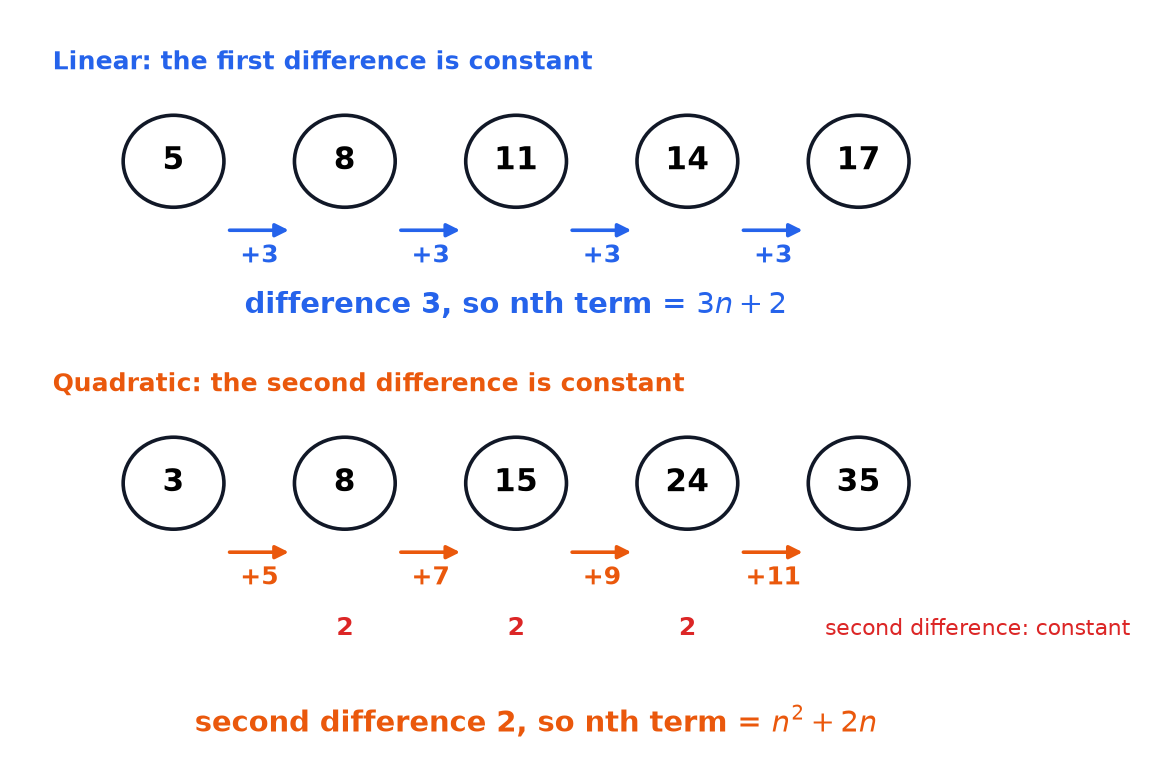
The differences between terms reveal the type of sequence. A constant first difference means the nth term is linear, and a constant second difference means it is quadratic.
Reading the differences
- Linear A first difference that is always the same, such as 3, gives an nth term that starts with \(3n\).
- Quadratic A first difference that changes but with a constant second difference, such as 2, gives an nth term that starts with \(n^2\), because half of 2 is 1.
- Check Always test your nth term by substituting \(n = 1\) and \(n = 2\).
The nth term of a linear sequence
The common difference is the number in front of \(n\).
-
Use the common difference
If the terms go up by 3, the nth term starts \(3n\).
-
Find the adjustment
Write out \(3n\) (3, 6, 9, 12) and compare it with the sequence (5, 8, 11, 14). The sequence is always 2 more, so the nth term is \(3n + 2\).
-
Decreasing sequences
If the terms go down by 3, the coefficient is \(-3\). For 20, 17, 14, 11 write \(-3n\) (\(-3, -6, -9, -12\)); the sequence is 23 more, so the nth term is \(-3n + 23\).
-
Check it
Substitute \(n = 1\): \(3 \times 1 + 2 = 5\), which is the first term.
Finding the nth term
Find an expression for the nth term of the sequence 7, 11, 15, 19, ...
Show the solutionHide the solution
- 1 Find the common difference \(11 - 7 = 4\), so the nth term begins \(4n\).
- 2 Write out \(4n\) The sequence \(4n\) is 4, 8, 12, 16.
- 3 Find the adjustment 7 is 3 more than 4, and 11 is 3 more than 8, so add 3.
- 4 Write the nth term \(4n + 3\). Check: when \(n = 4\), \(4 \times 4 + 3 = 19\).
Answer\(4n + 3\)
Is a number in the sequence?
The nth term of a sequence is \(3n + 2\). Is 100 a term of the sequence? Is 101?
Show the solutionHide the solution
- 1 Set the nth term equal to the number \(3n + 2 = 100\).
- 2 Solve \(3n = 98\), so \(n = 32.67\ldots\). A position must be a whole number, so 100 is not in the sequence.
- 3 Try 101 \(3n + 2 = 101\) gives \(3n = 99\), so \(n = 33\). 101 is the 33rd term.
Answer100 is not a term; 101 is the 33rd term
Sequences in context
Patterns of shapes are a favourite exam question because they connect a picture to an nth term.
-
Count and compare
Count the matchsticks, tiles or dots in the first few patterns and record them in a table.
-
Find what is added
In a row of squares made from matchsticks, each new square needs 3 more sticks, so the nth term starts \(3n\).
-
Check the start
Pattern 1 has 4 matchsticks, which is \(3 \times 1 + 1\), so the nth term is \(3n + 1\).
-
Explain in context
The \(3n\) is the three sticks added for each square, and the \(+1\) is the extra stick at the start.
Quadratic sequences (Higher tier)
When the first differences are not constant, look at the differences of the differences.
-
Second difference
If the second difference is constant, the sequence is quadratic and the nth term begins \(an^2\), where \(a\) is half the second difference.
-
Subtract
Subtract \(an^2\) from each term. What is left is a linear sequence.
-
Find its nth term
Use the usual method for a linear sequence, and add it to \(an^2\).
-
Check
Substitute \(n = 1\), \(2\) and \(3\) into your answer.
Finding a quadratic nth term
Find the nth term of the sequence 4, 10, 18, 28, 40, ...
Show the solutionHide the solution
- 1 First differences \(6, 8, 10, 12\).
- 2 Second differences \(2, 2, 2\). This is constant, so the sequence is quadratic, with \(a = 2 \div 2 = 1\).
- 3 Subtract \(n^2\) \(n^2\) is 1, 4, 9, 16, 25, and the sequence minus these is 3, 6, 9, 12, 15.
- 4 Find the linear nth term 3, 6, 9, 12, 15 is \(3n\).
- 5 Combine The nth term is \(n^2 + 3n\). Check: when \(n = 3\), \(9 + 9 = 18\).
Answer\(n^2 + 3n\)
Two ways to describe a sequence
Term-to-term rule
- Tells you how to get from one term to the next
- Needs the previous term, so it is slow for the 100th term
- Example: add 3 each time
Position-to-term rule (nth term)
- Gives any term directly from its position
- Lets you find the 100th term in one step
- Example: \(3n + 2\)
Sequences from patterns and tables
A table is the quickest way to turn a pattern of shapes into an nth term.
-
Record the pattern
Make a table with the pattern number \(n\) in one row and the number of matchsticks, tiles or dots in the next.
-
Find the difference
If each new pattern adds the same amount, that amount is the coefficient of \(n\).
-
Fix the start
Compare \(3n\) with the actual numbers to find the extra, such as \(+1\).
-
Explain in context
The part with \(n\) is what is added for each new shape, and the number on its own is what is there to begin with.
Finding the first term above a value
The nth term of a sequence is \(3n + 2\). Find the first term of the sequence that is greater than 100.
Show the solutionHide the solution
- 1 Write an inequality \(3n + 2 > 100\).
- 2 Solve it \(3n > 98\), so \(n > 32.67\ldots\).
- 3 Choose the smallest whole number \(n = 33\), because the position must be a whole number.
- 4 Work out the term \(3 \times 33 + 2 = 101\).
Answer101
Finding the nth term from two terms
The 3rd term of an arithmetic sequence is 11 and the 7th term is 27. Find the nth term.
Show the solutionHide the solution
- 1 Find the common difference From the 3rd to the 7th term there are 4 steps, and \(27 - 11 = 16\), so the difference is \(16 \div 4 = 4\).
- 2 Start the nth term The nth term begins \(4n\), and \(4 \times 3 = 12\).
- 3 Adjust The 3rd term is 11, which is 1 less than 12, so the nth term is \(4n - 1\).
- 4 Check When \(n = 7\), \(4 \times 7 - 1 = 27\).
Answer\(4n - 1\)
Geometric sequences and the nth term (Higher tier)
A geometric sequence is multiplied by the same number each time.
-
Common ratio
The number you multiply by. In 3, 6, 12, 24 the common ratio is 2.
-
The nth term
For a first term \(a\) and common ratio \(r\), the nth term is \(ar^{n-1}\). For the sequence above it is \(3 \times 2^{n-1}\).
-
Example
The 5th term is \(3 \times 2^4 = 3 \times 16 = 48\).
-
Decreasing sequences
A common ratio between 0 and 1 gives a decreasing sequence. In 80, 40, 20 the ratio is \(\tfrac{1}{2}\).
A quadratic sequence with a fractional coefficient (Higher tier)
Find the nth term of the triangular numbers 1, 3, 6, 10, 15.
Show the solutionHide the solution
- 1 First differences \(2, 3, 4, 5\).
- 2 Second differences \(1, 1, 1\), so the coefficient of \(n^2\) is half of 1, which is \(\tfrac{1}{2}\).
- 3 Subtract \(\tfrac{1}{2}n^2\) \(\tfrac{1}{2}n^2\) is 0.5, 2, 4.5, 8, 12.5. The sequence minus this is 0.5, 1, 1.5, 2, 2.5, which is \(\tfrac{1}{2}n\).
- 4 Combine The nth term is \(\tfrac{1}{2}n^2 + \tfrac{1}{2}n = \dfrac{n(n + 1)}{2}\). Check: when \(n = 5\), \(\dfrac{5 \times 6}{2} = 15\).
Answer\(\tfrac{1}{2}n^2 + \tfrac{1}{2}n\)
Common sequence mistakes
What students write
- The nth term of 5, 8, 11 is \(n + 3\)
- The nth term of 5, 8, 11 is \(3n\)
- 100 is in the sequence \(3n + 2\) because \(n\) is about 33
What is correct
- The nth term uses the common difference as the coefficient of \(n\)
- Compare \(3n\) with the terms to find the adjustment, which gives \(3n + 2\)
- \(n\) must be a whole number, and \(n = 32.67\ldots\) is not, so 100 is not in the sequence
Test yourself
-
1
What is the next term of 2, 6, 18, 54?
Show answerHide answer
162, because each term is multiplied by 3.
-
2
What is the nth term of 3, 7, 11, 15?
Show answerHide answer
\(4n - 1\).
-
3
What is the 10th term of the sequence with nth term \(2n + 5\)?
Show answerHide answer
25.
-
4
What is the common difference of 5, 11, 17, 23?
Show answerHide answer
6.
-
5
Is 24 a term of the sequence with nth term \(3n\)?
Show answerHide answer
Yes, because \(3n = 24\) gives \(n = 8\), which is a whole number.
Exam technique: sequences
Sequence questions are short and follow the same pattern from paper to paper.
-
Show the differences
Write the differences above or below the terms, as that is where the method mark is.
-
Test your nth term
Substitute \(n = 1\) and \(n = 2\) before you move on.
-
Use a whole-number test
To decide whether a number is in a sequence, solve for \(n\) and check it is a positive whole number.
-
Finish with a sentence
Say "No, because \(n\) is not a whole number" rather than leaving the working unexplained.
Summary and exam focus
- A term-to-term rule uses the previous term; the nth term uses the position.
- The coefficient of \(n\) in a linear sequence is the common difference.
- To find the nth term, write out the multiples of the difference, find the adjustment and test with \(n = 1\).
- To test whether a number is in a sequence, set the nth term equal to it and solve; \(n\) must be a positive whole number.
- For a quadratic sequence, half the second difference is the coefficient of \(n^2\); subtract and find the linear remainder.
Exam focus
Here are the first four terms of an arithmetic sequence: 9, 15, 21, 27. (a) Find an expression for the nth term. (b) Is 150 a term in this sequence? You must show how you decide. (4 marks) (4 marks)
For part (b), set your nth term equal to 150 and solve for \(n\); if \(n\) is not a whole number, the answer is no, and you must say so. Answering "no" with no working scores nothing, because the working is what is being tested.
Key terms
The words this lesson expects you to use. Each one is linked from the first place it appears above.
- Common ratio
- The number that each term of a geometric sequence is multiplied by to get the next term.
- Sequence
- A list of numbers that follow a rule.
- Term
- One of the numbers in a sequence.
- Term-to-term rule
- A rule that tells you how to get from one term to the next.
- nth term
- A formula that gives the term in position \(n\) of a sequence.
- Arithmetic sequence
- A sequence that increases or decreases by the same amount each time.
- Common difference
- The constant amount added to get from one term of an arithmetic sequence to the next.
- Geometric sequence
- A sequence in which each term is multiplied by the same number to get the next.
- Fibonacci-type sequence
- A sequence in which each term is the sum of the two terms before it.
- Quadratic sequence
- A sequence whose nth term includes an \(n^2\) term, so its second difference is constant.
Questions and answers
17 questions set on this lesson, with the mark schemes and model answers open.
Here are the first five terms of a sequence. \(7\) \(11\) \(15\) \(19\) \(23\) (a) Write down the next term. [1 mark] (b) Describe the term-to-term rule. [1 mark]
Mark scheme — 2 marks available
- (a) 27 — B1
- (b) Add 4 (to the previous term) — B1
Model answer
(a) The sequence goes up by 4, so the next term is \(23 + 4 = 27\). (b) Add 4 each time.
Write down an expression for the nth term of the sequence \(6, 9, 12, 15, \ldots\)
Mark scheme — 2 marks available
- \(3n\) seen — M1
- \(3n + 3\) — A1
Model answer
The difference is 3, so the nth term begins \(3n\). \(3n\) is \(3, 6, 9, 12\), and each term is 3 more, so the nth term is \(3n + 3\).
Find the nth term of the sequence \(20, 17, 14, 11, \ldots\)
Mark scheme — 2 marks available
- \(-3n\) seen — M1
- \(-3n + 23\) or \(23 - 3n\) — A1
Model answer
The sequence goes down by 3, so it begins \(-3n\). \(-3n\) is \(-3, -6, -9, -12\), and each term is 23 more. So the nth term is \(-3n + 23\).
The nth term of a sequence is \(5n - 2\). (a) Work out the 20th term. [1 mark] (b) Is 200 a term in the sequence? You must show how you decide. [2 marks]
Mark scheme — 3 marks available
- (a) 98 — B1
- (b) \(5n - 2 = 200\) or \(n = 40.4\) — M1
- (b) No, with a correct reason — Q1
Model answer
(a) \(5 \times 20 - 2 = 98\). (b) \(5n - 2 = 200\) gives \(5n = 202\), so \(n = 40.4\). The position must be a whole number, so 200 is not a term.
Here are the first three patterns in a sequence. Each pattern is made from matchsticks. (a) How many matchsticks are needed for Pattern 5? [1 mark] (b) Find an expression, in terms of \(n\), for the number of matchsticks in Pattern \(n\). [2 marks] (c) Is there a pattern that uses exactly 100 matchsticks? You must show how you decide. [2 marks]
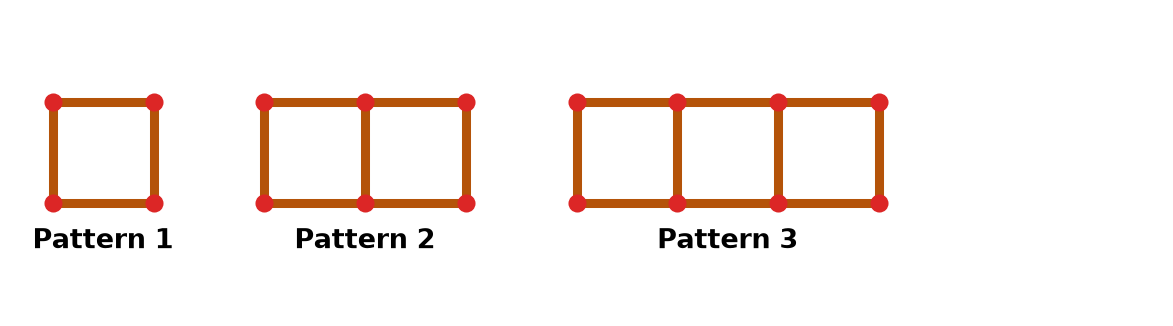
Mark scheme — 5 marks available
- (a) 16 — B1
- (b) \(3n\) seen — M1
- (b) \(3n + 1\) — A1
- (c) \(3n + 1 = 100\) or \(n = 33\) — M1
- (c) Yes, Pattern 33 — Q1
Model answer
(a) The numbers are 4, 7, 10, 13, 16, so Pattern 5 uses 16. (b) The nth term is \(3n + 1\). (c) \(3n + 1 = 100\) gives \(3n = 99\), so \(n = 33\). Yes, Pattern 33 uses exactly 100 matchsticks.
The first five terms of a quadratic sequence are \(2, 9, 20, 35, 54\). Find an expression for the nth term.
Mark scheme — 3 marks available
- Second difference 4 found, or \(2n^2\) seen — M1
- Subtracts \(2n^2\) to leave 0, 1, 2, 3, 4 or \(n - 1\) — M1
- \(2n^2 + n - 1\) — A1
Model answer
First differences: 7, 11, 15, 19. Second differences: 4, 4, 4. So the nth term starts \(2n^2\), which is 2, 8, 18, 32, 50. Subtracting from the terms leaves 0, 1, 2, 3, 4, which is \(n - 1\). The nth term is \(2n^2 + n - 1\).
The first two terms of a Fibonacci-type sequence are 3 and 5. Work out the 6th term.
Mark scheme — 2 marks available
- A correct continuation, such as 8 and 13 — M1
- 34 — A1
Model answer
Each term is the sum of the two before it: \(3, 5, 8, 13, 21, 34\). The 6th term is 34.
The nth term of a sequence is \(3n + 2\). What is the first term that is greater than 100?
Why: \(3n + 2 > 100\) gives \(n > 32.67\ldots\), so \(n = 33\) and the term is \(3 \times 33 + 2 = 101\).
What is the common ratio of the geometric sequence 5, 10, 20, 40, ...?
Why: Each term is the previous term multiplied by 2.
What is the next term in the sequence 2, 5, 8, 11, ...?
Why: The sequence goes up by 3 each time, so the next term is \(11 + 3 = 14\).
What is the nth term of the sequence 4, 7, 10, 13, ...?
Why: The difference is 3, so it begins \(3n\). The sequence is 1 more than \(3n\), so the nth term is \(3n + 1\).
Which sequence has nth term \(2n - 3\)?
Why: Substituting \(n = 1, 2, 3, 4\) gives \(-1, 1, 3, 5\).
What is the nth term of the sequence 20, 17, 14, 11, ...?
Why: The sequence goes down by 3, so it begins \(-3n\). Adding 23 gives 20 when \(n = 1\).
Which of these numbers is a term in the sequence with nth term \(4n + 1\)?
Why: \(4n + 1 = 61\) gives \(n = 15\). The other numbers do not give a whole number for \(n\).
Which of these is a geometric sequence?
Why: Each term is multiplied by 2: \(3 \times 2 = 6\), \(6 \times 2 = 12\), \(12 \times 2 = 24\).
The first four terms of a Fibonacci-type sequence are 1, 3, 4, 7. What is the 5th term?
Why: Each term is the sum of the two before it, so the 5th term is \(4 + 7 = 11\).
A sequence has a constant second difference of 2. Its nth term begins with which term?
Why: The coefficient of \(n^2\) is half the second difference, so it is \(1\), giving \(n^2\).