Maths · Geometry and Measures
Viewing as
Teacher view: every answer and mark scheme set out in full.
Angles in Parallel Lines and Polygons
Angle facts, angles in parallel lines, and the interior and exterior angles of polygons.
Learning Objectives
- 1Recall and use the angle facts for straight lines, points, triangles and quadrilaterals.
- 2Find missing angles in parallel lines using alternate, corresponding and co-interior angles, and give a reason for each step.
- 3Calculate the interior and exterior angles of polygons, including regular polygons.
- 4Form and solve equations from angle facts (Higher tier).
Angles are about reasons
Angle questions on a non-calculator paper are short on arithmetic and long on reasoning. Most of the marks are for saying why: "angles on a straight line add up to 180 degrees" or "alternate angles are equal". A correct answer with no reason often earns only the final mark, or none at all if the question says "give a reason". Learn the facts below word for word, and write one on every line of working.
Basic angle facts
Five facts do most of the work in this topic, and every other angle rule is built from them.
-
Angles on a straight line
They add up to \(180^\circ\).
-
Angles around a point
They add up to \(360^\circ\).
-
Vertically opposite angles
When two straight lines cross, the angles opposite each other are equal.
-
Angles in a triangle
They add up to \(180^\circ\). In an isosceles triangle, the two base angles are equal. In an equilateral triangle, all three angles are \(60^\circ\).
-
Angles in a quadrilateral
They add up to \(360^\circ\).
Using triangle and straight-line facts
A straight line is split into three angles. Two of them are \(47^\circ\) and \(68^\circ\). Work out the third angle.
Show the solutionHide the solution
- 1 Use the fact Angles on a straight line add up to \(180^\circ\).
- 2 Add the known angles \(47 + 68 = 115\).
- 3 Subtract \(180 - 115 = 65\).
- 4 Give a reason Angles on a straight line add up to \(180^\circ\), so the third angle is \(65^\circ\).
Answer\(65^\circ\)
Exterior angle of a triangle
If you extend one side of a triangle, the angle outside the triangle is called an exterior angle.
-
The rule
An exterior angle of a triangle equals the sum of the two interior angles opposite it.
-
Why it works
The exterior angle and its neighbouring interior angle make a straight line, so together they add up to \(180^\circ\). The three interior angles also add up to \(180^\circ\), which makes the exterior angle equal to the other two.
-
A time saver
It gives the answer in one step, but you can always use the two steps of straight line and triangle if you prefer.
Angles in parallel lines
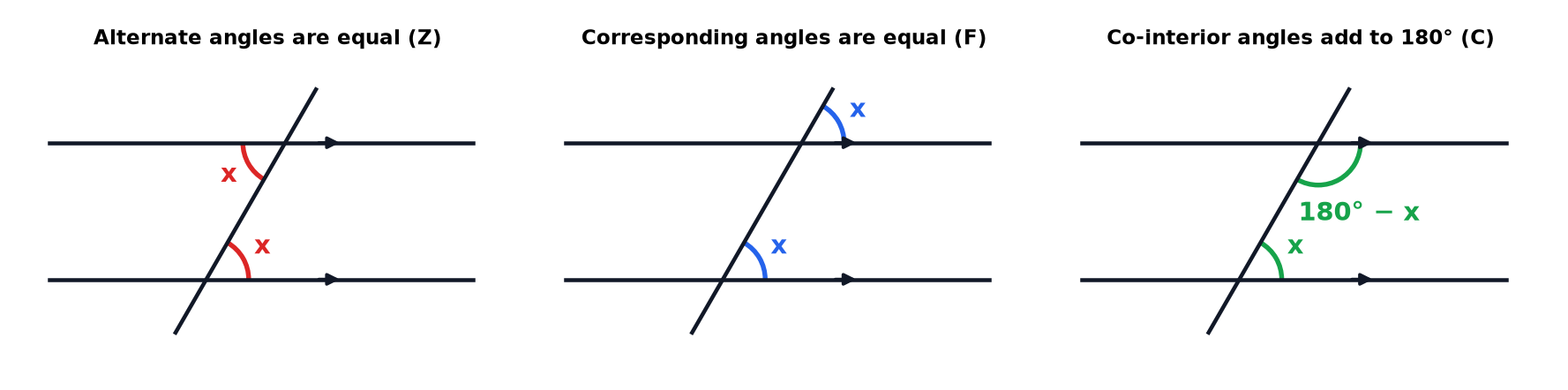
The arrows on the lines mean they are parallel. A line that crosses parallel lines is called a transversal, and it makes the same angle pattern at each crossing.
The three parallel line facts
- Alternate angles They are equal and form a Z shape. Use the words "alternate angles".
- Corresponding angles They are equal and form an F shape. Use the words "corresponding angles".
- Co-interior angles They add up to \(180^\circ\) and form a C shape. Use the words "co-interior angles" or "allied angles".
Parallel lines with a reason
Two parallel lines are crossed by a transversal. At the lower crossing, the angle on the right of the transversal and above the lower line is \(72^\circ\). Angle \(x\) is the alternate angle to it at the upper crossing, and angle \(y\) is the co-interior angle to it at the upper crossing. Find \(x\) and \(y\), giving a reason for each.
Show the solutionHide the solution
- 1 Find x \(x = 72^\circ\) because alternate angles are equal.
- 2 Find y \(y = 180 - 72 = 108^\circ\) because co-interior angles add up to \(180^\circ\).
- 3 Check \(x\) and \(y\) sit next to each other on a straight line, and \(72 + 108 = 180\).
Answer\(x = 72^\circ\) and \(y = 108^\circ\)
Polygons
A polygon is a closed shape made of straight lines. Its name comes from how many sides it has.
-
Names
3 triangle, 4 quadrilateral, 5 pentagon, 6 hexagon, 7 heptagon, 8 octagon, 9 nonagon, 10 decagon.
-
Regular polygon
All the sides are equal and all the angles are equal. An irregular polygon is any other polygon.
-
Sum of the interior angles
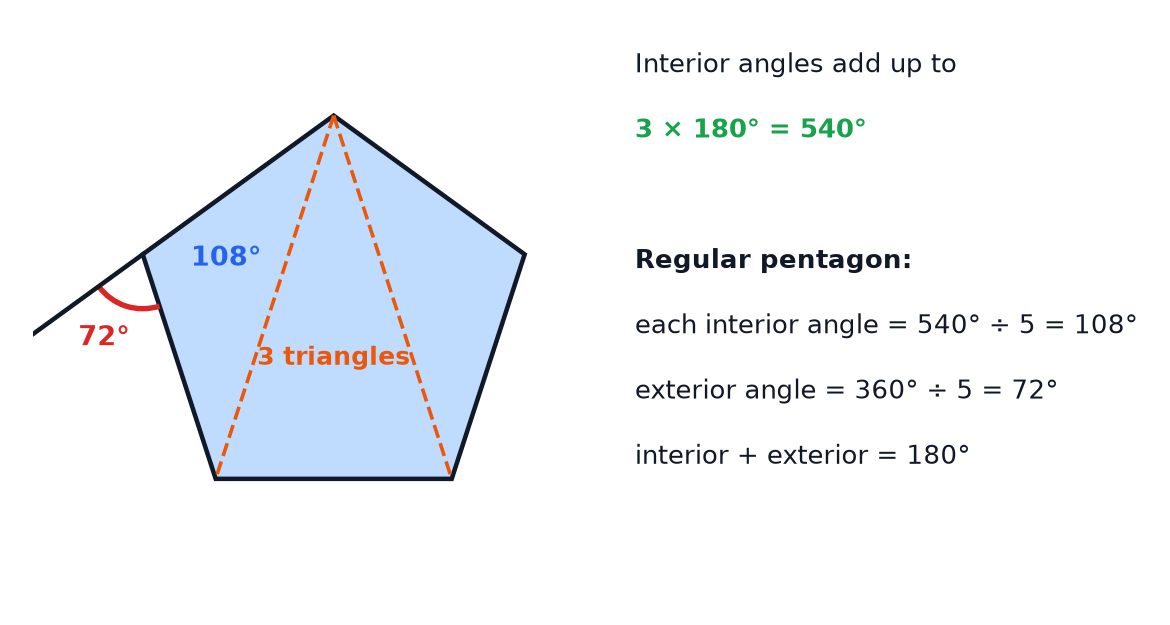
Split the polygon into triangles from one vertex. An \(n\)-sided polygon makes \(n - 2\) triangles, so the sum is \((n - 2) \times 180^\circ\).
-
Sum of the exterior angles
The exterior angles of any polygon always add up to \(360^\circ\).
Interior and exterior angles of a regular pentagon
A pentagon splits into three triangles, so its angles add up to \(3 \times 180 = 540^\circ\). For a regular pentagon, divide equally between the five angles.
Regular polygons
- Each exterior angle \(\dfrac{360}{n}\).
- Each interior angle \(180 - \text{exterior angle}\), or \(\dfrac{(n - 2) \times 180}{n}\).
- Find n from the exterior angle \(n = \dfrac{360}{\text{exterior angle}}\), which is the quickest method.
Finding the number of sides
Each exterior angle of a regular polygon is \(24^\circ\). How many sides does the polygon have?
Show the solutionHide the solution
- 1 Use the exterior angle fact Each exterior angle is \(\dfrac{360}{n}\).
- 2 Rearrange \(n = \dfrac{360}{24}\).
- 3 Calculate \(360 \div 24 = 15\).
- 4 Check A polygon with 15 sides has each interior angle \(180 - 24 = 156^\circ\), which is sensible for a shape close to a circle.
Answer15 sides
Interior angle of a regular hexagon
Work out the size of each interior angle of a regular hexagon.
Show the solutionHide the solution
- 1 Find the exterior angle \(360 \div 6 = 60^\circ\).
- 2 Interior and exterior make a straight line \(180 - 60 = 120^\circ\).
- 3 Check with the sum \((6 - 2) \times 180 = 720\) and \(720 \div 6 = 120\). Both methods agree.
Answer\(120^\circ\)
Angles and algebra (Higher tier)
Higher tier questions use letters for angles, and you must set up an equation from an angle fact.
-
Choose the fact
A triangle gives \(180\), a quadrilateral \(360\), a straight line \(180\).
-
Write an equation
If the angles of a triangle are \(x\), \(2x + 10\) and \(3x - 10\), then \(6x = 180\), so \(x = 30\).
-
Substitute back
Work out each angle and check they add up to the total.
-
Prove statements
A "show that" question needs a conclusion: write "so \(x = 30\)" and give the fact you used.
Test yourself
-
1
What do angles on a straight line add up to?
Show answerHide answer
\(180^\circ\).
-
2
What do the angles in a quadrilateral add up to?
Show answerHide answer
\(360^\circ\).
-
3
Which parallel line angles are equal and form a Z?
Show answerHide answer
Alternate angles.
-
4
What is the sum of the interior angles of a polygon with \(n\) sides?
Show answerHide answer
\((n - 2) \times 180^\circ\).
-
5
What is each exterior angle of a regular octagon?
Show answerHide answer
\(360 \div 8 = 45^\circ\).
Exam technique: angles
The working is mostly sentences, so a few habits make a big difference.
-
Give the reason in the right words
"Alternate angles are equal" is correct. "Z angles" and "Z shape" are not accepted by most mark schemes.
-
Reasons go on each line
One angle fact per line is clearer than a paragraph.
-
Do not measure
Diagrams are "not accurately drawn", so use facts, not a protractor.
-
Use the quickest route
For a regular polygon, \(360 \div n\) is usually quicker than the sum of interior angles.
Summary and exam focus
- Angles on a line add to \(180^\circ\), around a point \(360^\circ\), in a triangle \(180^\circ\), and in a quadrilateral \(360^\circ\).
- Alternate and corresponding angles are equal, and co-interior angles add up to \(180^\circ\).
- The interior angles of a polygon add up to \((n - 2) \times 180^\circ\), and the exterior angles add up to \(360^\circ\).
- For a regular polygon, each exterior angle is \(360 \div n\), and the interior angle is \(180\) minus that.
- Higher tier questions form equations from angle facts.
Exam focus
ABCDE is a regular pentagon. Work out the size of one interior angle of the pentagon. (3 marks) (3 marks)
The quick method is \(360 \div 5 = 72^\circ\) for the exterior angle and then \(180 - 72 = 108^\circ\). If you use the sum \((5 - 2) \times 180 = 540\), remember to divide by 5. A bare 108 can score full marks, but show your working in case of an error.
Key terms
The words this lesson expects you to use. Each one is linked from the first place it appears above.
- Transversal
- A line that crosses two or more other lines.
- Parallel lines
- Lines that stay the same distance apart and never meet, marked with arrows.
- Alternate angles
- Equal angles on opposite sides of a transversal between two parallel lines, forming a Z shape.
- Corresponding angles
- Equal angles in matching positions at each crossing of a transversal, forming an F shape.
- Co-interior angles
- Angles between parallel lines on the same side of a transversal, which add up to 180 degrees.
- Vertically opposite angles
- The equal angles opposite each other where two straight lines cross.
- Polygon
- A closed shape made from straight sides.
- Regular polygon
- A polygon with all sides equal and all angles equal.
- Exterior angle
- The angle between one side of a shape and the extension of the next side.
Questions and answers
15 questions set on this lesson, with the mark schemes and model answers open.
Three angles of a quadrilateral are \(85^\circ\), \(100^\circ\) and \(70^\circ\). Work out the fourth angle.
Mark scheme — 2 marks available
- \(85 + 100 + 70 = 255\) — M1
- \(105^\circ\) — A1
Model answer
The angles in a quadrilateral add up to \(360^\circ\). \(85 + 100 + 70 = 255\), and \(360 - 255 = 105^\circ\).
In triangle \(PQR\), angle \(P = 48^\circ\) and angle \(Q\) is twice the size of angle \(R\). Work out the size of angle \(Q\).
Mark scheme — 3 marks available
- \(180 - 48 = 132\) — M1
- \(132 \div 3 = 44\) — M1
- \(88^\circ\) — A1
Model answer
Angles \(Q\) and \(R\) add up to \(180 - 48 = 132^\circ\). Let angle \(R = r\), so \(3r = 132\) and \(r = 44^\circ\). Angle \(Q = 2 \times 44 = 88^\circ\).
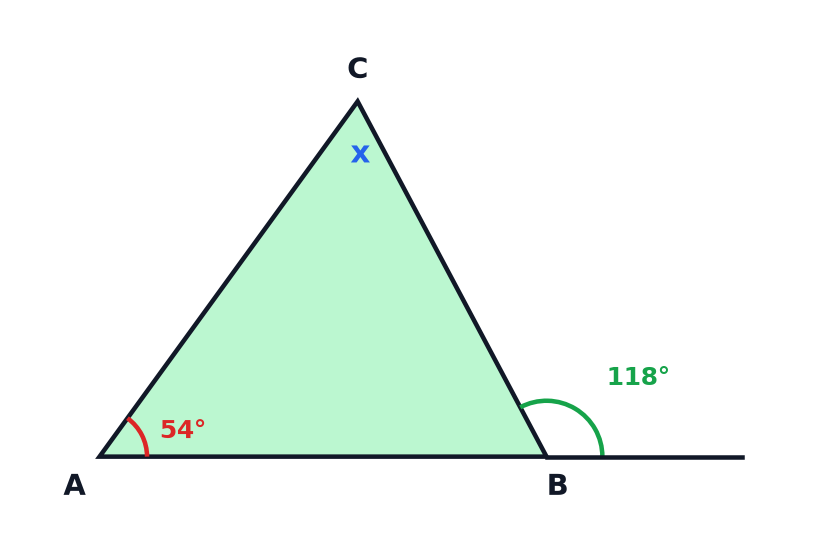
The diagram shows triangle \(ABC\). \(AB\) is extended to a point on a straight line. (a) Work out the size of angle \(x\). Give a reason for your answer. [3 marks] (b) Work out the size of angle \(ABC\). [1 mark]
Mark scheme — 4 marks available
- (a) \(118 - 54\) — M1
- (a) \(64^\circ\) — A1
- (a) Exterior angle equals the sum of the two opposite interior angles — Q1
- (b) \(62^\circ\) — B1
Model answer
(a) The exterior angle of a triangle equals the sum of the two interior opposite angles, so \(x = 118 - 54 = 64^\circ\). (b) Angles on a straight line add up to \(180^\circ\), so angle \(ABC = 180 - 118 = 62^\circ\).
Each interior angle of a regular polygon is \(150^\circ\). Work out the number of sides of the polygon.
Mark scheme — 3 marks available
- \(180 - 150 = 30\) — M1
- \(360 \div 30\) — M1
- 12 — A1
Model answer
The exterior angle is \(180 - 150 = 30^\circ\), and \(360 \div 30 = 12\) sides.
A regular hexagon and a square are joined along a common side. The shapes do not overlap. Work out the size of the angle at one end of the common side that is outside both shapes.
Mark scheme — 3 marks available
- \(120^\circ\) or \(90^\circ\) found — M1
- \(360 - 120 - 90\) — M1
- \(150^\circ\) — A1
Model answer
The interior angle of a regular hexagon is \(120^\circ\) and of a square is \(90^\circ\). Angles around a point add up to \(360^\circ\), so the angle is \(360 - 120 - 90 = 150^\circ\).
The interior angle of a regular polygon is 5 times the size of its exterior angle. Work out the number of sides of the polygon.
Mark scheme — 3 marks available
- Interior \(+\) exterior \(= 180\) — M1
- Exterior angle \(= 30^\circ\) — M1
- 12 — A1
Model answer
The interior and exterior angles add up to \(180^\circ\), so \(6 \times\) exterior \(= 180\) and the exterior angle is \(30^\circ\). Then \(360 \div 30 = 12\) sides.
Three angles on a straight line are \(47^\circ\), \(68^\circ\) and \(x\). What is \(x\)?
Why: Angles on a straight line add up to \(180^\circ\). \(180 - 47 - 68 = 65\).
Three angles of a quadrilateral are \(80^\circ\), \(95^\circ\) and \(110^\circ\). What is the fourth angle?
Why: The angles of a quadrilateral add up to \(360^\circ\). \(80 + 95 + 110 = 285\) and \(360 - 285 = 75\).
Which type of angles are equal and form a Z shape between parallel lines?
Why: Alternate angles are on opposite sides of the transversal, and make a Z shape.
Two co-interior angles lie between parallel lines. One is \(72^\circ\). What is the other?
Why: Co-interior angles add up to \(180^\circ\), so \(180 - 72 = 108\).
What is the sum of the interior angles of a hexagon?
Why: A hexagon has 6 sides, so the sum is \((6 - 2) \times 180 = 720\).
What is each exterior angle of a regular octagon?
Why: \(360 \div 8 = 45\). The interior angle is \(135^\circ\).
Each exterior angle of a regular polygon is \(24^\circ\). How many sides does it have?
Why: \(360 \div 24 = 15\). The number 156 is the interior angle.
An exterior angle of a triangle is \(118^\circ\). One of the interior opposite angles is \(54^\circ\). What is the other interior opposite angle?
Why: The exterior angle equals the sum of the two interior opposite angles, so \(118 - 54 = 64\).
The angles of a triangle are \(x\), \(2x + 10\) and \(3x - 10\) degrees. What is the size of the largest angle?
Why: \(6x = 180\), so \(x = 30\). The angles are \(30^\circ\), \(70^\circ\) and \(80^\circ\).