Maths · Graphs
Viewing as
Teacher view: every answer and mark scheme set out in full.
Cubic, Reciprocal and Other Graphs
Recognising and plotting cubic, reciprocal, exponential and circle graphs.
Learning Objectives
- 1Recognise the graphs of linear, quadratic, cubic and reciprocal functions from their equations.
- 2Complete tables of values for cubic and reciprocal functions, and plot them.
- 3Recognise the graph of an exponential function \(y = a^x\).
- 4Recognise and use the equation of a circle, \(x^2 + y^2 = r^2\) (Higher tier).
Every equation has a shape
Once you know the standard shapes you can often tell which equation a graph belongs to without plotting a single point. The question usually shows two or three curves and asks you to match them to equations, or asks you to plot one from a table. On Paper 1 the tables are small and the numbers are simple, so the marks come from remembering the shapes and from taking care with negatives, especially in cubes and reciprocals.
The standard graph shapes
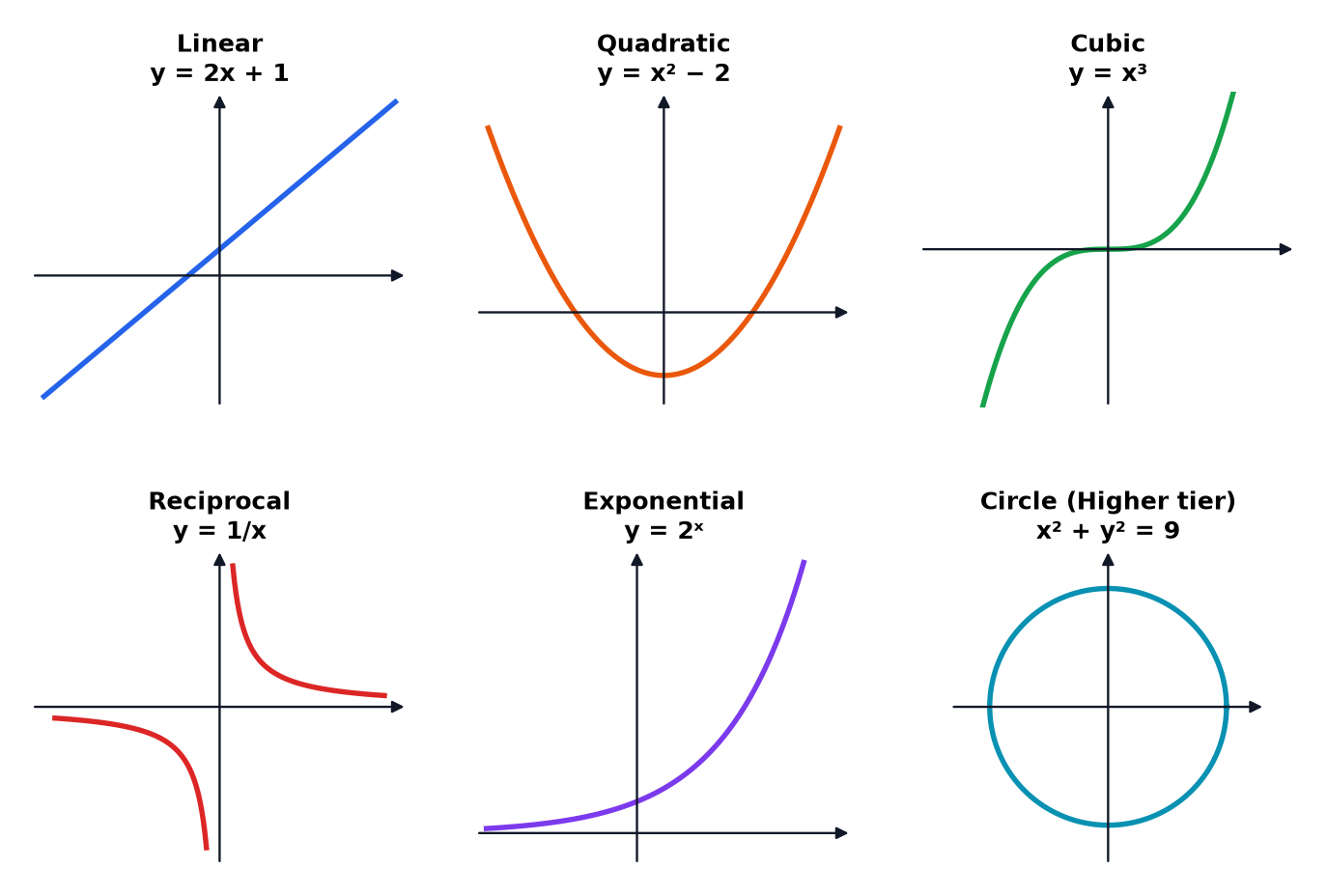
Learn these six shapes and what is special about each one. The equation tells you the shape: look at the highest power of \(x\) and whether \(x\) is on the bottom of a fraction or in a power.
What each shape looks like
- Linear \(y = mx + c\) A straight line.
- Quadratic \(y = ax^2 + bx + c\) A U shape, or an upside-down U when \(a\) is negative.
- Cubic \(y = ax^3 + \ldots\) An S shape. \(y = x^3\) goes through the origin, starting low on the left and ending high on the right.
- Reciprocal \(y = \dfrac{a}{x}\) Two separate branches that never touch the axes.
Cubic graphs
A cubic has an \(x^3\) term as its highest power, and its graph is an S shape.
-
Positive \(x^3\)
The curve starts at the bottom left and finishes at the top right.
-
Negative \(x^3\)
It starts at the top left and finishes at the bottom right, like \(y = -x^3\).
-
Turning points
A cubic can have a hill and a valley, like \(y = x^3 - 3x\), or none at all, like \(y = x^3\).
-
Tables of values
For \(y = x^3\) the values for \(x = -2, -1, 0, 1, 2\) are \(-8, -1, 0, 1, 8\). Cubing a negative gives a negative.
Completing a cubic table
Complete the table for \(y = x^3 - 3x\) for \(x = -2, -1, 0, 1, 2\).
Show the solutionHide the solution
- 1 \(x = -2\) \((-2)^3 - 3 \times (-2) = -8 + 6 = -2\).
- 2 \(x = -1\) \(-1 + 3 = 2\).
- 3 \(x = 0\) \(0 - 0 = 0\).
- 4 \(x = 1\) and \(x = 2\) \(1 - 3 = -2\) and \(8 - 6 = 2\).
Answer\(-2,\ 2,\ 0,\ -2,\ 2\)
Reciprocal graphs
The graph of \(y = \dfrac{1}{x}\) comes in two pieces, because you cannot divide by zero.
-
No value at x = 0
The curve never touches the \(y\)-axis. It gets closer and closer without reaching it.
-
Never reaches y = 0
The curve gets very close to the \(x\)-axis for large \(x\) but never touches it.
-
Two branches
One is in the top right (positive \(x\), positive \(y\)) and one in the bottom left (negative \(x\), negative \(y\)).
-
Tables of values
For \(y = \dfrac{4}{x}\), \(x = 1, 2, 4\) give \(4, 2, 1\), and \(x = -1, -2, -4\) give \(-4, -2, -1\).
Exponential graphs
In \(y = a^x\) the unknown is in the power. The graph climbs very quickly.
-
Passes through (0, 1)
Any number to the power 0 is 1, so \(y = 2^x\) meets the \(y\)-axis at \((0, 1)\).
-
Grows fast
\(y = 2^x\) gives \(1, 2, 4, 8, 16\) for \(x = 0, 1, 2, 3, 4\), doubling every time.
-
Never negative
The curve stays above the \(x\)-axis. For negative \(x\) it gets close to the axis: \(2^{-1} = \dfrac{1}{2}\) and \(2^{-2} = \dfrac{1}{4}\).
-
Decay
If the base is a fraction, such as \(y = \left(\dfrac{1}{2}\right)^x\), the curve falls instead.
The circle (Higher tier)
A circle with its centre at the origin has a very simple equation.
-
Equation
\(x^2 + y^2 = r^2\), where \(r\) is the radius. \(x^2 + y^2 = 25\) is a circle of radius 5.
-
Points on it
\((3, 4)\) is on this circle because \(9 + 16 = 25\). So are \((4, 3)\), \((5, 0)\) and \((0, -5)\).
-
Not a function
A circle has two \(y\)-values for most \(x\)-values, so it is not a single curve of the form \(y = \ldots\).
-
Use the radius
The radius is the square root of the number on the right, so \(x^2 + y^2 = 9\) has radius 3.
Matching equations to graphs
Which of these equations gives a cubic graph: \(y = 3x + 2\), \(y = x^2 - 4\), \(y = \dfrac{2}{x}\), \(y = x^3 + 1\)?
Show the solutionHide the solution
- 1 Look at the highest power A cubic has \(x^3\) as its highest power.
- 2 Rule out the others \(y = 3x + 2\) is linear, \(y = x^2 - 4\) is quadratic, and \(y = \dfrac{2}{x}\) is reciprocal.
- 3 Choose \(y = x^3 + 1\) is the cubic.
Answer\(y = x^3 + 1\)
Test yourself
-
1
What shape is the graph of \(y = x^3\)?
Show answerHide answer
An S shape through the origin.
-
2
What is special about the graph of \(y = \dfrac{1}{x}\)?
Show answerHide answer
It has two branches and never touches either axis.
-
3
Where does \(y = 3^x\) cross the y-axis?
Show answerHide answer
At \((0, 1)\).
-
4
What is the value of \(y = x^3\) when \(x = -3\)?
Show answerHide answer
\(-27\).
-
5
What is the radius of \(x^2 + y^2 = 36\) (Higher tier)?
Show answerHide answer
6.
Exam technique: recognising graphs
Matching questions can be solved quickly by testing a point.
-
Test a value
Put \(x = 0\) or \(x = 1\) into each equation and see which graph passes through the matching point.
-
Look for symmetry
A U shape is symmetrical about the \(y\)-axis for \(y = x^2 + k\), and a cubic turns round the origin.
-
Negative numbers
Put brackets round negative values in tables, like \((-2)^3\), to avoid sign mistakes.
-
Smooth curves
Draw curves by hand, and leave the gap at \(x = 0\) on a reciprocal graph.
Summary and exam focus
- Linear graphs are straight, quadratics are U-shaped, cubics are S-shaped and reciprocals have two branches.
- Exponential graphs pass through \((0, 1)\) and grow very quickly.
- A cubed negative number is negative, so check each entry in a table.
- \(x^2 + y^2 = r^2\) is a circle of radius \(r\) centred on the origin (Higher tier).
Exam focus
Complete the table of values for \(y = x^3\) for \(x = -2, -1, 0, 1, 2\). (2 marks) (2 marks)
The answers are \(-8, -1, 0, 1, 8\). Do not forget that cubing a negative gives a negative. Writing \((-2)^3 = -8\) in the margin shows the method.
Key terms
The words this lesson expects you to use. Each one is linked from the first place it appears above.
- Cubic
- An equation whose highest power of \(x\) is \(x^3\), with an S-shaped graph.
- Reciprocal
- One divided by a number or expression, such as \(\dfrac{1}{x}\).
- Exponential
- A relationship where the unknown is in the power, such as \(y = 2^x\).
- Asymptote
- A line that a curve gets closer and closer to without ever touching.
- Branch
- One of the separate pieces of a graph such as \(y = \dfrac{1}{x}\).
- Function
- A rule that gives one output for each input.
- Circle equation
- \(x^2 + y^2 = r^2\) for a circle with centre the origin and radius \(r\).
- Power
- The small number showing how many times to multiply, such as 3 in \(x^3\).
- Smooth curve
- A curve drawn freehand with no corners or breaks.
Questions and answers
15 questions set on this lesson, with the mark schemes and model answers open.
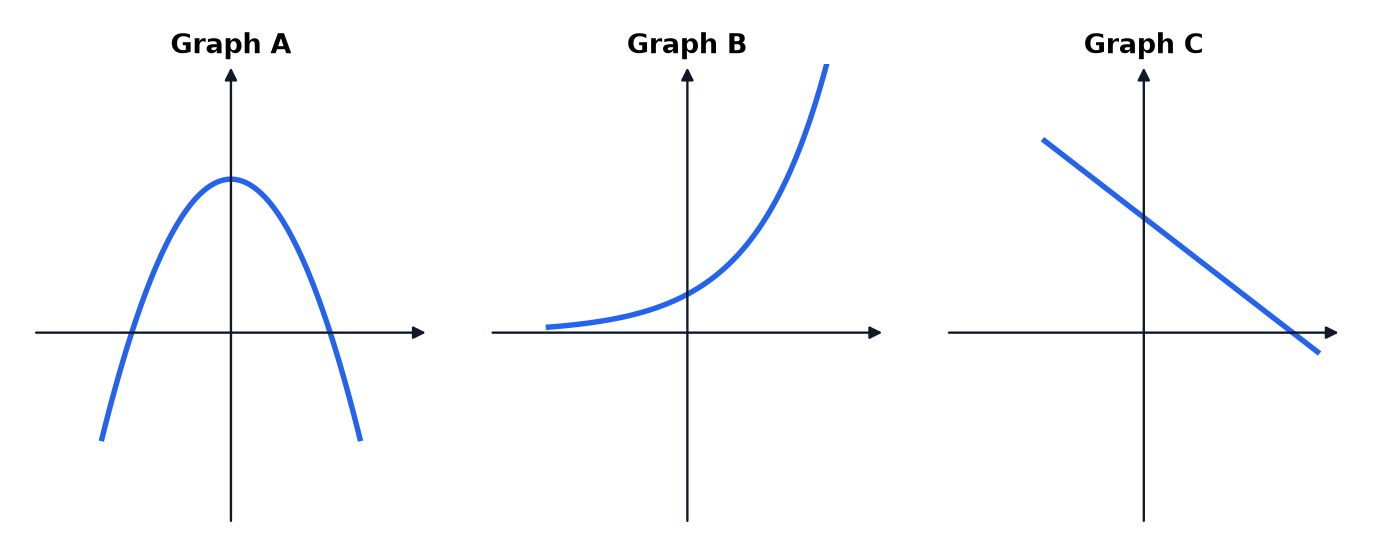
The diagram shows three graphs, \(A\), \(B\) and \(C\). The three equations are \(y = 2^x\), \(y = 4 - x^2\) and \(y = 3 - x\). Match each equation to the correct graph. [3 marks]
Mark scheme — 3 marks available
- \(A\) is \(y = 4 - x^2\) — B1
- \(B\) is \(y = 2^x\) — B1
- \(C\) is \(y = 3 - x\) — B1
Model answer
Graph \(A\) is an upside-down U, so \(y = 4 - x^2\). Graph \(B\) rises quickly and stays above the \(x\)-axis, so \(y = 2^x\). Graph \(C\) is a falling straight line, so \(y = 3 - x\).
Complete the table of values for \(y = x^3 + 1\). \(x = -2, -1, 0, 1, 2\)
Mark scheme — 2 marks available
- At least three correct values — M1
- \(-7, 0, 1, 2, 9\) — A1
Model answer
The values are \(-7, 0, 1, 2, 9\).
(a) Complete the table of values for \(y = \dfrac{6}{x}\). \(x = 1, 2, 3, 6, -2, -3\) [2 marks] (b) How many separate parts, or branches, does the graph of \(y = \dfrac{6}{x}\) have? [1 mark]
Mark scheme — 3 marks available
- (a) At least four correct values — M1
- (a) \(6, 3, 2, 1, -3, -2\) — A1
- (b) 2 — B1
Model answer
(a) The values are \(6, 3, 2, 1, -3, -2\). (b) The graph has 2 branches.
(a) Complete the table of values for \(y = 3^x\). \(x = 0, 1, 2, 3\) [2 marks] (b) Write down the \(y\)-intercept of the graph of \(y = 3^x\). [1 mark]
Mark scheme — 3 marks available
- (a) At least two correct values — M1
- (a) \(1, 3, 9, 27\) — A1
- (b) 1 — B1
Model answer
(a) The values are \(1, 3, 9, 27\). (b) The \(y\)-intercept is 1, because \(3^0 = 1\).
The graph of \(y = x^2 - 4\) is symmetrical. (a) Write down the equation of its line of symmetry. [1 mark] (b) Work out the coordinates of the points where the graph crosses the \(x\)-axis. [2 marks]
Mark scheme — 3 marks available
- (a) \(x = 0\) — B1
- (b) \(x^2 = 4\) — M1
- (b) \((2, 0)\) and \((-2, 0)\) — A1
Model answer
(a) The line of symmetry is the \(y\)-axis, \(x = 0\). (b) When \(y = 0\), \(x^2 = 4\), so \(x = 2\) or \(x = -2\). The points are \((2, 0)\) and \((-2, 0)\).
A circle has equation \(x^2 + y^2 = 100\). (a) Write down the radius of the circle. [1 mark] (b) Show that the point \((6, 8)\) lies on the circle. [2 marks]
Mark scheme — 3 marks available
- (a) 10 — B1
- (b) \(6^2 + 8^2\) or \(36 + 64\) — M1
- (b) 100 with a conclusion — Q1
Model answer
(a) The radius is \(\sqrt{100} = 10\). (b) \(6^2 + 8^2 = 36 + 64 = 100\), so the point lies on the circle.
What shape is the graph of \(y = x^3\)?
Why: Cubic graphs have an S shape.
What is special about the graph of \(y = \dfrac{1}{x}\)?
Why: You cannot divide by 0, and \(\dfrac{1}{x}\) is never 0.
Where does the graph of \(y = 3^x\) cross the \(y\)-axis?
Why: \(3^0 = 1\).
What is the value of \(x^3\) when \(x = -3\)?
Why: \((-3) \times (-3) \times (-3) = -27\).
Which of these equations gives a cubic graph?
Why: A cubic has \(x^3\) as its highest power.
Work out \(y\) when \(x = 2\) on \(y = x^3 - 3x\).
Why: \(8 - 6 = 2\).
What is \(2^3\)?
Why: \(2 \times 2 \times 2 = 8\).
What shape is the graph of \(y = -x^2\)?
Why: A negative \(x^2\) term turns the parabola upside down.
What is the radius of the circle \(x^2 + y^2 = 36\)?
Why: The radius is \(\sqrt{36} = 6\).