Maths · Ratio and Proportion
Viewing as
Teacher view: every answer and mark scheme set out in full.
Ratio: Simplifying and Sharing
Writing and simplifying ratios, sharing amounts in a given ratio, and linking ratios to fractions.
Learning Objectives
- 1Write ratios in the form \(a : b\) and simplify them, including ratios with units, fractions and decimals.
- 2Share an amount in a given ratio, and find an amount when one part or the difference is known.
- 3Link ratios to fractions and percentages and solve problems in context.
- 4Combine two ratios to make a three-part ratio (Higher tier).
Comparing sizes
A ratio compares the sizes of two or more quantities, such as 3 parts red paint to 5 parts blue. Ratio questions are popular on a non-calculator paper because the numbers are chosen to divide exactly, so they reward a tidy method far more than fast arithmetic. The method below, add the parts, find one part, then scale up, works for almost every ratio question you will meet.
What a ratio says
A ratio tells you how many of one thing there are for each of another, not how many there are altogether.
-
Part to part
A ratio of red to blue paint of \(3 : 5\) means that for every 3 parts of red there are 5 parts of blue. It does not tell you the total amount of paint.
-
Order matters
"Boys to girls is \(3 : 5\)" is a different statement from "girls to boys is \(3 : 5\)". Write the ratio in the order the question asks for.
-
Equivalent ratios
Multiplying or dividing every part by the same number gives an equivalent ratio, so \(3 : 5 = 6 : 10 = 30 : 50\).
-
Simplest form
Divide every part by the highest common factor. \(12 : 18\) simplifies to \(2 : 3\) because the HCF is 6.
Awkward ratios
Before you can simplify, a ratio must be in whole numbers with the same units.
-
Same units first
\(50\text{ cm} : 2\text{ m}\) becomes \(50 : 200\) after changing 2 m to 200 cm, which simplifies to \(1 : 4\).
-
Fractions
Multiply both parts by the common denominator. \(\dfrac{1}{2} : \dfrac{1}{3}\) times 6 gives \(3 : 2\).
-
Decimals
Multiply by 10 or 100 to make whole numbers. \(0.4 : 1.6\) becomes \(4 : 16\), which simplifies to \(1 : 4\).
-
The form \(1 : n\)
Divide both parts by the first part. \(4 : 10\) becomes \(1 : 2.5\). This form is used for scales and for comparing rates.
Sharing in a ratio with a bar model
Draw a bar split into equal parts, one for every part of the ratio. A bar model shows why the method works: the whole amount is the number of parts added together, and every part is the same size.
The method
- Add the parts \(2 + 3 = 5\) parts in total.
- Find one part \(60 \div 5 = 12\).
- Multiply up \(2 \times 12 = 24\) and \(3 \times 12 = 36\), then check that they add back up to 60.
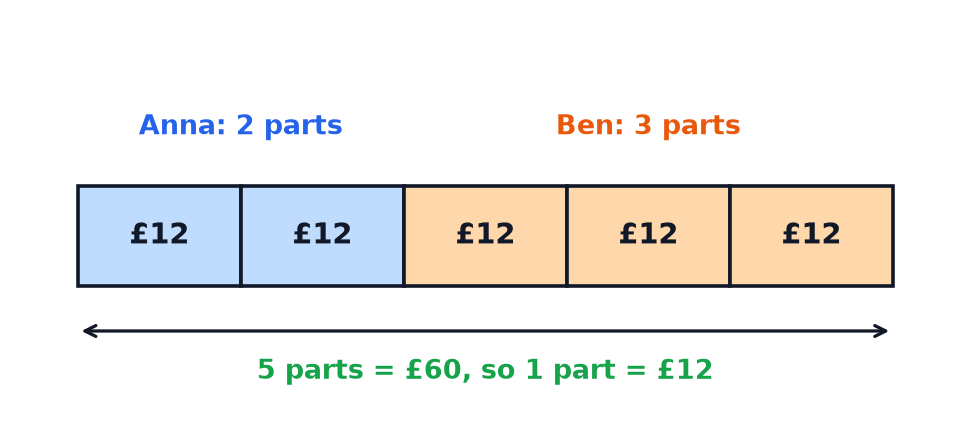
Sharing in a ratio
Anna and Ben share \(\pounds 60\) in the ratio \(2 : 3\). How much does each of them get?
Show the solutionHide the solution
- 1 Add the parts \(2 + 3 = 5\) parts.
- 2 Find the value of one part \(60 \div 5 = \pounds 12\).
- 3 Multiply for each person Anna: \(2 \times 12 = \pounds 24\). Ben: \(3 \times 12 = \pounds 36\).
- 4 Check \(24 + 36 = 60\).
AnswerAnna \(\pounds 24\), Ben \(\pounds 36\)
A three-part ratio
240 sweets are shared between three children in the ratio \(3 : 4 : 5\). How many sweets does each child get?
Show the solutionHide the solution
- 1 Add the parts \(3 + 4 + 5 = 12\) parts.
- 2 One part \(240 \div 12 = 20\) sweets.
- 3 Multiply \(3 \times 20 = 60\), \(4 \times 20 = 80\) and \(5 \times 20 = 100\).
- 4 Check \(60 + 80 + 100 = 240\).
Answer60, 80 and 100
When you know one part or the difference
Not every question gives the total. Look for what you are told, and turn it into the value of one part.
-
One amount is known
In the ratio \(3 : 5\), if the smaller part is \(\pounds 18\), then one part is \(18 \div 3 = \pounds 6\), the larger part is \(5 \times 6 = \pounds 30\), and the total is \(\pounds 48\).
-
The difference is known
In the ratio \(3 : 7\) the difference is 4 parts. If the difference is \(\pounds 20\), one part is \(20 \div 4 = \pounds 5\), so the amounts are \(\pounds 15\) and \(\pounds 35\).
-
The total is known
Divide by the number of parts, as in the bar model.
-
Check
The amounts must be in the ratio you were given and must satisfy the fact in the question.
One part is known
The ratio of boys to girls in a club is \(4 : 7\). There are 28 girls. How many boys are there, and how many members are there altogether?
Show the solutionHide the solution
- 1 Match the known amount to its part 28 girls is 7 parts.
- 2 Find one part \(28 \div 7 = 4\).
- 3 Find the boys \(4 \times 4 = 16\).
- 4 Find the total \(16 + 28 = 44\).
Answer16 boys and 44 members
Ratios, fractions and percentages
A ratio, a fraction and a percentage can describe the same situation.
-
Ratio to fraction
In the ratio \(2 : 3\) the whole is 5 parts, so the shares are \(\dfrac{2}{5}\) and \(\dfrac{3}{5}\) of the whole.
-
Fraction to ratio
If \(\dfrac{1}{4}\) of a class walk to school, the rest, \(\dfrac{3}{4}\), do not, so the ratio of walkers to the others is \(1 : 3\).
-
Ratio to percentage
A ratio of \(1 : 3\) is \(\dfrac{1}{4}\) and \(\dfrac{3}{4}\) of the whole, which is 25% and 75%.
-
Beware the difference
A ratio compares part with part, but a fraction compares a part with the whole.
Increasing and decreasing in a ratio (Higher tier)
A ratio can act as a scale factor.
-
Increase in the ratio 3 : 2
Multiply by \(\dfrac{3}{2}\). To increase 40 in the ratio \(3 : 2\), calculate \(40 \times \dfrac{3}{2} = 60\).
-
Decrease in the ratio 2 : 3
Multiply by \(\dfrac{2}{3}\). To decrease 60 in the ratio \(2 : 3\), calculate \(60 \times \dfrac{2}{3} = 40\).
-
Direction
The first number is what you are changing to, and the second is what you are changing from.
Combining ratios (Higher tier)
Two ratios that share a quantity can be joined into one three-part ratio.
-
Make the shared quantity match
Find a common multiple of its two values in the two ratios, and scale both ratios.
-
Join them
Write the three quantities in order.
-
Check
Each pair of values must simplify back to the original ratio.
Linking two ratios (Higher tier)
The ratio of red to blue counters is \(2 : 3\). The ratio of blue to green counters is \(4 : 5\). Find the ratio red : blue : green.
Show the solutionHide the solution
- 1 Look at the shared colour Blue is 3 in the first ratio and 4 in the second. The lowest common multiple of 3 and 4 is 12.
- 2 Scale the first ratio \(2 : 3\) times 4 gives \(8 : 12\).
- 3 Scale the second ratio \(4 : 5\) times 3 gives \(12 : 15\).
- 4 Join them \(8 : 12 : 15\).
Answer\(8 : 12 : 15\)
Ratio or fraction?
A ratio such as 2 : 3
- Compares one part with another part
- Needs the parts added to get the whole
- Has no units
A fraction such as 2/5
- Compares one part with the whole
- Is already a share of the whole, so the fractions add to 1
- Is found by dividing a part by the total
Test yourself
-
1
Simplify \(12 : 18\).
Show answerHide answer
\(2 : 3\), after dividing both parts by 6.
-
2
Simplify \(50\text{ cm} : 2\text{ m}\).
Show answerHide answer
\(1 : 4\), because 2 m is 200 cm.
-
3
Share \(\pounds 40\) in the ratio \(1 : 3\).
Show answerHide answer
\(\pounds 10\) and \(\pounds 30\).
-
4
What fraction of the total is the first part of \(2 : 3\)?
Show answerHide answer
\(\dfrac{2}{5}\).
-
5
In the ratio \(3 : 5\) the smaller part is 18. What is the larger part?
Show answerHide answer
30.
Exam technique: ratio questions
Ratio questions are usually 2 to 4 marks, with most of them for the method.
-
Add the parts first
Writing "\(2 + 3 = 5\)" earns a method mark even if the rest goes wrong.
-
Show one part
Write "one part \(= 12\)" on its own line, because it is the key step.
-
Answer each share
A question that asks "how much does each get?" needs every share, not just one.
-
Check the sum
The shares must add back up to the total. Doing this takes five seconds and catches slips.
Summary and exam focus
- A ratio compares parts, so the order matters and the units must match.
- Simplify by dividing every part by the highest common factor.
- To share in a ratio, add the parts, find one part, then multiply.
- If you know one amount or the difference, turn it into the value of one part first.
- A ratio of \(2 : 3\) is \(\dfrac{2}{5}\) and \(\dfrac{3}{5}\) of the whole.
Exam focus
Share \(\pounds 84\) in the ratio \(3 : 4\). (3 marks) (3 marks)
Write the total number of parts, 7, before you divide. Then give both amounts with a pound sign and check that they add to \(\pounds 84\). Giving only one amount scores at most 2 of the 3 marks.
Key terms
The words this lesson expects you to use. Each one is linked from the first place it appears above.
- Ratio
- A comparison of the sizes of two or more quantities, written with a colon such as \(3 : 5\).
- Part
- One share of a ratio. The parts added together make the whole.
- Simplest form
- A ratio whose parts have no common factor except 1.
- Equivalent ratios
- Ratios with the same relationship between their parts, such as \(1 : 2\) and \(3 : 6\).
- Total parts
- The sum of the numbers in a ratio, which is the number of equal parts the whole is split into.
- One part
- The value of a single part of the ratio, found by dividing the whole by the total parts.
- Proportion
- A part compared with the whole, often written as a fraction, decimal or percentage.
- Scale factor
- The number you multiply by to enlarge or reduce, such as \(\dfrac{3}{2}\) to increase in the ratio \(3 : 2\).
Questions and answers
15 questions set on this lesson, with the mark schemes and model answers open.
Write the ratio \(18 : 30\) in its simplest form.
Mark scheme — 2 marks available
- Divides both by a common factor, such as \(9 : 15\) or \(6 : 10\) — M1
- \(3 : 5\) — A1
Model answer
The highest common factor is 6, so \(18 : 30 = 3 : 5\).
Peter and Quinn share \(\pounds 84\) in the ratio \(3 : 4\). Work out Quinn's share.
Mark scheme — 3 marks available
- \(3 + 4 = 7\) or \(84 \div 7\) — M1
- \(4 \times 12\) or \(84 \div 7 \times 4\) — M1
- \(\pounds 48\) — A1
Model answer
There are \(3 + 4 = 7\) parts, and one part is \(84 \div 7 = 12\). Quinn's share is \(4 \times 12 = \pounds 48\).
Paint is mixed from blue and yellow in the ratio \(2 : 5\). Lena uses 600 ml of yellow paint. Work out how much blue paint she needs.
Mark scheme — 3 marks available
- \(600 \div 5 = 120\) — M1
- \(2 \times 120\) — M1
- 240 ml — A1
Model answer
The yellow is 5 parts, so one part is \(600 \div 5 = 120\) ml. The blue is \(2 \times 120 = 240\) ml.
The ratio of cats to dogs at a rescue centre is \(5 : 3\). There are 16 more cats than dogs. Work out the total number of cats and dogs.
Mark scheme — 3 marks available
- \(16 \div 2 = 8\) — M1
- \(8 \times 8\) or \(40 + 24\) — M1
- 64 — A1
Model answer
The difference is \(5 - 3 = 2\) parts, and \(2\) parts \(= 16\), so one part is 8. The total is \(8\) parts, which is \(8 \times 8 = 64\).
Concrete is made from cement, sand and gravel in the ratio \(1 : 3 : 5\). A builder makes 90 kg of concrete. Work out the mass of sand in the concrete.
Mark scheme — 3 marks available
- \(1 + 3 + 5 = 9\) or \(90 \div 9\) — M1
- \(3 \times 10\) — M1
- 30 kg — A1
Model answer
There are \(1 + 3 + 5 = 9\) parts, so one part is \(90 \div 9 = 10\) kg. The sand is \(3 \times 10 = 30\) kg.
\(x : y = 3 : 4\) and \(y : z = 6 : 5\). (a) Work out \(x : y : z\). (2 marks) (b) \(x + y + z = 124\). Work out the value of \(z\). (2 marks)
Mark scheme — 4 marks available
- (a) \(9 : 12\) or \(12 : 10\) seen — M1
- (a) \(9 : 12 : 10\) — A1
- (b) \(124 \div 31 = 4\) — M1
- (b) 40 — A1
Model answer
(a) Make \(y\) the same in both: the lowest common multiple of 4 and 6 is 12. So \(x : y = 9 : 12\) and \(y : z = 12 : 10\), giving \(x : y : z = 9 : 12 : 10\). (b) There are \(9 + 12 + 10 = 31\) parts, so one part is \(124 \div 31 = 4\) and \(z = 10 \times 4 = 40\).
Simplify the ratio \(24 : 36\).
Why: The highest common factor of 24 and 36 is 12. Dividing both parts by 12 gives \(2 : 3\).
Which ratio is equivalent to \(3 : 5\)?
Why: Multiplying both parts of \(3 : 5\) by 3 gives \(9 : 15\). The others do not keep the same relationship.
Write \(40\) cm to \(1.2\) m as a ratio in its simplest form.
Why: Change to the same unit: \(1.2\) m \(= 120\) cm. Then \(40 : 120 = 1 : 3\).
\(\pounds 60\) is shared in the ratio \(2 : 3\). How much is the larger share?
Why: There are \(2 + 3 = 5\) parts, and one part is \(60 \div 5 = 12\). The larger share is \(3 \times 12 = 36\).
The ratio of boys to girls in a class is \(3 : 5\). There are 12 boys. How many girls are there?
Why: One part is \(12 \div 3 = 4\), so the number of girls is \(5 \times 4 = 20\).
Red and blue beads are in the ratio \(2 : 5\). What fraction of the beads are red?
Why: The whole is \(2 + 5 = 7\) parts, so red is \(\dfrac{2}{7}\).
Orange juice and water are mixed in the ratio \(1 : 4\). There is 250 ml of orange juice. How much water is there?
Why: The water is 4 times the juice, so \(4 \times 250 = 1000\) ml.
Amy and Ben share money in the ratio \(3 : 7\). Ben gets \(\pounds 20\) more than Amy. How much money is shared?
Why: The difference is \(7 - 3 = 4\) parts, so 4 parts \(= 20\) and one part is 5. The total is \(10 \times 5 = 50\).
\(A : B = 2 : 3\) and \(B : C = 4 : 5\). Write \(A : B : C\) in its simplest form.
Why: Make the \(B\) values match. The lowest common multiple of 3 and 4 is 12. Then \(A : B = 8 : 12\) and \(B : C = 12 : 15\), so \(A : B : C = 8 : 12 : 15\).