Maths · Transformations and Similarity
Viewing as
Teacher view: every answer and mark scheme set out in full.
Reflections and Translations
Reflecting shapes in mirror lines, translating them with column vectors, and describing each transformation fully.
Learning Objectives
- 1Reflect a shape in a mirror line, including the lines \(x = a\), \(y = b\), \(y = x\) and \(y = -x\).
- 2Describe a reflection fully by giving the equation of the mirror line.
- 3Translate a shape using a column vector, and describe a translation fully.
- 4Say what changes and what stays the same under a reflection and a translation.
Moving shapes around a grid
A transformation changes the position, and sometimes the size, of a shape. The original shape is called the object and the new shape is the image. Reflections and translations are the two that never change the size or the shape, so the image is congruent to the object. Grid questions are very common on the non-calculator paper because they need only a pencil and a ruler, and the marks go to being exact: one point out of place costs the whole mark. A "describe" question wants all the details, so a reflection needs its mirror line and a translation needs its column vector.
Reflections
A reflection flips a shape over a mirror line, so that the image is a mirror image of the object.
-
Equal distances
Every point of the image is the same distance from the mirror line as the matching point of the object, but on the other side.
-
At right angles
The line joining a point to its image crosses the mirror line at a right angle.
-
Points on the line
A point on the mirror line does not move.
-
Vertical and horizontal lines
A mirror line \(x = 1\) is vertical and \(y = 2\) is horizontal. To reflect in \(x = 1\), a point 3 units to the right goes 3 units to the left.
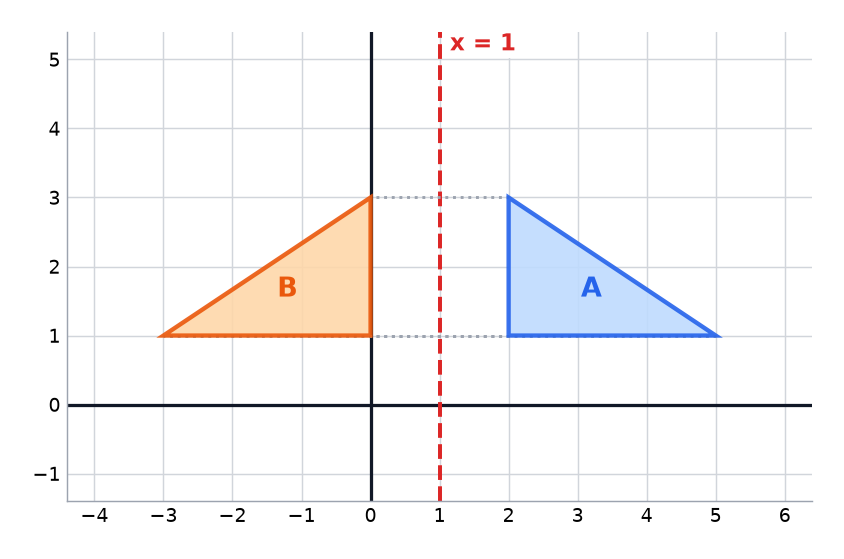
Reflecting in a vertical line
The corner (2, 1) is 1 unit to the right of the line \(x = 1\), so its image is 1 unit to the left, at \((0, 1)\). The corner \((5, 1)\) is 4 units to the right, so its image is 4 units to the left, at \((-3, 1)\).
Reflecting step by step
- Count the distance Find how far each corner is from the mirror line, counting squares at right angles to it.
- Go the same distance on the other side Plot the image corner there.
- Join them up The image has the same lengths and angles, but the order of the corners is reversed.
- Check The mirror line should be exactly halfway between each corner and its image.
Reflecting in a diagonal line
Reflect the point \((4, 1)\) in the line \(y = x\).
Show the solutionHide the solution
- 1 Use the pattern In the line \(y = x\) the coordinates swap, so \((a, b)\) goes to \((b, a)\).
- 2 Swap \((4, 1)\) becomes \((1, 4)\).
- 3 Check with the grid The point is 3 squares below and to the right of the diagonal line, and the image is 3 squares above and to the left, at the same distance.
- 4 For the line \(y = -x\) The coordinates swap and both change sign, so \((4, 1)\) would go to \((-1, -4)\).
Answer\((1, 4)\)
Describing a reflection
Name the transformation, then give the mirror line as an equation.
-
The words
"Reflection in the line \(x = 1\)" scores full marks, but "reflection" on its own does not.
-
Finding the line
Pick a point and its image, find the middle of the two points, and the mirror line passes through it at a right angle to the joining line.
-
Special lines
The \(x\)-axis is \(y = 0\), the \(y\)-axis is \(x = 0\), and a diagonal through the origin that goes up to the right is \(y = x\).
-
Two marks
A reflection is usually worth two marks, one for "reflection" and one for the line.
Translations
A translation slides every point of the shape the same distance in the same direction, with no turning and no flipping.
-
Column vector
A translation is written as \(\begin{pmatrix} x \\ y \end{pmatrix}\). The top number is the move right (or left if negative), and the bottom number is the move up (or down if negative).
-
Example
\(\begin{pmatrix} 4 \\ -3 \end{pmatrix}\) means 4 right and 3 down.
-
Finding the vector
Take any point and its image, and subtract: image minus object.
-
Applying it
Add the numbers to the coordinates of every corner.
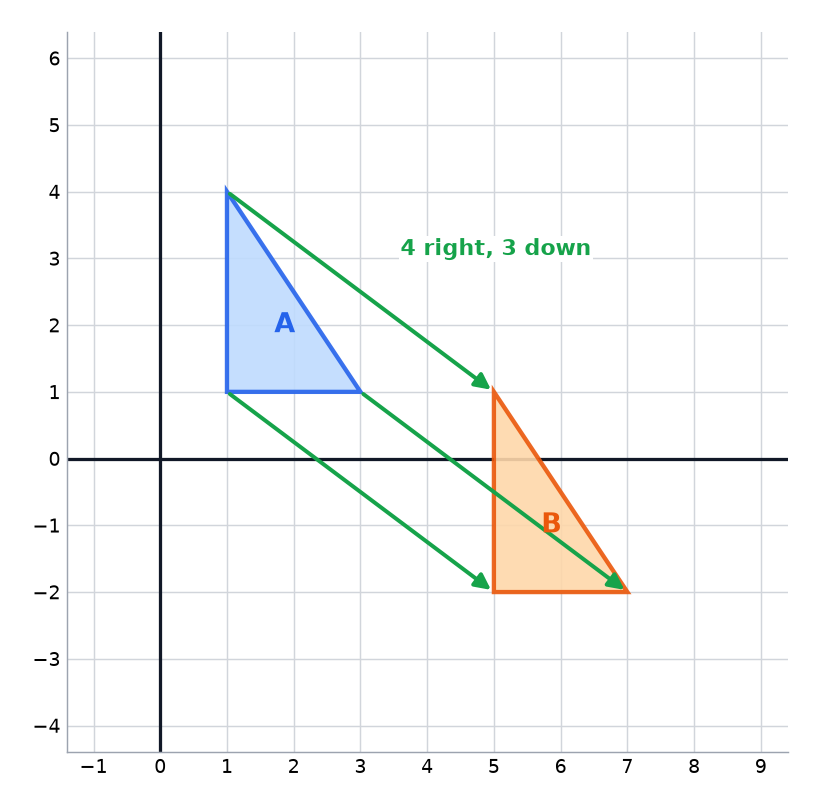
A translation
The corner \((1, 1)\) moves to \((5, -2)\), which is 4 right and 3 down. Every other corner moves the same way, so the translation is \(\begin{pmatrix} 4 \\ -3 \end{pmatrix}\).
Reading a translation
- Right is positive The top number is the change in \(x\): \(5 - 1 = 4\).
- Up is positive The bottom number is the change in \(y\): \(-2 - 1 = -3\).
- Same for every point If one point is right, the others are right too.
- Not a turn The triangle keeps the same orientation, with the same corner at the top.
Translating a point and describing a translation
(a) Translate the point \((4, 1)\) by \(\begin{pmatrix} -3 \\ 2 \end{pmatrix}\). (b) Describe the translation that takes the point \((2, 5)\) to \((7, 3)\).
Show the solutionHide the solution
- 1 Part (a) \(x\) \(4 + (-3) = 1\).
- 2 Part (a) \(y\) \(1 + 2 = 3\), so the image is \((1, 3)\).
- 3 Part (b) change in \(x\) \(7 - 2 = 5\).
- 4 Part (b) change in \(y\) \(3 - 5 = -2\), so the vector is \(\begin{pmatrix} 5 \\ -2 \end{pmatrix}\).
Answer(a) \((1, 3)\) (b) \(\begin{pmatrix} 5 \\ -2 \end{pmatrix}\)
What changes and what stays the same
Reflections and translations keep the size and shape, but they do not both keep the orientation.
-
Congruent
The image of a reflection or a translation is congruent to the object, with the same side lengths and angles.
-
Orientation
A translation keeps the shape facing the same way, while a reflection reverses it, like a mirror image.
-
Position
Both change the position unless a point lies on the mirror line.
-
Describe in the exam
The word "describe" asks for the type of transformation and its full details.
Test yourself
-
1
What is the image of the point \((3, 5)\) in the \(x\)-axis?
Show answerHide answer
\((3, -5)\).
-
2
What is the image of \((4, 1)\) in the line \(y = x\)?
Show answerHide answer
\((1, 4)\).
-
3
What does the column vector \(\begin{pmatrix} -2 \\ 5 \end{pmatrix}\) mean?
Show answerHide answer
2 left and 5 up.
-
4
What do you give to describe a reflection fully?
Show answerHide answer
The equation of the mirror line.
-
5
Is the image of a reflection congruent to the object?
Show answerHide answer
Yes, it has the same size and shape.
Exam technique: reflections and translations
Be exact, and give every detail.
-
Use a ruler
Draw each point carefully, and join the corners with straight lines.
-
Count squares
Count the distance to the mirror line from each corner separately.
-
Write the line as an equation
Say "reflection in the line \(x = 3\)", not "reflection in the middle".
-
Write the vector with the right sign
Right and up are positive, left and down are negative.
Summary and exam focus
- A reflection flips a shape over a mirror line, and every point is the same distance from the line as its image.
- To describe a reflection, give the equation of the mirror line.
- A translation is described by a column vector, with right and up positive.
- Reflections and translations give an image that is congruent to the object.
Exam focus
The point \(P\) is \((5, 2)\). Reflect \(P\) in the line \(x = 3\), and write down the coordinates of the image. (2 marks) (2 marks)
\(P\) is 2 units to the right of \(x = 3\), so the image is 2 units to the left, at \((1, 2)\). The \(y\)-coordinate does not change for a reflection in a vertical line. Writing the distance, 2, earns the method mark.
Key terms
The words this lesson expects you to use. Each one is linked from the first place it appears above.
- Transformation
- A change in the position or size of a shape.
- Object
- The original shape before a transformation.
- Image
- The shape after a transformation.
- Reflection
- A transformation that flips a shape over a mirror line.
- Mirror line
- The line over which a shape is reflected.
- Translation
- A transformation that slides a shape without turning or flipping it.
- Column vector
- A pair of numbers, one above the other, that gives a move right or left and up or down.
- Congruent
- Having exactly the same size and shape.
- Orientation
- The way round a shape faces.
Questions and answers
15 questions set on this lesson, with the mark schemes and model answers open.
The point \((4, -1)\) is translated by the vector \(\begin{pmatrix} -2 \\ 3 \end{pmatrix}\). Write down the coordinates of the image. [2 marks]
Mark scheme — 2 marks available
- \(4 - 2\) or \(-1 + 3\) — M1
- \((2, 2)\) — A1
Model answer
\((4 - 2, -1 + 3) = (2, 2)\).
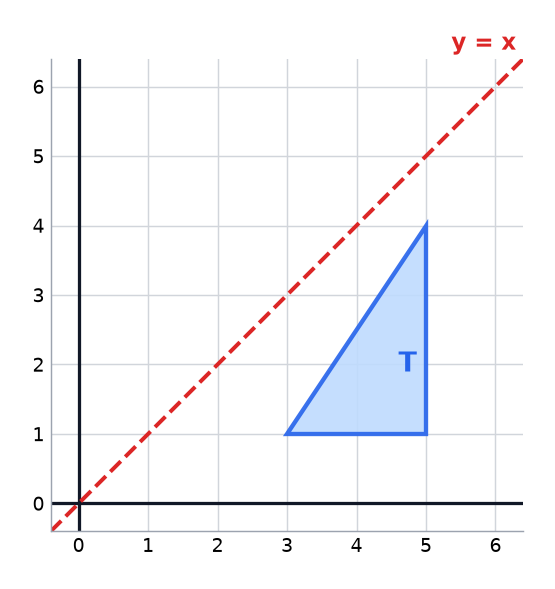
Triangle \(T\) is drawn on the grid. (a) Reflect triangle \(T\) in the line \(y = x\). [2 marks] (b) Write down the coordinates of the image of the point \((6, 2)\) in the line \(y = x\). [1 mark]
Mark scheme — 3 marks available
- (a) Reflects at least two vertices correctly — M1
- (a) Triangle with vertices \((1, 3)\), \((1, 5)\) and \((4, 5)\) — A1
- (b) \((2, 6)\) — B1
Model answer
(a) The coordinates swap, so \((3, 1)\), \((5, 1)\) and \((5, 4)\) go to \((1, 3)\), \((1, 5)\) and \((4, 5)\). (b) \((2, 6)\).
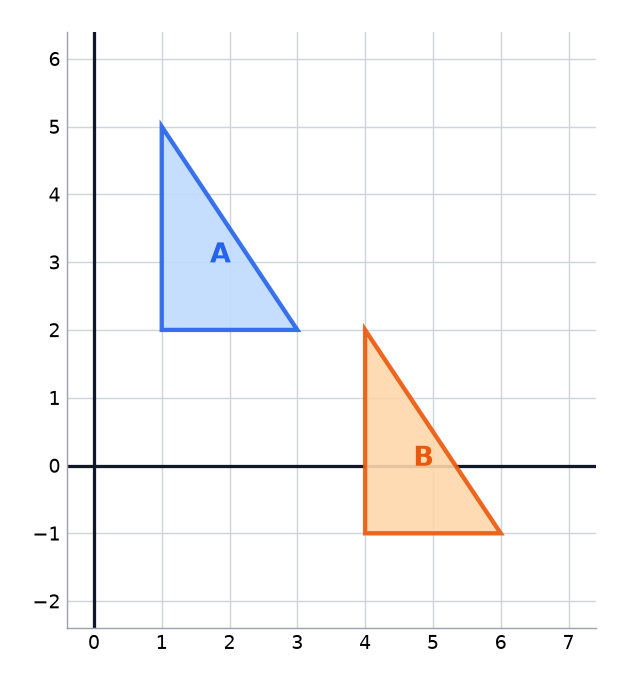
Triangle \(B\) is the image of triangle \(A\) after a single transformation. (a) Describe fully the single transformation. [2 marks] (b) Triangle \(A\) has an area of 3 square units. Write down the area of triangle \(B\). [1 mark]
Mark scheme — 3 marks available
- (a) Translation — B1
- (a) \(\begin{pmatrix} 3 \\ -3 \end{pmatrix}\) — B1
- (b) 3 — B1
Model answer
(a) The point \((1, 2)\) goes to \((4, -1)\), which is 3 right and 3 down. It is a translation by \(\begin{pmatrix} 3 \\ -3 \end{pmatrix}\). (b) A translation does not change the size, so the area is 3 square units.
A reflection maps the point \((5, 1)\) onto the point \((5, 7)\). Find the equation of the mirror line. [2 marks]
Mark scheme — 2 marks available
- \(\dfrac{1 + 7}{2}\) or 4 seen — M1
- \(y = 4\) — A1
Model answer
The mirror line is halfway between the two points, and the points differ only in \(y\). The midpoint of the \(y\)-values is \(\dfrac{1 + 7}{2} = 4\), so the mirror line is \(y = 4\).
Triangle \(T\) has vertices \((1, 1)\), \((4, 1)\) and \((1, 3)\). \(T\) is reflected in the line \(x = -1\). Write down the coordinates of the image of (a) the vertex \((4, 1)\), (b) the vertex \((1, 3)\). [3 marks]
Mark scheme — 3 marks available
- (a) Distance 5 from the line, or 5 seen — M1
- (a) \((-6, 1)\) — A1
- (b) \((-3, 3)\) — B1
Model answer
(a) \((4, 1)\) is 5 to the right of \(x = -1\), so the image is 5 to the left, at \((-6, 1)\). (b) \((1, 3)\) is 2 to the right, so the image is at \((-3, 3)\).
The point \(P\) is \((2, 5)\). \(P\) is reflected in the line \(y = x\) to give \(Q\). \(Q\) is translated by the vector \(\begin{pmatrix} -3 \\ -2 \end{pmatrix}\) to give \(R\). Write down the coordinates of \(R\). [3 marks]
Mark scheme — 3 marks available
- \(Q = (5, 2)\) — B1
- Adds the vector to their \(Q\) — M1
- \((2, 0)\) — A1
Model answer
Reflecting in \(y = x\) gives \(Q = (5, 2)\). Translating gives \(R = (5 - 3, 2 - 2) = (2, 0)\).
What is the image of the point \((3, 5)\) in the \(x\)-axis?
Why: A reflection in the \(x\)-axis changes the sign of the \(y\)-coordinate.
What is the image of the point \((2, 3)\) in the \(y\)-axis?
Why: A reflection in the \(y\)-axis changes the sign of the \(x\)-coordinate.
What is the image of \((4, 1)\) in the line \(y = x\)?
Why: In the line \(y = x\) the coordinates swap.
The point \((5, 2)\) is reflected in the line \(x = 3\). What is the image?
Why: \((5, 2)\) is 2 right of the line, so the image is 2 left of it, at \((1, 2)\).
What does the column vector \(\begin{pmatrix} -2 \\ 5 \end{pmatrix}\) mean?
Why: The top number is left or right, and the bottom number is up or down.
The point \((4, 1)\) is translated by \(\begin{pmatrix} -3 \\ 2 \end{pmatrix}\). What is the image?
Why: \((4 - 3, 1 + 2) = (1, 3)\).
A translation takes \((2, 5)\) to \((7, 3)\). What is the column vector?
Why: The change in \(x\) is \(7 - 2 = 5\) and the change in \(y\) is \(3 - 5 = -2\).
What must you give to describe a reflection fully?
Why: A reflection is described by its mirror line, such as \(x = 1\).
What is the image of \((4, 1)\) in the line \(y = -x\)?
Why: In the line \(y = -x\) the coordinates swap and both change sign.