Maths · Algebra
Viewing as
Teacher view: every answer and mark scheme set out in full.
Factorising Expressions
Taking out common factors, factorising quadratics, and using the difference of two squares.
Learning Objectives
- 1Factorise expressions by taking out the highest common factor, including letters.
- 2Factorise quadratic expressions of the form \(x^2 + bx + c\).
- 3Factorise the difference of two squares and use it to simplify number calculations.
- 4Factorise quadratic expressions of the form \(ax^2 + bx + c\) (Higher tier).
Expanding in reverse
Factorising is expanding backwards: you put the brackets back in. It is the key to solving quadratic equations, simplifying algebraic fractions and spotting patterns in number work. Because the answer can always be checked by expanding it, there is no excuse for leaving a factorisation unchecked in the exam.
Taking out common factors
Find everything that divides into every term and put it outside the bracket.
-
Numbers
Use the highest common factor of the numbers: \(12x + 18 = 6(2x + 3)\), because 6 is the HCF of 12 and 18.
-
Letters
A letter can be taken out if it is in every term: \(x^2 + 5x = x(x + 5)\).
-
Numbers and letters together
\(6x^2y - 9xy^2 = 3xy(2x - 3y)\). The 3 comes from the numbers and \(xy\) is in both terms.
-
Fully factorised
If there is still a common factor inside the bracket, you are not finished. \(4x + 8 = 2(2x + 4)\) is not fully factorised, but \(4(x + 2)\) is.
Factorising fully
Factorise fully \(6x^2y - 9xy^2\).
Show the solutionHide the solution
- 1 Highest common factor of the numbers The HCF of 6 and 9 is 3.
- 2 Common letters Both terms contain \(x\) and \(y\), so \(xy\) can come out as well.
- 3 Divide each term \(6x^2y \div 3xy = 2x\) and \(9xy^2 \div 3xy = 3y\).
- 4 Write the answer \(3xy(2x - 3y)\). Check by expanding: \(3xy \times 2x = 6x^2y\) and \(3xy \times (-3y) = -9xy^2\).
Answer\(3xy(2x - 3y)\)
Factorising simple quadratics
This is the reverse of expanding two brackets.
-
Find the pair
Look for two numbers that multiply to give \(c\) and add to give \(b\). For \(x^2 + 7x + 12\) the numbers are 3 and 4, because \(3 \times 4 = 12\) and \(3 + 4 = 7\).
-
Read the signs
If \(c\) is positive, both numbers have the same sign as \(b\). If \(c\) is negative, one number is positive and one is negative, and the larger one has the sign of \(b\).
-
Write the brackets
The answer is \((x + 3)(x + 4)\), and the order of the brackets does not matter.
-
Always check
Expand your answer. If it gives the original expression back, it is correct.
A grid for factorising quadratics
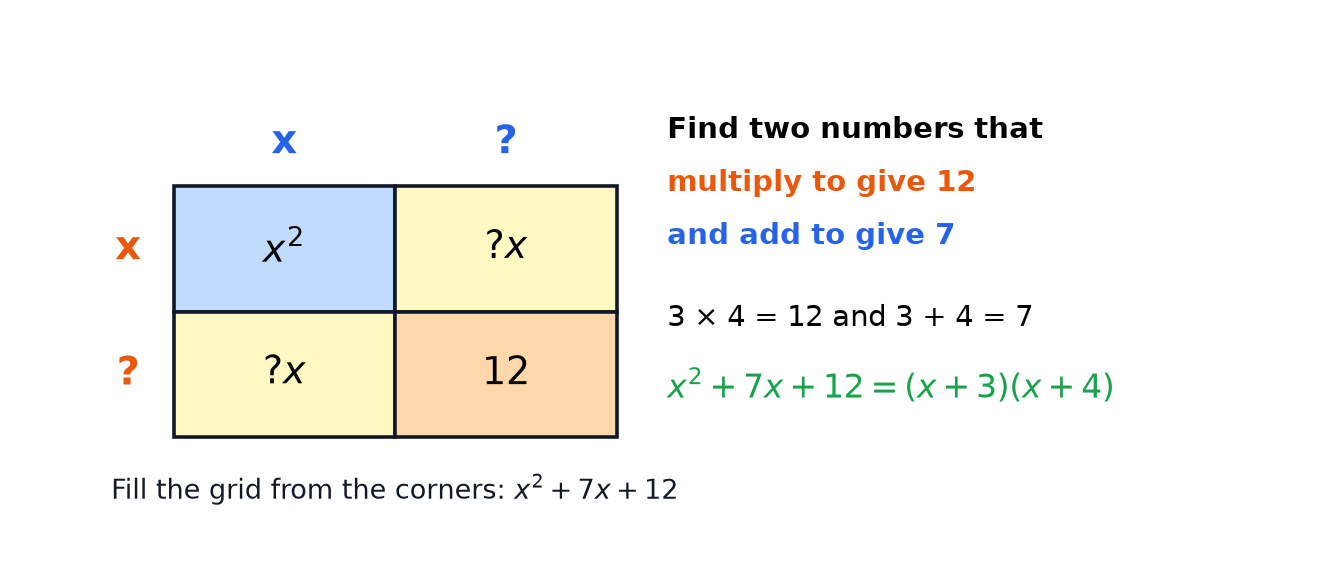
Put \(x^2\) in the top left corner and the constant in the bottom right corner. The two missing boxes must multiply to give the constant, and together they must add up to the middle term.
Working from the corners
- Corners first \(x^2\) and \(12\) go in opposite corners.
- Find the pair The two numbers that multiply to 12 and add to 7 are 3 and 4.
- Read off the brackets The labels on the sides give \((x + 3)(x + 4)\).
A quadratic with a negative number
Factorise \(x^2 - 2x - 15\).
Show the solutionHide the solution
- 1 Two numbers that multiply to \(-15\) The possible pairs are \(1\) and \(-15\), \(-1\) and \(15\), \(3\) and \(-5\), \(-3\) and \(5\).
- 2 Which pair adds to \(-2\)? \(3 + (-5) = -2\), so the numbers are 3 and \(-5\).
- 3 Write the brackets \((x + 3)(x - 5)\).
- 4 Check \(x^2 - 5x + 3x - 15 = x^2 - 2x - 15\). Correct.
Answer\((x - 5)(x + 3)\)
The difference of two squares
One special pattern factorises in a single step.
-
The rule
\(a^2 - b^2 = (a + b)(a - b)\). For example, \(x^2 - 49 = (x + 7)(x - 7)\).
-
How to spot it
There are two terms, both are perfect squares, and there is a minus sign between them. \(4x^2 - 25 = (2x)^2 - 5^2 = (2x + 5)(2x - 5)\).
-
A sum of squares does not work
\(x^2 + 49\) cannot be factorised, because there is no pair of numbers that multiply to 49 and add to 0.
-
A useful trick
The rule makes some number calculations easy. \(51^2 - 49^2 = (51 + 49)(51 - 49) = 100 \times 2 = 200\).
Why the difference of two squares works
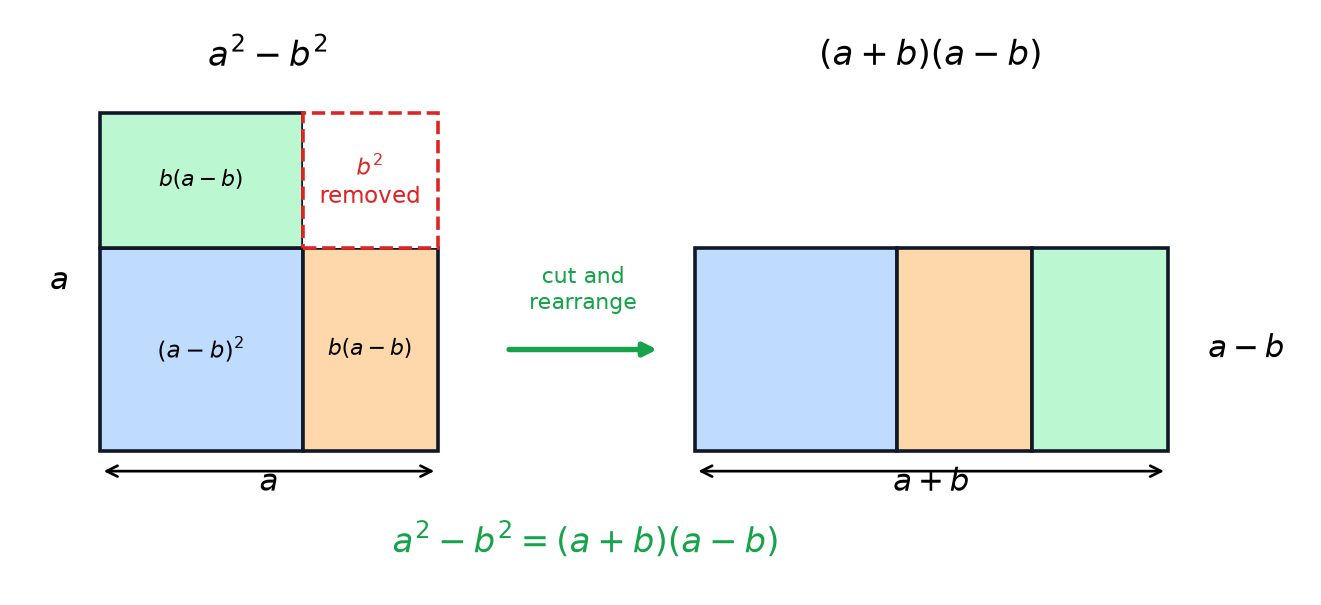
The area left after removing the \(b \times b\) square can be rearranged into a rectangle of area \((a + b)(a - b)\).
Factorising harder quadratics (Higher tier)
When the coefficient of \(x^2\) is not 1, split the middle term and factorise in pairs.
-
Multiply a and c
For \(2x^2 + 7x + 3\), \(a \times c = 6\). Find two numbers that multiply to 6 and add to 7. They are 6 and 1.
-
Split the middle term
\(2x^2 + 7x + 3 = 2x^2 + 6x + x + 3\).
-
Factorise in pairs
\(2x(x + 3) + 1(x + 3)\). Both parts contain the bracket \((x + 3)\).
-
Write the answer
\((2x + 1)(x + 3)\). Check by expanding.
Splitting the middle term
Factorise \(3x^2 - 10x - 8\).
Show the solutionHide the solution
- 1 Multiply a and c \(3 \times (-8) = -24\).
- 2 Find the pair Two numbers that multiply to \(-24\) and add to \(-10\) are \(-12\) and \(2\).
- 3 Split the middle term \(3x^2 - 12x + 2x - 8\).
- 4 Factorise in pairs \(3x(x - 4) + 2(x - 4) = (3x + 2)(x - 4)\).
Answer\((3x + 2)(x - 4)\)
The big idea
Factorising is just expanding in reverse, so you can always check it by expanding.
Do the check every time; it takes ten seconds and protects the marks.
Choosing a factorising method
Work through these steps in order each time.
-
1
Common factor first
Check whether every term shares a number or letter, and take out the highest common factor.
-
2
Count the terms
Two terms joined by a minus sign may be a difference of two squares. Three terms may be a quadratic.
-
3
Factorise the quadratic
Find two numbers that multiply to give \(c\) and add to give \(b\), or split the middle term on the Higher tier.
-
4
Check by expanding
Expand your brackets to confirm they give back the original expression.
Perfect squares
Some quadratics factorise into a squared bracket.
-
Recognise them
\(x^2 + 6x + 9 = (x + 3)^2\), because \(3 \times 3 = 9\) and \(3 + 3 = 6\).
-
With a minus sign
\(x^2 - 10x + 25 = (x - 5)^2\), because the pair of numbers is \(-5\) and \(-5\).
-
Writing the answer
\((x + 3)^2\) is neater than \((x + 3)(x + 3)\), and both are accepted.
-
Check
Expanding \((x - 5)^2\) gives \(x^2 - 5x - 5x + 25 = x^2 - 10x + 25\).
A common factor and then a difference of two squares
Factorise fully \(20 - 5x^2\).
Show the solutionHide the solution
- 1 Take out the common factor Both terms divide by 5: \(20 - 5x^2 = 5(4 - x^2)\).
- 2 Spot the difference of two squares \(4 - x^2 = 2^2 - x^2\).
- 3 Factorise it \(2^2 - x^2 = (2 + x)(2 - x)\).
- 4 Keep the common factor The answer is \(5(2 + x)(2 - x)\). Leaving out the 5 would lose the final mark.
Answer\(5(2 + x)(2 - x)\)
A quadratic with a negative middle term
Factorise \(x^2 - 10x + 24\).
Show the solutionHide the solution
- 1 Find the pair Two numbers that multiply to give 24 and add to give \(-10\). Both must be negative, because the product is positive and the sum is negative.
- 2 Choose \(-4 \times (-6) = 24\) and \(-4 + (-6) = -10\).
- 3 Write the brackets \((x - 4)(x - 6)\).
- 4 Check \(x^2 - 6x - 4x + 24 = x^2 - 10x + 24\).
Answer\((x - 4)(x - 6)\)
Simplifying algebraic fractions (Higher tier)
Factorising lets you cancel common brackets in the top and bottom of a fraction.
-
Factorise top and bottom first
Only factors can be cancelled, not terms.
-
A difference of two squares
\(\dfrac{x^2 - 9}{x + 3} = \dfrac{(x + 3)(x - 3)}{x + 3} = x - 3\).
-
Quadratics on both lines
\(\dfrac{x^2 - 9}{x^2 + 5x + 6} = \dfrac{(x + 3)(x - 3)}{(x + 2)(x + 3)} = \dfrac{x - 3}{x + 2}\).
-
Do not cancel terms
In \(\dfrac{x + 6}{x}\), the \(x\) is only one term of the top, so you cannot cancel it. The expression does not simplify to 6.
Test yourself
-
1
Factorise \(10x - 25\).
Show answerHide answer
\(5(2x - 5)\).
-
2
Factorise \(x^2 + 4x\).
Show answerHide answer
\(x(x + 4)\).
-
3
Factorise \(x^2 - 49\).
Show answerHide answer
\((x + 7)(x - 7)\).
-
4
Factorise \(x^2 + 5x + 6\).
Show answerHide answer
\((x + 2)(x + 3)\).
-
5
Expand \((x + 4)(x - 4)\).
Show answerHide answer
\(x^2 - 16\).
Exam technique: factorising
Examiners award a mark for each correct stage, so show each stage.
-
"Fully" means highest common factor first
\(2x^2 - 8\) is \(2(x + 2)(x - 2)\), not \((2x + 4)(x - 2)\), which still has a common factor in the first bracket.
-
Keep the factor you took out
Include it in the final answer, as in \(3(x + 2)(x - 2)\).
-
Always check
Expand your answer. It takes ten seconds and catches sign errors.
-
Use "hence"
If a question says "hence", use the factorisation you have just found rather than starting again.
Summary and exam focus
- Always take out the highest common factor first, including any common letters, and check that nothing common is left in the bracket.
- To factorise \(x^2 + bx + c\), find two numbers that multiply to \(c\) and add to \(b\).
- The difference of two squares is \(a^2 - b^2 = (a + b)(a - b)\), and it only works with a minus sign between two squares.
- On the Higher tier, for \(ax^2 + bx + c\), multiply \(a\) and \(c\), split the middle term and factorise in pairs.
- Expand your answer to check it.
Exam focus
Factorise \(x^2 - 5x - 24\). (2 marks) (2 marks)
List the factor pairs of 24 and then decide which pair differs by 5. Since the constant is negative, the two numbers have different signs, and the larger one takes the sign of the middle term. Writing the pair down earns the method mark even if you put the signs in the brackets the wrong way round.
Key terms
The words this lesson expects you to use. Each one is linked from the first place it appears above.
- Algebraic fraction
- A fraction whose numerator or denominator contains algebraic terms.
- Factorise
- Write an expression as a product of brackets, the reverse of expanding.
- Common factor
- A number or letter that divides exactly into every term of an expression.
- Fully factorised
- Written with the highest possible common factor taken out, with nothing common left inside the brackets.
- Quadratic expression
- An expression whose highest power is \(x^2\), such as \(x^2 + 5x + 6\).
- Coefficient
- The number multiplying a letter in a term.
- Constant term
- The term in an expression that is just a number, with no letter.
- Difference of two squares
- An expression of the form \(a^2 - b^2\), which factorises to \((a + b)(a - b)\).
- Perfect square
- A number or term that is the square of another, such as 49 or \(4x^2\).
- Factorising by grouping
- Splitting the middle term of a quadratic and factorising the terms in pairs.
Questions and answers
17 questions set on this lesson, with the mark schemes and model answers open.
Factorise \(6x + 15\).
Mark scheme — 2 marks available
- \(3(\ldots)\) or a common factor taken out correctly — M1
- \(3(2x + 5)\) — A1
Model answer
The highest common factor of 6 and 15 is 3, so \(6x + 15 = 3(2x + 5)\).
Factorise fully (a) \(12a + 18\) (1 mark) (b) \(6x^2y - 9xy^2\) (2 marks)
Mark scheme — 3 marks available
- (a) \(6(2a + 3)\) — B1
- (b) A correct partial factorisation, such as \(3(2x^2y - 3xy^2)\) or \(xy(6x - 9y)\) — M1
- (b) \(3xy(2x - 3y)\) — A1
Model answer
(a) The HCF of 12 and 18 is 6, so \(6(2a + 3)\). (b) The HCF of the numbers is 3 and both terms contain \(x\) and \(y\), so \(3xy(2x - 3y)\).
Factorise \(x^2 + 8x + 15\).
Mark scheme — 2 marks available
- \((x + a)(x + b)\) with \(ab = 15\) or \(a + b = 8\) — M1
- \((x + 3)(x + 5)\) — A1
Model answer
The numbers that multiply to give 15 and add to give 8 are 3 and 5, so \(x^2 + 8x + 15 = (x + 3)(x + 5)\).
Factorise \(x^2 - 2x - 15\).
Mark scheme — 2 marks available
- \((x + a)(x + b)\) with \(ab = -15\) or \(a + b = -2\) — M1
- \((x - 5)(x + 3)\) — A1
Model answer
The numbers that multiply to give \(-15\) and add to give \(-2\) are \(-5\) and \(3\), so \(x^2 - 2x - 15 = (x - 5)(x + 3)\).
(a) Factorise \(x^2 - 81\). (1 mark) (b) Factorise fully \(2y^2 - 50\). (2 marks)
Mark scheme — 3 marks available
- (a) \((x + 9)(x - 9)\) — B1
- (b) \(2(y^2 - 25)\) — M1
- (b) \(2(y + 5)(y - 5)\) — A1
Model answer
(a) This is a difference of two squares: \(x^2 - 9^2 = (x + 9)(x - 9)\). (b) Take out the common factor 2 first: \(2y^2 - 50 = 2(y^2 - 25) = 2(y + 5)(y - 5)\).
Factorise \(3x^2 - 10x - 8\).
Mark scheme — 2 marks available
- \((3x + a)(x + b)\) with \(ab = -8\) or the middle term correctly split as \(-12x + 2x\) — M1
- \((3x + 2)(x - 4)\) — A1
Model answer
\(3 \times (-8) = -24\), and \(-12\) and \(2\) multiply to \(-24\) and add to \(-10\). So \(3x^2 - 12x + 2x - 8 = 3x(x - 4) + 2(x - 4) = (3x + 2)(x - 4)\).
Work out the value of \(101^2 - 99^2\). You must show your working and you must not use a calculator.
Mark scheme — 2 marks available
- \((101 + 99)(101 - 99)\) — M1
- 400 — A1
Model answer
Using the difference of two squares, \(101^2 - 99^2 = (101 + 99)(101 - 99) = 200 \times 2 = 400\).
Factorise \(x^2 - 10x + 25\).
Why: The numbers are \(-5\) and \(-5\), so this is the perfect square \((x - 5)^2\).
Simplify \(\dfrac{x^2 - 9}{x + 3}\).
Why: \(x^2 - 9 = (x + 3)(x - 3)\), so the \((x + 3)\) cancels, leaving \(x - 3\).
Factorise \(6x + 15\).
Why: The highest common factor of 6 and 15 is 3, and \(3(2x + 5) = 6x + 15\).
Factorise fully \(8x^2 - 12x\).
Why: The HCF of 8 and 12 is 4, and \(x\) is in both terms, so \(4x\) comes out: \(4x(2x - 3)\).
Which expression expands to \(x^2 + x - 12\)?
Why: \((x + 4)(x - 3) = x^2 - 3x + 4x - 12 = x^2 + x - 12\).
Factorise \(x^2 + 9x + 18\).
Why: The numbers that multiply to 18 and add to 9 are 3 and 6.
Factorise \(x^2 - 36\).
Why: This is the difference of two squares: \(x^2 - 6^2 = (x + 6)(x - 6)\).
Which of these cannot be factorised as a difference of two squares?
Why: A difference of two squares needs a minus sign. \(x^2 + 16\) is a sum of squares, so it does not factorise this way.
Using \(a^2 - b^2 = (a + b)(a - b)\), work out \(52^2 - 48^2\).
Why: \((52 + 48)(52 - 48) = 100 \times 4 = 400\).
Factorise \(2x^2 + 7x + 3\).
Why: \(2 \times 3 = 6\), and 6 and 1 add to 7, so \(2x^2 + 6x + x + 3 = 2x(x + 3) + (x + 3) = (2x + 1)(x + 3)\).