Maths · Circle Theorems
Viewing as
Teacher view: every answer and mark scheme set out in full.
The Alternate Segment Theorem
Finding angles between a tangent and a chord using the alternate segment theorem.
Learning Objectives
- 1State the alternate segment theorem.
- 2Find the alternate segment from a diagram.
- 3Use the theorem to find angles between a tangent and a chord.
- 4Combine it with other circle theorems and give full reasons.
The angle between a tangent and a chord
When a chord is drawn from the point where a tangent touches a circle, the angle between the tangent and the chord is linked to an angle inside the circle. The link is called the alternate segment theorem. "Alternate" means the other side: the angle in the segment on the opposite side of the chord. This theorem is often the hardest to spot, so it is worth learning to recognise the pattern of a tangent, a chord from the point of contact, and a triangle in the opposite segment.
The theorem
The angle between a tangent and a chord equals the angle in the alternate segment.
-
The theorem
The angle between a tangent and a chord equals the angle in the alternate segment.
-
The tangent angle
The angle is made by the tangent and the chord, at the point of contact.
-
The alternate segment
The segment on the other side of the chord from that angle.
-
The reason
"Angle between tangent and chord equals angle in the alternate segment."
The alternate segment theorem
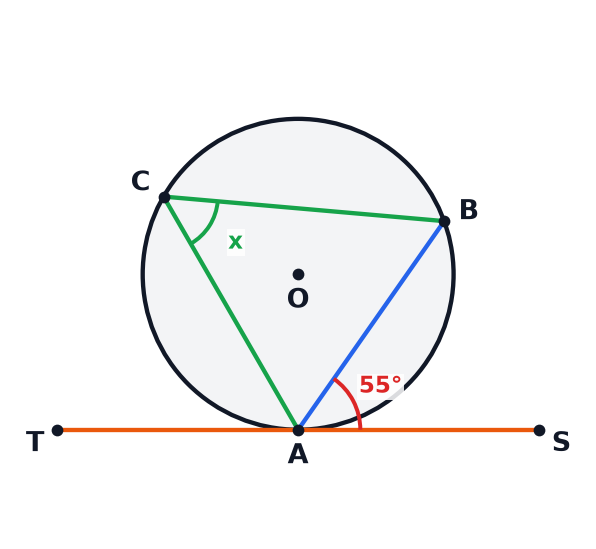
The angle \(SAB = 55^\circ\) is between the tangent and the chord \(AB\). The angle \(ACB\) is in the alternate segment, on the other side of the chord. So \(x = 55^\circ\), because the angle between a tangent and a chord equals the angle in the alternate segment.
Checking the diagram
- Tangent The line \(TAS\) touches the circle only at \(A\).
- Chord \(AB\) starts at the point of contact.
- Other side \(C\) is on the opposite side of the chord from the angle \(SAB\).
- Equal The two marked angles are equal.
Using the theorem
\(TA\) is a tangent to a circle at \(A\). \(B\) and \(C\) are points on the circle. Angle \(TAB = 62^\circ\). Work out angle \(ACB\), where \(C\) is in the alternate segment, and give a reason.
Show the solutionHide the solution
- 1 Spot the pattern \(TA\) is a tangent and \(AB\) is a chord from the point of contact.
- 2 Alternate segment \(C\) is on the other side of \(AB\) from angle \(TAB\).
- 3 Apply the theorem Angle \(ACB\) equals angle \(TAB\).
- 4 Reason "Angle between tangent and chord equals angle in the alternate segment", so \(ACB = 62^\circ\).
AnswerAngle \(ACB = 62^\circ\)
Combining theorems
Most exam questions use the alternate segment theorem with another theorem.
-
Triangles
Add the angles of a triangle to \(180^\circ\) to find the missing angle.
-
Isosceles triangle
Two radii make an isosceles triangle, so the base angles are equal.
-
Tangent and radius
The radius to the point of contact is perpendicular to the tangent.
-
One step at a time
Find each angle, write its reason, then use it in the next step.
Two theorems together
\(TA\) is a tangent to a circle at \(A\). \(B\) and \(C\) are points on the circle. Angle \(TAB = 48^\circ\) and angle \(ABC = 70^\circ\). Work out angle \(BAC\), giving reasons.
Show the solutionHide the solution
- 1 First angle Angle \(ACB = 48^\circ\), because the angle between a tangent and a chord equals the angle in the alternate segment.
- 2 Triangle The angles in triangle \(ABC\) add up to \(180^\circ\).
- 3 Missing angle \(BAC = 180 - 70 - 48 = 62^\circ\).
- 4 Reason "Angles in a triangle add up to \(180^\circ\)."
AnswerAngle \(BAC = 62^\circ\)
Test yourself
-
1
State the alternate segment theorem.
Show answerHide answer
The angle between a tangent and a chord equals the angle in the alternate segment.
-
2
Where does the chord start?
Show answerHide answer
At the point of contact of the tangent.
-
3
Which segment is the alternate segment?
Show answerHide answer
The one on the other side of the chord from the angle.
-
4
What else is a tangent perpendicular to?
Show answerHide answer
The radius at the point of contact.
-
5
What do the angles of a triangle add up to?
Show answerHide answer
\(180^\circ\).
Exam technique: a tangent in the diagram
Whenever you see a tangent, think of three theorems.
-
Radius
The tangent is perpendicular to the radius at the point of contact.
-
Chord
A chord from the point of contact gives the alternate segment theorem.
-
Equal tangents
Two tangents from a point are equal in length.
-
Write the full reason
"Alternate segment theorem" on its own may not earn the mark, so write it out.
Summary and exam focus
- The angle between a tangent and a chord equals the angle in the alternate segment.
- The chord must start at the point of contact.
- Combine it with the angle sum of a triangle and isosceles triangles.
- Write the full reason for every angle.
Exam focus
\(TA\) is a tangent to a circle at \(A\). \(B\) and \(C\) are points on the circle. Angle \(TAB = 62^\circ\). Work out angle \(ACB\), and give a reason. (2 marks) (2 marks)
\(ACB = 62^\circ\). The reason is: "The angle between a tangent and a chord equals the angle in the alternate segment."
Key terms
The words this lesson expects you to use. Each one is linked from the first place it appears above.
- Alternate segment
- The segment on the other side of a chord from a given angle.
- Tangent
- A straight line that touches a circle at one point.
- Chord
- A straight line joining two points on a circle.
- Point of contact
- The point where a tangent touches the circle.
- Segment
- The part of a circle cut off by a chord.
- Isosceles triangle
- A triangle with two equal sides.
- Base angles
- The two equal angles of an isosceles triangle.
- Radius
- The distance from the centre to the circle.
- Reason
- A statement of the theorem that justifies an angle.
Questions and answers
15 questions set on this lesson, with the mark schemes and model answers open.
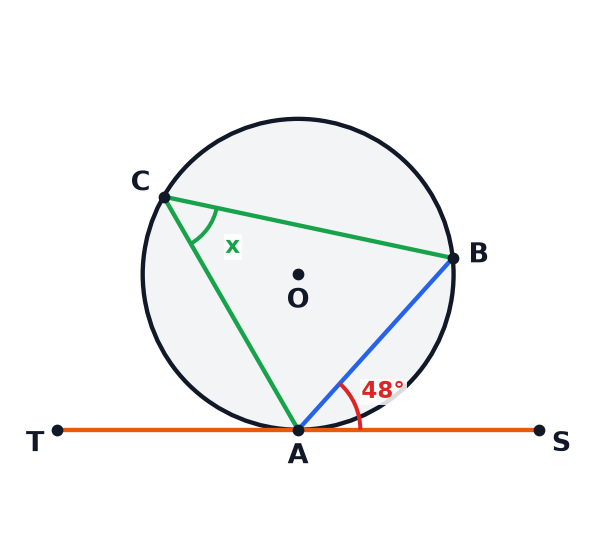
Diagram NOT accurately drawn. \(TAS\) is a tangent to the circle at \(A\). \(B\) and \(C\) are points on the circle. Angle \(SAB = 48^\circ\). Work out the size of angle \(ACB\). Give a reason for your answer. (2 marks)
Mark scheme — 2 marks available
- \(48\) — B1
- The angle between a tangent and a chord equals the angle in the alternate segment — C1
Model answer
Angle \(ACB = 48^\circ\), because the angle between a tangent and a chord equals the angle in the alternate segment.
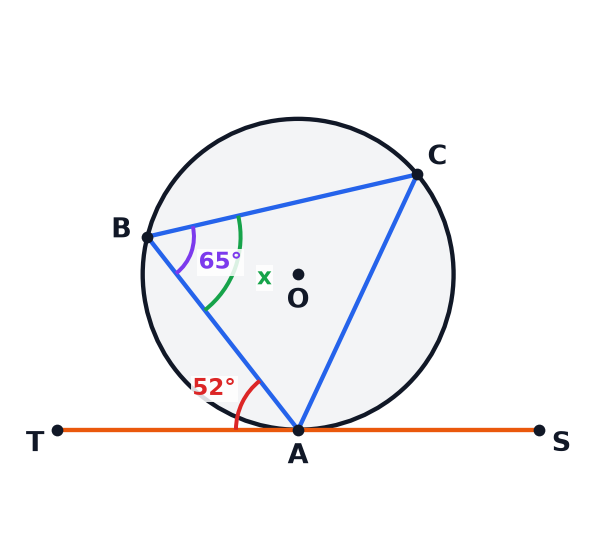
Diagram NOT accurately drawn. \(TAS\) is a tangent to the circle at \(A\). \(B\) and \(C\) are points on the circle. Angle \(TAB = 52^\circ\) and angle \(ABC = 65^\circ\). Work out the size of angle \(BAC\). Give reasons for your answer. (4 marks)
Mark scheme — 4 marks available
- \(ACB = 52\) — B1
- Alternate segment theorem stated — C1
- \(180 - 52 - 65\) — M1
- \(63\) — A1
Model answer
Angle \(ACB = 52^\circ\), because the angle between a tangent and a chord equals the angle in the alternate segment. Then \(BAC = 180 - 52 - 65 = 63^\circ\), because the angles in a triangle add up to \(180^\circ\).
\(TA\) is a tangent to a circle at \(A\), and \(B\) and \(C\) are points on the circle, with \(C\) in the alternate segment. Angle \(TAB = 3x + 10\) and angle \(ACB = 5x - 14\). Work out the value of \(x\). (3 marks)
Mark scheme — 3 marks available
- \(3x + 10 = 5x - 14\) — M1
- \(2x = 24\) — M1
- \(12\) — A1
Model answer
By the alternate segment theorem, \(3x + 10 = 5x - 14\). Then \(24 = 2x\), so \(x = 12\).
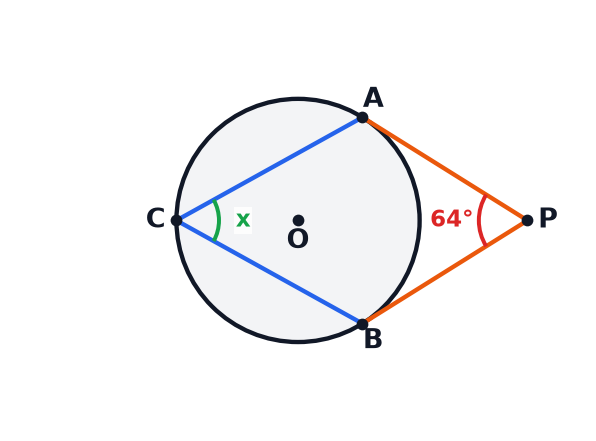
Diagram NOT accurately drawn. \(PA\) and \(PB\) are tangents to a circle, centre \(O\). \(C\) is a point on the circle. Angle \(APB = 64^\circ\). Work out the size of angle \(ACB\). Give reasons for your answer. (4 marks)
Mark scheme — 4 marks available
- \((180 - 64) \div 2\) — M1
- \(PAB = 58\) — A1
- \(ACB = 58\) — B1
- Alternate segment theorem stated — C1
Model answer
\(PA = PB\), so triangle \(PAB\) is isosceles and \(PAB = (180 - 64) \div 2 = 58^\circ\). By the alternate segment theorem, \(ACB = PAB = 58^\circ\).
\(AD\) is a diameter of a circle. \(TA\) is a tangent to the circle at \(A\). \(B\) is a point on the circle. Angle \(TAB = 38^\circ\). (a) Work out the size of angle \(ADB\). Give a reason for your answer. (2 marks) (b) Work out the size of angle \(DAB\). (2 marks)
Mark scheme — 4 marks available
- (a) \(38\) — B1
- (a) Alternate segment theorem stated — C1
- (b) \(90 - 38\), using angle \(TAD = 90^\circ\) — M1
- (b) \(52\) — A1
Model answer
(a) \(ADB = 38^\circ\), by the alternate segment theorem. (b) \(TAD = 90^\circ\) because a tangent is perpendicular to the radius, so \(DAB = 90 - 38 = 52^\circ\).
\(TA\) is a tangent to a circle at \(A\). \(AD\) is a diameter. \(B\) is a point on the circle. Prove that angle \(TAB\) equals angle \(ADB\). (4 marks)
Mark scheme — 4 marks available
- Angle \(TAD = 90^\circ\), because a tangent is perpendicular to the radius — B1
- Angle \(ABD = 90^\circ\), because the angle in a semicircle is a right angle — B1
- \(TAB = 90 - BAD\) and \(ADB = 90 - BAD\) — M1
- Concludes that the angles are equal — C1
Model answer
Angle \(TAD = 90^\circ\), because a tangent is perpendicular to the radius. Angle \(ABD = 90^\circ\), because the angle in a semicircle is \(90^\circ\). So \(TAB = 90 - BAD\), and in triangle \(ABD\), \(ADB = 90 - BAD\). Therefore \(TAB = ADB\).
What does the alternate segment theorem say?
Why: This is the alternate segment theorem.
Where must the chord start for the alternate segment theorem to apply?
Why: The chord starts at the point where the tangent touches the circle.
The angle between a tangent and a chord is \(58^\circ\). What is the angle in the alternate segment?
Why: They are equal.
What does “alternate” mean in the alternate segment theorem?
Why: The alternate segment is the one on the opposite side of the chord from the angle.
\(TA\) is a tangent at \(A\). Angle \(TAB = 40^\circ\) and angle \(ABC = 75^\circ\), where \(C\) is in the alternate segment. What is angle \(BAC\)?
Why: \(ACB = 40^\circ\) by the alternate segment theorem, so \(BAC = 180 - 75 - 40 = 65^\circ\).
\(PA\) and \(PB\) are tangents and \(\angle APB = 64^\circ\). \(C\) is on the major arc. What is angle \(ACB\)?
Why: \(PAB = (180 - 64) \div 2 = 58^\circ\), and this equals the angle in the alternate segment.
The angle between the tangent and the chord is \(2x + 4\) and the angle in the alternate segment is \(3x - 10\). What is \(x\)?
Why: \(2x + 4 = 3x - 10\), so \(x = 14\).
\(AD\) is a diameter, \(TA\) is a tangent at \(A\) and \(B\) is on the circle. Angle \(TAB = 36^\circ\). What is angle \(DAB\)?
Why: \(TAD = 90^\circ\) because a tangent is perpendicular to the radius, so \(DAB = 90 - 36 = 54^\circ\).
A tangent at \(A\) makes an angle of \(x\) with the chord \(AB\). What is the angle \(AOB\) at the centre, on the same side as that angle?
Why: The angle in the alternate segment is \(x\), and the angle at the centre is twice that.