Maths · Further Algebra
Viewing as
Teacher view: every answer and mark scheme set out in full.
Algebraic Fractions and Proof
Simplifying algebraic fractions, solving equations with fractions, and proving algebraic statements.
Learning Objectives
- 1Simplify algebraic fractions by factorising and cancelling common factors (Higher tier).
- 2Add, subtract, multiply and divide algebraic fractions (Higher tier).
- 3Solve equations that contain fractions with the unknown on the top.
- 4Prove algebraic statements, such as that the sum of two consecutive numbers is odd, and disprove others with a counter-example.
Fractions with letters, and showing why
Algebraic fractions follow exactly the same rules as number fractions, with brackets taking the place of numbers: cancel only what multiplies the whole top and the whole bottom, and use a common denominator to add. Proof is about showing that something is always true, using algebra instead of examples. Both topics use skills you already have, factorising and expanding, but they need tidy, careful working, and they are favourites for the last few marks of a Higher paper.
Simplifying an algebraic fraction
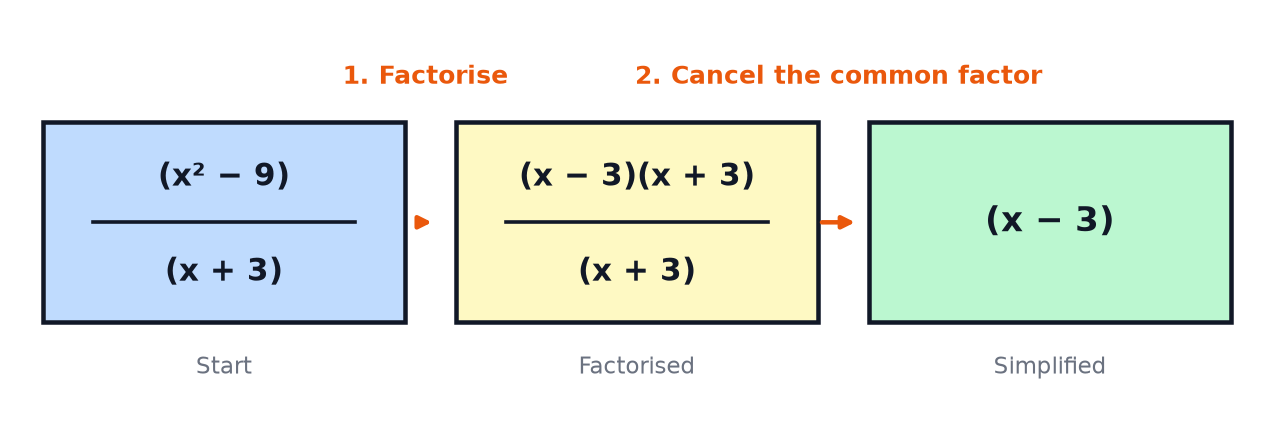
To simplify an algebraic fraction, factorise the top and the bottom, then cancel any bracket that appears on both. You can only cancel factors, never terms that are added or subtracted.
The rule for cancelling
- Factorise first The top \(x^2 - 9\) becomes \((x - 3)(x + 3)\).
- Cancel whole brackets The \((x + 3)\) on top and bottom cancels, leaving \(x - 3\).
- Never cancel terms \(\dfrac{x + 3}{3}\) is not \(x + 1\) and not \(x\). The 3 on top is added, not multiplied.
- Check with a number Put \(x = 5\) in the start and the end: \(\dfrac{16}{8} = 2\) and \(5 - 3 = 2\).
Simplifying with quadratics
(Higher tier) Simplify \(\dfrac{x^2 + 5x + 6}{x^2 + 3x + 2}\).
Show the solutionHide the solution
- 1 Factorise the top \(x^2 + 5x + 6 = (x + 2)(x + 3)\).
- 2 Factorise the bottom \(x^2 + 3x + 2 = (x + 1)(x + 2)\).
- 3 Cancel the common bracket \(\dfrac{(x + 2)(x + 3)}{(x + 1)(x + 2)} = \dfrac{x + 3}{x + 1}\).
- 4 Check Put \(x = 1\) in: \(\dfrac{12}{6} = 2\) and \(\dfrac{4}{2} = 2\).
Answer\(\dfrac{x + 3}{x + 1}\)
Adding, multiplying and dividing (Higher tier)
Use the rules for number fractions, with brackets for the denominators.
-
Multiply
Multiply the tops and the bottoms, and cancel before or after: \(\dfrac{x}{3} \times \dfrac{6}{x + 1} = \dfrac{6x}{3(x + 1)} = \dfrac{2x}{x + 1}\).
-
Divide
Turn the second fraction upside down and multiply.
-
Add or subtract
Find a common denominator. \(\dfrac{1}{x} + \dfrac{1}{x + 1} = \dfrac{x + 1}{x(x + 1)} + \dfrac{x}{x(x + 1)} = \dfrac{2x + 1}{x(x + 1)}\).
-
Keep the brackets
Leave the denominator factorised, which makes later cancelling easier.
Equations with fractions
Multiply every term by the lowest common denominator to remove the fractions.
-
Find the common multiple
For denominators 3 and 6, use 6.
-
Multiply every term
Every term, including any whole number on the other side.
-
Solve the new equation
Then check by substituting.
-
Brackets on the top
Treat \(2(x - 1)\) as one thing when multiplying.
An equation with fractions
Solve \(\dfrac{x - 1}{3} + \dfrac{x + 2}{6} = 2\).
Show the solutionHide the solution
- 1 Multiply every term by 6 \(2(x - 1) + (x + 2) = 12\).
- 2 Expand \(2x - 2 + x + 2 = 12\).
- 3 Collect terms \(3x = 12\).
- 4 Solve and check \(x = 4\), and \(\dfrac{3}{3} + \dfrac{6}{6} = 1 + 1 = 2\).
Answer\(x = 4\)
Algebraic proof
To prove a statement for every number, write it with letters. An example is not a proof.
-
Consecutive numbers
Call them \(n\) and \(n + 1\). Even numbers are \(2n\), and odd numbers are \(2n + 1\).
-
Prove: the sum of two consecutive numbers is odd
\(n + (n + 1) = 2n + 1\), which is odd.
-
Prove: the sum of three consecutive numbers is a multiple of 3
\(n + (n + 1) + (n + 2) = 3n + 3 = 3(n + 1)\).
-
Prove: \((n + 1)^2 - (n - 1)^2\) is a multiple of 4
\(n^2 + 2n + 1 - (n^2 - 2n + 1) = 4n\).
Counter-examples and identities
To show that a statement is false, one example that fails is enough.
-
Counter-example
"\(n^2 + n + 1\) is always prime" fails for \(n = 4\), because \(16 + 4 + 1 = 21 = 3 \times 7\).
-
Identity
The sign \(\equiv\) means two expressions are equal for every value, such as \((x + 3)^2 \equiv x^2 + 6x + 9\).
-
Conclude
End a proof with a sentence: "which is a multiple of 3, so the sum is always a multiple of 3".
-
Pick numbers carefully
A counter-example must make the statement false, not just fail to prove it.
Test yourself
-
1
What may you cancel in an algebraic fraction?
Show answerHide answer
Factors that multiply the whole top and the whole bottom.
-
2
How do you write an odd number using \(n\)?
Show answerHide answer
\(2n + 1\).
-
3
What is the sum of three consecutive numbers, written with \(n\)?
Show answerHide answer
\(3n + 3\).
-
4
What is the first step in solving \(\dfrac{x}{2} + \dfrac{x}{3} = 5\)?
Show answerHide answer
Multiply every term by 6.
-
5
What does one counter-example show?
Show answerHide answer
That the statement is not always true.
Exam technique: fractions and proof
The working is the answer in these questions, so lay it out neatly.
-
Factorise before cancelling
Cancelling terms instead of factors is the commonest error.
-
Show every step
One method mark per step is common.
-
End a proof with a conclusion
State what you have shown, in words.
-
Do not just test numbers
Examples alone score nothing for a proof.
Summary and exam focus
- Simplify an algebraic fraction by factorising the top and bottom and cancelling common factors (Higher tier).
- Add fractions over a common denominator, and multiply or divide as with number fractions.
- To solve an equation with fractions, multiply every term by the common denominator.
- To prove, use letters such as \(n\) and \(n + 1\), and finish with a sentence. One counter-example disproves a claim.
Exam focus
Show that the sum of any three consecutive whole numbers is a multiple of 3. (3 marks) (3 marks)
Call the numbers \(n\), \(n + 1\) and \(n + 2\). Their sum is \(3n + 3 = 3(n + 1)\), which has a factor of 3. Finish with a sentence saying so, because the conclusion is a mark.
Key terms
The words this lesson expects you to use. Each one is linked from the first place it appears above.
- Algebraic fraction
- A fraction whose top or bottom contains letters.
- Cancel
- Divide the top and bottom of a fraction by the same factor.
- Common denominator
- A shared multiple of the denominators, used to add or subtract fractions.
- Proof
- A logical argument that shows a statement is always true.
- Counter-example
- A single example that shows a statement is false.
- Identity
- An equation that is true for all values, written with \(\equiv\).
- Consecutive
- Following one after another, such as \(n\) and \(n + 1\).
- Factor
- An expression that divides exactly into another.
- Multiple
- A number in the times table of another number.
Questions and answers
15 questions set on this lesson, with the mark schemes and model answers open.
Prove that the sum of two consecutive odd numbers is a multiple of 4.
Mark scheme — 3 marks available
- \(2n + 1\) and \(2n + 3\) — M1
- \(4n + 4\) — M1
- \(4(n + 1)\) with a conclusion — C1
Model answer
Let the odd numbers be \(2n + 1\) and \(2n + 3\). Their sum is \(4n + 4 = 4(n + 1)\), which is a multiple of 4.
Simplify \(\dfrac{x^2 - 16}{x - 4}\).
Mark scheme — 2 marks available
- \((x - 4)(x + 4)\) — M1
- \(x + 4\) — A1
Model answer
\(\dfrac{(x - 4)(x + 4)}{x - 4} = x + 4\).
Solve \(\dfrac{x + 3}{2} + \dfrac{x - 1}{4} = 5\).
Mark scheme — 3 marks available
- \(2(x + 3) + (x - 1) = 20\) — M1
- \(3x + 5 = 20\) — M1
- \(x = 5\) — A1
Model answer
Multiply every term by 4: \(2(x + 3) + (x - 1) = 20\). Then \(3x + 5 = 20\), so \(x = 5\).
Simplify \(\dfrac{x^2 + x - 6}{x^2 - 9}\).
Mark scheme — 3 marks available
- \((x + 3)(x - 2)\) or \((x - 3)(x + 3)\) — M1
- Both factorised — M1
- \(\dfrac{x - 2}{x - 3}\) — A1
Model answer
\(\dfrac{(x + 3)(x - 2)}{(x - 3)(x + 3)} = \dfrac{x - 2}{x - 3}\).
Show that \((n + 3)^2 - (n - 3)^2\) is a multiple of 12 for every integer \(n\).
Mark scheme — 3 marks available
- \(n^2 + 6n + 9\) or \(n^2 - 6n + 9\) — M1
- \(12n\) — M1
- States that \(12n\) is a multiple of 12 — C1
Model answer
\((n + 3)^2 = n^2 + 6n + 9\) and \((n - 3)^2 = n^2 - 6n + 9\). The difference is \(12n\), which is a multiple of 12.
Write \(\dfrac{1}{x + 2} + \dfrac{1}{x - 1}\) as a single fraction, in its simplest form.
Mark scheme — 3 marks available
- Common denominator \((x + 2)(x - 1)\) — M1
- Numerator \((x - 1) + (x + 2)\) — M1
- \(\dfrac{2x + 1}{(x + 2)(x - 1)}\) — A1
Model answer
Use the common denominator \((x + 2)(x - 1)\): \(\dfrac{(x - 1) + (x + 2)}{(x + 2)(x - 1)} = \dfrac{2x + 1}{(x + 2)(x - 1)}\).
What may be cancelled in an algebraic fraction?
Why: Terms that are added or subtracted cannot be cancelled.
Simplify \(\dfrac{x^2 - 9}{x + 3}\).
Why: \(\dfrac{(x - 3)(x + 3)}{x + 3} = x - 3\).
Which statement about \(\dfrac{x + 3}{3}\) is correct?
Why: Only factors can be cancelled, not terms.
Solve \(\dfrac{x - 1}{3} + \dfrac{x + 2}{6} = 2\).
Why: Multiply by 6: \(2(x - 1) + (x + 2) = 12\), so \(3x = 12\).
Which expression is an odd number for any whole number \(n\)?
Why: \(2n\) is even, so adding 1 makes it odd.
What is the sum of three consecutive whole numbers \(n\), \(n + 1\) and \(n + 2\)?
Why: \(n + n + 1 + n + 2 = 3n + 3 = 3(n + 1)\).
Which value of \(n\) is a counter-example to “\(n^2 + n + 1\) is always prime”?
Why: \(16 + 4 + 1 = 21 = 3 \times 7\), which is not prime.
Simplify \(\dfrac{x^2 + 5x + 6}{x^2 + 3x + 2}\).
Why: \(\dfrac{(x + 2)(x + 3)}{(x + 1)(x + 2)} = \dfrac{x + 3}{x + 1}\).
Expand and simplify \((n + 1)^2 - (n - 1)^2\).
Why: \(n^2 + 2n + 1 - n^2 + 2n - 1 = 4n\).