Maths · Probability
Viewing as
Teacher view: every answer and mark scheme set out in full.
Conditional Probability
Finding probabilities given that something has already happened, from tables, Venn diagrams and tree diagrams.
Learning Objectives
- 1Work out conditional probabilities from Venn diagrams, two-way tables and tree diagrams.
- 2Use \(P(A \text{ and } B) = P(A \mid B) \times P(B)\) (Higher tier).
- 3Decide whether two events are independent.
- 4Solve combined-event problems that need more than one method.
Probability when you already know something
A conditional probability is the probability of an event given that something else has already happened, or is known. "Given that" shrinks the group you are looking at, so the bottom of the fraction becomes the size of that smaller group, not the whole total. It is the hardest idea in this chapter, but each of the three tools you know, Venn diagrams, tables and trees, makes it a counting job once you have found the right group. These questions are Higher tier content, so the lesson uses the Higher tier formula as well.
The idea of "given that"
The words "given that" or "knowing that" tell you which group to look at.
-
Shrink the group
If you know a student plays tennis, you only look at the tennis players.
-
Notation
\(P(A \mid B)\) means the probability of \(A\) given that \(B\) has happened.
-
Counting
\(P(A \mid B) = \dfrac{\text{number in both } A \text{ and } B}{\text{number in } B}\).
-
Not symmetric
\(P(A \mid B)\) is usually different from \(P(B \mid A)\), because the groups are different.
Given that on a Venn diagram
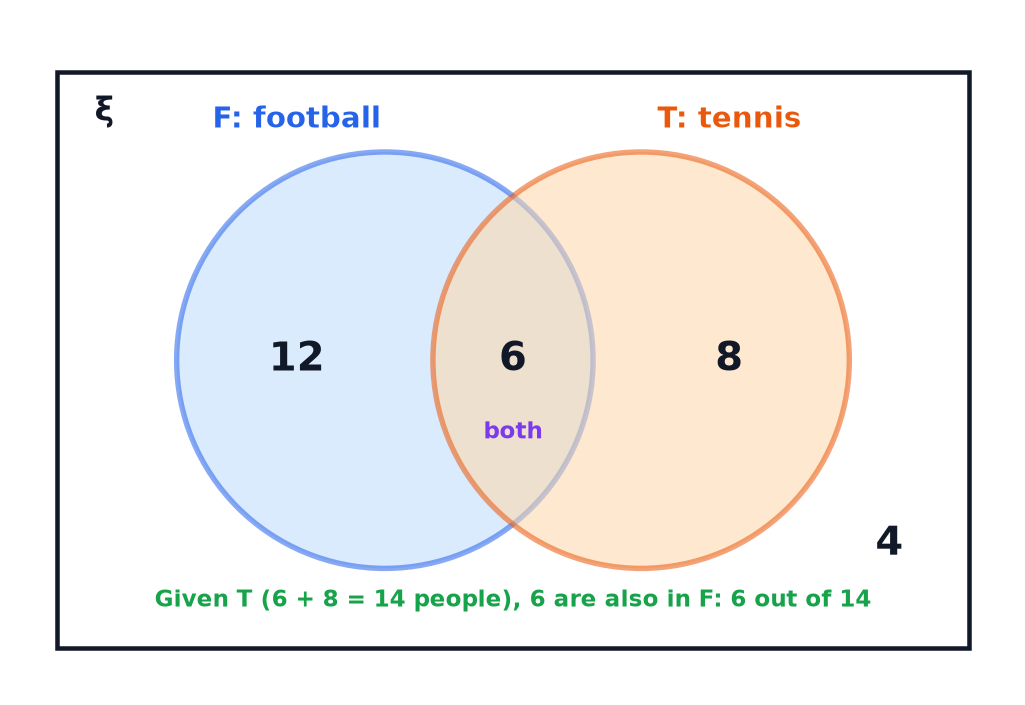
If a student is known to play tennis, the only students who matter are the tennis circle, 14 of them. Of those, 6 also play football, so \(P(F \mid T) = \dfrac{6}{14} = \dfrac{3}{7}\).
Reading the diagram
- Given tennis The group is \(6 + 8 = 14\).
- Also football The overlap is 6, so \(P(F \mid T) = \dfrac{6}{14} = \dfrac{3}{7}\).
- Given football The group is \(12 + 6 = 18\), so \(P(T \mid F) = \dfrac{6}{18} = \dfrac{1}{3}\).
- Compare \(\dfrac{3}{7}\) and \(\dfrac{1}{3}\) are different, so the order matters.
Conditional probability from a table
100 people were asked how they travel to work. Of the 60 males, 36 drive, 14 cycle and 10 take the bus. Of the 40 females, 24 drive, 10 cycle and 6 take the bus. A person who drives is chosen at random. Work out the probability that the person is female.
Show the solutionHide the solution
- 1 Find the group "Chosen from those who drive" means \(36 + 24 = 60\) people.
- 2 Count the females in the group 24 of those who drive are female.
- 3 Write the probability \(\dfrac{24}{60}\).
- 4 Simplify \(\dfrac{2}{5}\).
Answer\(\dfrac{2}{5}\)
Conditional probability on trees
On a tree for events without replacement, the second branches are conditional probabilities.
-
Second-stage branches
After a red counter is picked from 3 red and 2 blue, the probability of another red is \(\dfrac{2}{4}\), which is \(P(\text{red second} \mid \text{red first})\).
-
The multiplication rule
\(P(A \text{ and } B) = P(A) \times P(B \mid A)\), which is what you do along the branches.
-
Given the second result
If you are told the second counter was red, find all the paths that end in red and use their total as the bottom of the fraction.
-
Example
Paths ending in red: RR \(= \dfrac{6}{20}\) and BR \(= \dfrac{6}{20}\), total \(\dfrac{12}{20}\). Given the second counter is red, the probability that the first was red is \(\dfrac{6/20}{12/20} = \dfrac{1}{2}\).
The formula and independence (Higher tier)
These links let you move between the probabilities when you have only some of them.
-
Formula
\(P(A \text{ and } B) = P(A \mid B) \times P(B)\). It is given on the Higher tier formulae page for some boards and must be learned for others.
-
Rearranged
\(P(A \mid B) = \dfrac{P(A \text{ and } B)}{P(B)}\).
-
Independent events
\(A\) and \(B\) are independent if \(P(A \mid B) = P(A)\), which means \(P(A \text{ and } B) = P(A) \times P(B)\).
-
Test
If \(P(A) = 0.5\), \(P(B) = 0.4\) and \(P(A \text{ and } B) = 0.2\), then \(0.5 \times 0.4 = 0.2\), so they are independent.
Using the formula
(Higher tier) \(P(A) = 0.5\), \(P(B) = 0.4\) and \(P(A \text{ and } B) = 0.1\). Work out \(P(A \mid B)\), and say whether \(A\) and \(B\) are independent.
Show the solutionHide the solution
- 1 Rearrange the formula \(P(A \mid B) = \dfrac{P(A \text{ and } B)}{P(B)}\).
- 2 Substitute \(\dfrac{0.1}{0.4}\).
- 3 Calculate \(\dfrac{1}{4} = 0.25\).
- 4 Compare with \(P(A)\) \(0.25 \neq 0.5\), so the events are not independent.
Answer\(P(A \mid B) = 0.25\), and they are not independent
What the Edexcel exam gives you
Edexcel prints a formulae page in the question paper, so some formulae are given to you.
-
Given (Higher tier)
The formulae page shows \(P(A \text{ and } B) = P(A \mid B) \times P(B)\). Rearrange it to \(P(A \mid B) = \dfrac{P(A \text{ and } B)}{P(B)}\) when you need the conditional probability.
-
Not given
The method of finding a conditional probability by counting the smaller group from a table, a Venn diagram or a tree is not printed, and it is how most questions are answered.
-
Not given
The test for independence, \(P(A \mid B) = P(A)\), so learn it.
Test yourself
-
1
What does \(P(A \mid B)\) mean?
Show answerHide answer
The probability of \(A\) given that \(B\) has happened.
-
2
What is the bottom of the fraction in a conditional probability?
Show answerHide answer
The number in the group that is given.
-
3
What is the formula for \(P(A \text{ and } B)\) in terms of \(P(A \mid B)\) (Higher tier)?
Show answerHide answer
\(P(A \mid B) \times P(B)\).
-
4
What is true of \(P(A \text{ and } B)\) when \(A\) and \(B\) are independent?
Show answerHide answer
It equals \(P(A) \times P(B)\).
-
5
Out of 14 tennis players, 6 also play football. What is \(P(F \mid T)\)?
Show answerHide answer
\(\dfrac{6}{14} = \dfrac{3}{7}\).
Exam technique: conditional probability
Find the group first, then count inside it.
-
Underline the "given that" part
It tells you the group for the bottom of the fraction.
-
Count the group carefully
Add every cell, region or path that belongs to it.
-
Check the denominator is smaller than the total
A conditional probability usually has fewer than all the items on the bottom.
-
Show a sentence
"The group is the 14 tennis players" earns a mark for the method.
Summary and exam focus
- A conditional probability is a probability within a smaller group, so the bottom of the fraction is the size of that group.
- It can be found from a Venn diagram, two-way table or tree diagram.
- \(P(A \text{ and } B) = P(A \mid B) \times P(B)\), and independent events have \(P(A \text{ and } B) = P(A) \times P(B)\) (Higher tier).
Exam focus
100 people were asked how they travel to work. Of the 50 who drive, 20 are female. A person who drives is chosen at random. Write down the probability that the person is male. (1 mark) (1 marks)
The group is those who drive, 50 people, and 20 of them are female, so \(50 - 20 = 30\) are male. The answer is \(\dfrac{30}{50} = \dfrac{3}{5}\). The mistake to avoid is dividing by the total of 100.
Key terms
The words this lesson expects you to use. Each one is linked from the first place it appears above.
- Conditional probability
- The probability of an event given that another event has happened.
- Given that
- The words that mean you only look at part of the group.
- Independent
- Events where knowing one has no effect on the probability of the other.
- Group
- The set of items you are choosing from, after any given information.
- Denominator
- The number on the bottom of a fraction.
- Tree diagram
- A diagram showing outcomes in stages with probabilities on branches.
- Two-way table
- A table of counts sorted by two features.
- Venn diagram
- A diagram of overlapping sets with the number in each region.
- Notation
- The symbols used in mathematics, such as \(P(A \mid B)\).
Questions and answers
15 questions set on this lesson, with the mark schemes and model answers open.
There are 3 red sweets and 5 blue sweets in a bag. Tom takes a sweet at random and eats it. He then takes a second sweet. Given that the first sweet was red, work out the probability that the second sweet is blue.
Mark scheme — 2 marks available
- 7 sweets remaining, or the denominator 7 — M1
- \(\dfrac{5}{7}\) — A1
Model answer
After the red sweet is eaten there are 7 sweets left, 5 of them blue, so the probability is \(\dfrac{5}{7}\).
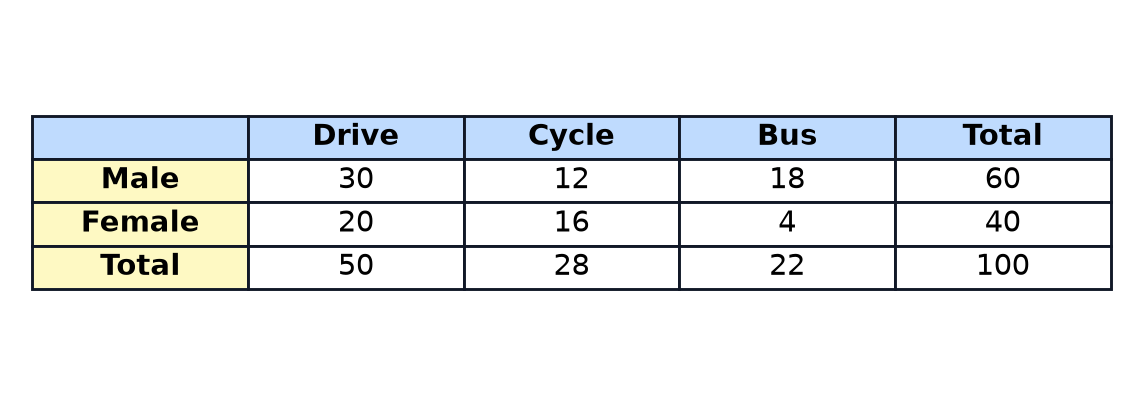
The two-way table shows how 100 people travel to work. (a) One of the people is chosen at random. Work out the probability that the person drives. (1 mark) (b) One of the females is chosen at random. Work out the probability that she cycles. (2 marks) (c) One of the people who take the bus is chosen at random. Work out the probability that the person is male. (2 marks)
Mark scheme — 5 marks available
- (a) \(\dfrac{50}{100}\) or \(\dfrac{1}{2}\) — B1
- (b) \(\dfrac{16}{40}\) — M1
- (b) \(\dfrac{2}{5}\) — A1
- (c) \(\dfrac{18}{22}\) — M1
- (c) \(\dfrac{9}{11}\) — A1
Model answer
(a) \(\dfrac{50}{100} = \dfrac{1}{2}\). (b) There are 40 females and 16 cycle, so \(\dfrac{16}{40} = \dfrac{2}{5}\). (c) There are 22 people who take the bus and 18 of them are male, so \(\dfrac{18}{22} = \dfrac{9}{11}\).
\(A\) and \(B\) are two events. \(P(A) = 0.4\), \(P(B) = 0.5\) and \(P(A \text{ and } B) = 0.2\). (a) Work out \(P(A \text{ given } B)\). (2 marks) (b) Are \(A\) and \(B\) independent? Give a reason for your answer. (1 mark)
Mark scheme — 3 marks available
- (a) \(\dfrac{0.2}{0.5}\) or \(0.2 = P(A \text{ given } B) \times 0.5\) — M1
- (a) \(0.4\) — A1
- (b) Yes, with the reason that \(P(A \text{ given } B) = P(A)\) — C1
Model answer
(a) \(P(A \text{ given } B) = \dfrac{0.2}{0.5} = 0.4\). (b) Yes, because \(P(A \text{ given } B) = 0.4 = P(A)\), so knowing \(B\) happened does not change the probability of \(A\).
There are 40 students in a class. 22 play football (F) and 19 play tennis (T). 6 play both and 5 play neither. (a) A student who plays tennis is chosen at random. Work out the probability that the student also plays football. (2 marks) (b) A student who does not play football is chosen at random. Work out the probability that the student plays tennis. (2 marks)
Mark scheme — 4 marks available
- (a) \(\dfrac{6}{19}\) with 19 as the denominator — M1
- (a) \(\dfrac{6}{19}\) — A1
- (b) \(\dfrac{13}{18}\) with 18 as the denominator — M1
- (b) \(\dfrac{13}{18}\) — A1
Model answer
(a) 19 play tennis and 6 of them also play football, so \(\dfrac{6}{19}\). (b) \(40 - 22 = 18\) do not play football, and 13 of them play tennis, so \(\dfrac{13}{18}\).
A bag contains 5 red counters and 3 blue counters. Two counters are taken at random without replacement. Given that the two counters are different colours, work out the probability that the first counter is red.
Mark scheme — 4 marks available
- \(\dfrac{5}{8} \times \dfrac{3}{7}\) — M1
- \(\dfrac{3}{8} \times \dfrac{5}{7}\) and the two added — M1
- \(\dfrac{15}{56} \div \dfrac{30}{56}\) or \(\dfrac{15}{30}\) — M1
- \(\dfrac{1}{2}\) — A1
Model answer
\(P(\text{red then blue}) = \dfrac{5}{8} \times \dfrac{3}{7} = \dfrac{15}{56}\) and \(P(\text{blue then red}) = \dfrac{3}{8} \times \dfrac{5}{7} = \dfrac{15}{56}\). The probability that they are different is \(\dfrac{30}{56}\), so the probability that the first is red is \(\dfrac{15}{56} \div \dfrac{30}{56} = \dfrac{1}{2}\).
Machine \(X\) makes 60% of the items in a factory and machine \(Y\) makes 40%. 5% of the items from \(X\) are faulty and 10% of the items from \(Y\) are faulty. An item is chosen at random and is found to be faulty. Work out the probability that it was made by machine \(X\).
Mark scheme — 4 marks available
- \(0.6 \times 0.05 = 0.03\) — M1
- \(0.4 \times 0.1 = 0.04\) — M1
- \(\dfrac{0.03}{0.07}\) — M1
- \(\dfrac{3}{7}\) — A1
Model answer
\(P(X \text{ and faulty}) = 0.6 \times 0.05 = 0.03\) and \(P(Y \text{ and faulty}) = 0.4 \times 0.1 = 0.04\). So \(P(\text{faulty}) = 0.07\), and the probability is \(\dfrac{0.03}{0.07} = \dfrac{3}{7}\).
What does \(P(A \mid B)\) mean?
Why: The vertical line means “given that”.
14 students play tennis, and 6 of them also play football. What is the probability that a tennis player also plays football?
Why: The group is the 14 tennis players: \(\dfrac{6}{14} = \dfrac{3}{7}\).
Of 50 people who drive to work, 20 are female. A driver is chosen at random. What is the probability that the person is male?
Why: \(\dfrac{30}{50} = \dfrac{3}{5}\). The group is the 50 drivers.
Of 100 people, 36 male drivers and 24 female drivers drive to work. A driver is chosen at random. What is the probability that the driver is female?
Why: The group is \(36 + 24 = 60\) drivers, and \(\dfrac{24}{60} = \dfrac{2}{5}\).
A bag has 3 red and 2 blue counters. One red counter is taken and not replaced. What is the probability that the next counter is red?
Why: 2 red counters are left among 4, so \(\dfrac{2}{4} = \dfrac{1}{2}\).
Is \(P(A \mid B)\) always equal to \(P(B \mid A)\)?
Why: The group on the bottom is different in each.
\(P(A) = 0.5\), \(P(B) = 0.4\) and \(P(A \text{ and } B) = 0.2\). Are \(A\) and \(B\) independent?
Why: Independent events have \(P(A \text{ and } B) = P(A) \times P(B)\).
\(P(A \text{ and } B) = 0.1\) and \(P(B) = 0.4\). What is \(P(A \mid B)\)?
Why: \(\dfrac{0.1}{0.4} = 0.25\).
\(P(A \mid B) = 0.5\) and \(P(B) = 0.6\). What is \(P(A \text{ and } B)\)?
Why: \(P(A \text{ and } B) = P(A \mid B) \times P(B) = 0.5 \times 0.6 = 0.3\).