Maths · Probability
Viewing as
Teaching this? The teacher view opens every answer and mark scheme.
Probability Basics and Relative Frequency
Calculating simple probabilities, using the probability scale, and estimating from relative frequency and expected outcomes.
Learning Objectives
- 1Use the probability scale from 0 to 1 and write probabilities as fractions, decimals or percentages.
- 2Calculate the probability of an event, and the probability that it does not happen.
- 3Use relative frequency to estimate probabilities, and work out expected numbers of outcomes.
- 4List outcomes systematically, and use the addition rule for mutually exclusive events.
Measuring chance
Probability tells you how likely something is, using a number from 0 to 1. Almost every probability question on a non-calculator paper uses neat numbers, such as a bag of 10 counters or two dice, so the answers come out as simple fractions. The marks are for choosing the right numbers for the top and bottom of the fraction, so it pays to slow down and count carefully, and to leave your answer as a fraction in its simplest form unless the question asks for something else.
The probability scale
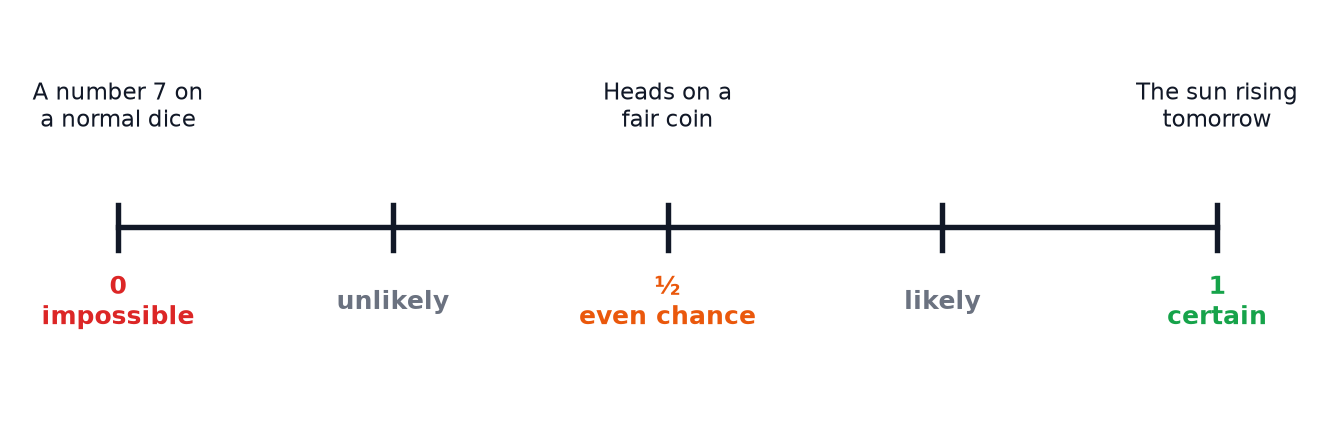
Every probability is between 0 and 1. An impossible event has probability 0 and a certain event has probability 1. Never write a probability bigger than 1 or a negative one.
Reading the scale
- The event cannot happen.
- \(\dfrac{1}{2}\) An even chance, equally likely to happen or not.
- 1 The event is certain to happen.
- Forms \(\dfrac{1}{4}\), 0.25 and 25% are the same probability, and you can use any form unless the question says which.
Working out a probability
When all the outcomes are equally likely, count the ones you want and divide by the total.
-
The formula
\(P(\text{event}) = \dfrac{\text{number of ways it can happen}}{\text{total number of equally likely outcomes}}\).
-
Example
A bag has 3 red, 5 blue and 2 green counters. There are 10 counters, so \(P(\text{blue}) = \dfrac{5}{10} = \dfrac{1}{2}\).
-
Not happening
\(P(\text{not } A) = 1 - P(A)\). \(P(\text{not green}) = 1 - \dfrac{2}{10} = \dfrac{8}{10} = \dfrac{4}{5}\).
-
All the outcomes add up to 1
\(\dfrac{3}{10} + \dfrac{5}{10} + \dfrac{2}{10} = 1\), a quick check that no outcome has been missed.
A probability from a bag
A bag contains 3 red counters, 5 blue counters and 2 green counters. One counter is taken at random. Work out the probability that it is red or green.
Show the solutionHide the solution
- 1 Count the favourable outcomes Red or green is \(3 + 2 = 5\) counters.
- 2 Count all the outcomes \(3 + 5 + 2 = 10\) counters.
- 3 Write the probability \(\dfrac{5}{10}\).
- 4 Simplify \(\dfrac{1}{2}\).
Answer\(\dfrac{1}{2}\)
Mutually exclusive events
Events that cannot happen at the same time are mutually exclusive, such as getting red and getting blue from one counter.
-
Addition rule
For mutually exclusive events, \(P(A \text{ or } B) = P(A) + P(B)\).
-
Example
\(P(\text{red or green}) = \dfrac{3}{10} + \dfrac{2}{10} = \dfrac{1}{2}\), the same answer as counting.
-
Not mutually exclusive (Higher tier)
If both can happen, \(P(A \text{ or } B) = P(A) + P(B) - P(A \text{ and } B)\), so the overlap is not counted twice.
-
Example
The probability of drawing a heart or a king from a pack of 52 cards is \(\dfrac{13}{52} + \dfrac{4}{52} - \dfrac{1}{52} = \dfrac{16}{52} = \dfrac{4}{13}\).
Relative frequency and expected outcomes
When you cannot count equally likely outcomes, because a dice may be biased, use an experiment.
-
Relative frequency
\(\dfrac{\text{number of times it happened}}{\text{total number of trials}}\). A dice is thrown 120 times and gives a 6 on 30 of them, so the relative frequency of a 6 is \(\dfrac{30}{120} = \dfrac{1}{4}\).
-
Biased or not
A fair dice gives \(\dfrac{1}{6}\) for a 6. A result of \(\dfrac{1}{4}\) suggests the dice may be biased, especially with many trials.
-
More trials, better estimate
Relative frequency gets closer to the true probability the more times the experiment is repeated.
-
Expected number
Expected outcomes \(=\) probability \(\times\) number of trials. A fair dice thrown 600 times is expected to give \(\dfrac{1}{6} \times 600 = 100\) sixes.
A sample space for two dice
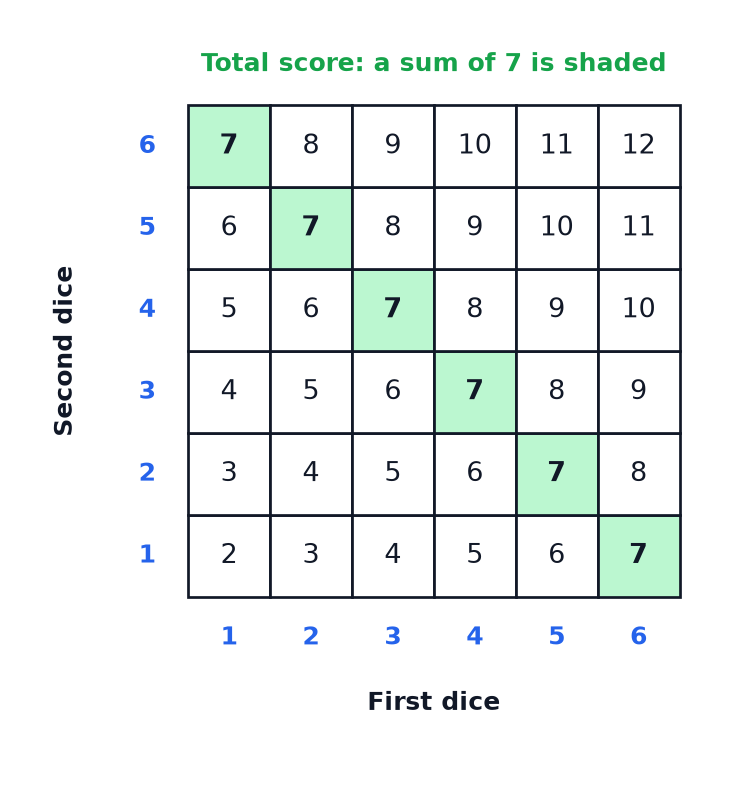
A sample space lists all the possible outcomes, so you can count them without missing any. There are 36 outcomes for two dice, all equally likely.
Using the sample space
- A total of 7 There are 6 cells showing 7, so \(P(\text{total } 7) = \dfrac{6}{36} = \dfrac{1}{6}\).
- A total of at least 10 The totals 10, 11 and 12 occur \(3 + 2 + 1 = 6\) times, so the probability is \(\dfrac{6}{36} = \dfrac{1}{6}\).
- A double The 6 cells down the diagonal give \(\dfrac{6}{36} = \dfrac{1}{6}\).
- Systematic listing When you list outcomes without a grid, go in order, such as HH, HT, TH, TT for two coins.
Using relative frequency
A spinner is spun 200 times. It lands on red 74 times. Another person says the probability of red is \(\dfrac{1}{4}\). Is this likely to be correct? Work out the number of times you would expect red in 200 spins if the probability is \(\dfrac{1}{4}\).
Show the solutionHide the solution
- 1 Expected number \(\dfrac{1}{4} \times 200 = 50\).
- 2 Compare with the result The result, 74, is much larger than 50.
- 3 Conclude The spinner is probably biased towards red, so \(\dfrac{1}{4}\) is probably not correct.
- 4 Relative frequency \(\dfrac{74}{200} = \dfrac{37}{100}\) is a better estimate.
Answer50, so the result of 74 suggests the spinner may be biased
What the Edexcel exam gives you
Edexcel prints a formulae page in the question paper, so some formulae are given to you.
-
Given (Higher tier)
The addition rule \(P(A \text{ or } B) = P(A) + P(B) - P(A \text{ and } B)\) is printed on the formulae page, so you do not have to remember where the minus sign goes.
-
Not given
The simple rules are not printed: probabilities add up to 1, \(P(\text{not } A) = 1 - P(A)\), and expected number \(=\) probability \(\times\) number of trials.
-
Not given
Relative frequency, which is the number of times something happens divided by the number of trials, so learn that too.
Test yourself
-
1
What is \(P(\text{not } A)\)?
Show answerHide answer
\(1 - P(A)\).
-
2
What do the probabilities of all the possible outcomes add up to?
Show answerHide answer
1.
-
3
What is the relative frequency formula?
Show answerHide answer
Number of times it happened divided by the number of trials.
-
4
What is the probability of a total of 7 with two dice?
Show answerHide answer
\(\dfrac{6}{36} = \dfrac{1}{6}\).
-
5
How many sixes would you expect in 120 throws of a fair dice?
Show answerHide answer
\(\dfrac{1}{6} \times 120 = 20\).
Exam technique: probability
Examiners award marks for a correct fraction, so write one.
-
Count the total carefully
Check whether the total includes the item you are choosing, or whether something has been removed.
-
Simplify at the end
\(\dfrac{6}{36}\) can be left unsimplified for the method mark, but simplify for the answer.
-
Answers as fractions, decimals or percentages
Do not write ratios such as 1 : 6 or words such as "1 in 6" as the answer.
-
Say why
For biased questions, compare relative frequency with the expected probability and give a conclusion.
Summary and exam focus
- Probability is a number from 0 to 1, found as favourable outcomes divided by all outcomes.
- \(P(\text{not } A) = 1 - P(A)\), and the probabilities of all outcomes add up to 1.
- Relative frequency estimates probability from an experiment, and expected outcomes are probability times trials.
- For mutually exclusive events add the probabilities.
Exam focus
A bag contains 4 red counters and 6 blue counters. One counter is taken at random. Write down the probability that it is red. (1 mark) (1 marks)
The total number of counters is \(4 + 6 = 10\), not 6, so the probability is \(\dfrac{4}{10} = \dfrac{2}{5}\). A common mistake is to put the number of blue counters on the bottom.
Key terms
The words this lesson expects you to use. Each one is linked from the first place it appears above.
- Probability
- A number from 0 to 1 that measures how likely an event is.
- Outcome
- One possible result of an experiment.
- Event
- One or more outcomes that you are interested in.
- Sample space
- A list or table of all the possible outcomes.
- Mutually exclusive
- Events that cannot happen at the same time.
- Relative frequency
- The fraction of trials in which an event happened.
- Expected frequency
- The number of times an event is expected to happen, found by probability times trials.
- Biased
- Not fair, with some outcomes more likely than others.
- Random
- Chosen so that every outcome has an equal chance.
You've finished the notes
Check your understanding
Test yourself while it is fresh. Start with the flashcards, then try the exam questions.
Something here looks wrong?
Tell us what and we will go and look. It goes to whoever writes these pages, nobody else, and we do not ask who you are — so there is nothing to sign and nothing comes back to you.