Maths · Probability
Viewing as
Teacher view: every answer and mark scheme set out in full.
Tree Diagrams
Combining independent and dependent events with tree diagrams, with and without replacement.
Learning Objectives
- 1Draw and complete a tree diagram for two or more events.
- 2Multiply along the branches for "and", and add the outcomes for "or".
- 3Solve problems with independent events, and with dependent events such as picking without replacement.
- 4Use "at least one" as 1 minus the probability of none.
Tracking two events
When two or more things happen one after the other, a tree diagram shows every possible path, with the probability written on each branch. It stops you missing outcomes, and it gives you a method that always works: multiply the probabilities along a path to get the chance of that path, and add the paths that match what you want. Tree diagram questions are among the most common on a non-calculator paper, usually with fractions that cancel nicely.
Independent events
Two events are independent if the first does not change the probability of the second, such as two throws of a coin, or picking a counter and then putting it back.
-
Same probabilities on each branch
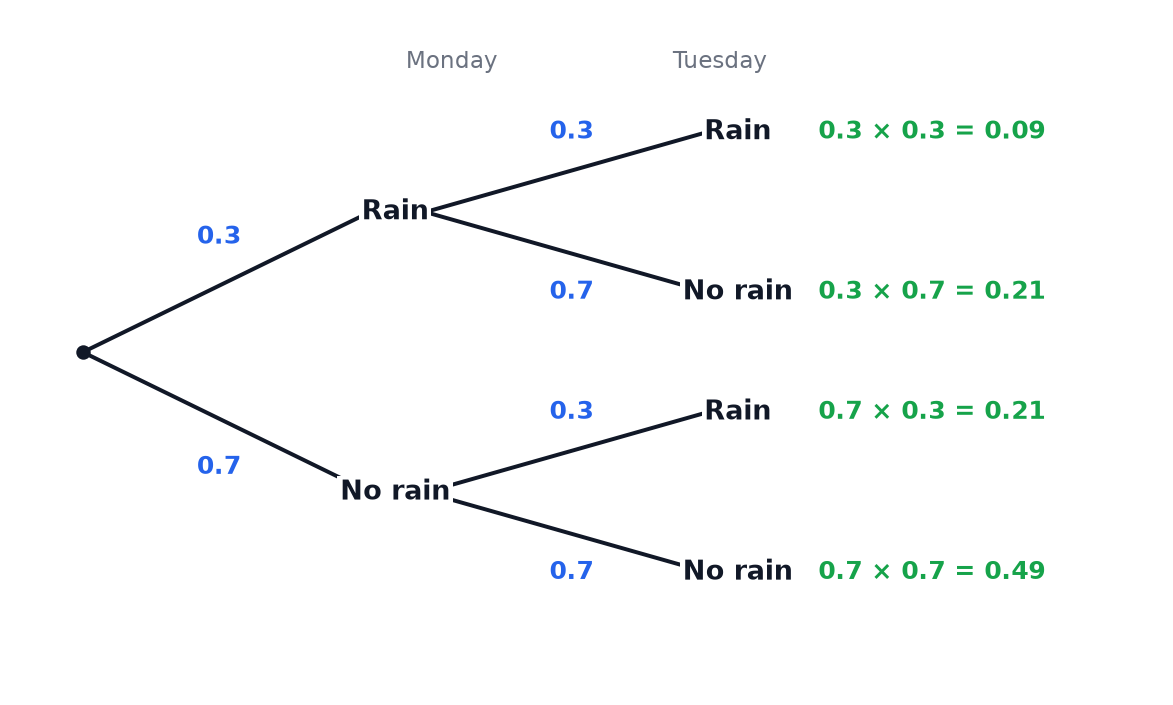
The second set of branches has the same probabilities as the first.
-
The branches from one point add up to 1
\(0.3 + 0.7 = 1\).
-
And means multiply
The probability of rain on both days is \(0.3 \times 0.3 = 0.09\).
-
Or means add
Add the end results that match what the question wants.
A tree diagram for two independent events
The four outcomes at the end cover everything that can happen, so their probabilities add up to 1: \(0.09 + 0.21 + 0.21 + 0.49 = 1\). That is a good check.
Using the tree
- Rain on both days \(0.09\).
- Rain on exactly one day Add the two paths: \(0.21 + 0.21 = 0.42\).
- No rain on either day \(0.49\).
- Rain on at least one day \(1 - 0.49 = 0.51\), which is quicker than adding three paths.
At least one
The probability that it rains on any day is 0.3. Assuming the days are independent, work out the probability that it rains on at least one of two days.
Show the solutionHide the solution
- 1 Find the probability of the opposite The opposite of "at least one" is "none": no rain on both days.
- 2 Multiply \(0.7 \times 0.7 = 0.49\).
- 3 Subtract from 1 \(1 - 0.49 = 0.51\).
- 4 Check with the paths \(0.09 + 0.21 + 0.21 = 0.51\).
Answer0.51
Dependent events
When an item is taken and not replaced, the numbers change for the second pick, so the second probabilities depend on the first.
-
Reduce the total
After one counter is removed, there is one fewer counter in the bag.
-
Reduce the right colour
If the first counter was red, there is one fewer red counter too.
-
Branches still add to 1
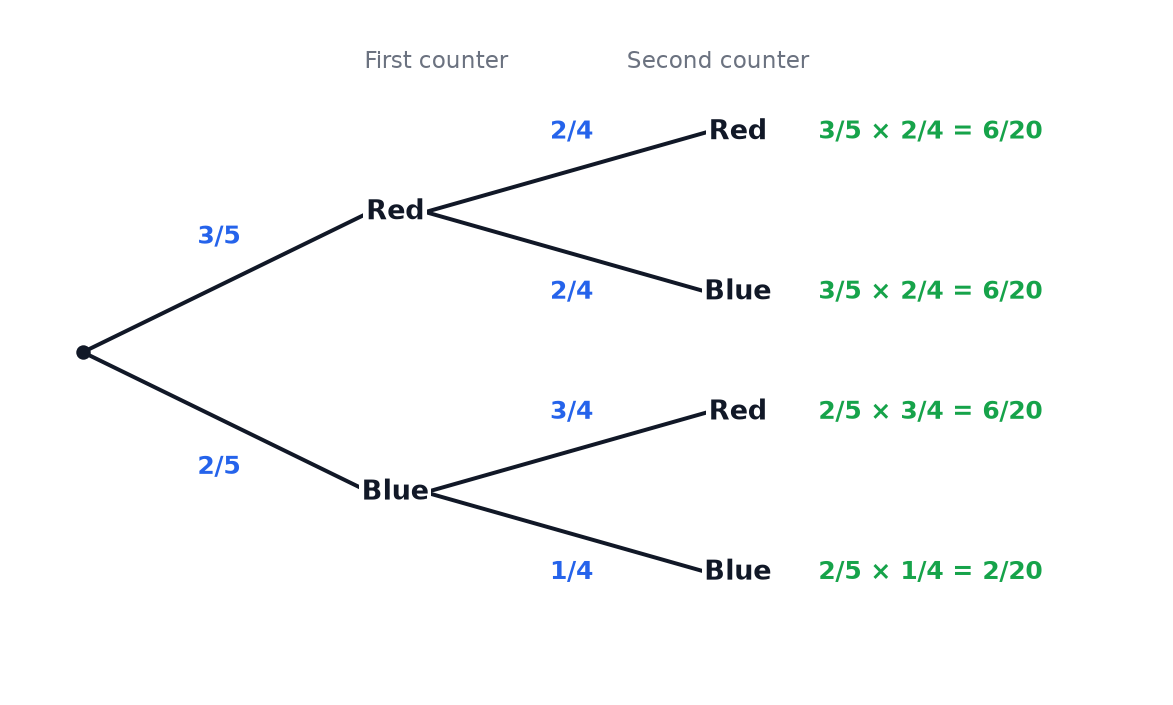
\(\dfrac{2}{4} + \dfrac{2}{4} = 1\).
-
Take care
The second probabilities on each branch are different, not the same as the first.
A tree diagram without replacement
A bag has 3 red and 2 blue counters, and two are taken without replacement. After a red is taken, 4 counters are left, and 2 of them are red. After a blue is taken, 4 counters are left, and 3 of them are red.
Reading the tree
- Two reds \(\dfrac{3}{5} \times \dfrac{2}{4} = \dfrac{6}{20} = \dfrac{3}{10}\).
- Same colour \(\dfrac{6}{20} + \dfrac{2}{20} = \dfrac{8}{20} = \dfrac{2}{5}\).
- Different colours \(\dfrac{6}{20} + \dfrac{6}{20} = \dfrac{12}{20} = \dfrac{3}{5}\).
- With replacement Two reds would be \(\dfrac{3}{5} \times \dfrac{3}{5} = \dfrac{9}{25}\), a different answer.
Without replacement
A bag contains 3 red counters and 2 blue counters. Two counters are taken at random without replacement. Work out the probability that they are different colours.
Show the solutionHide the solution
- 1 Red then blue \(\dfrac{3}{5} \times \dfrac{2}{4} = \dfrac{6}{20}\).
- 2 Blue then red \(\dfrac{2}{5} \times \dfrac{3}{4} = \dfrac{6}{20}\).
- 3 Add the two paths \(\dfrac{6}{20} + \dfrac{6}{20} = \dfrac{12}{20}\).
- 4 Simplify \(\dfrac{3}{5}\).
Answer\(\dfrac{3}{5}\)
Longer trees and finding a missing probability
The same rules work for three events, and for problems where you must find a branch.
-
Three events
Multiply three branches. For three coin tosses, each path has probability \(\dfrac{1}{2} \times \dfrac{1}{2} \times \dfrac{1}{2} = \dfrac{1}{8}\).
-
Missing branch
The probabilities leaving a point add up to 1. If one branch is 0.6, the other is 0.4.
-
Missing number of counters
If \(P(\text{two reds}) = \dfrac{2}{15}\) with 4 red counters in a bag of \(n\), the equation \(\dfrac{4}{n} \times \dfrac{3}{n - 1} = \dfrac{2}{15}\) can be solved (Higher tier).
-
Check the end
The outcome probabilities should add up to 1.
Test yourself
-
1
What do you do along the branches of a tree diagram?
Show answerHide answer
Multiply the probabilities.
-
2
What do you do to combine different paths that give the outcome you want?
Show answerHide answer
Add their probabilities.
-
3
What is \(P(\text{at least one})\)?
Show answerHide answer
\(1 - P(\text{none})\).
-
4
What changes for the second pick when there is no replacement?
Show answerHide answer
The total number, and the number of the colour picked first.
-
5
Two coins are tossed. What is the probability of two heads?
Show answerHide answer
\(\dfrac{1}{2} \times \dfrac{1}{2} = \dfrac{1}{4}\).
Exam technique: tree diagrams
Write on every branch, because the working is where the marks are.
-
Label every branch
Write the outcome and its probability on each.
-
Check the branches
Each pair leaving a point should add to 1.
-
Show the multiplication
Write \(\dfrac{3}{5} \times \dfrac{2}{4}\) before simplifying.
-
Use the opposite
For "at least one", subtracting from 1 is nearly always quicker.
Summary and exam focus
- A tree diagram shows all the outcomes, with probabilities written on the branches.
- Multiply along a path for "and", and add paths for "or".
- Without replacement, the numbers change on the second set of branches.
- \(P(\text{at least one}) = 1 - P(\text{none})\).
Exam focus
A bag contains 4 red counters and 6 blue counters. Two counters are taken at random without replacement. Work out the probability that both counters are blue. (2 marks) (2 marks)
The first counter is blue with probability \(\dfrac{6}{10}\), and then there are 5 blue counters among 9 left, so \(\dfrac{6}{10} \times \dfrac{5}{9} = \dfrac{30}{90} = \dfrac{1}{3}\). Show the two fractions before multiplying.
Key terms
The words this lesson expects you to use. Each one is linked from the first place it appears above.
- Tree diagram
- A diagram with branches that shows the outcomes of events in order and their probabilities.
- Branch
- A line on a tree diagram showing one possible outcome and its probability.
- Independent events
- Events where one does not affect the probability of the other.
- Dependent events
- Events where the first changes the probability of the second.
- Replacement
- Putting an item back before the next pick.
- Without replacement
- Not putting an item back, so the next pick has fewer items.
- At least one
- One or more, found as 1 minus the probability of none.
- Outcome probability
- The probability of one complete path through the tree.
- Product
- The result of multiplying.
Questions and answers
15 questions set on this lesson, with the mark schemes and model answers open.
Tom flips a fair coin twice. Work out the probability that he gets two heads.
Mark scheme — 2 marks available
- \(\dfrac{1}{2} \times \dfrac{1}{2}\) — M1
- \(\dfrac{1}{4}\) — A1
Model answer
\(\dfrac{1}{2} \times \dfrac{1}{2} = \dfrac{1}{4}\).
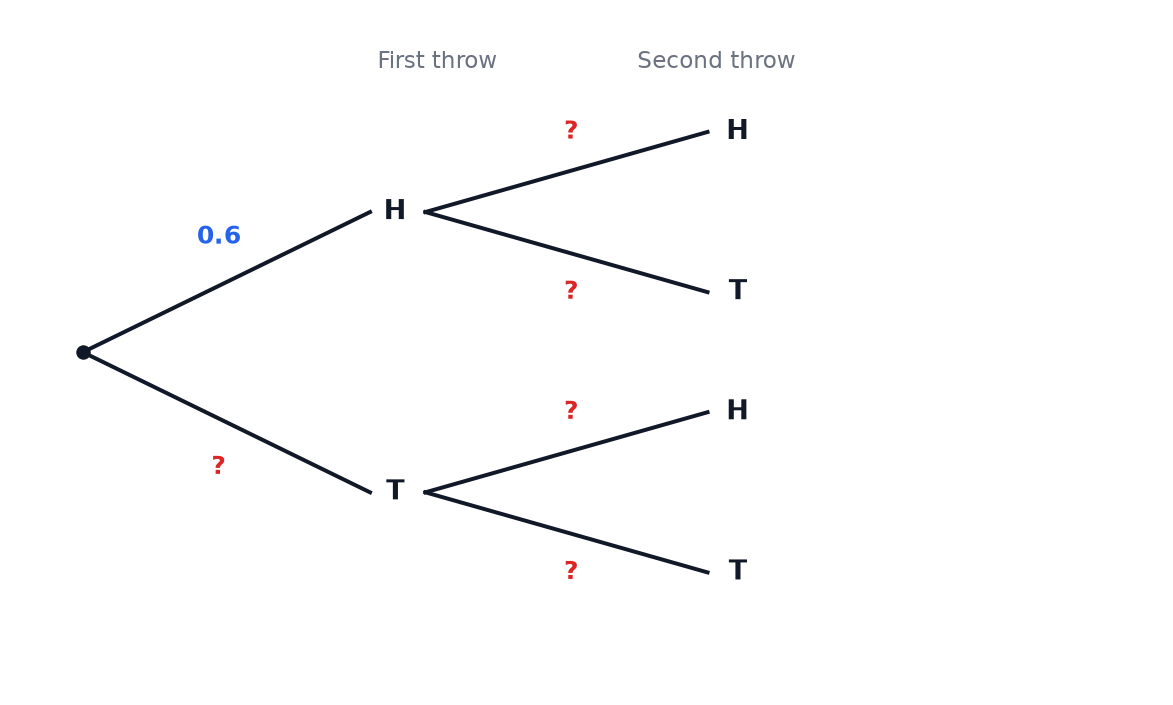
Mina throws a biased coin twice. The probability that it lands on heads is 0.6. The incomplete probability tree diagram shows the first throw and the second throw. (a) Complete the probability tree diagram. (2 marks) (b) Work out the probability that Mina gets one head and one tail. (2 marks)
Mark scheme — 4 marks available
- (a) 0.4 on the first tails branch — B1
- (a) 0.6 and 0.4 on each pair of second-throw branches — B1
- (b) \(0.6 \times 0.4\) and \(0.4 \times 0.6\) added — M1
- (b) \(0.48\) — A1
Model answer
(a) The probability of tails is \(1 - 0.6 = 0.4\). The first-throw tails branch is 0.4, and the second-throw branches are 0.6 for heads and 0.4 for tails on all four. (b) \(0.6 \times 0.4 + 0.4 \times 0.6 = 0.24 + 0.24 = 0.48\).
A bag contains 5 red pens and 3 blue pens. Eve takes two pens at random without replacement. Work out the probability that both pens are red.
Mark scheme — 3 marks available
- \(\dfrac{5}{8}\) and \(\dfrac{4}{7}\) seen — M1
- \(\dfrac{5}{8} \times \dfrac{4}{7}\) — M1
- \(\dfrac{5}{14}\) or \(\dfrac{20}{56}\) — A1
Model answer
\(\dfrac{5}{8} \times \dfrac{4}{7} = \dfrac{20}{56} = \dfrac{5}{14}\).
Sam has a written test and a practical test. The probability that he passes the written test is 0.7. The probability that he passes the practical test is 0.8. The tests are independent. Work out the probability that Sam passes at least one of the tests.
Mark scheme — 3 marks available
- \(0.3\) and \(0.2\) seen — M1
- \(0.3 \times 0.2 = 0.06\) — M1
- \(0.94\) — A1
Model answer
The probability that he fails both is \(0.3 \times 0.2 = 0.06\), so the probability he passes at least one is \(1 - 0.06 = 0.94\).
A fair dice is rolled twice. Work out the probability of getting at least one 6.
Mark scheme — 3 marks available
- \(\dfrac{5}{6} \times \dfrac{5}{6}\) — M1
- \(1 - \dfrac{25}{36}\) — M1
- \(\dfrac{11}{36}\) — A1
Model answer
No sixes in two rolls: \(\dfrac{5}{6} \times \dfrac{5}{6} = \dfrac{25}{36}\). So the probability of at least one 6 is \(1 - \dfrac{25}{36} = \dfrac{11}{36}\).
A bag contains 3 red counters and \(n\) blue counters. Two counters are taken at random without replacement. The probability that both counters are red is \(\dfrac{1}{15}\). (a) Show that \(n^2 + 5n - 84 = 0\). (3 marks) (b) Hence find the value of \(n\). (2 marks)
Mark scheme — 5 marks available
- (a) \(\dfrac{3}{n + 3} \times \dfrac{2}{n + 2}\) — M1
- (a) \(6 \times 15 = (n + 3)(n + 2)\) or equivalent — M1
- (a) \(n^2 + 5n - 84 = 0\) shown — C1
- (b) \((n + 12)(n - 7)\) — M1
- (b) \(n = 7\) — A1
Model answer
(a) There are \(n + 3\) counters, so \(\dfrac{3}{n + 3} \times \dfrac{2}{n + 2} = \dfrac{1}{15}\). Then \((n + 3)(n + 2) = 90\), so \(n^2 + 5n + 6 = 90\) and \(n^2 + 5n - 84 = 0\). (b) \((n + 12)(n - 7) = 0\), so \(n = 7\), because \(n\) cannot be negative.
The probability of rain on any day is 0.3, and days are independent. What is the probability of rain on both of two days?
Why: \(0.3 \times 0.3 = 0.09\).
The probability of rain on any day is 0.3, and days are independent. What is the probability of rain on at least one of two days?
Why: \(1 - 0.7 \times 0.7 = 1 - 0.49 = 0.51\).
Two fair coins are tossed. What is the probability of two heads?
Why: \(\dfrac{1}{2} \times \dfrac{1}{2} = \dfrac{1}{4}\).
A bag has 3 red and 2 blue counters. Two are taken without replacement. What is the probability that both are red?
Why: \(\dfrac{3}{5} \times \dfrac{2}{4} = \dfrac{6}{20} = \dfrac{3}{10}\).
A bag has 3 red and 2 blue counters. Two are taken without replacement. What is the probability that they are different colours?
Why: \(\dfrac{3}{5} \times \dfrac{2}{4} + \dfrac{2}{5} \times \dfrac{3}{4} = \dfrac{12}{20} = \dfrac{3}{5}\).
A bag has 3 red and 2 blue counters. Two are taken without replacement. What is the probability that they are the same colour?
Why: \(\dfrac{6}{20} + \dfrac{2}{20} = \dfrac{8}{20} = \dfrac{2}{5}\).
On a tree diagram, one branch has probability 0.6. What is the other branch from the same point?
Why: The branches from one point add up to 1.
A bag has 4 red and 6 blue counters. Two are taken without replacement. What is the probability that both are blue?
Why: \(\dfrac{6}{10} \times \dfrac{5}{9} = \dfrac{30}{90} = \dfrac{1}{3}\).
A bag has 4 red counters and some blue counters, \(n\) in all. Two are taken without replacement and \(P(\text{two reds}) = \dfrac{2}{15}\). How many counters are in the bag?
Why: \(\dfrac{4}{10} \times \dfrac{3}{9} = \dfrac{12}{90} = \dfrac{2}{15}\), so \(n = 10\).