Maths · Probability
Viewing as
Teacher view: every answer and mark scheme set out in full.
Venn Diagrams and Set Notation
Using sets, Venn diagrams and set notation to organise data and find probabilities.
Learning Objectives
- 1Use set notation: \(\in\), \(\cap\), \(\cup\), the complement \(A'\), and the universal set \(\xi\).
- 2Draw and complete a Venn diagram for two sets from given information.
- 3Use a Venn diagram to work out probabilities.
- 4Describe regions of a Venn diagram using set notation.
Sorting into overlapping groups
Many things belong to more than one group: a student can play football and tennis, or only one, or neither. A Venn diagram shows this with overlapping circles, and it is the best way to keep track of numbers in questions that say "both", "only" and "neither". The usual trap is to forget that a number given for a whole circle includes the overlap, so the key is to start from the middle and work outwards.
Set notation
Sets are collections of items, written inside curly brackets. Learn the symbols, as questions use them without explanation.
-
Universal set \(\xi\)
Everything being considered, drawn as the rectangle round the circles.
-
Element \(\in\)
\(3 \in A\) means 3 is a member of set \(A\).
-
Intersection \(A \cap B\)
The items in both \(A\) and \(B\), the overlap.
-
Union \(A \cup B\)
The items in \(A\) or \(B\) or both, everything inside either circle.
-
Complement \(A'\)
The items not in \(A\), everything outside the circle for \(A\).
Sets of numbers
\(\xi = \{1, 2, 3, \ldots, 10\}\), \(A = \{2, 4, 6, 8, 10\}\) and \(B = \{3, 6, 9\}\). List the members of \(A \cap B\), \(A \cup B\) and \(A'\).
Show the solutionHide the solution
- 1 Intersection Only 6 is in both sets, so \(A \cap B = \{6\}\).
- 2 Union Put every member of either set in once: \(\{2, 3, 4, 6, 8, 9, 10\}\).
- 3 Complement The numbers from 1 to 10 that are not even are \(1, 3, 5, 7, 9\).
- 4 Count check \(n(A \cup B) = 7\), which is \(5 + 3 - 1\), because 6 is counted twice if you just add.
Answer\(A \cap B = \{6\}\), \(A \cup B = \{2, 3, 4, 6, 8, 9, 10\}\), \(A' = \{1, 3, 5, 7, 9\}\)
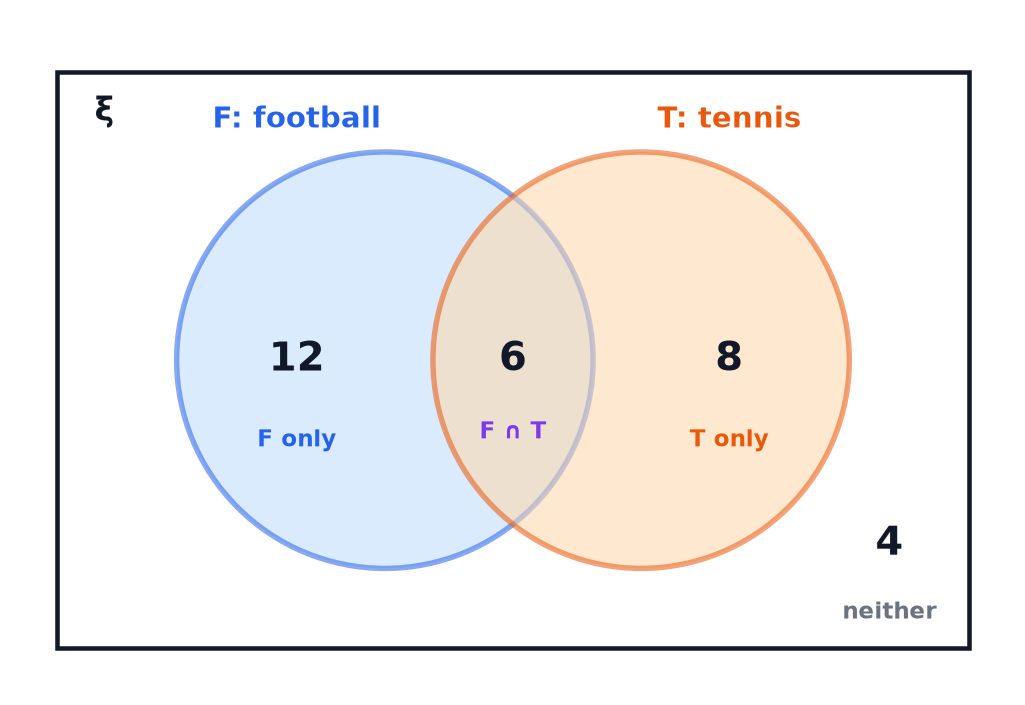
A Venn diagram for two sets
Each region holds the number of students in just that part. The football circle holds \(12 + 6 = 18\) students, and the tennis circle holds \(6 + 8 = 14\). The total is \(12 + 6 + 8 + 4 = 30\).
Reading the Venn diagram
- Football only 12.
- Both \(F \cap T = 6\).
- At least one sport \(F \cup T = 12 + 6 + 8 = 26\).
- Neither \((F \cup T)' = 4\).
Filling in a Venn diagram
Work from the middle outwards, one step at a time.
-
Step 1: the overlap
Start with the number who are in both groups.
-
Step 2: the rest of each circle
Subtract the overlap from each circle's total. If 18 play football and 6 play both, 12 play football only.
-
Step 3: the outside
Subtract everyone inside the circles from the grand total.
-
Step 4: check
All the regions should add up to the total.
A Venn diagram from information
30 students are asked about football (\(F\)) and tennis (\(T\)). 18 play football, 14 play tennis and 6 play both. Work out how many play neither.
Show the solutionHide the solution
- 1 Overlap 6 play both.
- 2 Football only \(18 - 6 = 12\).
- 3 Tennis only \(14 - 6 = 8\).
- 4 Neither \(30 - (12 + 6 + 8) = 30 - 26 = 4\).
Answer4
Probability from a Venn diagram
The numbers in a region are the favourable outcomes, and the total is the number in the whole rectangle.
-
One region
\(P(F \text{ only}) = \dfrac{12}{30} = \dfrac{2}{5}\).
-
A union
\(P(F \cup T) = \dfrac{26}{30} = \dfrac{13}{15}\).
-
A complement
\(P(\text{neither}) = \dfrac{4}{30} = \dfrac{2}{15}\).
-
A student is chosen
The probability that a student chosen at random is in both sets is \(\dfrac{6}{30} = \dfrac{1}{5}\).
Three sets and describing regions (Higher tier)
The same method works with a third circle, and some questions ask for the notation of a shaded region.
-
Three circles
Fill in the middle where all three overlap first, then the regions where two overlap, then the rest.
-
Shaded regions
The region in \(A\) but not \(B\) can be written \(A \cap B'\). Everything except the overlap is \((A \cap B)'\).
-
Addition rule
\(n(A \cup B) = n(A) + n(B) - n(A \cap B)\).
-
Checking
After filling in, each circle's total should match the information in the question.
Test yourself
-
1
What does \(A \cap B\) mean?
Show answerHide answer
The items that are in both \(A\) and \(B\).
-
2
What does \(A \cup B\) mean?
Show answerHide answer
The items that are in \(A\) or \(B\) or both.
-
3
What does \(A'\) mean?
Show answerHide answer
The items that are not in \(A\).
-
4
In a Venn diagram, where do you start filling in numbers?
Show answerHide answer
In the overlap.
-
5
18 play football, 6 of them also play tennis. How many play football only?
Show answerHide answer
\(18 - 6 = 12\).
Exam technique: Venn diagrams
Be careful about totals that include the overlap.
-
Use the middle first
Subtract the overlap from each circle before writing in the single regions.
-
Check the total
Add every region, including the outside.
-
Read the question
"Football" means everyone in the football circle, but "football only" excludes the overlap.
-
Write probabilities as fractions
Use the total of the whole rectangle on the bottom.
Summary and exam focus
- A Venn diagram uses overlapping circles inside a rectangle to show groups and their overlap.
- \(\cap\) means both, \(\cup\) means either or both, and \(A'\) means not in \(A\).
- Fill in the overlap first, then the rest of each circle, then the outside.
- Probabilities from a Venn diagram use the region as the top and the whole rectangle as the bottom.
Exam focus
In a class of 40 students, 22 play football, 19 play tennis and 5 play neither. Work out the number who play both. (3 marks) (3 marks)
The number who play at least one sport is \(40 - 5 = 35\). Adding the circles gives \(22 + 19 = 41\), which counts the overlap twice, so the overlap is \(41 - 35 = 6\). A Venn diagram is a good way to show this.
Key terms
The words this lesson expects you to use. Each one is linked from the first place it appears above.
- Set
- A collection of items, written in curly brackets.
- Universal set
- The set of everything being considered, written \(\xi\).
- Intersection
- The items in both sets, written \(A \cap B\).
- Union
- The items in either set or both, written \(A \cup B\).
- Complement
- The items not in a set, written \(A'\).
- Element
- A member of a set.
- Venn diagram
- A diagram with overlapping circles showing how sets overlap.
- Overlap
- The region where two circles intersect.
- Region
- One of the separate parts of a Venn diagram.
Questions and answers
15 questions set on this lesson, with the mark schemes and model answers open.
\(\xi = \{1, 2, 3, 4, 5, 6, 7, 8, 9, 10\}\). \(A\) is the set of even numbers and \(B = \{2, 3, 5, 7\}\). (a) Write down \(A \cap B\). (1 mark) (b) Write down \(A \cup B\). (1 mark)
Mark scheme — 2 marks available
- (a) \(\{2\}\) — B1
- (b) \(\{2, 3, 4, 5, 6, 7, 8, 10\}\) — B1
Model answer
(a) \(A \cap B = \{2\}\). (b) \(A \cup B = \{2, 3, 4, 5, 6, 7, 8, 10\}\).
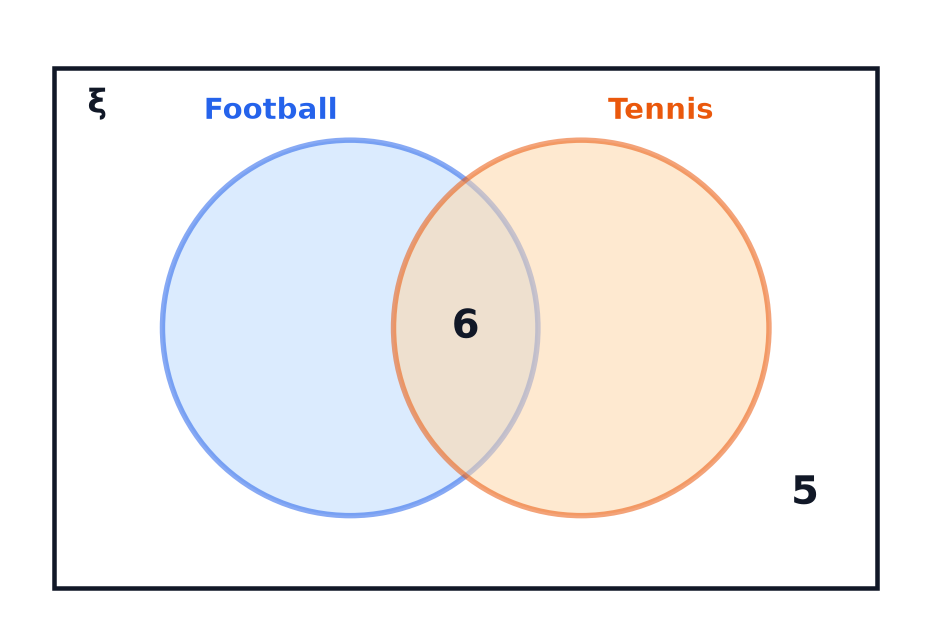
There are 40 students in a class. 22 play football and 19 play tennis. The incomplete Venn diagram shows 6 who play both sports and 5 who play neither. (a) Complete the Venn diagram. (2 marks) (b) A student is chosen at random. Work out the probability that the student plays exactly one of the two sports. (2 marks)
Mark scheme — 4 marks available
- (a) 16 — B1
- (a) 13 — B1
- (b) \(16 + 13 = 29\) seen — M1
- (b) \(\dfrac{29}{40}\) — A1
Model answer
(a) Football only is \(22 - 6 = 16\) and tennis only is \(19 - 6 = 13\). Check: \(16 + 6 + 13 + 5 = 40\). (b) \(\dfrac{16 + 13}{40} = \dfrac{29}{40}\).
\(\xi = \{1, 2, 3, \ldots, 12\}\). \(A\) is the set of multiples of 3 and \(B\) is the set of factors of 12. (a) List the members of \(A \cap B\). (1 mark) (b) Work out \(n((A \cup B)')\). (2 marks)
Mark scheme — 3 marks available
- (a) \(\{3, 6, 12\}\) — B1
- (b) Lists or counts 7 members of \(A \cup B\) — M1
- (b) 5 — A1
Model answer
(a) \(A = \{3, 6, 9, 12\}\) and \(B = \{1, 2, 3, 4, 6, 12\}\), so \(A \cap B = \{3, 6, 12\}\). (b) \(A \cup B = \{1, 2, 3, 4, 6, 9, 12\}\), which has 7 members, so \(n((A \cup B)') = 12 - 7 = 5\).
In a group of 50 people, 30 like tea and 25 like coffee. 8 people like neither drink. Work out the number of people who like both tea and coffee.
Mark scheme — 3 marks available
- \(50 - 8 = 42\) — M1
- \(30 + 25 - 42\) — M1
- 13 — A1
Model answer
The number who like at least one drink is \(50 - 8 = 42\). Then \(30 + 25 - 42 = 13\) like both.
In a Venn diagram of 52 people, the number in set \(A\) only is \(2x\), the number in both sets is \(x\), the number in set \(B\) only is \(x + 4\), and 8 people are in neither set. (a) Work out the value of \(x\). (2 marks) (b) A person is chosen at random. Work out the probability that the person is in set \(A\). Give your answer in its simplest form. (2 marks)
Mark scheme — 4 marks available
- (a) \(4x + 12 = 52\) — M1
- (a) \(x = 10\) — A1
- (b) \(\dfrac{30}{52}\) — M1
- (b) \(\dfrac{15}{26}\) — A1
Model answer
(a) \(2x + x + x + 4 + 8 = 52\), so \(4x + 12 = 52\) and \(x = 10\). (b) Set \(A\) has \(2x + x = 30\) people, so the probability is \(\dfrac{30}{52} = \dfrac{15}{26}\).
There are 30 students in a class. 18 study French and 12 study Spanish. 5 study both. A student is chosen at random. Work out the probability that the student studies neither French nor Spanish.
Mark scheme — 3 marks available
- \(18 + 12 - 5 = 25\) — M1
- 5 students study neither — A1
- \(\dfrac{1}{6}\) — A1
Model answer
At least one language: \(18 + 12 - 5 = 25\). Neither: \(30 - 25 = 5\). The probability is \(\dfrac{5}{30} = \dfrac{1}{6}\).
What does \(A \cap B\) mean?
Why: \(\cap\) is the intersection, the overlap.
What does \(A \cup B\) mean?
Why: \(\cup\) is the union, everything in either circle.
What does \(A'\) mean?
Why: \(A'\) is the complement of \(A\).
\(A = \{2, 4, 6, 8, 10\}\) and \(B = \{3, 6, 9\}\). What is \(A \cap B\)?
Why: Only 6 is in both sets.
18 students play football and 6 of them also play tennis. How many play football only?
Why: \(18 - 6 = 12\).
30 students: 18 play football, 14 play tennis and 6 play both. How many play neither?
Why: \(12 + 6 + 8 = 26\) play at least one, so \(30 - 26 = 4\).
In the same survey, what is the probability that a student chosen at random plays football only?
Why: \(\dfrac{12}{30} = \dfrac{2}{5}\). The fraction \(\dfrac{18}{30}\) would include those who play both.
In a class of 40, 22 play football, 19 play tennis and 5 play neither. How many play both?
Why: \(40 - 5 = 35\) play at least one, and \(22 + 19 - 35 = 6\).
\(n(A) = 15\), \(n(B) = 12\) and \(n(A \cap B) = 5\). What is \(n(A \cup B)\)?
Why: \(15 + 12 - 5 = 22\).