Maths · Standard Form and Accuracy
Viewing as
Teacher view: every answer and mark scheme set out in full.
Error Intervals and Bounds
Writing error intervals for rounded and truncated numbers, and finding upper and lower bounds of calculations.
Learning Objectives
- 1Write an error interval for a number that has been rounded or truncated.
- 2Use inequality notation with the correct signs.
- 3Find the upper and lower bounds of a rounded measurement.
- 4Calculate the bounds of a sum, difference, product or quotient (Higher tier).
How wrong could it be
A rounded number is not exact, so the true value could be a little more or a little less. An error interval shows every value that would round to the given number, and it is written with inequality signs. The lower end is included and the upper end is not, because a value that is exactly halfway rounds up. Error intervals are Foundation content. Working out the bounds of a calculation, for example the biggest possible area of a rectangle, is Higher tier content on every board, and it needs a careful choice of upper or lower bounds for each number.
Error intervals
An error interval is written as \(\text{lower bound} \leq x < \text{upper bound}\).
-
Rounded to the nearest whole number
12 cm means \(11.5 \leq L < 12.5\).
-
Rounded to 1 decimal place
3.7 means \(3.65 \leq x < 3.75\).
-
Half the unit
The bounds are half a unit of the rounding below and above the number.
-
Truncated
A number truncated to a whole number, such as 5, means \(5 \leq n < 6\), since digits are cut off, not rounded.
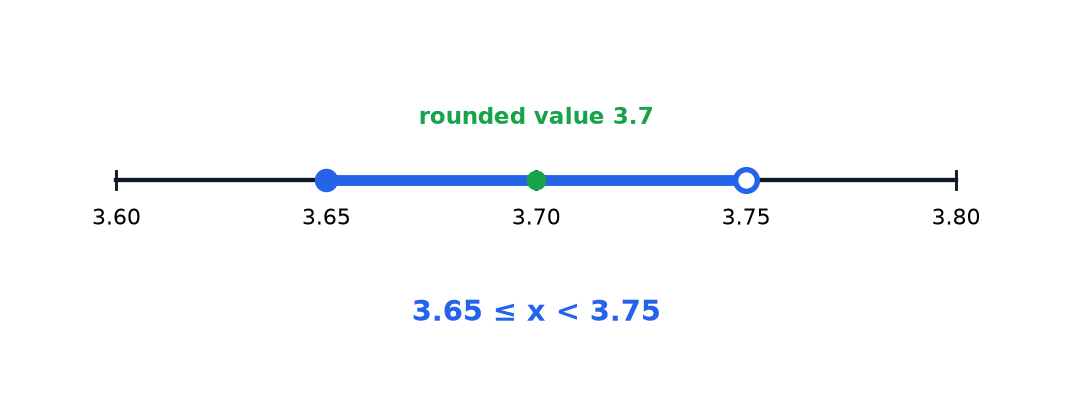
An error interval on a number line
Any value from \(3.65\) up to but not including \(3.75\) rounds to \(3.7\) to 1 decimal place. The closed dot at \(3.65\) shows that it is included, because \(3.65\) rounds up to \(3.7\), and the open circle at \(3.75\) shows that it is not, because \(3.75\) rounds up to \(3.8\).
Writing the interval
- Half a unit The unit of rounding is 0.1, so half of it is 0.05.
- Subtract and add \(3.7 - 0.05 = 3.65\) and \(3.7 + 0.05 = 3.75\).
- The signs The lower bound has \(\leq\), and the upper bound has \(<\).
- Check Both ends should round to the right number or the one beyond it.
Writing an error interval
The mass of a parcel is 4.8 kg, rounded to 1 decimal place. Write down the error interval for the mass \(m\).
Show the solutionHide the solution
- 1 Unit of rounding 0.1 kg, so half is 0.05 kg.
- 2 Lower bound \(4.8 - 0.05 = 4.75\).
- 3 Upper bound \(4.8 + 0.05 = 4.85\).
- 4 Write it \(4.75 \leq m < 4.85\).
Answer\(4.75 \leq m < 4.85\)
Bounds of a calculation (Higher tier)
To get the biggest or smallest possible answer, choose the bound of each number that pushes the answer the right way.
-
Sum
The upper bound of \(a + b\) uses the upper bounds of \(a\) and \(b\).
-
Difference
The upper bound of \(a - b\) uses the upper bound of \(a\) and the lower bound of \(b\).
-
Product
The upper bound of \(a \times b\) uses both upper bounds.
-
Quotient
The upper bound of \(a \div b\) uses the upper bound of \(a\) and the lower bound of \(b\).
Bounds of an area (Higher tier)
A rectangle has a length of 8 cm and a width of 5 cm, each measured to the nearest centimetre. Work out the upper bound and the lower bound of the area.
Show the solutionHide the solution
- 1 Bounds for the length \(7.5 \leq l < 8.5\).
- 2 Bounds for the width \(4.5 \leq w < 5.5\).
- 3 Upper bound \(8.5 \times 5.5 = 46.75\).
- 4 Lower bound \(7.5 \times 4.5 = 33.75\).
AnswerUpper bound 46.75 cm\(^2\), lower bound 33.75 cm\(^2\)
Test yourself
-
1
What is the error interval for 12 cm, rounded to the nearest cm?
Show answerHide answer
\(11.5 \leq L < 12.5\).
-
2
Which end of an error interval uses the less than or equal to sign?
Show answerHide answer
The lower end.
-
3
What is the error interval for 5, truncated to a whole number?
Show answerHide answer
\(5 \leq n < 6\).
-
4
Which bounds give the upper bound of \(a - b\)?
Show answerHide answer
Upper bound of \(a\) and lower bound of \(b\) (Higher tier).
-
5
What is half of 0.1?
Show answerHide answer
0.05.
Exam technique: accuracy
Think about which direction each number pushes the answer.
-
Write both bounds for each number
Then pick the right one.
-
Use the correct signs
\(\leq\) at the bottom and \(<\) at the top.
-
Do not just round
The upper bound is not 8.5 rounded.
-
Say which kind of rounding
Truncation uses the unit, not half.
Summary and exam focus
- An error interval is \(\text{lower} \leq x < \text{upper}\), found by going half a unit down and up.
- Truncation cuts digits off, so the interval is one whole unit.
- For the upper bound of a sum or product, use the upper bounds of the numbers.
- For a difference or quotient, use the upper bound of the first number and the lower bound of the second (Higher tier).
Exam focus
\(x = 3.7\) correct to 1 decimal place. Write down the error interval for \(x\). (2 marks) (2 marks)
Half of 0.1 is 0.05, so \(3.65 \leq x < 3.75\). Both signs matter for the second mark: the lower end has \(\leq\) and the upper end has \(<\).
Key terms
The words this lesson expects you to use. Each one is linked from the first place it appears above.
- Error interval
- The range of values that round to a given number.
- Lower bound
- The smallest value in an error interval.
- Upper bound
- The value that the interval goes up to but does not include.
- Truncation
- Cutting off digits without rounding.
- Limit of accuracy
- The bounds of a measurement or rounded number.
- Inequality
- A statement using signs such as \(<\) and \(\leq\).
- Rounding
- Replacing a number with a simpler one that is close to it.
- Half a unit
- Half the size of the rounding unit.
- Measurement
- A quantity found by measuring, which is never exact.
Questions and answers
15 questions set on this lesson, with the mark schemes and model answers open.
The length of a pencil is 12 cm, correct to the nearest centimetre. Write down the error interval for the length \(L\).
Mark scheme — 2 marks available
- 11.5 and 12.5 seen — M1
- \(11.5 \leq L < 12.5\) — A1
Model answer
Half a centimetre below and above 12: \(11.5 \leq L < 12.5\).
\(x = 3.7\) correct to 1 decimal place. Write down the error interval for \(x\).
Mark scheme — 2 marks available
- 3.65 and 3.75 seen — M1
- \(3.65 \leq x < 3.75\) — A1
Model answer
Half of 0.1 is 0.05, so \(3.65 \leq x < 3.75\).
The number \(n\) is 5 after it has been truncated to a whole number. Write down the error interval for \(n\).
Mark scheme — 2 marks available
- 5 and 6 seen — M1
- \(5 \leq n < 6\) — A1
Model answer
Truncating cuts off the digits, so \(n\) was at least 5 and less than 6: \(5 \leq n < 6\).
\(a = 6.4\) and \(b = 2.5\), each correct to 1 decimal place. Work out the upper bound of \(a + b\).
Mark scheme — 3 marks available
- 6.45 or 2.55 seen — M1
- \(6.45 + 2.55\) — M1
- 9 — A1
Model answer
The upper bounds are \(6.45\) and \(2.55\), so the upper bound of the sum is \(6.45 + 2.55 = 9\).
A rectangle has a length of 8 cm and a width of 5 cm, each correct to the nearest centimetre. Work out the upper bound of the area of the rectangle.
Mark scheme — 3 marks available
- 8.5 or 5.5 seen — M1
- \(8.5 \times 5.5\) — M1
- 46.75 cm\(^2\) — A1
Model answer
The upper bounds are 8.5 cm and 5.5 cm, so the upper bound of the area is \(8.5 \times 5.5 = 46.75\) cm\(^2\).
\(a = 6.4\) and \(b = 2.5\), each correct to 1 decimal place. Work out the lower bound of \(a - b\).
Mark scheme — 3 marks available
- 6.35 or 2.55 seen — M1
- \(6.35 - 2.55\) — M1
- 3.8 — A1
Model answer
For the smallest difference, use the lower bound of \(a\) and the upper bound of \(b\): \(6.35 - 2.55 = 3.8\).
A length is 12 cm to the nearest cm. What is the error interval?
Why: Half a unit below and above 12, with the lower end included.
\(x = 3.7\) correct to 1 decimal place. What is the error interval?
Why: Half of 0.1 is 0.05, so go from 3.65 up to 3.75.
\(n = 5\) after being truncated to a whole number. What is the error interval?
Why: Truncating cuts off the digits, so the number was at least 5 and less than 6.
\(x = 40\) to the nearest 10. What is the error interval?
Why: Half of 10 is 5.
Why is the upper bound of an error interval not included?
Why: A value exactly half way rounds up, so it belongs to the next number.
\(x = 0.4\) correct to 1 significant figure. What is the error interval?
Why: The unit is 0.1, so half is 0.05.
What is the upper bound of \(a + b\)?
Why: The biggest total comes from the biggest values.
What is the upper bound of \(a - b\)?
Why: To make the difference big, take the biggest \(a\) and subtract the smallest \(b\).
A rectangle is 8 cm by 5 cm, each to the nearest cm. What is the upper bound of its area?
Why: \(8.5 \times 5.5 = 46.75\).