Maths · Standard Form and Accuracy
Viewing as
Teacher view: every answer and mark scheme set out in full.
Rounding and Estimating
Rounding to decimal places and significant figures, estimating calculations, and spotting over- and underestimates.
Learning Objectives
- 1Round numbers to a given number of decimal places and significant figures.
- 2Round to the nearest 10, 100 or 1000, and understand the effect of zeros.
- 3Estimate calculations by rounding each number to one significant figure.
- 4Say whether an estimate is an overestimate or an underestimate.
Being roughly right
Rounding makes a number simpler by keeping only the digits that matter, and an estimate uses rounded numbers to get an answer that is quick to work out and close to the truth. On the non-calculator paper an estimate is often the first part of a question, and the second part asks you to compare it with the exact value. The key idea is to round each number to one significant figure so that the arithmetic is easy, and to show each rounded value so that the examiner can see the method.
Decimal places and significant figures
Decimal places count after the decimal point, and significant figures count from the first non-zero digit.
-
Decimal places
\(4.678\) to 1 decimal place is \(4.7\), because the next digit, 7, is 5 or more.
-
Significant figures
\(0.004567\) to 2 significant figures is \(0.0046\), because the first significant figure is the 4.
-
The rule
Look at the next digit. If it is 5 or more, round up. If it is 4 or less, round down.
-
Keep the zeros
Large numbers keep their place value: \(6482\) to 2 significant figures is \(6500\).
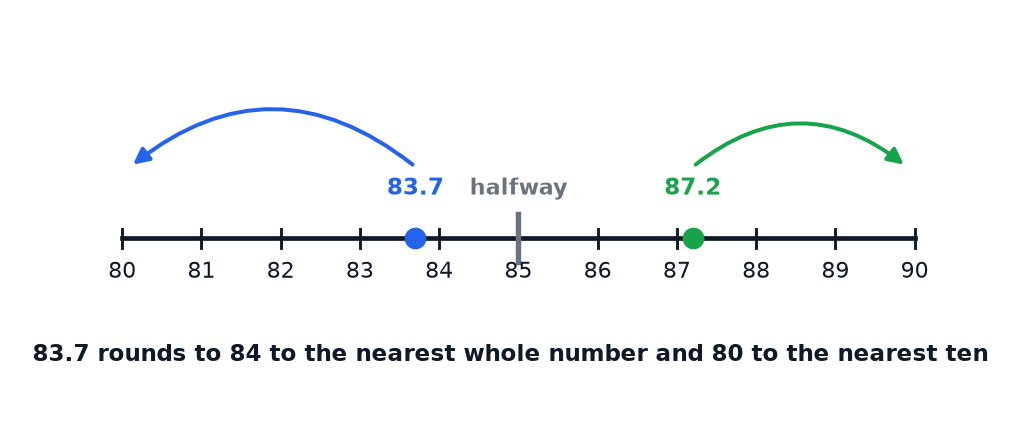
Rounding on a number line
A number halfway or more between two multiples rounds up, and a number less than halfway rounds down. The number \(83.7\) is less than halfway between 80 and 90, so it rounds to 80 to the nearest ten.
Rounding rules
- Find the digit Underline the digit you are rounding to.
- Look next door The next digit decides whether to round up or down.
- Fill with zeros Large numbers need zeros to hold the place value.
- Say the accuracy Write "to 2 s.f." or "to 1 d.p." with the answer.
Rounding to significant figures
Write (a) \(0.004567\) to 2 significant figures, and (b) \(6482\) to 2 significant figures.
Show the solutionHide the solution
- 1 Part (a) first significant figure The first non-zero digit is 4, the second is 5.
- 2 Part (a) next digit The next digit is 6, so round the 5 up to 6, giving \(0.0046\).
- 3 Part (b) first two figures 6 and 4. The next digit is 8, so round the 4 up to 5.
- 4 Part (b) keep the place value \(6500\), with two zeros to hold the place.
Answer(a) \(0.0046\) (b) \(6500\)
Estimating
Round every number to 1 significant figure, then work out the easy calculation.
-
Round
\(4.97 \to 5\), \(20.1 \to 20\), \(0.49 \to 0.5\).
-
Calculate
\(\dfrac{4.97 \times 20.1}{0.49} \approx \dfrac{5 \times 20}{0.5} = 200\).
-
Show the steps
Write the rounded numbers, not just the answer.
-
Use the symbol
\(\approx\) means "is approximately equal to".
A fraction estimate
Estimate the value of \(\dfrac{39.8 \times 5.1}{0.21}\).
Show the solutionHide the solution
- 1 Round each number \(39.8 \approx 40\), \(5.1 \approx 5\) and \(0.21 \approx 0.2\).
- 2 Write the calculation \(\dfrac{40 \times 5}{0.2}\).
- 3 Work out the top \(40 \times 5 = 200\).
- 4 Divide \(200 \div 0.2 = 1000\).
Answer1000
Over- and underestimates
Decide the effect of each rounding on the answer.
-
Rounding up the top
A bigger number on top of a fraction makes the answer bigger.
-
Rounding up the bottom
A bigger number on the bottom makes the answer smaller.
-
Say which way
"Both numbers on the top were rounded up, so the estimate is bigger than the true value."
-
Be careful
Check whether each number is on the top or the bottom.
Test yourself
-
1
What is 4.678 to 1 decimal place?
Show answerHide answer
4.7.
-
2
What is 6482 to 2 significant figures?
Show answerHide answer
6500.
-
3
What do you round each number to when estimating?
Show answerHide answer
1 significant figure.
-
4
What does \(\approx\) mean?
Show answerHide answer
Approximately equal to.
-
5
Rounding the bottom of a fraction up has what effect on the answer?
Show answerHide answer
It makes the answer smaller.
Exam technique: rounding and estimating
Show each rounded number.
-
Write the rounded values
They earn the method mark.
-
Keep the working simple
Choose numbers that are easy to calculate with.
-
Count significant figures from the first non-zero digit
Zeros at the start do not count.
-
Say the direction of the error
Give a reason using which numbers were rounded up or down.
Summary and exam focus
- To round, look at the next digit: 5 or more rounds up, and 4 or less rounds down.
- Significant figures are counted from the first non-zero digit.
- To estimate, round every number to 1 significant figure and calculate.
- Rounding up the bottom of a fraction makes the answer smaller.
Exam focus
Work out an estimate for \(\dfrac{8.2 \times 29.6}{0.52}\). (3 marks) (3 marks)
Round to 1 s.f.: \(\dfrac{8 \times 30}{0.5} = \dfrac{240}{0.5} = 480\). Write the rounded numbers first. A mark is given for each of the three roundings used correctly, and one for the final answer.
Key terms
The words this lesson expects you to use. Each one is linked from the first place it appears above.
- Rounding
- Replacing a number with a simpler one that is close to it.
- Decimal place
- A position after the decimal point.
- Significant figure
- A digit that counts, starting from the first non-zero digit.
- Estimate
- An approximate answer found by rounding.
- Approximately equal
- Nearly equal, shown by the symbol \(\approx\).
- Overestimate
- An estimate that is bigger than the true value.
- Underestimate
- An estimate that is smaller than the true value.
- Nearest
- The closest value of a given type, such as the nearest 10.
- Place value
- The value of a digit because of its position.
Questions and answers
15 questions set on this lesson, with the mark schemes and model answers open.
(a) Write 4.678 correct to 1 decimal place. (1 mark) (b) Write 4.678 correct to the nearest whole number. (1 mark)
Mark scheme — 2 marks available
- (a) 4.7 — B1
- (b) 5 — B1
Model answer
(a) The next digit is 7, so \(4.7\). (b) The next digit is 6, so 5.
Write 0.004567 correct to 2 significant figures.
Mark scheme — 2 marks available
- 0.004 or 0.005 seen, or a correct method — M1
- 0.0046 — A1
Model answer
The first significant figure is 4, the second is 5, and the next digit 6 rounds the 5 up. The answer is 0.0046.
Work out an estimate for \(\dfrac{4.97 \times 20.1}{0.49}\).
Mark scheme — 3 marks available
- At least two numbers rounded to 1 s.f., such as 5 and 20 — M1
- \(\dfrac{5 \times 20}{0.5}\) — M1
- 200 — A1
Model answer
Round each number to 1 significant figure: \(\dfrac{5 \times 20}{0.5} = \dfrac{100}{0.5} = 200\).
Work out an estimate for \(\dfrac{39.8 \times 5.1}{0.21}\).
Mark scheme — 3 marks available
- Rounds to 40, 5 and 0.2 — M1
- \(\dfrac{40 \times 5}{0.2}\) — M1
- 1000 — A1
Model answer
\(\dfrac{40 \times 5}{0.2} = \dfrac{200}{0.2} = 1000\).
Write 6482 (a) correct to 2 significant figures, (b) correct to the nearest hundred.
Mark scheme — 2 marks available
- (a) 6500 — B1
- (b) 6500 — B1
Model answer
(a) The first two figures are 6 and 4, and the next digit 8 rounds the 4 up: 6500. (b) The hundreds digit is 4, and the next digit 8 rounds it up: 6500.
(a) Work out an estimate for \(\dfrac{4.9 \times 9.8}{0.52}\). (2 marks) (b) Is your estimate bigger or smaller than the exact value? Give a reason. (1 mark)
Mark scheme — 3 marks available
- (a) \(\dfrac{5 \times 10}{0.5}\) — M1
- (a) 100 — A1
- (b) Bigger, with a reason about the rounding — C1
Model answer
(a) \(\dfrac{5 \times 10}{0.5} = 100\). (b) Both numbers on the top were rounded up, and the bottom was rounded down, which makes the fraction bigger. So the estimate is bigger than the exact value.
What is 4.678 to 1 decimal place?
Why: The next digit is 7, so round up.
What is 6482 to 2 significant figures?
Why: The first two figures are 6 and 4, and the next digit 8 rounds the 4 up to 5, with zeros to hold the place.
What is 0.004567 to 2 significant figures?
Why: The first significant figure is the 4, and the next digit 6 rounds the 5 up.
What is 83.7 to the nearest 10?
Why: 83.7 is closer to 80 than to 90.
What is the best estimate for \(\dfrac{4.97 \times 20.1}{0.49}\)?
Why: \(\dfrac{5 \times 20}{0.5} = \dfrac{100}{0.5} = 200\).
To estimate a calculation, to how many significant figures do you round each number?
Why: One significant figure keeps the arithmetic easy.
The bottom of a fraction is rounded up. What happens to the estimate?
Why: A bigger number on the bottom makes the fraction smaller.
What is the best estimate for \(\dfrac{39.8 \times 5.1}{0.21}\)?
Why: \(\dfrac{40 \times 5}{0.2} = \dfrac{200}{0.2} = 1000\).
What is 0.0305 to 2 significant figures?
Why: The significant figures are 3 and 0. The next digit is 5, so round the 0 up to 1.