Maths · Functions, Sequences and Rates of Change
Viewing as
Teaching this? The teacher view opens every answer and mark scheme.
Functions and Function Notation
Using f(x) notation, composite functions such as fg(x), and inverse functions.
Learning Objectives
- 1Use function notation, such as \(f(x) = 3x - 5\), to evaluate a function and to solve \(f(x) = k\).
- 2Write and evaluate composite functions such as \(fg(x)\) and \(gf(x)\), in the correct order.
- 3Find the inverse function \(f^{-1}(x)\) of a function.
- 4Use functions in problems, including equations that involve two functions.
Functions as machines
A function is a rule that turns each input into exactly one output. Function notation writes this rule as \(f(x)\), read as "f of x". The brackets do not mean multiply: \(f(4)\) means the output when the input is 4. Functions are a Higher tier topic on every board. A function machine is a good way to picture one, and the same ideas of composite and inverse functions follow from joining machines together or running them backwards.
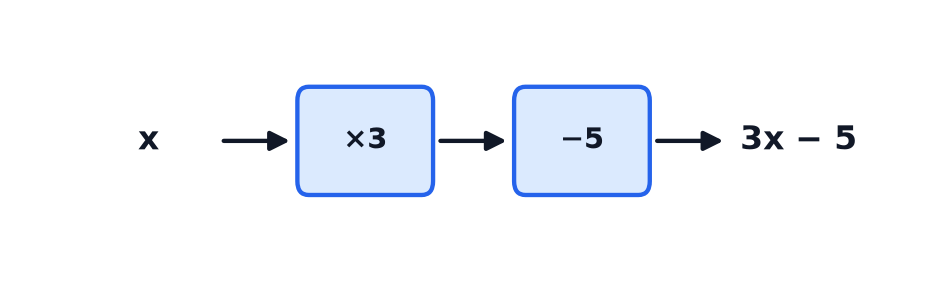
A function machine
The machine multiplies the input by 3 and then subtracts 5, so \(f(x) = 3x - 5\). If the input is 4, the output is \(f(4) = 3 \times 4 - 5 = 7\).
Using function notation
- \(f(x)\) The output when the input is \(x\).
- \(f(4)\) Replace \(x\) by 4 everywhere, so \(f(4) = 3 \times 4 - 5 = 7\).
- \(f(x) = 16\) Solve \(3x - 5 = 16\), so \(x = 7\).
- \(f(a + 1)\) Replace \(x\) by \(a + 1\), so \(f(a + 1) = 3(a + 1) - 5 = 3a - 2\).
Evaluating and solving
\(f(x) = 2x^2 - 3\). Work out \(f(-2)\), and find the values of \(x\) for which \(f(x) = 5\).
Show the solutionHide the solution
- 1 Substitute \(f(-2) = 2 \times (-2)^2 - 3\).
- 2 Square first \((-2)^2 = 4\), so \(f(-2) = 8 - 3 = 5\).
- 3 Set up an equation \(2x^2 - 3 = 5\), so \(2x^2 = 8\) and \(x^2 = 4\).
- 4 Both roots \(x = 2\) or \(x = -2\).
Answer\(f(-2) = 5\), and \(x = 2\) or \(x = -2\)
Composite functions
A composite function is one function applied after another.
-
Notation
\(fg(x)\) means \(f(g(x))\): do \(g\) first, then \(f\).
-
The order
The function nearest to \(x\) is applied first, so \(fg(x)\) and \(gf(x)\) are usually different.
-
Method
Replace the \(x\) in \(f\) by the whole of \(g(x)\), and then simplify.
-
Numbers
For \(fg(3)\), work out \(g(3)\) first, then put the answer into \(f\).
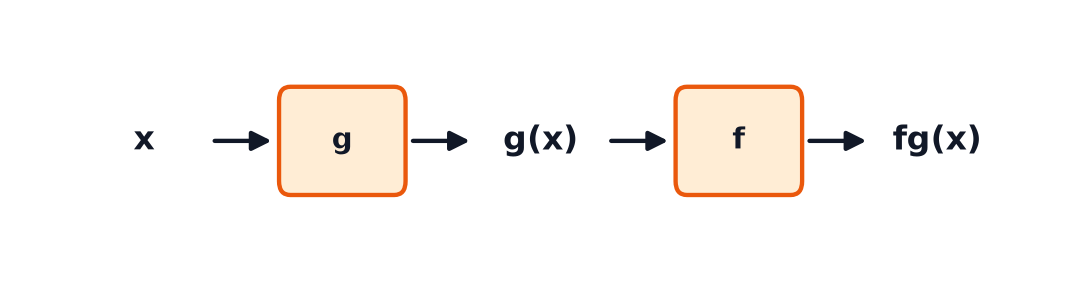
A composite function
The input \(x\) goes through \(g\) first, giving \(g(x)\). That output then goes through \(f\). The result is \(fg(x)\), so you work from right to left in the name.
Reading the name
- \(fg(x)\) \(g\) is applied first.
- \(gf(x)\) \(f\) is applied first.
- \(ff(x)\) The function is applied twice.
- Check Try a number, such as \(x = 1\), in both the original and the simplified form.
A composite function
\(f(x) = 2x - 1\) and \(g(x) = x^2\). Work out \(fg(3)\) and find \(gf(x)\), giving your answer in the form \(ax^2 + bx + c\).
Show the solutionHide the solution
- 1 Do g first \(g(3) = 3^2 = 9\).
- 2 Then f \(fg(3) = f(9) = 2 \times 9 - 1 = 17\).
- 3 For gf(x) Do \(f\) first: \(f(x) = 2x - 1\).
- 4 Then g \(gf(x) = (2x - 1)^2 = 4x^2 - 4x + 1\).
Answer\(fg(3) = 17\) and \(gf(x) = 4x^2 - 4x + 1\)
Inverse functions
An inverse function reverses a function, and takes the output back to the input.
-
Notation
\(f^{-1}(x)\) is the inverse of \(f(x)\). The \(-1\) is not a power.
-
Finding it
Write \(y = f(x)\), make \(x\) the subject, and then swap \(y\) back to \(x\).
-
Check
\(f(f^{-1}(x)) = x\) and \(f^{-1}(f(x)) = x\).
-
Machines
Reverse the order of the operations and use the opposite operation of each.
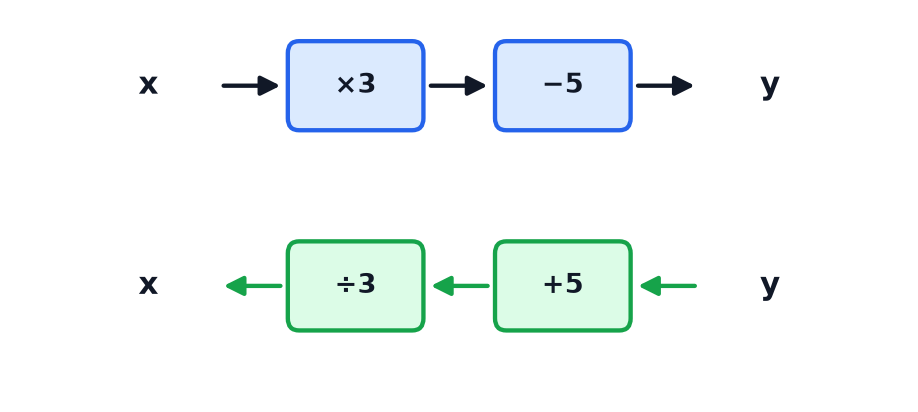
An inverse function
The inverse machine undoes each step in the reverse order. The forward machine multiplies by 3 and then subtracts 5. The inverse adds 5 first and then divides by 3.
Finding the inverse
- Forward \(y = 3x - 5\).
- Make x the subject \(y + 5 = 3x\), so \(x = \dfrac{y + 5}{3}\).
- Swap the letters \(f^{-1}(x) = \dfrac{x + 5}{3}\).
- Check \(f^{-1}(7) = \dfrac{12}{3} = 4\), which agrees with \(f(4) = 7\).
An inverse function
\(f(x) = \dfrac{x + 4}{3}\). Find \(f^{-1}(x)\), and solve \(f^{-1}(x) = f(x)\).
Show the solutionHide the solution
- 1 Write y \(y = \dfrac{x + 4}{3}\).
- 2 Rearrange \(3y = x + 4\), so \(x = 3y - 4\).
- 3 Swap \(f^{-1}(x) = 3x - 4\).
- 4 Solve \(3x - 4 = \dfrac{x + 4}{3}\), so \(9x - 12 = x + 4\), \(8x = 16\) and \(x = 2\).
Answer\(f^{-1}(x) = 3x - 4\) and \(x = 2\)
Test yourself
-
1
What does \(fg(x)\) mean?
Show answerHide answer
\(f(g(x))\): do \(g\) first, then \(f\).
-
2
What does \(f^{-1}(x)\) do?
Show answerHide answer
It reverses \(f\), taking an output back to the input.
-
3
How do you find an inverse function?
Show answerHide answer
Write \(y = f(x)\), make \(x\) the subject, then swap \(y\) for \(x\).
-
4
Are \(fg(x)\) and \(gf(x)\) usually equal?
Show answerHide answer
No, the order changes the answer.
-
5
What is \(f(f^{-1}(x))\)?
Show answerHide answer
\(x\).
Exam technique: functions
Most errors are about order, so slow down at that point.
-
Write the order
Underline which function goes first before substituting.
-
Brackets
Put the whole of the inner function in brackets when you substitute, such as \((2x - 1)^2\).
-
Inverse
Always check by trying a number.
-
Two functions
An equation such as \(fg(x) = gf(x)\) needs both sides worked out and then solved.
Summary and exam focus
- \(f(x)\) is the output from input \(x\), so \(f(a)\) means replace \(x\) by \(a\).
- \(fg(x) = f(g(x))\), with \(g\) applied first.
- The inverse \(f^{-1}(x)\) reverses \(f\): make \(x\) the subject, then swap letters.
- Functions are Higher tier on every board.
Exam focus
\(f(x) = 3x + 2\) and \(g(x) = x^2\). Work out \(fg(x)\) and \(gf(x)\), and find \(f^{-1}(x)\). (5 marks) (5 marks)
\(fg(x) = 3x^2 + 2\) and \(gf(x) = (3x + 2)^2\), because the order is different. Then \(y = 3x + 2\) gives \(x = \dfrac{y - 2}{3}\), so \(f^{-1}(x) = \dfrac{x - 2}{3}\).
Key terms
The words this lesson expects you to use. Each one is linked from the first place it appears above.
- Function
- A rule that gives one output for each input.
- Function notation
- Writing a function as \(f(x)\).
- Input
- The value put into a function.
- Output
- The value that comes out of a function.
- Composite function
- One function applied after another.
- Inverse function
- A function that reverses another function.
- Subject
- The letter on its own on one side of an equation.
- Substitute
- Replace a letter by a number or expression.
- Domain
- The set of allowed input values.
You've finished the notes
Check your understanding
Test yourself while it is fresh. Start with the flashcards, then try the exam questions.
Something here looks wrong?
Tell us what and we will go and look. It goes to whoever writes these pages, nobody else, and we do not ask who you are — so there is nothing to sign and nothing comes back to you.