Maths · Functions, Sequences and Rates of Change
Viewing as
Teacher view: every answer and mark scheme set out in full.
Transformations of Graphs
Sketching and describing translations and reflections of graphs, including trigonometric graphs.
Learning Objectives
- 1Sketch and describe the graphs of \(y = f(x) + a\) and \(y = f(x + a)\), which are translations.
- 2Sketch and describe the graphs of \(y = -f(x)\) and \(y = f(-x)\), which are reflections.
- 3Say where a turning point or intercept moves to under a transformation.
- 4Write down the equation of a transformed graph, including trigonometric graphs.
Transforming a graph
If you know what the graph of \(y = f(x)\) looks like, you can sketch many related graphs without plotting points. Adding to the function moves the graph up or down. Changing the input moves the graph left or right, or reflects it. The key is to follow one important point, such as a turning point, and see where it goes. These are Higher tier skills on every board, and they apply to any graph, including the trigonometric graphs.
Four transformations
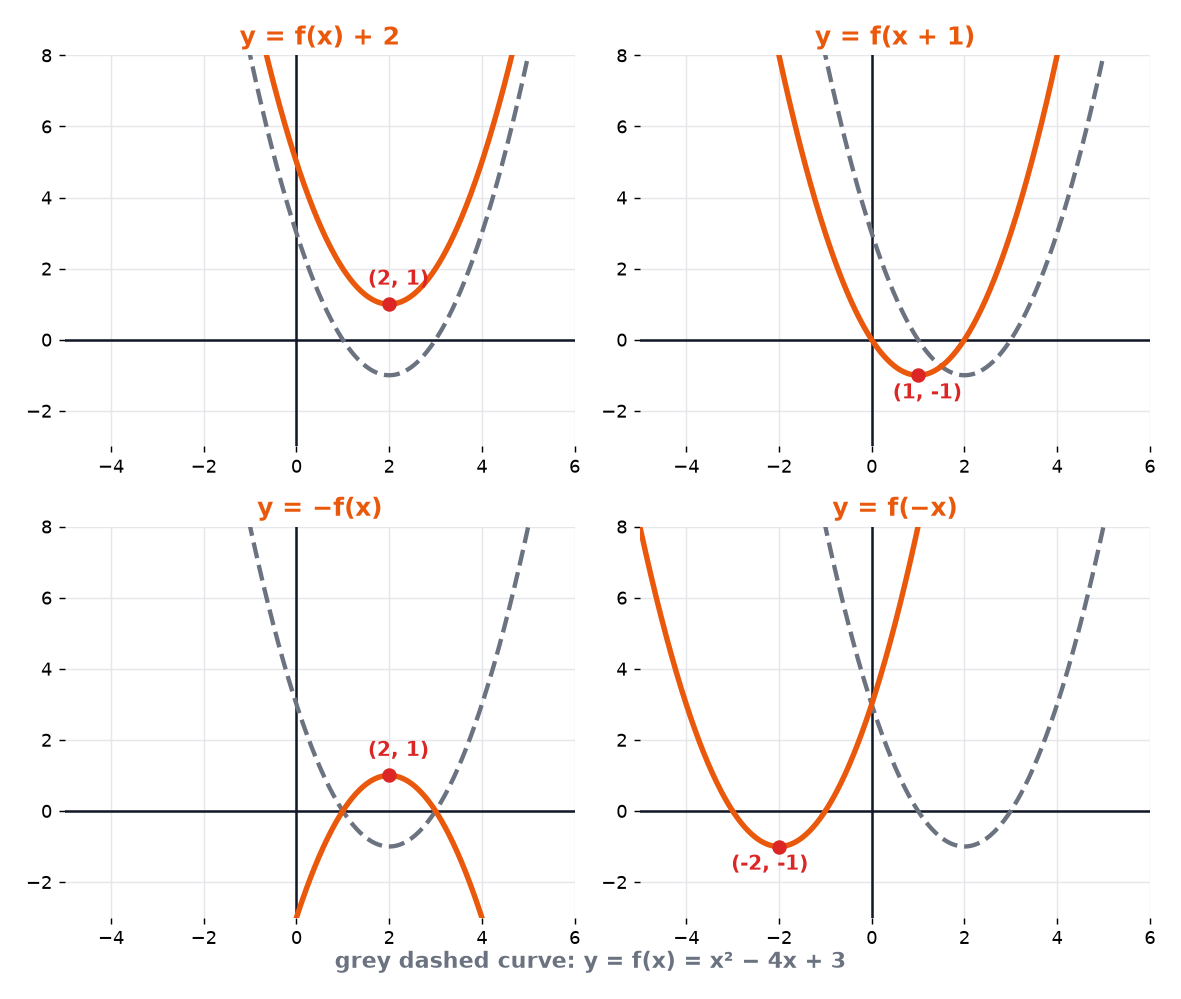
The original turning point \((2, -1)\) moves to a new place in each panel. Following that one point shows the effect of each transformation.
Where the turning point goes
- \(f(x) + 2\) Up 2, so \((2, 1)\).
- \(f(x + 1)\) Left 1, so \((1, -1)\).
- \(-f(x)\) Reflected in the \(x\)-axis, so \((2, 1)\).
- \(f(-x)\) Reflected in the \(y\)-axis, so \((-2, -1)\).
Translations
There are two kinds of translation, and the horizontal one often causes errors.
-
\(y = f(x) + a\)
The graph moves up by \(a\), which is the translation \(\begin{pmatrix} 0 \\ a \end{pmatrix}\).
-
\(y = f(x + a)\)
The graph moves to the left by \(a\), which is the translation \(\begin{pmatrix} -a \\ 0 \end{pmatrix}\).
-
Opposite direction
For \(f(x + a)\), the sign inside the bracket is the opposite of the direction of movement.
-
Check
For \(y = (x - 3)^2\), the turning point is at \(x = 3\), so the graph of \(y = x^2\) has moved right by 3.
Moving a turning point
The graph of \(y = f(x)\) has a maximum point at \((3, 5)\). Write down the coordinates of the maximum point of \(y = f(x - 2)\) and of \(y = f(x) - 4\).
Show the solutionHide the solution
- 1 \(f(x - 2)\) The graph moves right by 2, so \(x\) becomes \(3 + 2 = 5\).
- 2 Maximum The \(y\)-coordinate stays 5, so the maximum is \((5, 5)\).
- 3 \(f(x) - 4\) The graph moves down by 4, so \(y\) becomes \(5 - 4 = 1\).
- 4 Maximum The \(x\)-coordinate stays 3, so the maximum is \((3, 1)\).
Answer\((5, 5)\) for \(y = f(x - 2)\), and \((3, 1)\) for \(y = f(x) - 4\)
Reflections
A minus sign reflects the graph in one of the axes.
-
\(y = -f(x)\)
The minus is outside the function, so the graph is reflected in the \(x\)-axis. Every \(y\)-coordinate changes sign.
-
\(y = f(-x)\)
The minus is inside the brackets, so the graph is reflected in the \(y\)-axis. Every \(x\)-coordinate changes sign.
-
A point \((a, b)\)
Moves to \((a, -b)\) for \(-f(x)\), and to \((-a, b)\) for \(f(-x)\).
-
Memory aid
Outside the bracket changes \(y\), and inside the bracket changes \(x\).
Transforming a trigonometric graph
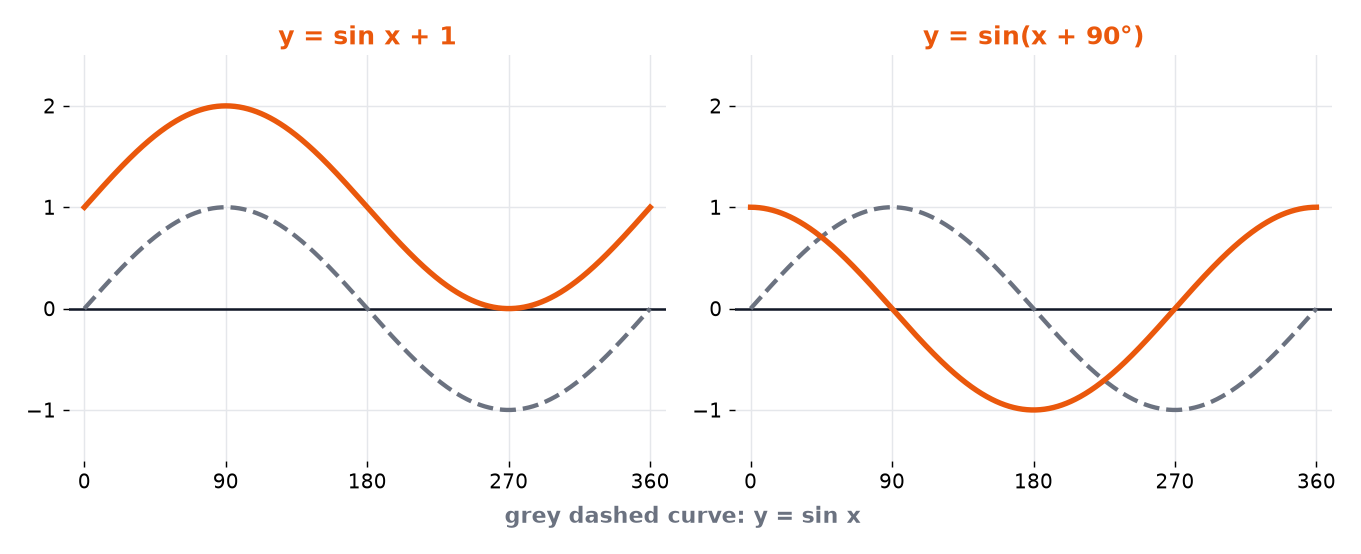
Adding 1 moves the sine curve up by 1, so it now lies between 0 and 2. Replacing \(x\) with \(x + 90^\circ\) moves it \(90^\circ\) to the left, which gives the graph of cosine, so \(\sin(x + 90^\circ) = \cos x\).
Transforming sine
- \(y = \sin x + 1\) Up 1, with a maximum at \((90, 2)\) and a minimum at \((270, 0)\).
- \(y = \sin(x + 90^\circ)\) Left \(90^\circ\), so it starts at 1.
- \(y = -\sin x\) Reflected in the \(x\)-axis, so it starts by falling.
- \(y = \sin(x - 90^\circ)\) Right \(90^\circ\), which gives \(-\cos x\).
The equation of a transformed graph
The graph of \(y = x^2\) is translated 3 units to the right and then reflected in the \(x\)-axis. Write down the equation of the new graph.
Show the solutionHide the solution
- 1 Translate right Replace \(x\) by \(x - 3\) to get \(y = (x - 3)^2\).
- 2 Reflect in the x-axis Change the sign of the whole function.
- 3 New equation \(y = -(x - 3)^2\).
- 4 Check The turning point is \((3, 0)\), and the curve opens downwards, so it is a maximum.
Answer\(y = -(x - 3)^2\)
Test yourself
-
1
What does \(y = f(x) + a\) do?
Show answerHide answer
Moves the graph up by \(a\).
-
2
What does \(y = f(x + a)\) do?
Show answerHide answer
Moves the graph left by \(a\).
-
3
What does \(y = -f(x)\) do?
Show answerHide answer
Reflects the graph in the \(x\)-axis.
-
4
What does \(y = f(-x)\) do?
Show answerHide answer
Reflects the graph in the \(y\)-axis.
-
5
Where does \((4, 3)\) go under \(y = -f(x)\)?
Show answerHide answer
\((4, -3)\).
Exam technique: transformations
Track one point, and check with the equation.
-
Follow a point
Move the turning point or an intercept, and redraw around it.
-
Label
Write the coordinates of the new key points on the sketch.
-
Direction
Remember that \(f(x + a)\) moves left, which is the opposite of what you might expect.
-
Describe fully
For a description, say the type of transformation and give the vector or the axis.
Summary and exam focus
- \(f(x) + a\) moves the graph up by \(a\), and \(f(x + a)\) moves it left by \(a\).
- \(-f(x)\) reflects in the \(x\)-axis, and \(f(-x)\) reflects in the \(y\)-axis.
- Follow a turning point to see where a graph goes.
- The same rules apply to every graph, including sine and cosine.
Exam focus
The graph of \(y = f(x)\) has a minimum point at \((2, -1)\). Write down the coordinates of the minimum point of \(y = f(x + 1)\). (1 mark) (1 marks)
\(f(x + 1)\) moves the graph 1 unit to the left, so the minimum is at \((1, -1)\). The \(y\)-coordinate does not change.
Key terms
The words this lesson expects you to use. Each one is linked from the first place it appears above.
- Transformation
- A change to the position or shape of a graph.
- Translation
- A movement of a graph without turning or flipping it.
- Reflection
- A flip of a graph in a line, such as an axis.
- Turning point
- A point where a graph changes from rising to falling, or the reverse.
- Intercept
- A point where a graph crosses an axis.
- Function notation
- Writing a function as \(f(x)\).
- Vector
- A pair of numbers that gives a movement.
- Maximum
- The highest point of a graph.
- Minimum
- The lowest point of a graph.
Questions and answers
15 questions set on this lesson, with the mark schemes and model answers open.
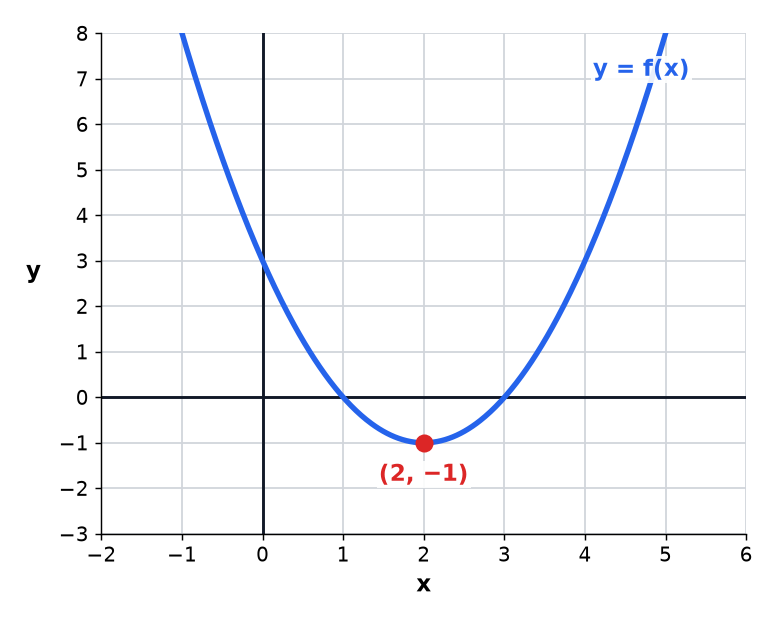
The graph of \(y = f(x)\) is shown. The turning point is \((2, -1)\). (a) Write down the coordinates of the turning point of the graph of \(y = f(x) + 2\). (1 mark) (b) Write down the coordinates of the turning point of the graph of \(y = f(x + 1)\). (1 mark)
Mark scheme — 2 marks available
- (a) \((2, 1)\) — B1
- (b) \((1, -1)\) — B1
Model answer
(a) \((2, 1)\). (b) \((1, -1)\).
The graph of \(y = g(x)\) has a minimum point at \((-1, -3)\). (a) Write down the coordinates of the minimum point of \(y = g(x) + 4\). (1 mark) (b) Write down the coordinates of the maximum point of \(y = -g(x)\). (1 mark)
Mark scheme — 2 marks available
- (a) \((-1, 1)\) — B1
- (b) \((-1, 3)\) — B1
Model answer
(a) \((-1, 1)\). (b) \((-1, 3)\).
The graph of \(y = x^2\) is transformed. Write down the equation of the new graph after (a) a translation of 3 units to the right, (1 mark) (b) a translation of 2 units up, (1 mark) (c) a reflection in the \(x\)-axis. (1 mark)
Mark scheme — 3 marks available
- (a) \(y = (x - 3)^2\) — B1
- (b) \(y = x^2 + 2\) — B1
- (c) \(y = -x^2\) — B1
Model answer
(a) \(y = (x - 3)^2\). (b) \(y = x^2 + 2\). (c) \(y = -x^2\).
The graph of \(y = f(x)\) has a maximum point at \((3, 5)\). Write down the coordinates of the maximum point of the graph of (a) \(y = f(x - 2)\) (1 mark) (b) \(y = f(x) - 4\) (1 mark) (c) \(y = -f(x)\) (1 mark) (d) \(y = f(-x)\) (1 mark)
Mark scheme — 4 marks available
- (a) \((5, 5)\) — B1
- (b) \((3, 1)\) — B1
- (c) \((3, -5)\) — B1
- (d) \((-3, 5)\) — B1
Model answer
(a) \((5, 5)\). (b) \((3, 1)\). (c) \((3, -5)\), which is now a minimum. (d) \((-3, 5)\).
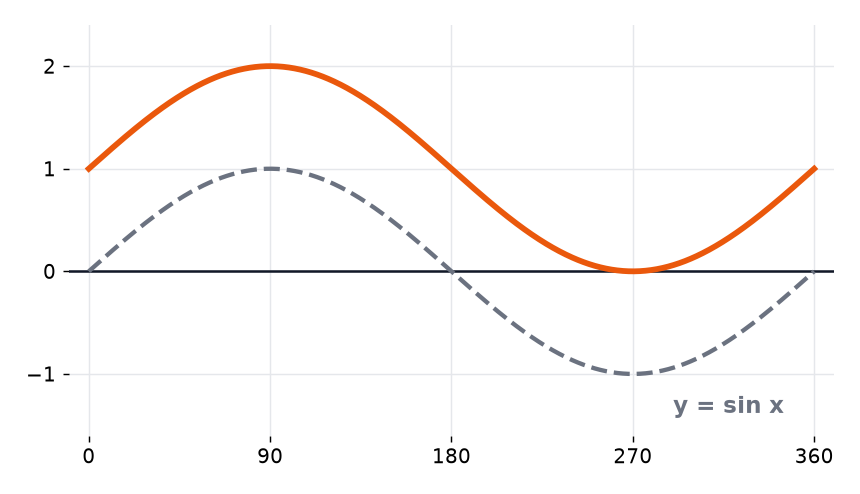
The diagram shows the graph of \(y = \sin x\) and a transformation of it, for \(0^\circ \le x \le 360^\circ\). (a) Write down the equation of the transformed graph. (1 mark) (b) Describe fully the single transformation. (2 marks)
Mark scheme — 3 marks available
- (a) \(y = \sin x + 1\) — B1
- (b) Translation — B1
- (b) Vector \(\begin{pmatrix} 0 \\ 1 \end{pmatrix}\), or 1 unit up — B1
Model answer
(a) \(y = \sin x + 1\). (b) A translation by the vector \(\begin{pmatrix} 0 \\ 1 \end{pmatrix}\), which is 1 unit up.
\(f(x) = x^2 - 4x + 3\). Show that \(f(x + 1) = x^2 - 2x\), and hence solve \(f(x + 1) = 0\). (4 marks)
Mark scheme — 4 marks available
- \((x + 1)^2 - 4(x + 1) + 3\) — M1
- \(x^2 - 2x\) with the working shown — A1
- \(x(x - 2) = 0\) — M1
- \(x = 0\) and \(x = 2\) — A1
Model answer
\(f(x + 1) = (x + 1)^2 - 4(x + 1) + 3 = x^2 + 2x + 1 - 4x - 4 + 3 = x^2 - 2x\). Then \(x(x - 2) = 0\), so \(x = 0\) or \(x = 2\).
What does \(y = f(x) + 3\) do to the graph of \(y = f(x)\)?
Why: Adding to the function moves the graph up.
What does \(y = f(x + 2)\) do to the graph of \(y = f(x)\)?
Why: A plus inside the bracket moves the graph left.
What does \(y = -f(x)\) do to the graph of \(y = f(x)\)?
Why: A minus outside changes the \(y\)-values.
What does \(y = f(-x)\) do to the graph of \(y = f(x)\)?
Why: A minus inside changes the \(x\)-values.
The maximum of \(y = f(x)\) is at \((3, 5)\). Where is the maximum of \(y = f(x - 2)\)?
Why: The graph moves right 2.
The maximum of \(y = f(x)\) is at \((3, 5)\). Where is the turning point of \(y = -f(x)\)?
Why: The \(y\)-coordinate changes sign.
What is the equation of \(y = x^2\) after a translation of 3 units to the right?
Why: Moving right replaces \(x\) with \(x - 3\).
What is the maximum value of \(y = \sin x + 1\)?
Why: The sine graph is moved up by 1, so its maximum is \(1 + 1 = 2\).
Which equation gives the same graph as \(y = \cos x\)?
Why: Moving the sine graph left by \(90^\circ\) gives the cosine graph.