Maths · Functions, Sequences and Rates of Change
Viewing as
Teacher view: every answer and mark scheme set out in full.
Iteration
Using iterative formulae, rearranging equations, and finding roots by a change of sign and trial and improvement.
Learning Objectives
- 1Use an iterative formula \(x_{n+1} = f(x_n)\) to find the next terms from a starting value.
- 2Rearrange an equation into an iterative formula.
- 3Use a change of sign to show that a root lies between two values.
- 4Find a root to a given accuracy by trial and improvement, and find the limit of an iteration.
Solving equations by repeating a process
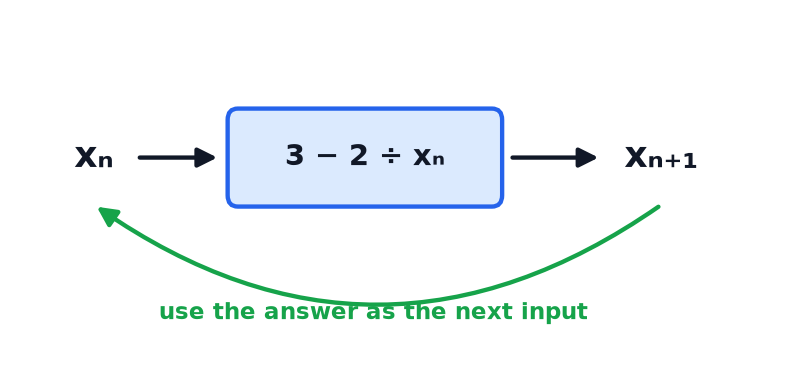
Many equations cannot be solved exactly by a simple method, but their solutions can be found as accurately as you like by repeating a calculation. Iteration starts with a guess, puts it into a formula, and uses the answer as the next guess. If the values settle down towards a single number, that number is a solution of the equation. Iteration is a Higher tier topic on every board. On a calculator paper, use the calculator to work with decimals: the Ans key feeds each answer back in, and you should keep the full display until the end.
An iterative formula
The formula \(x_{n+1} = 3 - \dfrac{2}{x_n}\) takes the current value \(x_n\) and gives the next value \(x_{n+1}\). Starting from \(x_0 = 4\), the first answer is \(x_1 = 3 - \dfrac{2}{4} = 2.5\).
Using an iterative formula
- Start The first value is given, such as \(x_0 = 4\).
- Step Substitute the current value into the right-hand side.
- Next value The answer becomes \(x_{1}\), then \(x_{2}\), and so on.
- Keep going Write down every value, so that a pattern is clear.
Using a formula
\(x_{n+1} = 3 - \dfrac{2}{x_n}\) and \(x_0 = 4\). Work out \(x_1\) and \(x_2\).
Show the solutionHide the solution
- 1 First step \(x_1 = 3 - \dfrac{2}{4} = 3 - 0.5 = 2.5\).
- 2 Second step \(x_2 = 3 - \dfrac{2}{2.5} = 3 - 0.8 = 2.2\).
- 3 Pattern The values are getting closer to 2.
- 4 Next value \(x_3 = 3 - \dfrac{2}{2.2} = 2.0909\ldots\), still moving towards 2.
Answer\(x_1 = 2.5\) and \(x_2 = 2.2\)
The values settle down
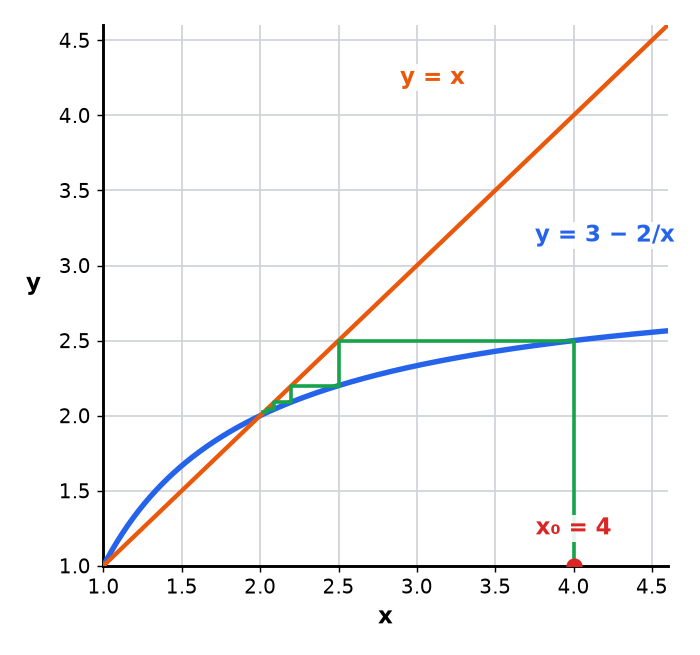
Each step goes up to the curve, across to the line \(y = x\), and up to the curve again. The steps get smaller, and the values move towards \(x = 2\), where the curve meets the line. A point where the curve meets \(y = x\) is a solution of \(x = 3 - \dfrac{2}{x}\).
Where the iteration ends up
- Limit The number the values approach, here \(2\).
- Why it works At the limit, \(x_{n+1} = x_n\).
- Equation So the limit \(a\) satisfies \(a = 3 - \dfrac{2}{a}\).
- Solving Multiply by \(a\): \(a^2 = 3a - 2\), so \(a^2 - 3a + 2 = 0\) and \(a = 1\) or \(a = 2\).
Rearranging into an iterative formula
An iterative formula comes from rearranging an equation so that \(x\) is on one side.
-
Start
\(x^2 - 3x + 2 = 0\).
-
Divide by x
\(x - 3 + \dfrac{2}{x} = 0\).
-
Rearrange
\(x = 3 - \dfrac{2}{x}\).
-
Iterative form
\(x_{n+1} = 3 - \dfrac{2}{x_n}\).
A change of sign
A root of \(f(x) = 0\) lies between two values if \(f\) changes sign between them.
-
Method
Work out \(f\) at both values. If one is negative and the other is positive, there is a root between them.
-
Condition
The graph must be a continuous curve, with no gaps.
-
Narrowing down
Try a value in the middle, and keep the interval where the sign changes.
-
To 1 decimal place
Test the midpoint of the last interval, so that you know which way to round.
Trial and improvement
\(f(x) = x^3 + x - 3\). Show that \(f(x) = 0\) has a root between 1 and 2, and find this root to 1 decimal place.
Show the solutionHide the solution
- 1 Test 1 and 2 \(f(1) = 1 + 1 - 3 = -1\) and \(f(2) = 8 + 2 - 3 = 7\). The sign changes, so there is a root between 1 and 2.
- 2 Narrow down \(f(1.2) = 1.728 + 1.2 - 3 = -0.072\), and \(f(1.3) = 2.197 + 1.3 - 3 = 0.497\).
- 3 Interval The root is between 1.2 and 1.3.
- 4 Midpoint \(f(1.25) = 1.953125 + 1.25 - 3 = 0.203\ldots\) is positive, so the root is between 1.2 and 1.25, and rounds to 1.2.
AnswerThe root is 1.2 to 1 decimal place
Test yourself
-
1
What does \(x_{n+1}\) mean in an iterative formula?
Show answerHide answer
The next value, found from \(x_n\).
-
2
What is true at the limit of an iteration?
Show answerHide answer
\(x_{n+1} = x_n\).
-
3
How do you show a root lies between two values?
Show answerHide answer
Show that \(f\) changes sign between them.
-
4
Why do you test the midpoint when rounding?
Show answerHide answer
To see which side of the midpoint the root is, and so how to round.
-
5
How do you find the limit of an iteration exactly?
Show answerHide answer
Replace \(x_{n+1}\) and \(x_n\) with \(a\) and solve.
Exam technique: iteration
Show every value, and write why you reach your conclusion.
-
Write each term
Show \(x_1\), \(x_2\), and so on, so that errors can be spotted.
-
Limit equation
Replace \(x_n\) and \(x_{n+1}\) with \(a\) and solve for \(a\).
-
Choose the right root
The question will usually tell you the values are positive, or give a start value.
-
Conclusion
Write that the sign changes, so there is a root between the two values.
Summary and exam focus
- Iteration repeats a formula, using each answer as the next input.
- The limit \(a\) satisfies \(a = f(a)\).
- A change of sign shows a root between two values, for a continuous function.
- Rearrange an equation to get an iterative formula.
Exam focus
\(x_{n+1} = 1 + \dfrac{6}{x_n}\) converges to a positive number \(a\). Show that \(a^2 - a - 6 = 0\), and find the value of \(a\). (4 marks) (4 marks)
At the limit \(a = 1 + \dfrac{6}{a}\), so \(a^2 = a + 6\) and \(a^2 - a - 6 = 0\). Factorise: \((a - 3)(a + 2) = 0\), and \(a\) is positive, so \(a = 3\).
Key terms
The words this lesson expects you to use. Each one is linked from the first place it appears above.
- Iteration
- A process that is repeated, using each output as the next input.
- Iterative formula
- A formula that gives the next value from the current one.
- Limit
- The value that the terms of an iteration approach.
- Root
- A solution of an equation \(f(x) = 0\).
- Change of sign
- The function is negative at one value and positive at another.
- Continuous
- A graph with no breaks or gaps.
- Trial and improvement
- Testing values to find a solution to a given accuracy.
- Converge
- To get closer and closer to a value.
- Starting value
- The first input of an iteration.
Questions and answers
15 questions set on this lesson, with the mark schemes and model answers open.
\(x_{n+1} = 4 - \dfrac{3}{x_n}\) and \(x_0 = 6\). Calculate \(x_1\) and \(x_2\). Give \(x_2\) as a fraction. [2 marks]
Mark scheme — 2 marks available
- \(x_1 = 3.5\) — B1
- \(x_2 = \dfrac{22}{7}\) — B1
Model answer
\(x_1 = 4 - \dfrac{3}{6} = 3.5\) and \(x_2 = 4 - \dfrac{3}{3.5} = 4 - \dfrac{6}{7} = \dfrac{22}{7}\).
Show that the equation \(x^2 - 4x + 3 = 0\) can be rearranged to give \(x = 4 - \dfrac{3}{x}\). [2 marks]
Mark scheme — 2 marks available
- Divides by \(x\), giving \(x - 4 + \dfrac{3}{x} = 0\) — M1
- \(x = 4 - \dfrac{3}{x}\) — B1
Model answer
Divide every term by \(x\): \(x - 4 + \dfrac{3}{x} = 0\). Then \(x = 4 - \dfrac{3}{x}\).
\(x_{n+1} = 3 + \dfrac{10}{x_n}\). The values \(x_n\) tend to a positive limit \(a\). Show that \(a^2 - 3a - 10 = 0\), and calculate the value of \(a\). [4 marks]
Mark scheme — 4 marks available
- \(a = 3 + \dfrac{10}{a}\) — M1
- \(a^2 - 3a - 10 = 0\) — M1
- \((a - 5)(a + 2) = 0\) — M1
- \(5\) — A1
Model answer
At the limit, \(a = 3 + \dfrac{10}{a}\), so \(a^2 = 3a + 10\) and \(a^2 - 3a - 10 = 0\). Then \((a - 5)(a + 2) = 0\), and \(a\) is positive, so \(a = 5\).
\(f(x) = x^3 - x - 1\) (a) Show that the equation \(f(x) = 0\) has a root between 1 and 2. [2 marks] (b) Find this root to 1 decimal place. Show your working. [2 marks]
Mark scheme — 4 marks available
- (a) \(f(1) = -1\) and \(f(2) = 5\) — M1
- (a) A change of sign, so there is a root — B1
- (b) \(f(1.3) < 0\), \(f(1.4) > 0\) and a test of 1.35 — M1
- (b) \(1.3\) — A1
Model answer
(a) \(f(1) = -1\) and \(f(2) = 5\). The sign changes, so there is a root between 1 and 2. (b) \(f(1.3) = -0.103\) and \(f(1.4) = 0.344\), and \(f(1.35) = 0.110\ldots\), which is positive, so the root is between 1.3 and 1.35, which is 1.3 to 1 decimal place.
Use trial and improvement to find the value of \(\sqrt{11}\) correct to 1 decimal place. Show all your working. [4 marks]
Mark scheme — 4 marks available
- \(3.3^2 = 10.89\) and \(3.4^2 = 11.56\) — B1
- Tests \(3.35\) — M1
- \(3.35^2 = 11.2225\) — A1
- \(3.3\) — A1
Model answer
\(3.3^2 = 10.89\) and \(3.4^2 = 11.56\), so \(\sqrt{11}\) is between 3.3 and 3.4. \(3.35^2 = 11.2225\), which is more than 11, so \(\sqrt{11}\) is below 3.35. So \(\sqrt{11} = 3.3\) to 1 decimal place.
\(x_{n+1} = 4 - \dfrac{3}{x_n}\). Explain what happens to the values of \(x_n\) if \(x_0 = 1\). [2 marks]
Mark scheme — 2 marks available
- \(x_1 = 4 - 3 = 1\) — M1
- States that every term is 1, because the value does not change — B1
Model answer
\(x_1 = 4 - \dfrac{3}{1} = 1\), so every term is 1. The sequence stays at 1.
\(x_{n+1} = 3 - \dfrac{2}{x_n}\) and \(x_0 = 4\). What is \(x_1\)?
Why: \(3 - \dfrac{2}{4} = 3 - 0.5 = 2.5\).
What does \(x_0\) mean in an iteration?
Why: \(x_0\) is where the iteration starts.
At the limit of an iteration, which statement is true?
Why: At the limit the values stop changing.
\(x_{n+1} = 3 - \dfrac{2}{x_n}\) and \(x_1 = 2.5\). What is \(x_2\)?
Why: \(3 - \dfrac{2}{2.5} = 3 - 0.8 = 2.2\).
Which equation can be rearranged to \(x = 3 - \dfrac{2}{x}\)?
Why: Divide \(x^2 - 3x + 2 = 0\) by \(x\) to get \(x - 3 + \dfrac{2}{x} = 0\).
\(f(x) = x^3 + x - 3\). What does \(f(1) = -1\) and \(f(2) = 7\) show?
Why: The sign changes, so a root lies between them.
\(x_{n+1} = 1 + \dfrac{6}{x_n}\) converges to a positive number \(a\). Which equation does \(a\) satisfy?
Why: \(a = 1 + \dfrac{6}{a}\), so \(a^2 = a + 6\).
What is the value of \(a\) in the previous question?
Why: \((a - 3)(a + 2) = 0\) and \(a\) is positive.
\(f(x) = x^2 - 7\). \(f(2.6) = -0.24\) and \(f(2.7) = 0.29\). Why is the root 2.6 to 1 decimal place, given \(f(2.65) = 0.0225\)?
Why: \(f(2.65) > 0\) means the root is between 2.6 and 2.65.