Maths · Circle Theorems
Viewing as
Teacher view: every answer and mark scheme set out in full.
Tangents and Chords
Using the tangent and radius, equal tangents, and the perpendicular from the centre to a chord.
Learning Objectives
Tangents and chords
A tangent is a straight line that touches a circle at exactly one point. A chord is a straight line joining two points on a circle. Both have important properties that connect them to the radius. In these questions the radius is usually the key, because it gives you either a right angle or an isosceles triangle. Draw in the radii to the points where the line meets the circle, then look for right-angled triangles and isosceles triangles.
Tangents
A tangent touches the circle at a single point, and is linked to the radius at that point.
-
The theorem
A tangent to a circle is perpendicular to the radius at the point of contact.
-
Two tangents
Tangents drawn to a circle from the same point are equal in length.
-
The kite
The two tangents and two radii make a kite, with two right angles.
-
The reason
"The angle between a tangent and a radius is \(90^\circ\)." and "Tangents from an external point are equal."
Two tangents from a point
The angles at \(A\) and \(B\) are right angles, because a tangent meets the radius at \(90^\circ\). The angles of the quadrilateral \(OATB\) add up to \(360^\circ\), so \(x = 360 - 90 - 90 - 110 = 70^\circ\).
Checking the diagram
- Right angles A tangent and the radius at the contact point meet at \(90^\circ\).
- Equal tangents \(TA = TB\), shown by the ticks.
- Kite \(OATB\) is a kite, so its angles add up to \(360^\circ\).
- Isosceles Triangle \(TAB\) is isosceles, because \(TA = TB\).
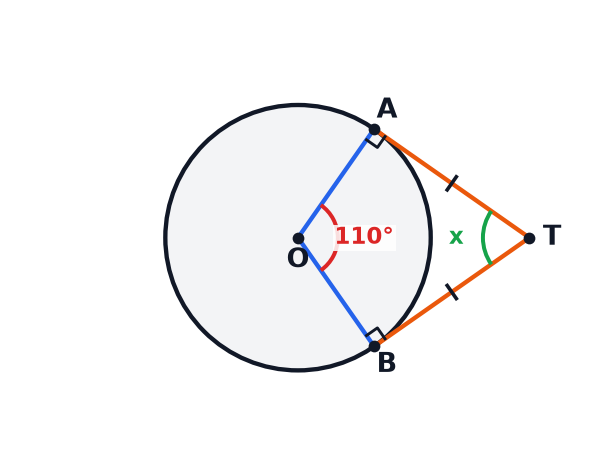
A tangent and Pythagoras
\(PT\) is a tangent to a circle with centre \(O\) and radius 5 cm. \(T\) is the point of contact and \(OP = 13\) cm. Work out the length of \(PT\).
Show the solutionHide the solution
- 1 Draw the radius Join \(O\) to \(T\), so \(OT = 5\) cm.
- 2 Right angle The tangent meets the radius at \(90^\circ\), so triangle \(OTP\) has a right angle at \(T\).
- 3 Hypotenuse \(OP\) is opposite the right angle, so \(OP = 13\) is the hypotenuse.
- 4 Pythagoras \(PT^2 = 13^2 - 5^2 = 169 - 25 = 144\), so \(PT = 12\) cm.
Answer\(PT = 12\) cm
Chords
A line from the centre to the middle of a chord is linked to the chord by a right angle.
-
The theorem
The perpendicular from the centre of a circle to a chord bisects the chord.
-
The reverse
A line from the centre to the midpoint of a chord is perpendicular to the chord.
-
The triangle
Joining the centre to both ends of the chord makes an isosceles triangle, because the two sides are radii.
-
The reason
"The perpendicular from the centre to a chord bisects the chord."
The perpendicular to a chord
\(OM\) is perpendicular to \(AB\), so \(M\) is the midpoint of \(AB\) and \(AM = MB\). The two triangles \(OMA\) and \(OMB\) are right-angled, with \(OA\) and \(OB\) as radii.
Using the diagram
- Equal halves \(AM = MB = \frac{1}{2}AB\).
- Right-angled Triangle \(OMA\) is right-angled at \(M\), so use Pythagoras.
- Hypotenuse \(OA\) is the radius, and it is the longest side of the triangle.
- Distance \(OM\) is the shortest distance from the centre to the chord.
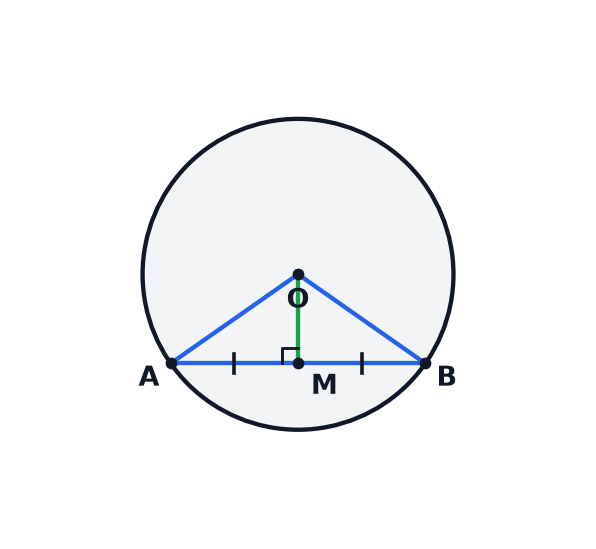
Finding the distance to a chord
A circle has centre \(O\) and radius 10 cm. A chord \(AB\) has length 16 cm. Work out the shortest distance from \(O\) to the chord.
Show the solutionHide the solution
- 1 The midpoint The shortest distance \(OM\) meets \(AB\) at a right angle, so \(M\) is the midpoint and \(AM = 8\) cm.
- 2 Triangle Triangle \(OMA\) is right-angled, with hypotenuse \(OA = 10\) cm.
- 3 Pythagoras \(OM^2 = 10^2 - 8^2 = 100 - 64 = 36\).
- 4 Square root \(OM = 6\) cm.
Answer6 cm
Test yourself
-
1
What is the angle between a tangent and the radius?
Show answerHide answer
\(90^\circ\).
-
2
What is true of two tangents from the same point?
Show answerHide answer
They are equal in length.
-
3
What does a perpendicular from the centre do to a chord?
Show answerHide answer
It bisects the chord.
-
4
What shape do two tangents and two radii make?
Show answerHide answer
A kite.
-
5
Which theorem do you use to find lengths with these facts?
Show answerHide answer
Pythagoras.
Exam technique: lengths and angles
Radii are the key to nearly every tangent and chord question.
-
Draw the radii
Join the centre to each point of contact, and to the ends of the chord.
-
Mark right angles
Mark every \(90^\circ\) on the diagram.
-
Pythagoras
Use it when you need a length in a right-angled triangle.
-
Reasons
Give the theorem in words for every angle you find.
Summary and exam focus
- A tangent meets the radius at \(90^\circ\).
- Tangents from a point are equal in length.
- The perpendicular from the centre bisects a chord.
- Use Pythagoras in the right-angled triangles that result.
Exam focus
\(PA\) and \(PB\) are tangents to a circle with centre \(O\). Angle \(AOB = 120^\circ\). Work out angle \(APB\), and give reasons. (3 marks) (3 marks)
The angles at \(A\) and \(B\) are \(90^\circ\), because a tangent meets the radius at \(90^\circ\). Then \(APB = 360 - 90 - 90 - 120 = 60^\circ\), because the angles in a quadrilateral add up to \(360^\circ\).
Key terms
The words this lesson expects you to use. Each one is linked from the first place it appears above.
- Tangent
- A straight line that touches a circle at one point.
- Chord
- A straight line joining two points on a circle.
- Point of contact
- The point where a tangent touches the circle.
- Perpendicular
- At \(90^\circ\) to a line.
- Bisect
- Cut exactly in half.
- Radius
- The distance from the centre to the circle.
- Kite
- A quadrilateral with two pairs of equal adjacent sides.
- Hypotenuse
- The longest side of a right-angled triangle.
- Isosceles triangle
- A triangle with two equal sides.
Questions and answers
15 questions set on this lesson, with the mark schemes and model answers open.
The diagram is not drawn to scale. \(TA\) and \(TB\) are tangents to a circle, centre \(O\). Angle \(ATB = 72^\circ\). Calculate angle \(TAB\), giving a reason for your answer. [3 marks]
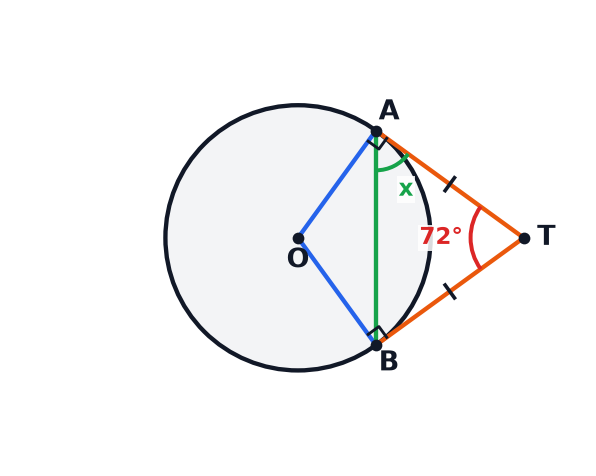
Mark scheme — 3 marks available
- Tangents from a point are equal, so triangle TAB is isosceles — B1
- \((180 - 72) \div 2\) — M1
- \(54\) — A1
Model answer
\(TA = TB\), because tangents from a point to a circle are equal, so triangle \(TAB\) is isosceles. Angle \(TAB = (180 - 72) \div 2 = 54^\circ\).
\(PT\) is a tangent to a circle, centre \(O\), touching the circle at \(T\). The radius of the circle is 7 cm and \(PT = 24\) cm. Calculate the length of \(OP\). [3 marks]
Mark scheme — 3 marks available
- Angle OTP is a right angle, as a tangent is perpendicular to the radius — B1
- \(7^2 + 24^2\) or \(49 + 576\) — M1
- \(25\) — A1
Model answer
The tangent is perpendicular to the radius, so angle \(OTP = 90^\circ\). \(OP^2 = 7^2 + 24^2 = 49 + 576 = 625\), so \(OP = 25\) cm.
The diagram is not drawn to scale. \(AB\) is a chord of a circle, centre \(O\), with radius 10 cm. \(AB = 16\) cm. \(M\) is the point on \(AB\) where \(OM\) is perpendicular to \(AB\). Calculate the length of \(OM\). [3 marks]
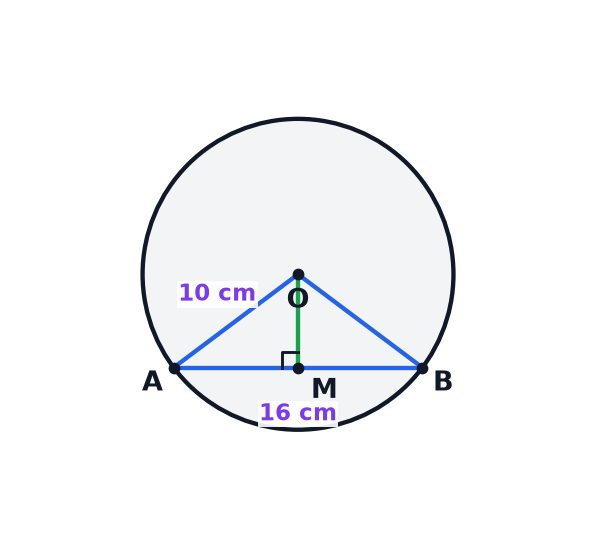
Mark scheme — 3 marks available
- \(AM = 8\) — M1
- \(10^2 - 8^2\) — M1
- \(6\) — A1
Model answer
The perpendicular from the centre bisects the chord, so \(AM = 8\) cm. \(OM^2 = 10^2 - 8^2 = 100 - 64 = 36\), so \(OM = 6\) cm.
The diagram is not drawn to scale. \(PA\) and \(PB\) are tangents to a circle, centre \(O\). Angle \(OAB = 40^\circ\). Calculate angle \(APB\), giving reasons for your answer. [4 marks]
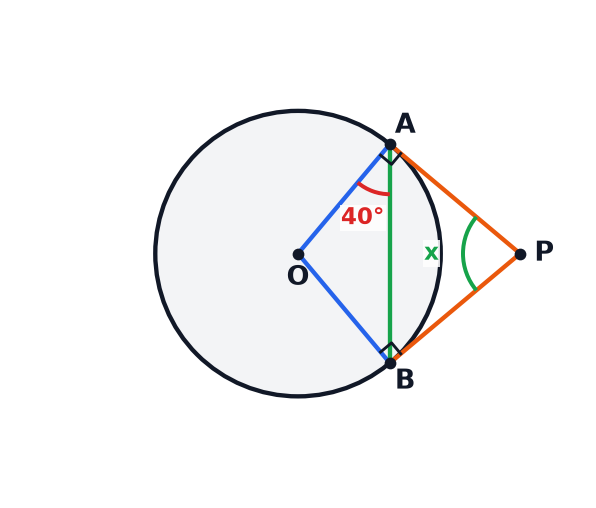
Mark scheme — 4 marks available
- Angle \(PAB = 90 - 40 = 50\) — M1
- \(180 - 50 - 50\) — M1
- \(80\) — A1
- Tangent perpendicular to the radius, and tangents from a point are equal — B1
Model answer
Angle \(OAP = 90^\circ\), because a tangent is perpendicular to the radius, so \(PAB = 90 - 40 = 50^\circ\). \(PA = PB\), so \(PBA = 50^\circ\) and \(APB = 180 - 50 - 50 = 80^\circ\).
A circle has centre \(O\) and radius 13 cm. A chord is 12 cm from \(O\). Calculate the length of the chord. [3 marks]
Mark scheme — 3 marks available
- \(13^2 - 12^2\) or \(169 - 144\) — M1
- \(5\) found as half the chord — M1
- \(10\) — A1
Model answer
Half the chord is \(\sqrt{13^2 - 12^2} = \sqrt{25} = 5\) cm, so the chord is 10 cm.
\(TA\) and \(TB\) are tangents to a circle, centre \(O\), touching the circle at \(A\) and \(B\). Prove that triangles \(OAT\) and \(OBT\) are congruent, and so that \(TA = TB\). [4 marks]
Mark scheme — 4 marks available
- OA = OB because they are radii — B1
- Angles \(OAT = OBT = 90^\circ\), because a tangent is perpendicular to the radius — B1
- OT is common, so the triangles are congruent (right angle, hypotenuse, side) — B1
- Concludes TA = TB because corresponding sides of congruent triangles are equal — B1
Model answer
\(OA = OB\), because they are radii. Angles \(OAT\) and \(OBT\) are both \(90^\circ\), because a tangent is perpendicular to the radius. \(OT\) is common to both triangles. So the triangles are congruent (RHS), and \(TA = TB\).
What is the angle between a tangent and the radius at the point of contact?
Why: A tangent is perpendicular to the radius.
Two tangents from the point \(P\) touch a circle at \(A\) and \(B\). \(PA = 9\) cm. What is \(PB\)?
Why: Tangents from the same point are equal in length.
A perpendicular from the centre of a circle meets a chord. What does it do to the chord?
Why: The perpendicular from the centre bisects the chord.
\(PT\) is a tangent, \(O\) is the centre, the radius is 3 cm and \(OP = 5\) cm. How long is \(PT\)?
Why: \(OTP\) is right-angled at \(T\), so \(PT^2 = 5^2 - 3^2 = 16\).
Tangents \(PA\) and \(PB\) touch a circle with centre \(O\). Angle \(AOB = 100^\circ\). What is angle \(APB\)?
Why: \(OAPB\) is a quadrilateral with two right angles, so \(APB = 360 - 90 - 90 - 100 = 80^\circ\).
A circle has radius 5 cm and a chord is 8 cm long. How far is the chord from the centre?
Why: Half the chord is 4 cm, so the distance is \(\sqrt{5^2 - 4^2} = 3\).
Tangents \(PA\) and \(PB\) touch a circle at \(A\) and \(B\). Angle \(APB = 50^\circ\). What is angle \(PAB\)?
Why: \(PA = PB\), so triangle \(PAB\) is isosceles and \(PAB = (180 - 50) \div 2 = 65^\circ\).
The distance from the centre of a circle of radius 13 cm to a chord is 5 cm. How long is the chord?
Why: Half the chord is \(\sqrt{13^2 - 5^2} = 12\), so the chord is 24 cm.
A line from the centre to a point \(P\) outside a circle of radius \(r\) has length \(d\). Which expression gives the tangent length from \(P\)?
Why: The radius and tangent make a right angle, with \(d\) as the hypotenuse.