Maths · Further Algebra
Viewing as
Teacher view: every answer and mark scheme set out in full.
Inequalities and Regions
Showing inequalities on graphs, describing regions, and solving quadratic inequalities.
Learning Objectives
- 1Show an inequality in one variable on a number line and write one from a number line.
- 2Represent inequalities in two variables as a region on a graph.
- 3Write the inequalities that define a shaded region, and find integer points inside it.
- 4Solve quadratic inequalities (Higher tier).
Regions instead of points
An equation such as \(y = x + 1\) is a line, but an inequality such as \(y \leq x + 1\) is a whole region of the graph. Questions give you a drawing of a region and ask for the inequalities that describe it, or ask you to draw the region from the inequalities. The skill is to read each boundary line carefully: write down its equation, then decide on which side the region lies by testing one point. Everything is exact, so Paper 1 is a natural home for it.
Inequalities in one variable
These were met in the algebra chapter, and the same symbols are used on a graph.
-
Symbols
\(<\) less than, \(>\) greater than, \(\leq\) less than or equal to, \(\geq\) greater than or equal to.
-
On a number line
An open circle for \(<\) or \(>\), a filled circle for \(\leq\) or \(\geq\).
-
A double inequality
\(-2 < x \leq 3\) means \(x\) is greater than \(-2\) and at most 3.
-
Integer values
The integers satisfying \(-2 < x \leq 3\) are \(-1, 0, 1, 2, 3\).
Inequalities on a graph
Each inequality is a line with one side shaded or marked.
-
Draw the boundary
Draw the line as if it were an equation. For \(x + y \leq 6\), draw \(x + y = 6\).
-
Solid or dashed
A solid line when the inequality includes the line (\(\leq\), \(\geq\)), and a dashed line when it does not (\(<\), \(>\)).
-
Test a point
Put \((0, 0)\), or another easy point, into the inequality. If it is true, shade that side. For \(x + y \leq 6\), \(0 + 0 \leq 6\) is true, so shade towards the origin.
-
Follow the question
Some questions say shade the region wanted, and others say shade the unwanted region. Read the instruction and label \(R\) as asked.
A region defined by three inequalities
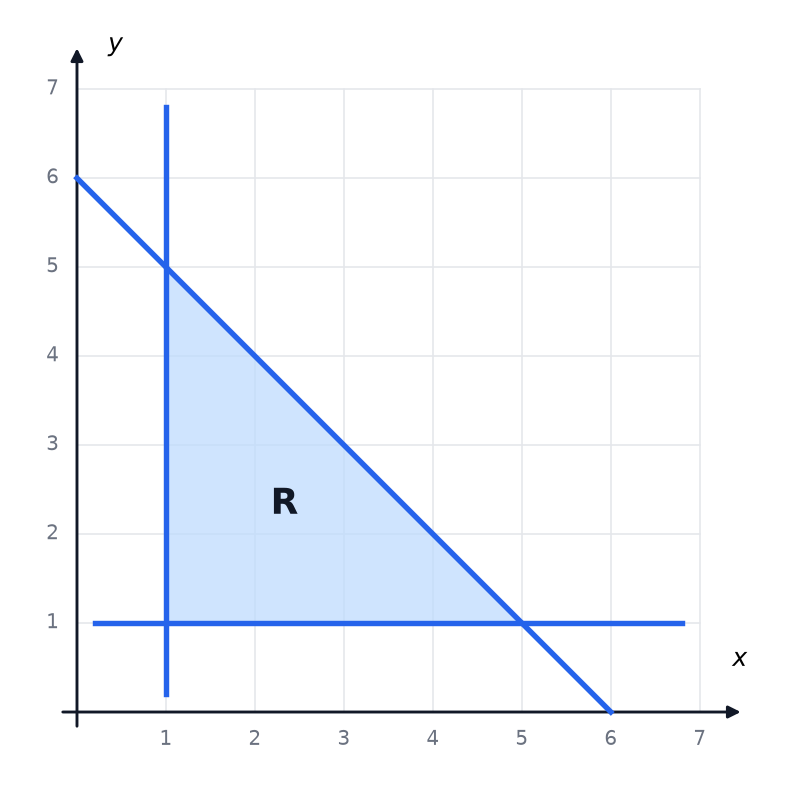
The triangle \(R\) is where all three inequalities are true at once: it lies to the right of \(x = 1\), above \(y = 1\) and below \(x + y = 6\).
Reading the region
- Right of x = 1 \(x \geq 1\).
- Above y = 1 \(y \geq 1\).
- Below x + y = 6 \(x + y \leq 6\), because the origin side is shaded.
- All three together \(x \geq 1\), \(y \geq 1\) and \(x + y \leq 6\).
Writing inequalities for a region
A region is bounded by the lines \(y = 2\), \(y = 2x\) and \(x + y = 9\), and it contains the point \((3, 3)\). Write down the three inequalities that define it.
Show the solutionHide the solution
- 1 Test (3, 3) in y and 2 \(3 \geq 2\), so \(y \geq 2\).
- 2 Test in y and 2x \(3 \leq 6\), so \(y \leq 2x\).
- 3 Test in x + y and 9 \(3 + 3 = 6 \leq 9\), so \(x + y \leq 9\).
- 4 Write all three The region satisfies all of them together.
Answer\(y \geq 2\), \(y \leq 2x\) and \(x + y \leq 9\)
Integer points in a region
Questions often ask how many points with whole-number coordinates lie in the region.
-
Check the boundaries
Points on a solid line count, and points on a dashed line do not.
-
Count column by column
For \(x \geq 1\), \(y \geq 1\), \(x + y \leq 6\): \(x = 1\) has \(y = 1\) to 5, \(x = 2\) has 1 to 4, then 3, 2 and 1.
-
Add them up
\(5 + 4 + 3 + 2 + 1 = 15\) points.
-
List them if it helps
A tidy list gives a mark for the method and makes checking easy.
Quadratic inequalities (Higher tier)
Solve the equation first, then think about the graph.
-
Find the roots
For \(x^2 - x - 6 < 0\), \(x^2 - x - 6 = (x - 3)(x + 2) = 0\) gives \(x = 3\) and \(x = -2\).
-
Sketch the graph
A U-shaped curve is below the \(x\)-axis between the roots.
-
Read the answer
\(x^2 - x - 6 < 0\) means \(-2 < x < 3\).
-
Outside the roots
\(x^2 > 9\) gives \(x < -3\) or \(x > 3\), two separate parts.
Test yourself
-
1
What does a dashed line on a graph show?
Show answerHide answer
The line is not included, so the inequality is \(<\) or \(>\).
-
2
How do you decide which side of a line to shade?
Show answerHide answer
Test a point, such as the origin, in the inequality.
-
3
What inequality describes the region below the line \(y = 4\), including the line?
Show answerHide answer
\(y \leq 4\).
-
4
What are the integers satisfying \(1 \leq x < 4\)?
Show answerHide answer
1, 2 and 3.
-
5
What is the solution of \(x^2 < 16\) (Higher tier)?
Show answerHide answer
\(-4 < x < 4\).
Exam technique: inequalities and regions
Be careful about the lines and about the symbols.
-
Find each line's equation
Use two points on it to find the gradient and intercept.
-
Use \(\leq\) or \(<\) correctly
A solid boundary gives \(\leq\) or \(\geq\).
-
Test a point
One quick substitution settles the direction.
-
Check with a point inside
Your three inequalities should all be true at a point inside the region.
Summary and exam focus
- An inequality in two variables is a region, bounded by a line drawn as a solid or a dashed line.
- Test a point to decide which side of the line to shade.
- A region is the part where every inequality is true, such as \(x \geq 1\), \(y \geq 1\) and \(x + y \leq 6\).
- Quadratic inequalities are solved using the roots and a sketch (Higher tier).
Exam focus
On the grid, the region \(R\) is bounded by \(x = 2\), \(y = 1\) and \(x + y = 7\). Write down the three inequalities that define \(R\). (3 marks) (3 marks)
Write down each line's equation first, then test a point inside \(R\), such as \((3, 2)\), in each. This gives \(x \geq 2\), \(y \geq 1\) and \(x + y \leq 7\). Check them all with your test point.
Key terms
The words this lesson expects you to use. Each one is linked from the first place it appears above.
- Inequality
- A statement that one value is less than or greater than another.
- Region
- An area of a graph that satisfies one or more inequalities.
- Boundary
- The line that separates the points that satisfy an inequality from those that do not.
- Solid line
- A boundary that is included in the region.
- Dashed line
- A boundary that is not included in the region.
- Integer
- A whole number, positive, negative or zero.
- Integer point
- A point whose coordinates are both whole numbers.
- Double inequality
- An inequality with two parts, such as \(-2 < x \leq 3\).
- Test point
- A point put into an inequality to see which side of the line to shade.
Questions and answers
15 questions set on this lesson, with the mark schemes and model answers open.
\(n\) is an integer such that \(1 \leq 2n < 9\). Write down all the possible values of \(n\).
Mark scheme — 2 marks available
- \(0.5 \leq n < 4.5\) or three correct values — M1
- 1, 2, 3, 4 — A1
Model answer
Dividing by 2 gives \(0.5 \leq n < 4.5\), so \(n = 1, 2, 3, 4\).
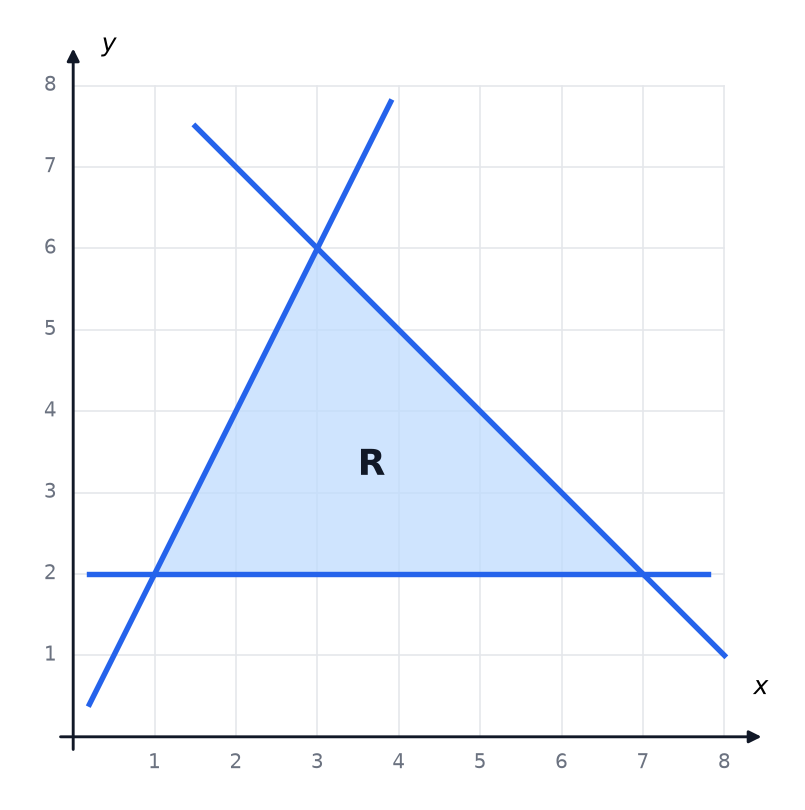
The diagram shows a shaded region \(R\). (a) Write down the three inequalities that define \(R\). [3 marks] (b) Show that the point \((4, 5)\) is inside \(R\) or on its boundary. [2 marks]
Mark scheme — 5 marks available
- (a) \(y \geq 2\) — B1
- (a) \(y \leq 2x\) — B1
- (a) \(x + y \leq 9\) — B1
- (b) Substitutes \((4, 5)\) into at least two inequalities — M1
- (b) All three satisfied, with a conclusion — A1
Model answer
(a) \(y \geq 2\), \(y \leq 2x\) and \(x + y \leq 9\). (b) \(5 \geq 2\), \(5 \leq 2 \times 4 = 8\) and \(4 + 5 = 9 \leq 9\), so the point satisfies all three inequalities, and is on the boundary \(x + y = 9\).
Solve \(-2 < 3x + 1 \leq 10\).
Mark scheme — 3 marks available
- \(-3 < 3x \leq 9\) — M1
- \(-1 < x\) — A1
- \(x \leq 3\) — A1
Model answer
Subtract 1: \(-3 < 3x \leq 9\). Divide by 3: \(-1 < x \leq 3\).
A region is above the line \(y = 2\), below the line \(y = 5\) and to the right of the line \(x = 1\), and includes all three lines. Write down the three inequalities that define the region.
Mark scheme — 2 marks available
- Two correct inequalities — M1
- \(y \geq 2\), \(y \leq 5\) and \(x \geq 1\) — A1
Model answer
The inequalities are \(y \geq 2\), \(y \leq 5\) and \(x \geq 1\).
Solve \(x^2 - 7x + 10 < 0\).
Mark scheme — 3 marks available
- \((x - 2)(x - 5)\) — M1
- A sketch or a clear statement that the curve is below the axis between the roots — M1
- \(2 < x < 5\) — A1
Model answer
\((x - 2)(x - 5) < 0\), with roots 2 and 5. The curve is below the axis between the roots, so \(2 < x < 5\).
Solve \(x^2 - x - 12 \leq 0\).
Mark scheme — 3 marks available
- \((x - 4)(x + 3)\) — M1
- A sketch or a clear statement that the curve is below the axis between the roots — M1
- \(-3 \leq x \leq 4\) — A1
Model answer
\((x - 4)(x + 3) \leq 0\), with roots \(-3\) and 4. The curve is below or on the axis between the roots, so \(-3 \leq x \leq 4\).
What does a dashed boundary line mean on a graph of an inequality?
Why: A dashed line goes with \(<\) or \(>\).
Which inequality describes the region to the right of the line \(x = 1\), including the line?
Why: To the right means larger \(x\), and the line is included.
Which inequality describes the region on or below the line \(y = 2x\)?
Why: Below the line means smaller \(y\), and the line is included.
Which integers satisfy \(-2 < x \leq 3\)?
Why: \(-2\) is not included but 3 is.
The origin is tested in \(x + y \leq 6\). What does this show?
Why: \(0 + 0 \leq 6\) is true.
How many points with whole-number coordinates satisfy \(x \geq 1\), \(y \geq 1\) and \(x + y \leq 6\)?
Why: The columns \(x = 1, 2, 3, 4, 5\) have \(5, 4, 3, 2, 1\) points.
Which kind of boundary line goes with the inequality \(y > 3\)?
Why: Strict inequalities do not include the boundary.
Solve \(x^2 - x - 6 < 0\).
Why: The roots are \(-2\) and 3, and the curve is below the axis between them.
Solve \(x^2 > 9\).
Why: The curve is above the axis outside the roots \(-3\) and 3.