Maths · Further Trigonometry
Viewing as
Teacher view: every answer and mark scheme set out in full.
Area of a Triangle and Segments
Using half ab sin C to find areas, sides and angles, and finding the area of a segment of a circle.
Learning Objectives
- 1Use the formula \(\text{area} = \dfrac{1}{2}ab\sin C\) to find the area of a triangle.
- 2Find a missing side or angle from the area of a triangle.
- 3Find the area of a segment of a circle.
- 4Use exact values to give answers with surds, such as \(12\sqrt{3}\).
The area of any triangle
The usual formula, half the base times the perpendicular height, needs the height, which is often not given. If you know two sides and the angle between them, the height can be written using sine, and this gives a new formula for the area that does not need the height. The formula is also a quick way to find the area of a segment of a circle, which is the sector minus a triangle.
Area with a sine
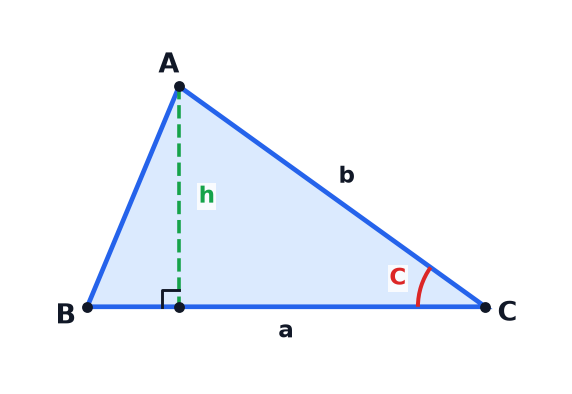
The height \(h\) is found from the right-angled triangle that it makes with side \(b\), so \(h = b\sin C\). The area is \(\dfrac{1}{2} \times a \times h = \dfrac{1}{2}ab\sin C\).
Where the formula comes from
- Height \(h = b\sin C\).
- Area \(\dfrac{1}{2} \times \text{base} \times \text{height} = \dfrac{1}{2} \times a \times b\sin C\).
- The angle It must be the angle between the two sides used.
- Other forms \(\dfrac{1}{2}bc\sin A\) and \(\dfrac{1}{2}ac\sin B\).
Using the formula
Choose two sides and the angle between them.
-
The formula
\(\text{Area} = \dfrac{1}{2}ab\sin C\).
-
Included angle
The angle \(C\) is between the sides \(a\) and \(b\).
-
Exact values
Use \(\sin 30^\circ = \dfrac{1}{2}\), \(\sin 45^\circ = \dfrac{\sqrt{2}}{2}\) and \(\sin 60^\circ = \dfrac{\sqrt{3}}{2}\).
-
Units
The area is in square units.
The area of a triangle
In triangle \(ABC\), \(a = 6\) cm, \(b = 8\) cm and angle \(C = 60^\circ\). Work out the exact area of the triangle.
Show the solutionHide the solution
- 1 Choose the formula Two sides and the angle between them are known.
- 2 Substitute \(\text{Area} = \dfrac{1}{2} \times 6 \times 8 \times \sin 60^\circ\).
- 3 Exact value \(\sin 60^\circ = \dfrac{\sqrt{3}}{2}\), so the area is \(24 \times \dfrac{\sqrt{3}}{2}\).
- 4 Simplify \(12\sqrt{3}\) cm\(^2\).
Answer\(12\sqrt{3}\) cm\(^2\)
Finding an angle or a side from the area
If the area is given, substitute it and solve.
-
Write the equation
\(\text{Area} = \dfrac{1}{2}ab\sin C\), with the area on the left.
-
Rearrange
\(\sin C = \dfrac{2 \times \text{Area}}{ab}\).
-
Inverse sine
Use an exact value to find \(C\). If \(C\) could be obtuse, there are two possible angles, \(C\) and \(180^\circ - C\).
-
Missing side
Rearrange for \(a\) or \(b\) in the same way.
Finding an angle from the area
A triangle has sides of 10 cm and 8 cm, and an area of \(20\) cm\(^2\). The angle between the sides is acute. Work out the size of this angle.
Show the solutionHide the solution
- 1 Write the equation \(20 = \dfrac{1}{2} \times 10 \times 8 \times \sin C\).
- 2 Simplify \(20 = 40\sin C\), so \(\sin C = \dfrac{1}{2}\).
- 3 Exact value \(\sin 30^\circ = \dfrac{1}{2}\), so \(C = 30^\circ\).
- 4 Check The other solution of \(\sin C = \dfrac{1}{2}\) is \(150^\circ\), which is obtuse, so it is not used.
Answer\(30^\circ\)
The area of a segment
A segment is the part of a circle between a chord and an arc.
-
Sector
Area of the sector \(= \dfrac{\theta}{360} \times \pi r^2\).
-
Triangle
The two radii and the chord make a triangle, with area \(\dfrac{1}{2}r^2\sin\theta\).
-
Segment
Area of the segment \(=\) area of the sector \(-\) area of the triangle.
-
Exact answers
Leave \(\pi\) and surds in the answer.
The area of a segment
\(O\) is the centre of a circle of radius 6 cm. \(A\) and \(B\) are points on the circle and angle \(AOB = 60^\circ\). Work out the exact area of the segment cut off by the chord \(AB\).
Show the solutionHide the solution
- 1 Sector \(\dfrac{60}{360} \times \pi \times 6^2 = \dfrac{1}{6} \times 36\pi = 6\pi\).
- 2 Triangle \(\dfrac{1}{2} \times 6 \times 6 \times \sin 60^\circ = 18 \times \dfrac{\sqrt{3}}{2} = 9\sqrt{3}\).
- 3 Subtract Segment \(= 6\pi - 9\sqrt{3}\).
- 4 Units The answer is in \(\text{cm}^2\).
Answer\((6\pi - 9\sqrt{3})\) cm\(^2\)
Test yourself
-
1
What is the formula for the area of a triangle using a sine?
Show answerHide answer
\(\dfrac{1}{2}ab\sin C\).
-
2
Which angle is used?
Show answerHide answer
The angle between the two sides.
-
3
What is \(\sin 60^\circ\)?
Show answerHide answer
\(\dfrac{\sqrt{3}}{2}\).
-
4
What is the area of a segment?
Show answerHide answer
Area of the sector minus area of the triangle.
-
5
What is \(\sin 90^\circ\)?
Show answerHide answer
1.
Exam technique: area questions
Check the angle, then write each step.
-
Angle between
Make sure the angle is between the two sides that you are using.
-
Exact answers
If the question says exact, leave surds and \(\pi\).
-
Two possible angles
If an angle is found from \(\sin\), check whether it could be obtuse.
-
Show every step
The formula with the numbers in earns the first mark.
Summary and exam focus
- \(\text{Area} = \dfrac{1}{2}ab\sin C\) with \(C\) between \(a\) and \(b\).
- Rearrange the formula to find an angle or a side.
- A segment is a sector minus a triangle.
- Use exact values to give answers in surd form.
Exam focus
Triangle \(ABC\) has \(AB = 10\) cm, \(AC = 12\) cm and angle \(BAC = 30^\circ\). Work out the area of the triangle. (2 marks) (2 marks)
\(\text{Area} = \dfrac{1}{2} \times 10 \times 12 \times \sin 30^\circ = 60 \times \dfrac{1}{2} = 30\) cm\(^2\). Show the formula with the numbers substituted.
Key terms
The words this lesson expects you to use. Each one is linked from the first place it appears above.
- Area
- The amount of surface inside a shape.
- Included angle
- The angle between two given sides.
- Segment
- The part of a circle cut off by a chord.
- Sector
- The part of a circle between two radii.
- Exact value
- A value written with fractions, surds and \(\pi\).
- Chord
- A straight line joining two points on a circle.
- Perpendicular height
- The shortest distance from a vertex to the opposite side.
- Surd
- A root that cannot be written as a whole number or fraction.
- Radius
- The distance from the centre of a circle to its edge.
Questions and answers
15 questions set on this lesson, with the mark schemes and model answers open.
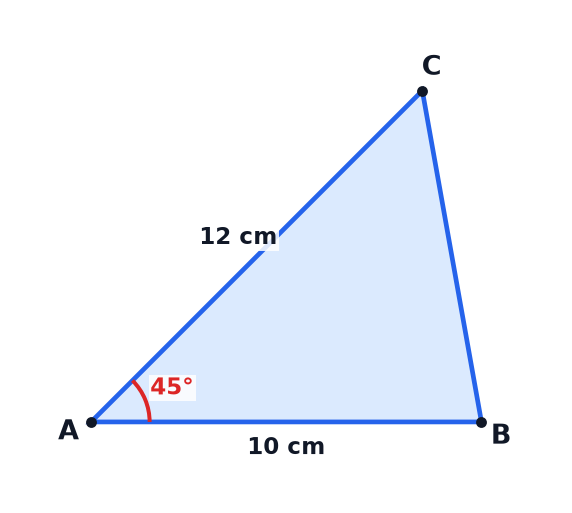
The diagram is not drawn to scale. Calculate the exact area of triangle \(ABC\). [2 marks]
Mark scheme — 2 marks available
- \(\dfrac{1}{2} \times 10 \times 12 \times \sin 45^\circ\) — M1
- \(30\sqrt{2}\) — A1
Model answer
Area \(= \dfrac{1}{2} \times 10 \times 12 \times \sin 45^\circ = 60 \times \dfrac{\sqrt{2}}{2} = 30\sqrt{2}\) cm\(^2\).
A triangle has two sides of length 10 cm and 4 cm. Its area is \(10\sqrt{2}\) cm\(^2\). The angle between the two sides is acute. Calculate the size of this angle. [3 marks]
Mark scheme — 3 marks available
- \(10\sqrt{2} = \dfrac{1}{2} \times 10 \times 4 \times \sin C\) — M1
- \(\sin C = \dfrac{\sqrt{2}}{2}\) — M1
- \(45\) — A1
Model answer
\(10\sqrt{2} = \dfrac{1}{2} \times 10 \times 4 \times \sin C = 20\sin C\), so \(\sin C = \dfrac{\sqrt{2}}{2}\) and \(C = 45^\circ\).
In triangle \(ABC\), \(b = 8\) cm and angle \(C = 45^\circ\). The area of the triangle is \(20\sqrt{2}\) cm\(^2\). Calculate the length of \(a\). [3 marks]
Mark scheme — 3 marks available
- \(20\sqrt{2} = \dfrac{1}{2} \times a \times 8 \times \sin 45^\circ\) — M1
- \(20\sqrt{2} = 2\sqrt{2}a\) or equivalent — M1
- \(10\) — A1
Model answer
\(20\sqrt{2} = \dfrac{1}{2} \times a \times 8 \times \sin 45^\circ = 2\sqrt{2}a\), so \(a = 10\) cm.
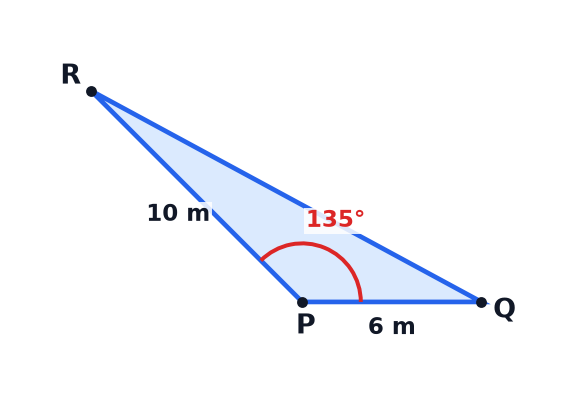
The diagram is not drawn to scale. The diagram shows a triangular plot of land \(PQR\). Calculate the exact area of the plot. [3 marks]
Mark scheme — 3 marks available
- \(\dfrac{1}{2} \times 6 \times 10 \times \sin 135^\circ\) — M1
- \(\sin 135^\circ = \dfrac{\sqrt{2}}{2}\) — M1
- \(15\sqrt{2}\) — A1
Model answer
Area \(= \dfrac{1}{2} \times 6 \times 10 \times \sin 135^\circ = 30 \times \dfrac{\sqrt{2}}{2} = 15\sqrt{2}\) m\(^2\).
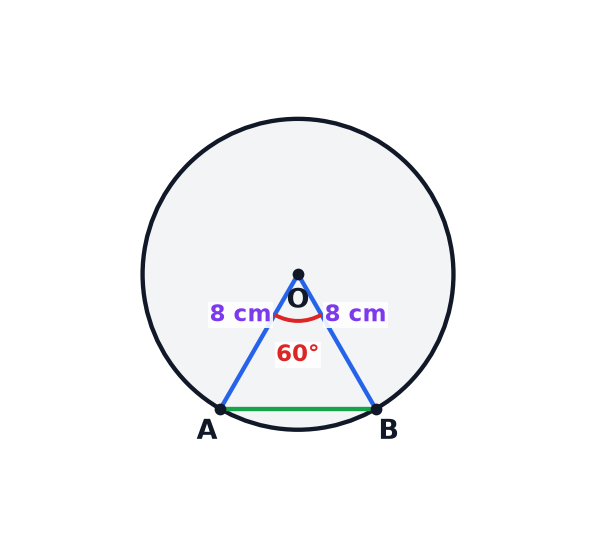
The diagram is not drawn to scale. The diagram shows a circle, centre \(O\), with radius 8 cm. \(A\) and \(B\) are points on the circle and angle \(AOB = 60^\circ\). Calculate the exact area of the segment bounded by the chord \(AB\) and the minor arc \(AB\). [5 marks]
Mark scheme — 5 marks available
- \(\dfrac{60}{360} \times \pi \times 8^2\) — M1
- \(\dfrac{32\pi}{3}\) — A1
- \(\dfrac{1}{2} \times 8 \times 8 \times \sin 60^\circ\) — M1
- \(16\sqrt{3}\) — A1
- \(\dfrac{32\pi}{3} - 16\sqrt{3}\) — A1
Model answer
Sector \(= \dfrac{60}{360} \times \pi \times 8^2 = \dfrac{32\pi}{3}\). Triangle \(= \dfrac{1}{2} \times 8 \times 8 \times \sin 60^\circ = 32 \times \dfrac{\sqrt{3}}{2} = 16\sqrt{3}\). Segment \(= \dfrac{32\pi}{3} - 16\sqrt{3}\) cm\(^2\).
A regular hexagon has sides of length 2 cm. Calculate the exact area of the hexagon. [4 marks]
Mark scheme — 4 marks available
- Splits the hexagon into 6 triangles, each with an angle of \(60^\circ\) at the centre — M1
- \(\dfrac{1}{2} \times 2 \times 2 \times \sin 60^\circ\) — M1
- \(\sqrt{3}\) for each triangle — A1
- \(6\sqrt{3}\) — A1
Model answer
The hexagon is made of 6 triangles with two sides of 2 cm and an angle of \(60^\circ\) between them. Each has area \(\dfrac{1}{2} \times 2 \times 2 \times \sin 60^\circ = \sqrt{3}\). So the total is \(6\sqrt{3}\) cm\(^2\).
What is the formula for the area of a triangle using a sine?
Why: The area is half the product of two sides and the sine of the angle between them.
Which angle is used in \(\dfrac{1}{2}ab\sin C\)?
Why: \(C\) is the included angle.
What is \(\sin 90^\circ\)?
Why: This is on the sine graph at its maximum.
A triangle has sides 8 cm and 5 cm with an angle of \(30^\circ\) between them. What is the area?
Why: \(\dfrac{1}{2} \times 8 \times 5 \times \dfrac{1}{2} = 10\).
A triangle has sides 6 cm and 8 cm with an angle of \(60^\circ\) between them. What is the exact area?
Why: \(\dfrac{1}{2} \times 6 \times 8 \times \dfrac{\sqrt{3}}{2} = 12\sqrt{3}\).
A triangle has sides of 10 cm and 8 cm and an area of 20 cm\(^2\). The included angle is acute. What is it?
Why: \(20 = 40\sin C\), so \(\sin C = \dfrac{1}{2}\) and \(C = 30^\circ\).
What is the area of a segment of a circle?
Why: The segment is the sector with the triangle removed.
A sector of a circle with radius 6 cm has an angle of \(60^\circ\). What is the area of the sector?
Why: \(\dfrac{60}{360} \times \pi \times 36 = 6\pi\).
A triangle has two sides of 4 cm and 6 cm and an area of 6 cm\(^2\). What could the included angle be?
Why: \(6 = 12\sin C\), so \(\sin C = \dfrac{1}{2}\), which gives \(30^\circ\) or \(150^\circ\).