Maths · Further Trigonometry
Viewing as
Teacher view: every answer and mark scheme set out in full.
Trigonometric Graphs and Exact Values
Sketching and using the sine, cosine and tangent graphs, and solving equations between 0 and 360 degrees using exact values.
Learning Objectives
- 1Sketch and recognise the graphs of \(y = \sin x\), \(y = \cos x\) and \(y = \tan x\).
- 2State the key values of each graph, including where each crosses the axis and its maximum and minimum.
- 3Use the symmetry of the graphs to find more than one angle with the same sine or cosine.
- 4Solve equations such as \(\sin x = \dfrac{1}{2}\) between \(0^\circ\) and \(360^\circ\), using exact values.
Trigonometry beyond right-angled triangles
In a right-angled triangle the angle is always below \(90^\circ\), but the sine, cosine and tangent functions are defined for any angle. Their graphs repeat, and have a shape that you should know well. The graphs show why an equation such as \(\sin x = \dfrac{1}{2}\) has more than one solution between \(0^\circ\) and \(360^\circ\). On a non-calculator paper, the values come from the exact values table that you met in right-angled trigonometry, and the symmetry of the graph gives the other solutions.
The sine and cosine graphs
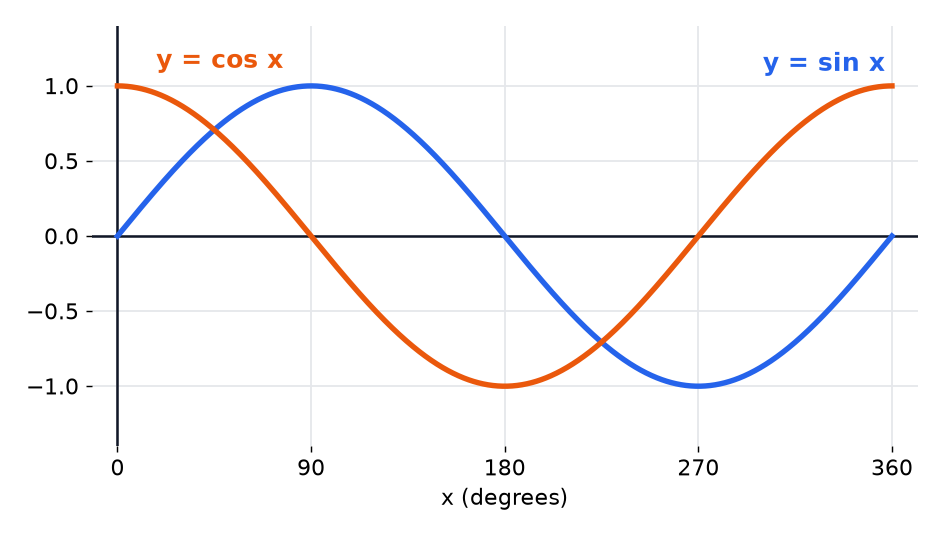
Both graphs are smooth waves that repeat every \(360^\circ\) and stay between \(-1\) and \(1\).
-
\(y = \sin x\)
Starts at 0 when \(x = 0^\circ\), reaches a maximum of 1 at \(90^\circ\), crosses zero at \(180^\circ\), has a minimum of \(-1\) at \(270^\circ\) and returns to 0 at \(360^\circ\).
-
\(y = \cos x\)
Starts at 1 when \(x = 0^\circ\), crosses zero at \(90^\circ\), has a minimum of \(-1\) at \(180^\circ\), crosses zero at \(270^\circ\) and returns to 1 at \(360^\circ\).
-
The shape
The cosine graph is the sine graph moved \(90^\circ\) to the left.
-
Range
The values of sine and cosine are never greater than 1 or less than \(-1\).
The sine and cosine graphs
Both curves have a maximum of 1 and a minimum of \(-1\). Sine passes through the origin, and cosine starts at its maximum value of 1.
Key points
- Sine \((0, 0)\), \((90, 1)\), \((180, 0)\), \((270, -1)\), \((360, 0)\).
- Cosine \((0, 1)\), \((90, 0)\), \((180, -1)\), \((270, 0)\), \((360, 1)\).
- Meeting point The curves cross at \(45^\circ\) and \(225^\circ\), where sine and cosine are equal.
- Period Both repeat every \(360^\circ\).
The tangent graph
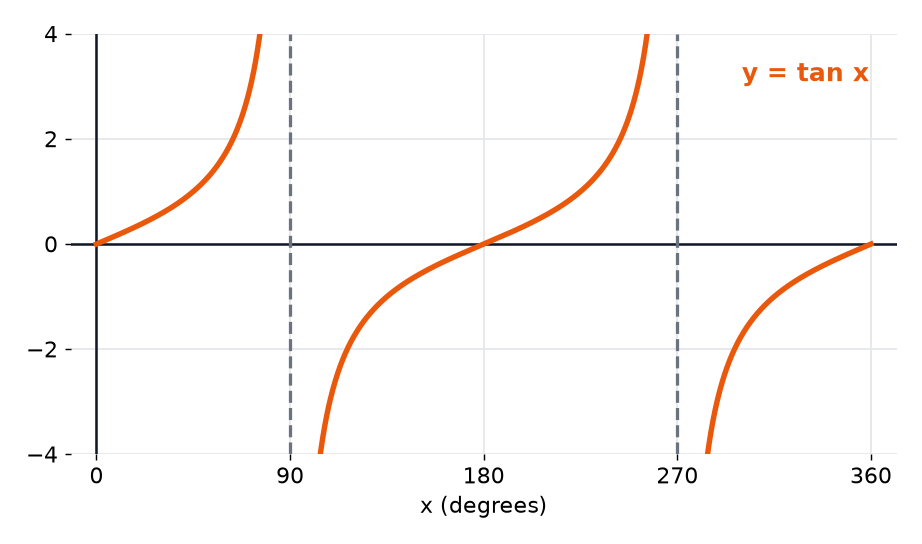
The tangent graph is different. It has no maximum or minimum, and it has gaps where the function is undefined.
-
\(y = \tan x\)
Starts at 0 when \(x = 0^\circ\), rises towards infinity as \(x\) approaches \(90^\circ\), then comes up from minus infinity after \(90^\circ\).
-
Asymptotes
The lines \(x = 90^\circ\) and \(x = 270^\circ\) are asymptotes, which the graph approaches but never touches.
-
Zeros
The graph crosses the axis at \(0^\circ\), \(180^\circ\) and \(360^\circ\).
-
Period
The tangent graph repeats every \(180^\circ\), and its values can be any number.
The tangent graph
Each branch rises from the left to the right. The graph passes through 0 at \(0^\circ\), \(180^\circ\) and \(360^\circ\), and \(\tan 45^\circ = 1\).
Features to remember
- Asymptotes At \(90^\circ\) and \(270^\circ\).
- Zeros At \(0^\circ\), \(180^\circ\) and \(360^\circ\).
- Value at \(45^\circ\) \(\tan 45^\circ = 1\).
- Period \(180^\circ\), which is half that of sine and cosine.
Reading a value from the graph
Use the graph of \(y = \cos x\) to write down the value of \(\cos 180^\circ\) and the values of \(x\) between \(0^\circ\) and \(360^\circ\) where \(\cos x = 0\).
Show the solutionHide the solution
- 1 Find 180 The cosine graph reaches its minimum at \(x = 180^\circ\), so \(\cos 180^\circ = -1\).
- 2 Find the zeros The curve crosses the \(x\)-axis where \(y = 0\).
- 3 Read the values It crosses at \(90^\circ\) and \(270^\circ\).
Answer\(\cos 180^\circ = -1\), and \(\cos x = 0\) when \(x = 90^\circ\) and \(x = 270^\circ\)
Solving \(\sin x = k\) and \(\cos x = k\)
An equation has more than one solution because the graph reaches the same height more than once.
-
Step 1
Find the first angle from the exact values table, for example \(\sin 30^\circ = \dfrac{1}{2}\).
-
Sine
The graph is symmetrical about \(90^\circ\), so the second solution is \(180^\circ - x\).
-
Cosine
The graph is symmetrical about \(180^\circ\), so the second solution is \(360^\circ - x\).
-
Check
Look at the graph to see how many solutions to expect between \(0^\circ\) and \(360^\circ\).
Solving \(\sin x = 0.5\)
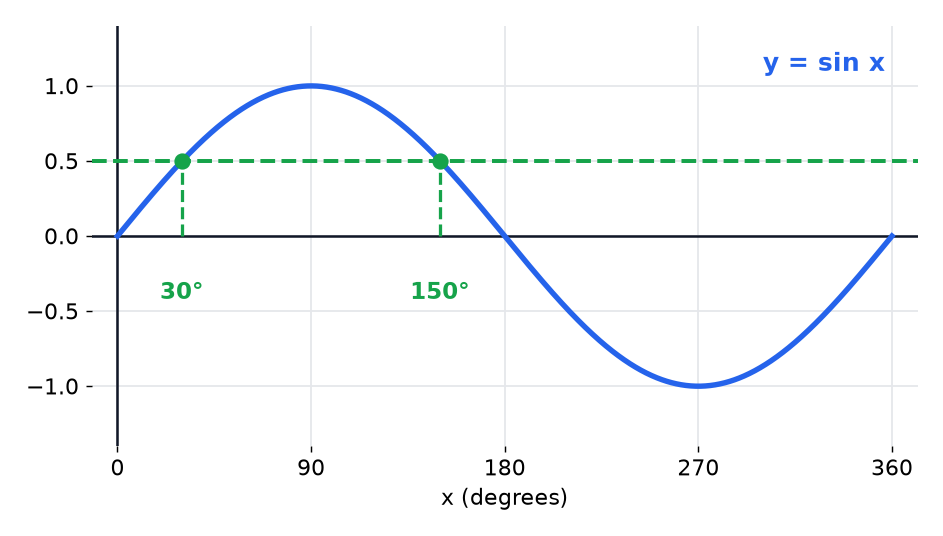
The horizontal line \(y = 0.5\) crosses the sine curve twice between \(0^\circ\) and \(360^\circ\). The first solution is \(30^\circ\), and the second is \(180^\circ - 30^\circ = 150^\circ\).
Reading the graph
- First solution \(x = 30^\circ\), from \(\sin 30^\circ = \dfrac{1}{2}\).
- Second solution \(x = 180^\circ - 30^\circ = 150^\circ\), from the symmetry about \(90^\circ\).
- Check \(\sin 150^\circ = \dfrac{1}{2}\) as well.
- Negative values If \(\sin x = -\dfrac{1}{2}\) the solutions are \(210^\circ\) and \(330^\circ\).
Solving a cosine equation
Solve \(\cos x = -\dfrac{1}{2}\) for \(0^\circ \le x \le 360^\circ\).
Show the solutionHide the solution
- 1 Use the positive value \(\cos 60^\circ = \dfrac{1}{2}\), so the related acute angle is \(60^\circ\).
- 2 Negative cosine Cosine is negative between \(90^\circ\) and \(270^\circ\).
- 3 First solution \(180^\circ - 60^\circ = 120^\circ\).
- 4 Second solution \(180^\circ + 60^\circ = 240^\circ\).
Answer\(x = 120^\circ\) and \(x = 240^\circ\)
Test yourself
-
1
What are the maximum and minimum values of \(\sin x\)?
Show answerHide answer
1 and \(-1\).
-
2
Where does the cosine graph start?
Show answerHide answer
At 1, when \(x = 0^\circ\).
-
3
Where are the asymptotes of the tangent graph?
Show answerHide answer
At \(90^\circ\) and \(270^\circ\).
-
4
What is the period of the tangent graph?
Show answerHide answer
\(180^\circ\).
-
5
If \(\sin 30^\circ = \dfrac{1}{2}\), what is the other solution of \(\sin x = \dfrac{1}{2}\)?
Show answerHide answer
\(150^\circ\).
Exam technique: trigonometric graphs
Most marks come from knowing the shapes and the values.
-
Sketching
Label the axes with \(90\), \(180\), \(270\) and \(360\), and mark the maximum and minimum.
-
Find all the solutions
Use the graph to find out how many solutions there are, then use symmetry to find them.
-
Exact values
Without a calculator, the numbers will be exact values, so learn the table.
-
The range
If a question gives \(\sin x = 2\), there is no solution, because sine is never above 1.
Summary and exam focus
- Sine and cosine are waves between \(-1\) and \(1\) that repeat every \(360^\circ\).
- Tangent has asymptotes at \(90^\circ\) and \(270^\circ\), and repeats every \(180^\circ\).
- For \(\sin x = k\), the second solution is \(180^\circ - x\). For \(\cos x = k\), it is \(360^\circ - x\).
- Use the exact values table to solve equations without a calculator.
Exam focus
Solve \(\sin x = \dfrac{\sqrt{3}}{2}\) for \(0^\circ \le x \le 360^\circ\). (3 marks) (3 marks)
\(\sin 60^\circ = \dfrac{\sqrt{3}}{2}\), so \(x = 60^\circ\) is one solution. The second is \(180^\circ - 60^\circ = 120^\circ\). Check that you have found both.
Key terms
The words this lesson expects you to use. Each one is linked from the first place it appears above.
- Sine
- The ratio of the opposite side to the hypotenuse.
- Cosine
- The ratio of the adjacent side to the hypotenuse.
- Tangent
- The ratio of the opposite side to the adjacent side.
- Period
- The distance after which a graph repeats.
- Asymptote
- A line that a graph approaches but never touches.
- Amplitude
- Half the distance between the maximum and minimum values.
- Exact value
- A value written with fractions and surds, not as a decimal.
- Symmetry
- A balance in a graph, so that values are repeated.
- Periodic
- Repeating at regular intervals.
Questions and answers
15 questions set on this lesson, with the mark schemes and model answers open.
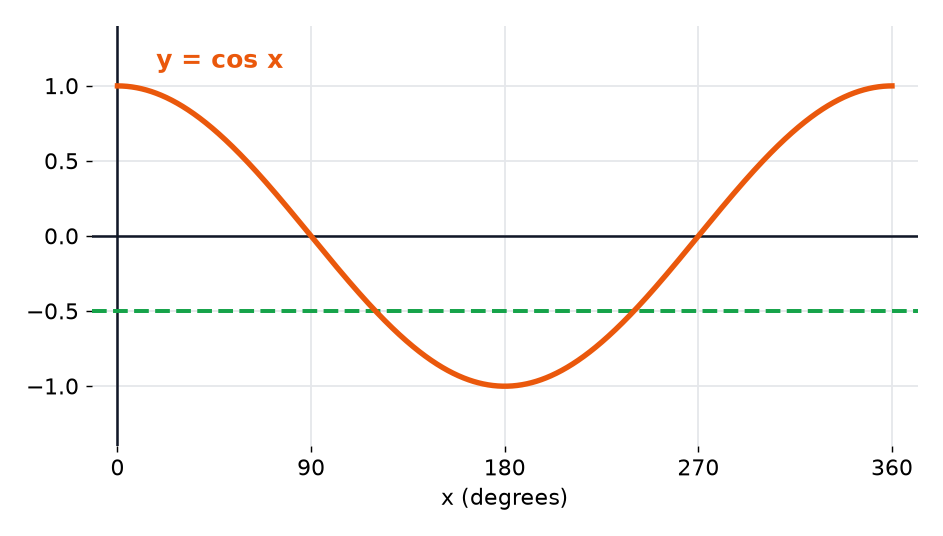
The diagram shows the graph of \(y = \cos x\) for \(0^\circ \le x \le 360^\circ\), and the line \(y = -0.5\). Solve \(\cos x = -0.5\) for \(0^\circ \le x \le 360^\circ\). [2 marks]
Mark scheme — 2 marks available
- \(120\) — M1
- \(240\) — A1
Model answer
\(\cos 60^\circ = 0.5\), and cosine is negative between \(90^\circ\) and \(270^\circ\), so \(x = 180 - 60 = 120^\circ\) or \(x = 180 + 60 = 240^\circ\).
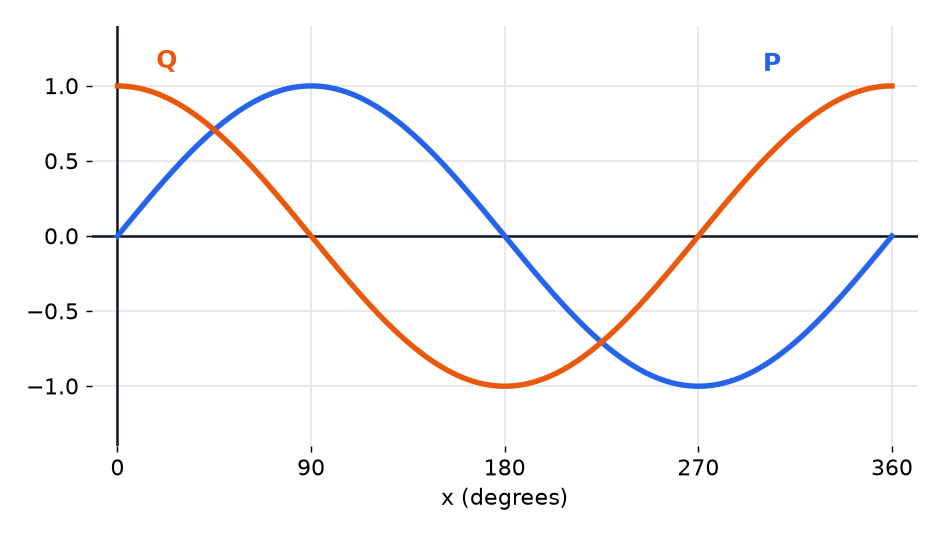
The diagram shows the graphs of two curves, \(P\) and \(Q\), for \(0^\circ \le x \le 360^\circ\). One is \(y = \sin x\) and the other is \(y = \cos x\). (a) State which curve is \(y = \sin x\). [1 mark] (b) Solve \(\sin x = \cos x\) for \(0^\circ \le x \le 360^\circ\). [2 marks]
Mark scheme — 3 marks available
- (a) Curve P, because it starts at the origin — B1
- (b) \(45\) — B1
- (b) \(225\) — B1
Model answer
(a) \(P\), because it passes through the origin. (b) The curves cross at \(x = 45^\circ\), where \(\sin 45^\circ = \cos 45^\circ = \dfrac{\sqrt{2}}{2}\), and at \(x = 225^\circ\).
Write down the exact value of (a) \(\sin 135^\circ\) [1 mark] (b) \(\cos 135^\circ\) [1 mark] (c) \(\tan 150^\circ\) [1 mark]
Mark scheme — 3 marks available
- (a) \(\dfrac{\sqrt{2}}{2}\) — B1
- (b) \(-\dfrac{\sqrt{2}}{2}\) — B1
- (c) \(-\dfrac{1}{\sqrt{3}}\) or \(-\dfrac{\sqrt{3}}{3}\) — B1
Model answer
(a) \(\dfrac{\sqrt{2}}{2}\). (b) \(-\dfrac{\sqrt{2}}{2}\). (c) \(-\dfrac{\sqrt{3}}{3}\), which is the same as \(-\dfrac{1}{\sqrt{3}}\).
Solve \(2\cos x + 1 = 0\) for \(0^\circ \le x \le 360^\circ\). [3 marks]
Mark scheme — 3 marks available
- \(\cos x = -\dfrac{1}{2}\) — M1
- \(120\) — A1
- \(240\) — A1
Model answer
\(\cos x = -\dfrac{1}{2}\), so \(x = 120^\circ\) or \(x = 240^\circ\).
Solve \(\tan x = -\sqrt{3}\) for \(0^\circ \le x \le 360^\circ\). [3 marks]
Mark scheme — 3 marks available
- Uses \(60^\circ\) as the related angle — M1
- \(120\) — A1
- \(300\) — A1
Model answer
\(\tan 60^\circ = \sqrt{3}\), and tangent is negative between \(90^\circ\) and \(180^\circ\), and between \(270^\circ\) and \(360^\circ\). So \(x = 180 - 60 = 120^\circ\) or \(x = 360 - 60 = 300^\circ\).
(a) Write down the period of the graph of \(y = \tan x\). [1 mark] (b) How many solutions does \(\cos x = 0.3\) have for \(0^\circ \le x \le 720^\circ\)? [1 mark]
Mark scheme — 2 marks available
- (a) \(180^\circ\) — B1
- (b) 4 — B1
Model answer
(a) \(180^\circ\). (b) Four solutions, two in each \(360^\circ\).
What is the maximum value of \(y = \sin x\)?
Why: The sine graph is a wave between \(-1\) and \(1\).
What is \(\cos 0^\circ\)?
Why: The cosine graph starts at its maximum, 1.
Where are the asymptotes of \(y = \tan x\) between \(0^\circ\) and \(360^\circ\)?
Why: The tangent is undefined at \(90^\circ\) and \(270^\circ\).
How many solutions does \(\sin x = \dfrac{1}{2}\) have for \(0^\circ \le x \le 360^\circ\)?
Why: The line \(y = \dfrac{1}{2}\) crosses the sine curve twice, at \(30^\circ\) and \(150^\circ\).
If \(\sin 30^\circ = \dfrac{1}{2}\), what is the other solution of \(\sin x = \dfrac{1}{2}\) between \(0^\circ\) and \(360^\circ\)?
Why: The second solution is \(180^\circ - 30^\circ = 150^\circ\).
What is the period of \(y = \tan x\)?
Why: The tangent graph repeats every \(180^\circ\).
Solve \(\cos x = \dfrac{1}{2}\) for \(0^\circ \le x \le 360^\circ\).
Why: \(\cos 60^\circ = \dfrac{1}{2}\), and the second solution is \(360^\circ - 60^\circ = 300^\circ\).
Solve \(\sin x = -\dfrac{1}{2}\) for \(0^\circ \le x \le 360^\circ\).
Why: Sine is negative between \(180^\circ\) and \(360^\circ\), so the solutions are \(180 + 30 = 210\) and \(360 - 30 = 330\).
Which equation has no solutions?
Why: Sine and cosine are never greater than 1, so \(\sin x = 1.5\) has no solution.