Maths · Graphs
Viewing as
Teacher view: every answer and mark scheme set out in full.
Quadratic Graphs
Plotting quadratics and using the roots, turning point and line of symmetry to read and solve.
Learning Objectives
- 1Complete a table of values for a quadratic and plot its graph as a smooth curve.
- 2Describe the features of a parabola: roots, turning point, line of symmetry and \(y\)-intercept.
- 3Use a quadratic graph to solve equations, including \(x^2 - 2x - 3 = 0\).
- 4Sketch a quadratic, and use completing the square to find its turning point (Higher tier).
The curve with one turn
A quadratic equation such as \(y = x^2 - 2x - 3\) has an \(x^2\) term and no higher power, and its graph is a smooth, symmetrical curve called a parabola. It is a U shape when the \(x^2\) term is positive and an upside-down U when it is negative. The questions ask you to complete a table, plot the points, and then read information from the curve, so accuracy with the arithmetic and a smooth freehand curve are what earn the marks.
Plotting a quadratic
Work out each value carefully, because one slip makes the curve lumpy.
-
Square first
In \(x^2 - 2x - 3\), work out \(x^2\) first. For \(x = -2\), \(x^2 = 4\), so \(y = 4 + 4 - 3 = 5\).
-
Take care with negatives
\((-2)^2 = 4\), not \(-4\), and \(-2x\) with \(x = -2\) is \(+4\).
-
Complete the table
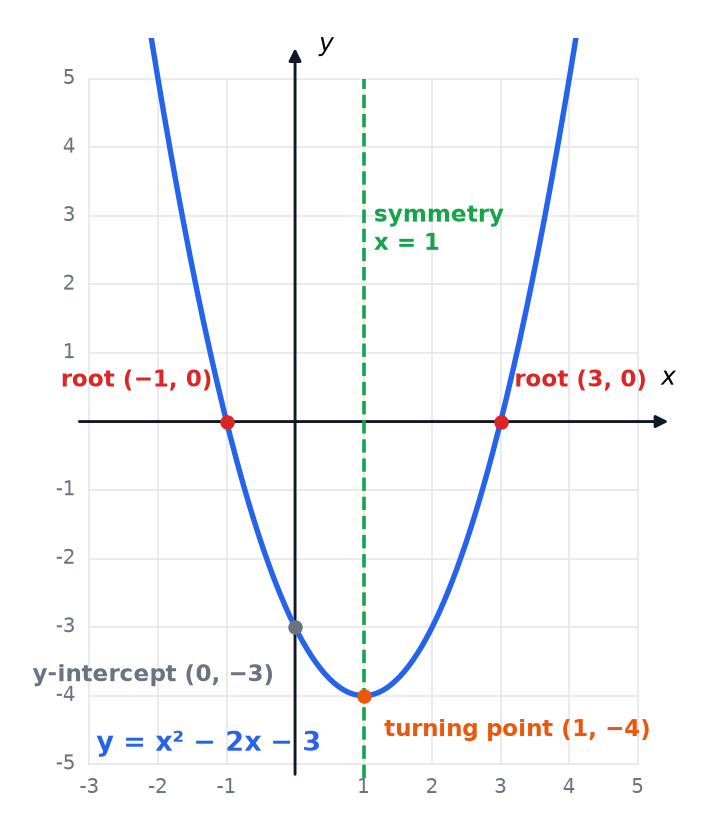
For \(y = x^2 - 2x - 3\) the values for \(x = -2, -1, 0, 1, 2, 3, 4\) are \(5, 0, -3, -4, -3, 0, 5\).
-
Draw a smooth curve
Do not use a ruler. Draw through the points in one flowing line, and do not make the bottom pointed or flat.
Features of a parabola
Every parabola has a line of symmetry through its turning point. The curve either side is a mirror image, which is why the table of values is also symmetrical.
The features to name
- Roots Where the curve crosses the \(x\)-axis, so \(y = 0\). Here they are \(x = -1\) and \(x = 3\).
- Turning point The lowest point of a U-shaped curve, here \((1, -4)\), or the highest point of an upside-down U.
- Line of symmetry A vertical line through the turning point, here \(x = 1\).
- y-intercept Where the curve crosses the \(y\)-axis. It is the number on its own, here \(-3\).
Solving from the graph
Use the graph of \(y = x^2 - 2x - 3\) to solve \(x^2 - 2x - 3 = 0\).
Show the solutionHide the solution
- 1 Understand the equation \(x^2 - 2x - 3 = 0\) means \(y = 0\), so look for where the curve crosses the \(x\)-axis.
- 2 Read the crossing points The curve crosses at \(x = -1\) and \(x = 3\).
- 3 Check \((-1)^2 - 2(-1) - 3 = 1 + 2 - 3 = 0\) and \(3^2 - 6 - 3 = 0\).
- 4 Write both answers A quadratic usually has two solutions.
Answer\(x = -1\) and \(x = 3\)
Solving other equations from the same graph
A graph can solve more than one equation. Draw a horizontal line at the right height.
-
Equal to a number
To solve \(x^2 - 2x - 3 = -3\), draw the line \(y = -3\) and read the \(x\)-values where it meets the curve: \(x = 0\) and \(x = 2\).
-
Between the roots
The curve is below the \(x\)-axis for \(-1 < x < 3\), so \(x^2 - 2x - 3 < 0\) there.
-
No solutions
A horizontal line below the turning point, such as \(y = -6\), does not meet the curve.
-
Show your reading
Draw the line on the grid and mark where it crosses, because the method is worth a mark.
Sketching and completing the square
A sketch shows the shape and the key points, not accurate plotting.
-
Direction
Positive \(x^2\) gives a U, negative gives an upside-down U, like \(y = 4x - x^2\).
-
Mark the intercepts
The \(y\)-intercept is the constant, and the roots come from factorising.
-
Turning point from the roots
The turning point is halfway between the roots in \(x\). Roots at 1 and 3 give a turning point at \(x = 2\).
-
Completing the square (Higher tier)
\(y = (x - a)^2 + b\) has its turning point at \((a, b)\). Since \(x^2 - 2x - 3 = (x - 1)^2 - 4\), the turning point is \((1, -4)\).
A turning point from the roots
The curve \(y = x^2 - 6x + 5\) crosses the \(x\)-axis at \(x = 1\) and \(x = 5\). Work out the coordinates of its turning point.
Show the solutionHide the solution
- 1 Use symmetry The turning point is halfway between the roots: \(x = \dfrac{1 + 5}{2} = 3\).
- 2 Find y \(y = 3^2 - 6 \times 3 + 5 = 9 - 18 + 5 = -4\).
- 3 Write the point \((3, -4)\).
- 4 Check the shape The \(x^2\) term is positive, so the turning point is a minimum, which fits a negative \(y\)-value.
Answer\((3, -4)\)
Test yourself
-
1
What is the shape of the graph of a quadratic?
Show answerHide answer
A parabola, a smooth U or upside-down U.
-
2
What are the roots of a graph?
Show answerHide answer
The \(x\)-values where the curve crosses the \(x\)-axis.
-
3
Where is the line of symmetry of \(y = x^2 - 6x + 5\)?
Show answerHide answer
At \(x = 3\), halfway between the roots 1 and 5.
-
4
What is the \(y\)-intercept of \(y = x^2 + 4x - 7\)?
Show answerHide answer
\(-7\).
-
5
What do you draw to solve \(x^2 - 2x - 3 = 2\) from a graph of \(y = x^2 - 2x - 3\)?
Show answerHide answer
The line \(y = 2\).
Exam technique: quadratic graphs
The curve is marked for accuracy and for smoothness.
-
Check the table with symmetry
The \(y\)-values should read the same in both directions around the turning point.
-
Plot every point
If a point is off the curve, recheck it.
-
Draw by hand
A smooth curve through the points, with no ruler and no gaps.
-
Give both solutions
Roots come in pairs, so write both unless the question says positive only.
Summary and exam focus
- A quadratic graph is a smooth parabola, a U shape if \(x^2\) is positive.
- The roots are where it crosses the \(x\)-axis, and the turning point lies on the line of symmetry, halfway between them.
- The \(y\)-intercept is the constant term.
- To solve \(ax^2 + bx + c = k\), read the \(x\)-values where the curve meets the line \(y = k\).
Exam focus
Here is the graph of \(y = x^2 - 4x + 3\). Use the graph to write down the solutions of \(x^2 - 4x + 3 = 0\). (2 marks) (2 marks)
Read the \(x\)-values where the curve crosses the \(x\)-axis, which are 1 and 3. Both answers are needed for the second mark. If the graph is not accurate enough, you can check by substituting.
Key terms
The words this lesson expects you to use. Each one is linked from the first place it appears above.
- Quadratic
- An expression or equation whose highest power of \(x\) is \(x^2\).
- Parabola
- The smooth U-shaped curve that is the graph of a quadratic.
- Root
- A value of \(x\) where a graph crosses the \(x\)-axis, so \(y = 0\).
- Turning point
- The point where a curve changes direction, such as the lowest point of a U.
- Line of symmetry
- A line that divides a shape into two mirror-image halves.
- Maximum
- The highest value, found at the turning point of an upside-down U.
- Minimum
- The lowest value, found at the turning point of a U.
- y-intercept
- The point where a graph crosses the \(y\)-axis.
- Completing the square
- Rewriting a quadratic as \((x - a)^2 + b\) to find its turning point.
Questions and answers
15 questions set on this lesson, with the mark schemes and model answers open.
Complete the table of values for \(y = x^2 - 2x\). \(x = -1, 0, 1, 2, 3\)
Mark scheme — 2 marks available
- At least three correct values — M1
- \(3, 0, -1, 0, 3\) — A1
Model answer
The values are \(3, 0, -1, 0, 3\).
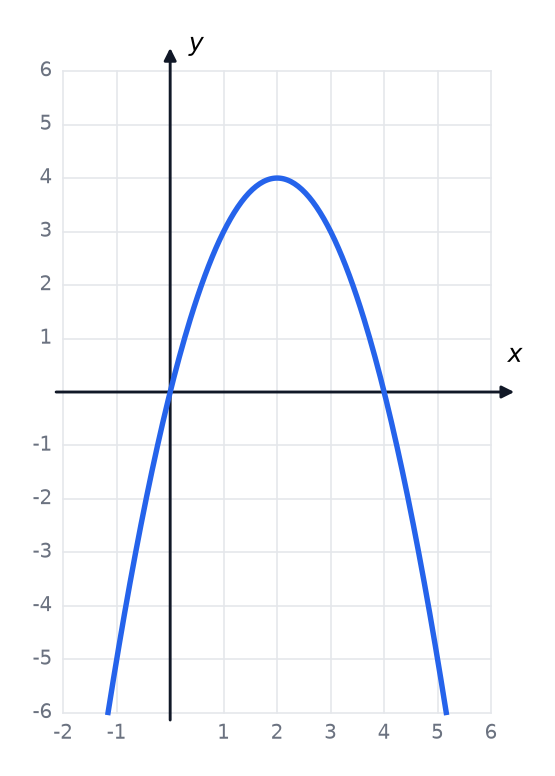
The diagram shows the graph of \(y = 4x - x^2\). (a) Write down the coordinates of the maximum point. [1 mark] (b) Use the graph to solve \(4x - x^2 = 0\). [2 marks] (c) Write down the equation of the line of symmetry. [1 mark]
Mark scheme — 4 marks available
- (a) \((2, 4)\) — B1
- (b) One of \(x = 0\) or \(x = 4\) — M1
- (b) \(x = 0\) and \(x = 4\) — A1
- (c) \(x = 2\) — B1
Model answer
(a) The highest point is \((2, 4)\). (b) The curve crosses the \(x\)-axis at \(x = 0\) and \(x = 4\). (c) The line of symmetry is \(x = 2\).
A curve has equation \(y = x^2 + 2x - 3\). (a) Write down the coordinates of the point where the curve crosses the \(y\)-axis. [1 mark] (b) Solve \(x^2 + 2x - 3 = 0\) to find where the curve crosses the \(x\)-axis. [2 marks]
Mark scheme — 3 marks available
- (a) \((0, -3)\) — B1
- (b) \((x + 3)(x - 1)\) — M1
- (b) \(x = -3\) and \(x = 1\) — A1
Model answer
(a) \((0, -3)\). (b) \(x^2 + 2x - 3 = (x + 3)(x - 1) = 0\), so \(x = -3\) and \(x = 1\).
The curve \(y = x^2 - 4x + k\) has its turning point at \((2, -1)\). Find the value of \(k\).
Mark scheme — 3 marks available
- \(x = 2\) and \(y = -1\) substituted — M1
- \(-1 = 4 - 8 + k\) — M1
- 3 — A1
Model answer
At the turning point \(x = 2\) and \(y = -1\), so \(-1 = 2^2 - 4 \times 2 + k = -4 + k\) and \(k = 3\).
(a) Write \(x^2 - 10x + 7\) in the form \((x - a)^2 + b\). [2 marks] (b) Write down the coordinates of the turning point of the graph of \(y = x^2 - 10x + 7\). [1 mark]
Mark scheme — 3 marks available
- (a) \((x - 5)^2\) seen — M1
- (a) \((x - 5)^2 - 18\) — A1
- (b) \((5, -18)\) — B1
Model answer
(a) \((x - 5)^2 - 25 + 7 = (x - 5)^2 - 18\). (b) The turning point is \((5, -18)\).
The graph of \(y = x^2 - 4x + 3\) crosses the \(x\)-axis at \(x = 1\) and \(x = 3\). Write down the values of \(x\) for which \(y\) is negative.
Mark scheme — 2 marks available
- Between the roots 1 and 3 identified — M1
- \(1 < x < 3\) — A1
Model answer
The graph is a U shape, so it is below the \(x\)-axis between the roots: \(1 < x < 3\).
What is the shape of the graph of a quadratic equation?
Why: Quadratic graphs are parabolas.
What are the roots of a graph?
Why: At the roots \(y = 0\), so the curve meets the \(x\)-axis.
Work out \(y\) when \(x = -2\) on \(y = x^2 - 2x - 3\).
Why: \((-2)^2 - 2 \times (-2) - 3 = 4 + 4 - 3 = 5\).
What is the \(y\)-intercept of \(y = x^2 + 4x - 7\)?
Why: Put \(x = 0\): \(y = -7\).
The graph of \(y = x^2 - 2x - 3\) crosses the \(x\)-axis at \(-1\) and 3. What are the solutions of \(x^2 - 2x - 3 = 0\)?
Why: The solutions are the \(x\)-values where \(y = 0\).
A parabola crosses the \(x\)-axis at \(x = 1\) and \(x = 5\). What is its line of symmetry?
Why: The line of symmetry is halfway between the roots: \(\dfrac{1 + 5}{2} = 3\).
The curve \(y = x^2 - 4x + 3\) crosses the \(x\)-axis at 1 and 3. What are the coordinates of its turning point?
Why: \(x = 2\) is halfway between the roots. Then \(y = 4 - 8 + 3 = -1\).
Which line do you draw on the graph of \(y = x^2 - 2x - 3\) to solve \(x^2 - 2x - 3 = 2\)?
Why: Solutions are where the curve meets the horizontal line \(y = 2\).
What are the coordinates of the turning point of \(y = (x - 3)^2 - 4\)?
Why: In \(y = (x - a)^2 + b\) the turning point is \((a, b)\).