Maths · Standard Form and Accuracy
Viewing as
Teacher view: every answer and mark scheme set out in full.
Standard Form
Writing very large and very small numbers in standard form, converting back, and comparing and ordering them.
Learning Objectives
- 1Write large and small numbers in standard form, and convert back to ordinary numbers.
- 2Say whether a number is in standard form, and correct it if it is not.
- 3Compare and order numbers written in standard form.
- 4Choose the right power of 10 for a number from its size.
Very big and very small numbers
Standard form is a short way to write numbers that are very large or very small, such as the distance to the Sun or the width of a cell. A number in standard form is written as \(A \times 10^n\), where \(A\) is at least 1 and less than 10, and \(n\) is a whole number. The skill is moving the decimal point the right number of places and counting carefully, which is why the examiner usually asks for the working as well as the answer. Standard form is on every Foundation and Higher paper, and the non-calculator paper uses it with simple numbers.
What standard form means
A number in standard form has two parts, a number between 1 and 10 and a power of 10.
-
The first part
\(A\) must be at least 1 and less than 10, so \(4.5\) is allowed but \(45\) and \(0.45\) are not.
-
The power
\(n\) is a whole number. It is positive for numbers of 10 or more, and negative for numbers between 0 and 1.
-
Example
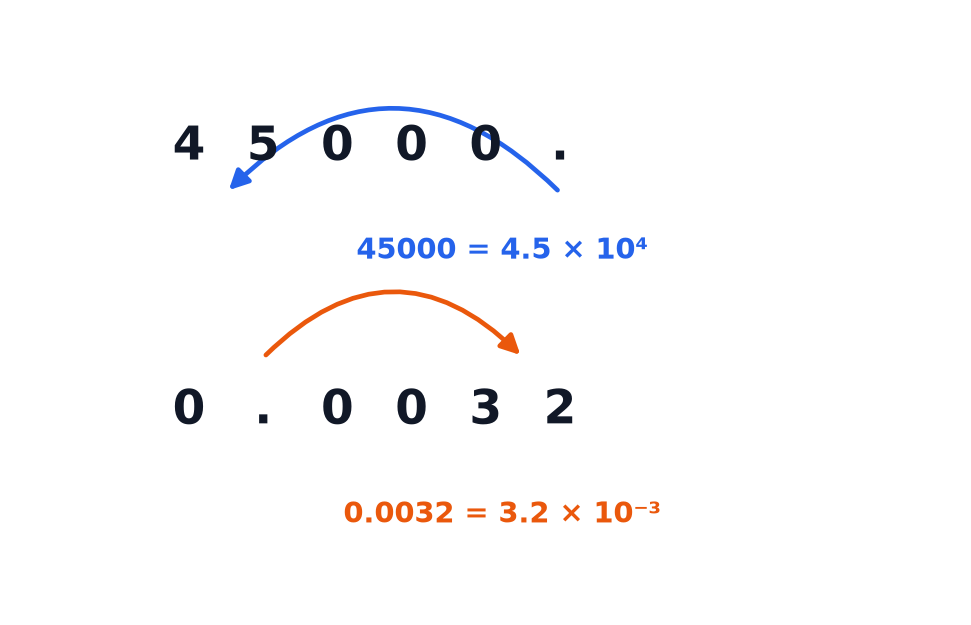
\(45\,000 = 4.5 \times 10^4\), because the decimal point moves 4 places to the left.
-
Example
\(0.0032 = 3.2 \times 10^{-3}\), because the decimal point moves 3 places to the right.
Moving the decimal point
Count how many places the decimal point moves to make a number between 1 and 10. Moving left means a positive power, and moving right means a negative power.
A quick check
- Big number The power is positive, and it is one less than the number of digits before the decimal point.
- Small number The power is negative, and it is the number of places the first non-zero digit is after the decimal point.
- Test the answer \(4.5 \times 10^4\) means \(4.5 \times 10\,000 = 45\,000\).
- Between 1 and 10 If the first part is not in that range, adjust it.
Writing numbers in standard form
Write (a) \(3\,200\,000\) and (b) \(0.00045\) in standard form.
Show the solutionHide the solution
- 1 Part (a) place the point \(3.2\) is between 1 and 10.
- 2 Part (a) count The decimal point moves 6 places left, so the power is 6.
- 3 Part (b) place the point \(4.5\) is between 1 and 10.
- 4 Part (b) count The decimal point moves 4 places right, so the power is \(-4\).
Answer(a) \(3.2 \times 10^6\) (b) \(4.5 \times 10^{-4}\)
Numbers that are not in standard form
If \(A\) is not between 1 and 10, adjust it and change the power to keep the value the same.
-
Too big
\(45 \times 10^3 = 4.5 \times 10 \times 10^3 = 4.5 \times 10^4\).
-
Too small
\(0.6 \times 10^5 = 6 \times 10^{-1} \times 10^5 = 6 \times 10^4\).
-
Rule
Each time \(A\) is divided by 10, the power goes up by 1, and each time \(A\) is multiplied by 10, the power goes down by 1.
-
Explain
"45 is not between 1 and 10" earns the mark.
Comparing and ordering
Compare the powers first, then the first parts.
-
Bigger power
\(2 \times 10^7\) is bigger than \(9 \times 10^6\), because 7 is bigger than 6.
-
Same power
\(3.4 \times 10^5\) is bigger than \(2.9 \times 10^5\).
-
Negative powers
\(5 \times 10^{-3}\) is bigger than \(8 \times 10^{-5}\), because \(-3\) is bigger than \(-5\).
-
Check
Write them as ordinary numbers if you are not sure.
Ordering numbers
Write these in order, smallest first: \(3.4 \times 10^5\), \(2.9 \times 10^6\), \(8.7 \times 10^4\).
Show the solutionHide the solution
- 1 Compare the powers The powers are 5, 6 and 4.
- 2 Smallest The smallest power is 4, so \(8.7 \times 10^4\) is smallest.
- 3 Next Power 5 comes next, then power 6.
- 4 Write the order \(8.7 \times 10^4 < 3.4 \times 10^5 < 2.9 \times 10^6\).
Answer\(8.7 \times 10^4\), \(3.4 \times 10^5\), \(2.9 \times 10^6\)
Test yourself
-
1
What is 45 000 in standard form?
Show answerHide answer
\(4.5 \times 10^4\).
-
2
What is \(3.2 \times 10^{-3}\) as an ordinary number?
Show answerHide answer
0.0032.
-
3
Is \(45 \times 10^3\) in standard form?
Show answerHide answer
No, 45 is not between 1 and 10.
-
4
Which is bigger, \(2 \times 10^7\) or \(9 \times 10^6\)?
Show answerHide answer
\(2 \times 10^7\).
-
5
What does a negative power mean?
Show answerHide answer
The number is between 0 and 1.
Exam technique: standard form
Count with care.
-
Write the first part first
Make sure it is between 1 and 10.
-
Count the places
Mark each jump of the decimal point.
-
Check by converting back
Multiply out the power of 10.
-
Show the working
One counting slip should not lose every mark.
Summary and exam focus
- A number in standard form is \(A \times 10^n\), with \(A\) at least 1 and less than 10.
- Large numbers have positive powers, and numbers between 0 and 1 have negative powers.
- If \(A\) is not between 1 and 10, adjust it and change the power.
- To compare numbers, compare the powers first.
Exam focus
Write \(0.0000052\) in standard form. (2 marks) (2 marks)
The first non-zero digit is the 6th place after the decimal point, so \(0.0000052 = 5.2 \times 10^{-6}\). Check: \(5.2 \times 10^{-6}\) is a very small number, so the power must be negative.
Key terms
The words this lesson expects you to use. Each one is linked from the first place it appears above.
- Standard form
- A number written as \(A \times 10^n\), with \(A\) at least 1 and less than 10.
- Power of 10
- 10 raised to a whole-number power, such as \(10^4\).
- Index
- The small raised number that shows the power.
- Decimal point
- The dot that separates whole numbers from fractions.
- Significant figure
- A digit that carries meaning, starting from the first non-zero digit.
- Ordinary number
- A number written in the usual way, not in standard form.
- Negative power
- A power below zero, which gives a number between 0 and 1.
- Order of magnitude
- The power of 10 that shows roughly how big a number is.
- Scientific notation
- Another name for standard form.
Questions and answers
15 questions set on this lesson, with the mark schemes and model answers open.
Write 620 000 in standard form. [2 marks]
Mark scheme — 2 marks available
- 6.2 seen — M1
- \(6.2 \times 10^5\) — A1
Model answer
The decimal point moves 5 places left, so \(6.2 \times 10^5\).
Write \(5.6 \times 10^{-4}\) as an ordinary number. [2 marks]
Mark scheme — 2 marks available
- Moves the decimal point 4 places — M1
- 0.00056 — A1
Model answer
Move the decimal point 4 places right: 0.00056.
Write these numbers in order of size. Start with the largest. [2 marks] \(4 \times 10^3\) \(3.5 \times 10^4\) \(9 \times 10^2\)
Mark scheme — 2 marks available
- Compares the powers — M1
- \(3.5 \times 10^4\), \(4 \times 10^3\), \(9 \times 10^2\) — A1
Model answer
Compare the powers: 4, 3 and 2. The order is \(3.5 \times 10^4\), \(4 \times 10^3\), \(9 \times 10^2\).
(a) Write 38 000 000 000 in standard form. [1 mark] (b) Write 0.000000075 in standard form. [2 marks]
Mark scheme — 3 marks available
- (a) \(3.8 \times 10^{10}\) — B1
- (b) 7.5 seen — M1
- (b) \(7.5 \times 10^{-8}\) — A1
Model answer
(a) \(3.8 \times 10^{10}\). (b) The point moves 8 places right, so \(7.5 \times 10^{-8}\).
Ben writes \(0.45 \times 10^6\) in standard form. Explain what is wrong, and write it correctly. [2 marks]
Mark scheme — 2 marks available
- 0.45 is not between 1 and 10 — B1
- \(4.5 \times 10^5\) — B1
Model answer
The first number, 0.45, is not at least 1 and less than 10. \(0.45 \times 10^6 = 4.5 \times 10^5\).
\(N = 9.1 \times 10^{-3}\). Write each of these in standard form. [3 marks] (a) \(10N\) [1 mark] (b) \(1000N\) [1 mark] (c) \(N \div 10\) [1 mark]
Mark scheme — 3 marks available
- (a) \(9.1 \times 10^{-2}\) — B1
- (b) \(9.1 \times 10^0\) or 9.1 — B1
- (c) \(9.1 \times 10^{-4}\) — B1
Model answer
(a) \(9.1 \times 10^{-2}\). (b) \(9.1 \times 10^0\), which is 9.1. (c) \(9.1 \times 10^{-4}\).
What is 45 000 in standard form?
Why: The decimal point moves 4 places left to give 4.5.
What is \(3.2 \times 10^{-3}\) as an ordinary number?
Why: A power of \(-3\) moves the decimal point 3 places to the right of the 3, giving 0.0032.
Which of these is in standard form?
Why: The first part must be at least 1 and less than 10, and the base must be 10.
What is 0.00045 in standard form?
Why: The decimal point moves 4 places right, so the power is \(-4\).
What is \(45 \times 10^3\) in standard form?
Why: \(45 = 4.5 \times 10\), so \(45 \times 10^3 = 4.5 \times 10^4\).
Which is bigger, \(2 \times 10^7\) or \(9 \times 10^6\)?
Why: \(2 \times 10^7 = 20\,000\,000\) and \(9 \times 10^6 = 9\,000\,000\).
The distance to the Sun is about 150 million km. What is this in standard form?
Why: 150 million is 150 000 000, so the point moves 8 places to give 1.5.
What is \(3.2 \times 10^5\) as an ordinary number?
Why: Move the decimal point 5 places right.
Which is smaller, \(5 \times 10^{-3}\) or \(8 \times 10^{-5}\)?
Why: \(5 \times 10^{-3} = 0.005\) and \(8 \times 10^{-5} = 0.00008\).