Maths · Transformations and Similarity
Viewing as
Teacher view: every answer and mark scheme set out in full.
Combined Transformations
Carrying out one transformation after another, finding the single equivalent transformation, and spotting invariant points.
Learning Objectives
- 1Carry out a sequence of reflections, rotations and translations on a shape.
- 2Describe the single transformation that has the same effect as a combination of two transformations.
- 3Use the rules for two reflections in parallel lines and in lines that cross.
- 4Identify invariant points and invariant lines.
One transformation after another
When one transformation is followed by another, the final image is often the same as the image from a single transformation, and the exam asks you to find it. This is Higher tier content on every board. The skill is to do the steps carefully, one at a time, on the grid, and then compare the first shape with the last. Several combinations come up again and again, such as two reflections giving a rotation or a translation, so the patterns are worth learning, though the grid always gives you a way to check.
Doing the steps in order
Work out the image after the first transformation, then transform that image.
-
Label each shape
Call the object \(A\), the first image \(B\) and the second image \(C\), so it is clear which shape is which.
-
One step at a time
Transform the whole shape each time, not just one point, so that you can see the final position.
-
Compare \(A\) and \(C\)
Look at how \(A\) turned into \(C\), and ask which single transformation does that.
-
Congruent shapes
Reflections, rotations and translations all keep the size, so \(C\) is congruent to \(A\).
Two reflections make a rotation
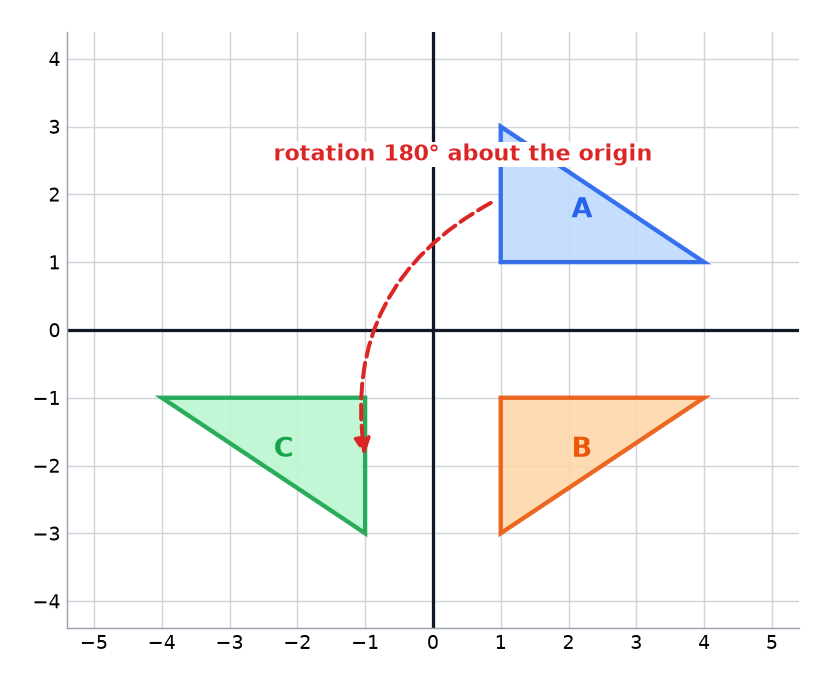
Triangle \(A\) is reflected in the \(x\)-axis to give \(B\), and \(B\) is reflected in the \(y\)-axis to give \(C\). Comparing \(A\) with \(C\), the corner \((4, 1)\) has gone to \((-4, -1)\), which is a rotation of \(180^\circ\) about the origin.
Reading the result
- Both coordinates change sign \((x, y)\) goes to \((-x, -y)\), so the single transformation is a rotation of \(180^\circ\) about the origin.
- The order did not matter here Reflecting in the \(y\)-axis first and the \(x\)-axis second gives the same result.
- Check a corner \((1, 3)\) goes to \((-1, -3)\).
- Mirror image twice The orientation is back to the original, so the combination is a rotation, not a reflection.
Two reflections in parallel lines
The point \((1, 1)\) is reflected in the line \(x = 2\), and the image is then reflected in the line \(x = 5\). Describe the single transformation that takes \((1, 1)\) to the final image.
Show the solutionHide the solution
- 1 First reflection \((1, 1)\) is 1 left of \(x = 2\), so its image is 1 right, at \((3, 1)\).
- 2 Second reflection \((3, 1)\) is 2 left of \(x = 5\), so its image is 2 right, at \((7, 1)\).
- 3 Compare \((1, 1)\) has gone to \((7, 1)\), which is 6 to the right.
- 4 Rule Two reflections in parallel lines give a translation, at right angles to the lines, of twice the distance between them: \(2 \times (5 - 2) = 6\).
AnswerA translation by \(\begin{pmatrix} 6 \\ 0 \end{pmatrix}\)
Patterns to know
These patterns save time, but always check one point on the grid.
-
Two reflections in parallel lines
A translation of twice the distance between the lines, at right angles to them.
-
Two reflections in lines that cross
A rotation about the point where the lines cross, through twice the angle between them.
-
Reflections in the two axes
A rotation of \(180^\circ\) about the origin.
-
Reflection in \(y = x\) then the \(x\)-axis
A rotation of \(90^\circ\) clockwise about the origin, since \((x, y)\) goes to \((y, x)\) and then to \((y, -x)\).
Invariant points and lines
A point or a line is invariant if it does not move under a transformation.
-
Reflection
Every point on the mirror line is invariant.
-
Rotation
The centre is the only invariant point.
-
Enlargement
The centre is the only invariant point, for any scale factor other than 1.
-
Translation
There are no invariant points, because everything moves.
Describing a combination
The point \((2, 1)\) is reflected in the line \(y = x\), and the image is then reflected in the \(x\)-axis. Describe the single transformation that takes \((2, 1)\) to the final image.
Show the solutionHide the solution
- 1 First reflection Swap the coordinates, giving \((1, 2)\).
- 2 Second reflection Change the sign of \(y\), giving \((1, -2)\).
- 3 Compare \((2, 1)\) goes to \((1, -2)\), and the rule for \(90^\circ\) clockwise is \((x, y)\) to \((y, -x)\).
- 4 State it fully Rotation, \(90^\circ\) clockwise, centre the origin.
AnswerA rotation of \(90^\circ\) clockwise about the origin
Test yourself
-
1
What single transformation is a reflection in the \(x\)-axis then the \(y\)-axis?
Show answerHide answer
A rotation of \(180^\circ\) about the origin.
-
2
What do two reflections in parallel lines give?
Show answerHide answer
A translation.
-
3
How far is the translation for parallel lines 3 apart?
Show answerHide answer
6, which is twice the distance.
-
4
Which points are invariant in a reflection?
Show answerHide answer
The points on the mirror line.
-
5
What is invariant in a rotation?
Show answerHide answer
The centre.
Exam technique: combined transformations
Be systematic, and describe the final result in one step.
-
Label every shape
\(A\), \(B\) and \(C\) keep the working clear.
-
Compare the first and last
Describe the single transformation from \(A\) to \(C\), not each step.
-
Test with a point
Check one corner against your rule.
-
Full details
A rotation needs a centre, an angle and a direction, and a translation needs a vector.
Summary and exam focus
- To combine transformations, apply them in order to the whole shape and compare the first shape with the last.
- Two reflections in parallel lines give a translation, and two reflections in crossing lines give a rotation.
- A point is invariant if it does not move.
- Describe the single transformation fully, with a centre, angle or vector as needed.
Exam focus
Triangle \(A\) is reflected in the \(y\)-axis to give \(B\), and \(B\) is reflected in the \(x\)-axis to give \(C\). Describe fully the single transformation that takes \(A\) to \(C\). (3 marks) (3 marks)
Two reflections in the two axes give a rotation of \(180^\circ\) about the origin. Check with a point: \((2, 1)\) goes to \((-2, 1)\) and then to \((-2, -1)\). Write "rotation", "\(180^\circ\)" and "centre the origin" to get all three marks.
Key terms
The words this lesson expects you to use. Each one is linked from the first place it appears above.
- Combined transformation
- One transformation followed by another.
- Invariant
- Not changed by a transformation.
- Invariant point
- A point that stays in the same place under a transformation.
- Single transformation
- One transformation that has the same effect as a combination.
- Reflection
- A transformation that flips a shape over a mirror line.
- Rotation
- A transformation that turns a shape about a centre.
- Translation
- A transformation that slides a shape.
- Parallel lines
- Lines that stay the same distance apart and never meet.
- Congruent
- Having exactly the same size and shape.
Questions and answers
15 questions set on this lesson, with the mark schemes and model answers open.
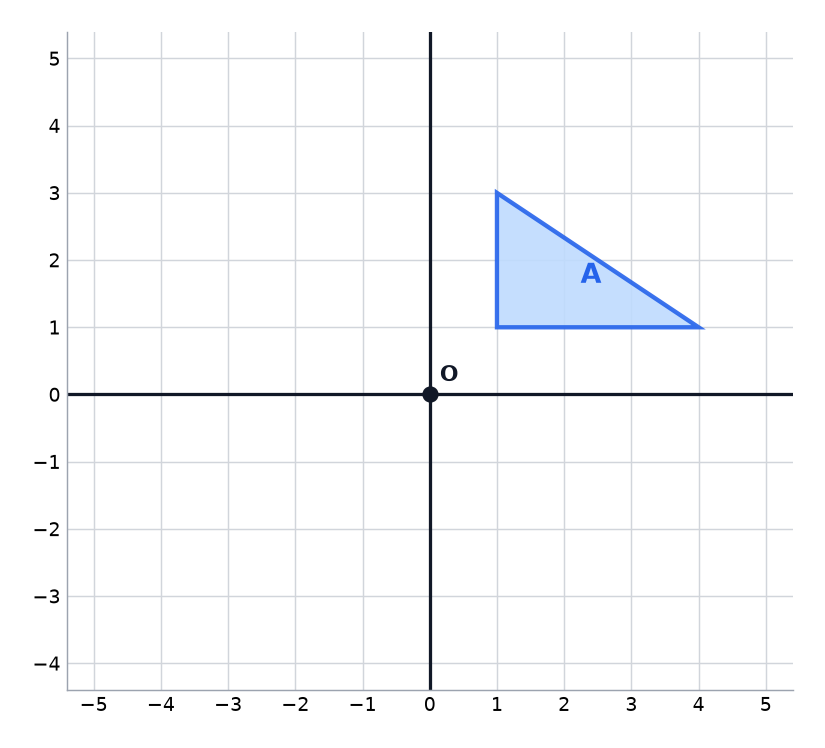
Triangle \(A\) is rotated through \(90^\circ\) anticlockwise about the origin \(O\) to give triangle \(B\). Triangle \(B\) is reflected in the \(y\)-axis to give triangle \(C\). (a) Draw triangles \(B\) and \(C\). [2 marks] (b) Describe fully the single transformation that maps \(A\) onto \(C\). [2 marks]
Mark scheme — 4 marks available
- (a) \(B\) correct — B1
- (a) \(C\) correct — B1
- (b) Reflection — B1
- (b) In the line \(y = x\) — B1
Model answer
(a) \(B\) has vertices \((-1, 1)\), \((-1, 4)\) and \((-3, 1)\), and \(C\) has vertices \((1, 1)\), \((1, 4)\) and \((3, 1)\). (b) \((x, y)\) goes to \((-y, x)\) and then to \((y, x)\), which is a reflection in the line \(y = x\).
The point \((2, 5)\) is reflected in the line \(y = 1\), and the image is then reflected in the line \(y = 4\). Describe the single transformation that has the same effect. [3 marks]
Mark scheme — 3 marks available
- \((2, -3)\) seen — M1
- \((2, 11)\) seen — M1
- Translation by \(\begin{pmatrix} 0 \\ 6 \end{pmatrix}\) — A1
Model answer
The first reflection gives \((2, -3)\) and the second gives \((2, 11)\). The point has moved 6 up, which is twice the distance between the lines. It is a translation by \(\begin{pmatrix} 0 \\ 6 \end{pmatrix}\).
(a) A shape is enlarged by a scale factor of 2 with the centre \((1, 1)\). Write down the coordinates of the point that does not move. [1 mark] (b) A shape is reflected in the line \(x = 3\). Describe the points that do not move. [1 mark]
Mark scheme — 2 marks available
- (a) \((1, 1)\) — B1
- (b) The points on the line \(x = 3\) — B1
Model answer
(a) The centre of enlargement, \((1, 1)\). (b) Every point on the line \(x = 3\).
The point \((3, 2)\) is reflected in the \(x\)-axis and the image is then translated by the vector \(\begin{pmatrix} -4 \\ 1 \end{pmatrix}\). Calculate the coordinates of the final image. [3 marks]
Mark scheme — 3 marks available
- \((3, -2)\) — B1
- Adds the vector to their image — M1
- \((-1, -1)\) — A1
Model answer
The reflection gives \((3, -2)\), and the translation gives \((3 - 4, -2 + 1) = (-1, -1)\).
Show that a rotation of \(90^\circ\) clockwise about the origin followed by a rotation of \(90^\circ\) clockwise about the origin is the same as a rotation of \(180^\circ\) about the origin. Use the point \((4, 1)\). [3 marks]
Mark scheme — 3 marks available
- \((1, -4)\) seen — M1
- \((-4, -1)\) seen — M1
- Compares with the \(180^\circ\) rotation, \((-4, -1)\) — A1
Model answer
The first rotation sends \((4, 1)\) to \((1, -4)\), and the second sends it to \((-4, -1)\). A \(180^\circ\) rotation about the origin sends \((4, 1)\) to \((-4, -1)\), the same point.
The point \((3, 1)\) is reflected in the \(y\)-axis and the image is then reflected in the line \(y = x\). Describe fully the single transformation that has the same effect. [4 marks]
Mark scheme — 4 marks available
- \((-3, 1)\) seen — M1
- \((1, -3)\) seen — M1
- Rotation, \(90^\circ\) clockwise — A1
- About the origin — A1
Model answer
The first reflection gives \((-3, 1)\), and the second gives \((1, -3)\). In general \((x, y)\) goes to \((-x, y)\) and then to \((y, -x)\). That is a rotation of \(90^\circ\) clockwise about the origin.
What single transformation is a reflection in the \(x\)-axis followed by a reflection in the \(y\)-axis?
Why: \((x, y)\) goes to \((x, -y)\) and then to \((-x, -y)\), which is a half turn.
What do two reflections in parallel lines give?
Why: The shape is moved in a straight line, at right angles to the mirror lines.
The point \((1, 1)\) is reflected in \(x = 2\) and then in \(x = 5\). Which translation has the same effect?
Why: The lines are 3 apart, and the translation is twice that distance, 6, at right angles to them.
Which points are invariant in a reflection?
Why: Points on the mirror line do not move.
Which point is invariant in a rotation?
Why: The centre stays fixed while everything else turns around it.
The point \((2, 1)\) is reflected in the line \(y = x\) and then in the \(x\)-axis. What is the final image?
Why: Swapping gives \((1, 2)\), and changing the sign of \(y\) gives \((1, -2)\).
Two mirror lines cross at a point, with an angle of \(30^\circ\) between them. What single transformation is a reflection in one followed by the other?
Why: The rotation is through twice the angle between the lines.
Does a translation have an invariant point?
Why: A translation moves every point by the same vector.
Two rotations of \(90^\circ\) clockwise about the same centre are carried out one after the other. What single transformation is this?
Why: \(90^\circ + 90^\circ = 180^\circ\).