Maths · Transformations and Similarity
Viewing as
Teacher view: every answer and mark scheme set out in full.
Congruence and Similarity
Proving triangles congruent, finding missing lengths in similar shapes, and using scale factors for length, area and volume.
Learning Objectives
Same shape, same size or same shape, different size
Two shapes are congruent if they are exactly the same size and shape, so one can be moved onto the other by reflections, rotations and translations. Two shapes are similar if they are the same shape but not necessarily the same size, so one is an enlargement of the other. The exam questions are about proving that triangles are congruent, using the correct conditions and giving reasons, and about finding missing lengths in similar shapes using a scale factor. All the numbers are chosen so that the scale factors are whole numbers or simple fractions, and none of the sums needs a calculator.
Congruent triangles
Two triangles are congruent if you can show that one of four conditions is true.
-
SSS
All three sides are equal.
-
SAS
Two sides and the angle between them are equal.
-
ASA
Two angles and a side between or next to them are equal. If two angles are equal, the third is too.
-
RHS
A right angle, the hypotenuse and one other side are equal.
Matching triangles
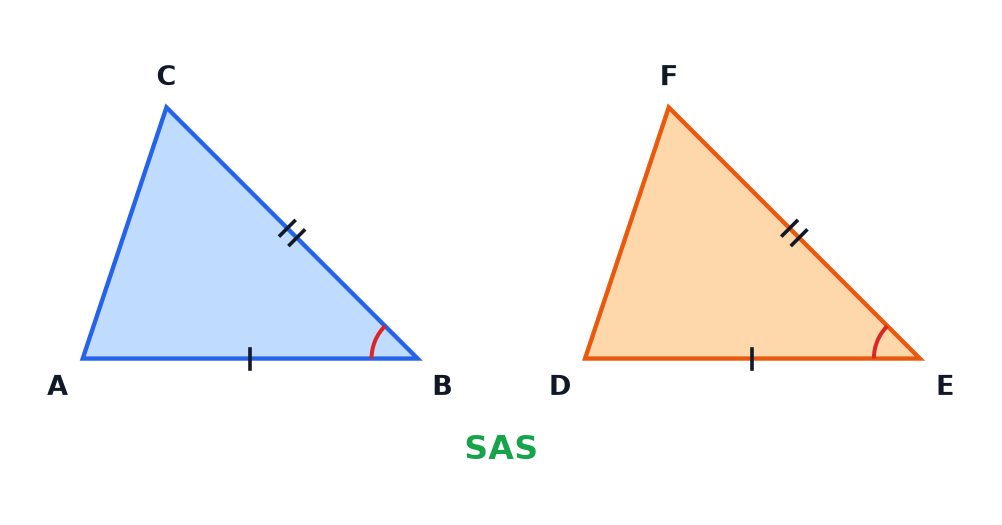
The matching ticks show equal sides: \(AB = DE\) and \(BC = EF\). The red arcs show that the angle \(B\) equals the angle \(E\), and this angle is between the two sides. Two sides and the angle between them are equal, so the triangles are congruent by SAS.
What is not enough
- AAA Three equal angles give similar triangles, but they could be different sizes.
- SSA Two sides and an angle that is not between them does not fix the triangle.
- Say which condition Always name SSS, SAS, ASA or RHS in a proof.
- Corresponding order Write the vertices in matching order, such as triangle \(ABC\) is congruent to triangle \(DEF\).
Proving two triangles are congruent
In the quadrilateral \(ABCD\), \(AB = AD\) and \(BC = DC\). Prove that triangles \(ABC\) and \(ADC\) are congruent.
Show the solutionHide the solution
- 1 Equal sides \(AB = AD\) is given.
- 2 Equal sides \(BC = DC\) is given.
- 3 Common side \(AC\) is a side of both triangles.
- 4 Conclusion All three sides are equal, so the triangles are congruent by SSS.
AnswerSSS: \(AB = AD\), \(BC = DC\), and \(AC\) is common
Similar shapes
Similar shapes have equal angles and sides in the same ratio.
-
Scale factor
Divide a side of the larger shape by the matching side of the smaller shape.
-
Corresponding sides
Match the sides in the same position, such as the shortest side with the shortest side.
-
Missing length
Multiply or divide by the scale factor.
-
Triangles
If two angles are equal, the triangles are similar, because the third angle is equal too.
Similar triangles
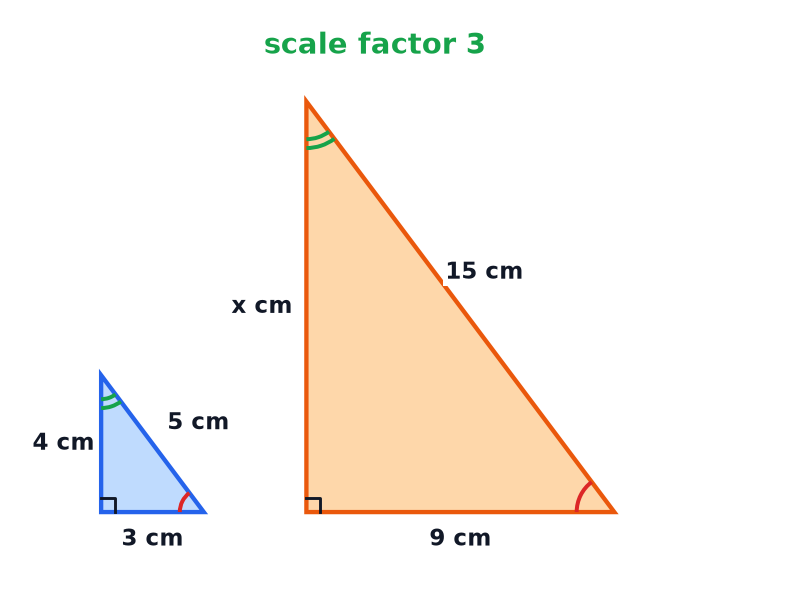
The matching sides are 3 and 9, so the scale factor is \(\dfrac{9}{3} = 3\). The hypotenuse is \(5 \times 3 = 15\), which matches the diagram, and the missing side is \(x = 4 \times 3 = 12\) cm.
Using the scale factor
- Find it from a pair of matching sides \(9 \div 3 = 3\).
- Multiply for a larger shape \(x = 4 \times 3 = 12\).
- Divide for a smaller shape A side of 15 on the larger triangle corresponds to \(15 \div 3 = 5\).
- Check All three sides are in the ratio \(1 : 3\).
A missing length in similar shapes
Triangles \(ABC\) and \(PQR\) are similar. \(AB = 6\) cm, \(BC = 8\) cm and \(PQ = 9\) cm, where \(AB\) corresponds to \(PQ\) and \(BC\) corresponds to \(QR\). Work out the length of \(QR\).
Show the solutionHide the solution
- 1 Scale factor \(\dfrac{PQ}{AB} = \dfrac{9}{6} = 1.5\).
- 2 Multiply \(QR = 8 \times 1.5\).
- 3 Calculate \(8 \times 1.5 = 12\) cm.
- 4 Check \(\dfrac{12}{8} = 1.5\), the same scale factor.
Answer12 cm
Area and volume of similar shapes (Higher tier)
When the lengths are multiplied by \(k\), the areas are multiplied by \(k^2\) and the volumes by \(k^3\).
-
Length scale factor
\(k\).
-
Area scale factor
\(k^2\). A shape with sides doubled has 4 times the area.
-
Volume scale factor
\(k^3\). A solid with lengths doubled has 8 times the volume.
-
Working backwards
If the areas are in the ratio \(9 : 25\), the lengths are in the ratio \(3 : 5\), because \(\sqrt{9} = 3\) and \(\sqrt{25} = 5\).
Scale factors for area and volume
Two similar cones have heights of 4 cm and 12 cm. The smaller cone has a volume of 30 cm\(^3\). Work out the volume of the larger cone.
Show the solutionHide the solution
- 1 Length scale factor \(\dfrac{12}{4} = 3\).
- 2 Volume scale factor \(3^3 = 27\).
- 3 Multiply \(30 \times 27 = 810\).
- 4 Check the size The larger cone is much bigger, which is reasonable for lengths three times as long.
Answer810 cm\(^3\)
Test yourself
-
1
What does congruent mean?
Show answerHide answer
Exactly the same size and shape.
-
2
Name the four conditions for congruent triangles.
Show answerHide answer
SSS, SAS, ASA and RHS.
-
3
Are two triangles with equal angles always congruent?
Show answerHide answer
No, they are only similar.
-
4
How do you find the scale factor between similar shapes?
Show answerHide answer
Divide a length on one shape by the matching length on the other.
-
5
If the lengths are doubled, what happens to the area?
Show answerHide answer
It is multiplied by 4.
Exam technique: congruence and similarity
State the condition, and match the sides carefully.
-
Give a reason for every statement
"Common side", "given" and "vertically opposite angles" are all reasons.
-
Name the condition
Finish with SSS, SAS, ASA or RHS.
-
Match corresponding sides
Check the letters before dividing.
-
Use ratios
A scale factor from sides can be reused for the other missing sides.
Summary and exam focus
- Congruent shapes are identical, and triangles are congruent if SSS, SAS, ASA or RHS holds.
- Similar shapes have equal angles and sides in the same ratio, the scale factor.
- Find a missing length by multiplying or dividing by the scale factor.
- Areas scale by \(k^2\) and volumes by \(k^3\) (Higher tier).
Exam focus
Triangles \(ABC\) and \(DEF\) are similar. \(AB = 4\) cm and \(DE = 10\) cm. \(BC = 6\) cm, where \(BC\) corresponds to \(EF\). Work out the length of \(EF\). (2 marks) (2 marks)
The scale factor is \(\dfrac{10}{4} = 2.5\), so \(EF = 6 \times 2.5 = 15\) cm. Writing the scale factor first earns the method mark, even if the final multiplication slips.
Key terms
The words this lesson expects you to use. Each one is linked from the first place it appears above.
- Congruent
- Exactly the same size and shape.
- Similar
- The same shape, with corresponding sides in the same ratio.
- Scale factor
- The ratio of corresponding lengths in similar shapes.
- Corresponding sides
- Sides in the same position on two similar shapes.
- SSS
- A condition for congruence: three pairs of equal sides.
- SAS
- A condition for congruence: two sides and the angle between them equal.
- ASA
- A condition for congruence: two angles and a side equal.
- RHS
- A condition for congruence of right-angled triangles: hypotenuse and one other side equal.
- Proof
- A logical argument that shows a statement is true, with a reason for each step.
Questions and answers
15 questions set on this lesson, with the mark schemes and model answers open.
Two triangles each have angles of \(40^\circ\), \(60^\circ\) and \(80^\circ\). Are the triangles congruent? Explain your answer. [2 marks]
Mark scheme — 2 marks available
- Not necessarily — B1
- They could be different sizes, or the angles only show similarity — B1
Model answer
Not necessarily. Equal angles show the triangles are similar, but they could be different sizes, so they are not necessarily congruent.
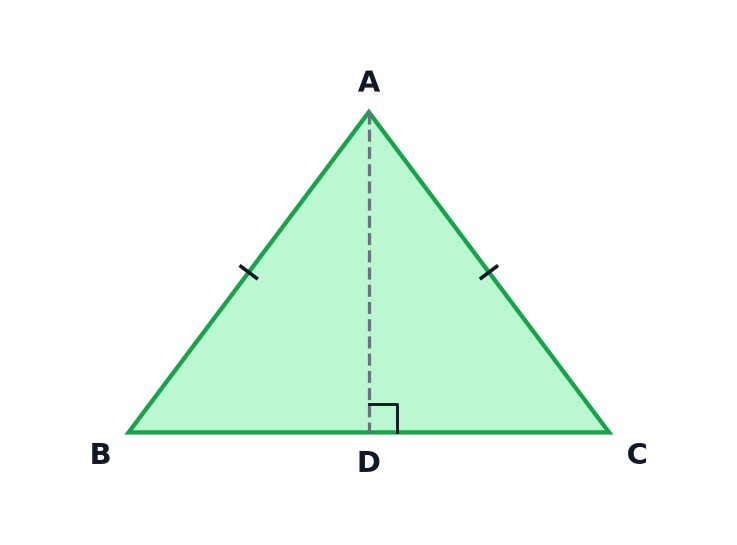
Triangle \(ABC\) is isosceles with \(AB = AC\). \(D\) is a point on \(BC\) such that \(AD\) is perpendicular to \(BC\). (a) Prove that triangles \(ABD\) and \(ACD\) are congruent. [3 marks] (b) Hence show that \(BD = DC\). [1 mark]
Mark scheme — 4 marks available
- Right angle at D in both triangles — M1
- \(AB = AC\) and \(AD\) common — M1
- RHS, so the triangles are congruent — A1
- (b) \(BD = DC\) from the congruent triangles — B1
Model answer
(a) Both triangles have a right angle at \(D\), the hypotenuses \(AB\) and \(AC\) are equal (given), and \(AD\) is a common side. The triangles are congruent by RHS. (b) Corresponding sides of congruent triangles are equal, so \(BD = DC\).
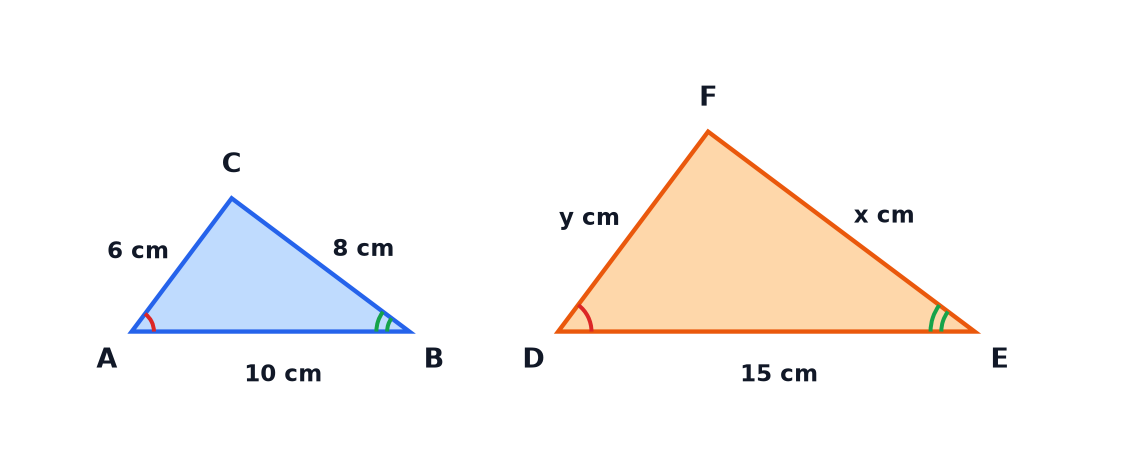
Triangles \(ABC\) and \(DEF\) are similar. (a) Calculate the scale factor from \(ABC\) to \(DEF\). [1 mark] (b) Calculate the length of \(EF\). [1 mark] (c) Calculate the length of \(FD\). [1 mark]
Mark scheme — 3 marks available
- (a) 1.5 — B1
- (b) 12 — B1
- (c) 9 — B1
Model answer
(a) \(DE\) matches \(AB\), so the scale factor is \(\dfrac{15}{10} = 1.5\). (b) \(EF = 8 \times 1.5 = 12\) cm. (c) \(FD = 6 \times 1.5 = 9\) cm.
A photograph is 10 cm by 15 cm. It is enlarged so that the shorter side is 25 cm. (a) Calculate the length of the longer side of the enlarged photograph. [2 marks] (b) Calculate the perimeter of the enlarged photograph. [1 mark]
Mark scheme — 3 marks available
- (a) \(\dfrac{25}{10}\) or 2.5 — M1
- (a) 37.5 cm — A1
- (b) 125 cm — B1 (follow through from (a))
Model answer
(a) The scale factor is \(\dfrac{25}{10} = 2.5\), so the longer side is \(15 \times 2.5 = 37.5\) cm. (b) \(2 \times (25 + 37.5) = 125\) cm.
Two similar shapes have corresponding lengths of 6 cm and 15 cm. The area of the smaller shape is 8 cm\(^2\). Calculate the area of the larger shape. [3 marks]
Mark scheme — 3 marks available
- \(\dfrac{15}{6}\) or 2.5 — M1
- \(8 \times 2.5^2\) or \(8 \times 6.25\) — M1
- 50 cm\(^2\) — A1
Model answer
The length scale factor is \(\dfrac{15}{6} = 2.5\), so the area scale factor is \(2.5^2 = 6.25\). The larger area is \(8 \times 6.25 = 50\) cm\(^2\).
Two similar bottles have heights of 15 cm and 20 cm. The smaller bottle holds 270 ml. Calculate the volume of the larger bottle. [3 marks]
Mark scheme — 3 marks available
- \(\dfrac{20}{15}\) or \(\dfrac{4}{3}\) — M1
- \(270 \times \left(\dfrac{4}{3}\right)^3\) or \(270 \times \dfrac{64}{27}\) — M1
- 640 ml — A1
Model answer
The length scale factor is \(\dfrac{20}{15} = \dfrac{4}{3}\), so the volume scale factor is \(\left(\dfrac{4}{3}\right)^3 = \dfrac{64}{27}\). The larger bottle holds \(270 \times \dfrac{64}{27} = 640\) ml.
Which of these is not enough to show that two triangles are congruent?
Why: Three equal angles give similar triangles, which may be different sizes.
Two triangles have two equal sides and the equal angle between them. Which condition is this?
Why: Side, angle, side with the angle between the sides is SAS.
Two similar triangles have matching sides of 6 cm and 15 cm. What is the scale factor from the smaller to the larger?
Why: \(\dfrac{15}{6} = 2.5\).
A triangle with sides 3, 4 and 5 cm is similar to a triangle with sides 9 cm, \(x\) cm and 15 cm. What is \(x\)?
Why: The scale factor is \(\dfrac{9}{3} = 3\), so \(x = 4 \times 3 = 12\).
Triangles \(ABC\) and \(DEF\) are similar, with \(AB = 4\), \(DE = 10\) and \(BC = 6\). What is \(EF\)?
Why: The scale factor is \(\dfrac{10}{4} = 2.5\), so \(EF = 6 \times 2.5 = 15\) cm.
Two triangles have all three angles equal. What can you say?
Why: Equal angles make the shapes similar, but not necessarily the same size.
The lengths of a shape are doubled. By what factor is the area multiplied?
Why: The area scale factor is \(2^2 = 4\).
The lengths of a solid are multiplied by 3. By what factor is the volume multiplied?
Why: The volume scale factor is \(3^3 = 27\).
Two similar shapes have areas in the ratio \(9 : 25\). What is the ratio of their lengths?
Why: Take square roots: \(\sqrt{9} : \sqrt{25} = 3 : 5\).