Maths · Transformations and Similarity
Viewing as
Teaching this? The teacher view opens every answer and mark scheme.
Enlargements
Enlarging shapes by whole-number, fractional and negative scale factors, and describing an enlargement fully.
Learning Objectives
- 1Enlarge a shape by a positive whole-number or fractional scale factor from a given centre.
- 2Describe an enlargement fully by its scale factor and centre.
- 3Find the scale factor and centre of an enlargement from a diagram.
- 4Enlarge a shape by a negative scale factor (Higher tier), and say what happens to lengths and angles.
Changing the size
An enlargement changes the size of a shape, but not its angles, so the image is similar to the object but not congruent unless the scale factor is 1. Every length is multiplied by the scale factor, and the centre of enlargement is the fixed point from which the distances are scaled. A scale factor bigger than 1 makes the shape larger, and a scale factor between 0 and 1 makes it smaller, which is still called an enlargement. Enlargements are tested on the non-calculator paper with simple numbers on a grid, and the marks come from the centre as well as the scale factor.
Scale factor and centre
Every length is multiplied by the scale factor, and every point moves along a line from the centre.
-
Lengths
A side of 3 cm enlarged by a scale factor of 2 becomes 6 cm.
-
Angles
They stay the same.
-
Distances from the centre
The image of a point is on the line from the centre through the point, at a distance of scale factor times the original distance.
-
Fractional scale factors
A scale factor of \(\dfrac{1}{2}\) halves every length, so the image is smaller and closer to the centre.
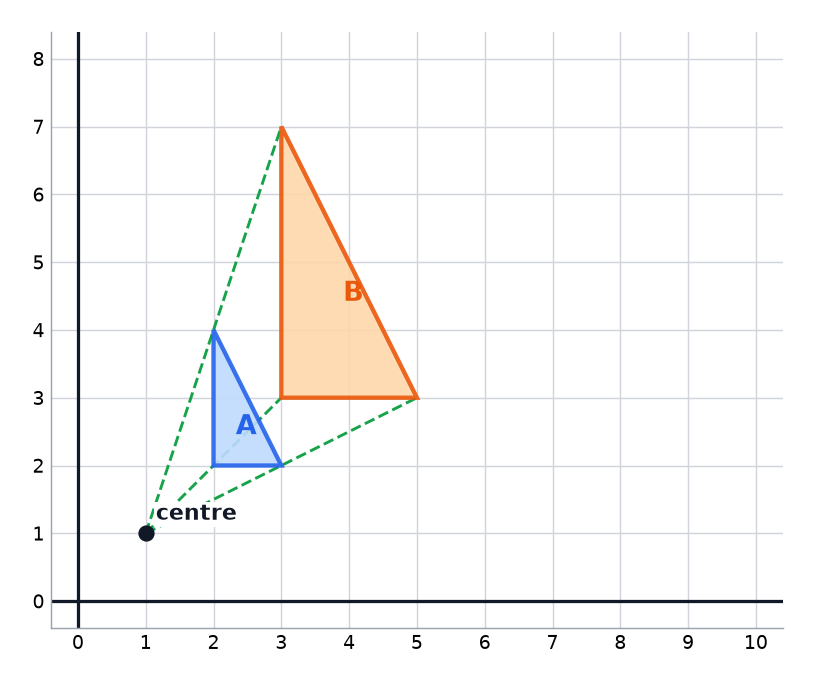
An enlargement by scale factor 2
The corner \((2, 2)\) is 1 right and 1 up from the centre \((1, 1)\). The image is 2 right and 2 up, at \((3, 3)\). Every side of \(B\) is twice the length of the matching side of \(A\), and the green lines through the centre pass through each corner and its image.
Enlarging step by step
- Distance from the centre Count the horizontal and vertical steps from the centre to a corner.
- Multiply by the scale factor Multiply both numbers, and count from the centre again to find the image corner.
- Check with a line The centre, the corner and the image corner should be on one straight line.
- Compare sides The image sides are scale factor times the object sides.
Enlarging a point
The centre of enlargement is \((1, 2)\) and the scale factor is 3. Find the image of the point \((3, 3)\).
Show the solutionHide the solution
- 1 Distance from the centre \((3, 3)\) is 2 right and 1 up from \((1, 2)\).
- 2 Multiply by 3 The image is \(3 \times 2 = 6\) right and \(3 \times 1 = 3\) up from the centre.
- 3 Count from the centre \((1 + 6, 2 + 3) = (7, 5)\).
- 4 Check The centre, \((3, 3)\) and \((7, 5)\) are on a line, because the steps \((2, 1)\) and \((6, 3)\) have the same direction.
Answer\((7, 5)\)
Describing an enlargement
Give the scale factor and the centre, and name the transformation.
-
Scale factor
Divide a length on the image by the matching length on the object. A side of 6 cm from 2 cm gives a scale factor of 3.
-
Centre
Draw a line through each corner and its image, and the lines meet at the centre.
-
A small image
The scale factor is less than 1, such as \(\dfrac{1}{2}\), and the image is closer to the centre.
-
Full description
"Enlargement, scale factor \(2\), centre \((1, 1)\)" gives all the marks.
Finding the scale factor and centre
A rectangle with corners \((2, 2)\), \((4, 2)\), \((4, 3)\) and \((2, 3)\) is enlarged to give a rectangle with corners \((3, 3)\), \((7, 3)\), \((7, 5)\) and \((3, 5)\). Describe the enlargement.
Show the solutionHide the solution
- 1 Scale factor The bottom of the object is 2 long and the bottom of the image is 4 long, so the scale factor is 2.
- 2 Centre Join \((2, 2)\) to \((3, 3)\) and \((4, 3)\) to \((7, 5)\), and extend the lines back.
- 3 They meet at The point \((1, 1)\).
- 4 Check \((1, 1)\) to \((2, 2)\) is 1 right and 1 up, and \((1, 1)\) to \((3, 3)\) is twice that.
AnswerEnlargement, scale factor 2, centre \((1, 1)\)
Negative scale factors (Higher tier)
A negative scale factor puts the image on the other side of the centre, and turns it upside down.
-
The image is on the opposite side
A point 2 right and 1 up from the centre goes to 2 left and 1 down for a scale factor of \(-1\).
-
Size
The lengths are multiplied by the size of the scale factor, so \(-2\) gives sides twice as long.
-
Same as a rotation
An enlargement with scale factor \(-1\) is a rotation of \(180^\circ\) about the centre.
-
Describe
Give the negative scale factor and the centre, such as "enlargement, scale factor \(-2\), centre \((0, 0)\)".
Test yourself
-
1
What happens to the angles in an enlargement?
Show answerHide answer
They stay the same.
-
2
What is the scale factor from 3 cm to 12 cm?
Show answerHide answer
4.
-
3
What do you give to describe an enlargement?
Show answerHide answer
The scale factor and the centre.
-
4
What does a scale factor between 0 and 1 do?
Show answerHide answer
It makes the shape smaller.
-
5
Which way is the image for a negative scale factor?
Show answerHide answer
On the opposite side of the centre.
Exam technique: enlargements
Use the centre, and check with straight lines.
-
Count from the centre, not from the shape
Distances are measured from the centre of enlargement.
-
Draw construction lines
Rays through the corners help the examiner see your method.
-
Check two corners
They should both be on lines from the centre.
-
Use the right words
"Enlargement" with a scale factor and a centre, not "bigger" or "zoom".
Summary and exam focus
- An enlargement multiplies every length by the scale factor, and keeps the angles.
- The image of a point is on the line from the centre through the point, at scale factor times the distance.
- A full description needs the scale factor and the centre.
- A negative scale factor (Higher tier) puts the image on the other side of the centre.
Exam focus
The point \(A\) is \((2, 3)\). Enlarge the point \(A\) by scale factor 2 with centre \((0, 0)\), and write down the coordinates of the image. (2 marks) (2 marks)
Multiply the coordinates by the scale factor, since the centre is the origin: \((2 \times 2, 3 \times 2) = (4, 6)\). With a different centre, count from the centre instead.
Key terms
The words this lesson expects you to use. Each one is linked from the first place it appears above.
- Enlargement
- A transformation that changes the size of a shape by a scale factor.
- Scale factor
- The number by which every length of a shape is multiplied.
- Centre of enlargement
- The fixed point from which an enlargement is measured.
- Similar
- The same shape but not necessarily the same size.
- Congruent
- Having exactly the same size and shape.
- Corresponding sides
- Sides in the same position on two similar shapes.
- Image
- The shape after a transformation.
- Ray
- A straight line drawn from the centre through a point and its image.
- Negative scale factor
- A scale factor that puts the image on the opposite side of the centre.
You've finished the notes
Check your understanding
Test yourself while it is fresh. Start with the flashcards, then try the exam questions.
Something here looks wrong?
Tell us what and we will go and look. It goes to whoever writes these pages, nobody else, and we do not ask who you are — so there is nothing to sign and nothing comes back to you.