Maths · Vectors, Constructions and Loci
Viewing as
Teacher view: every answer and mark scheme set out in full.
Bearings, Scale Drawings, Plans and Elevations
Three-figure bearings and back bearings, map scales, and the plan and elevations of simple solids.
Learning Objectives
- 1Measure and draw three-figure bearings, and find the bearing back from a bearing there.
- 2Use bearings in problems with parallel north lines and angle facts.
- 3Use scale drawings and map scales.
- 4Draw and interpret plans and elevations of simple solids.
Directions and views
A bearing is a way to give a direction as an angle measured clockwise from north, and it is written with three figures, so that east is 090 degrees. Bearings are tested with a protractor on one question and with angle facts on another, and on the non-calculator paper the angle facts are the main skill, since the diagrams are not drawn accurately. A scale drawing turns a real situation into a drawing in which lengths are in proportion, and a plan and elevations are the views of a solid from above and from the sides. Both are practical skills that appear on every paper.
Three-figure bearings
A bearing is measured clockwise from north, and written with three figures.
-
Starting line
Always measure from the north line at the point you start from.
-
Direction
Always measure clockwise, in the direction of a clock.
-
Three figures
Write 40 degrees as 040 and 5 degrees as 005.
-
The main directions
North is 000, east is 090, south is 180 and west is 270.
A bearing
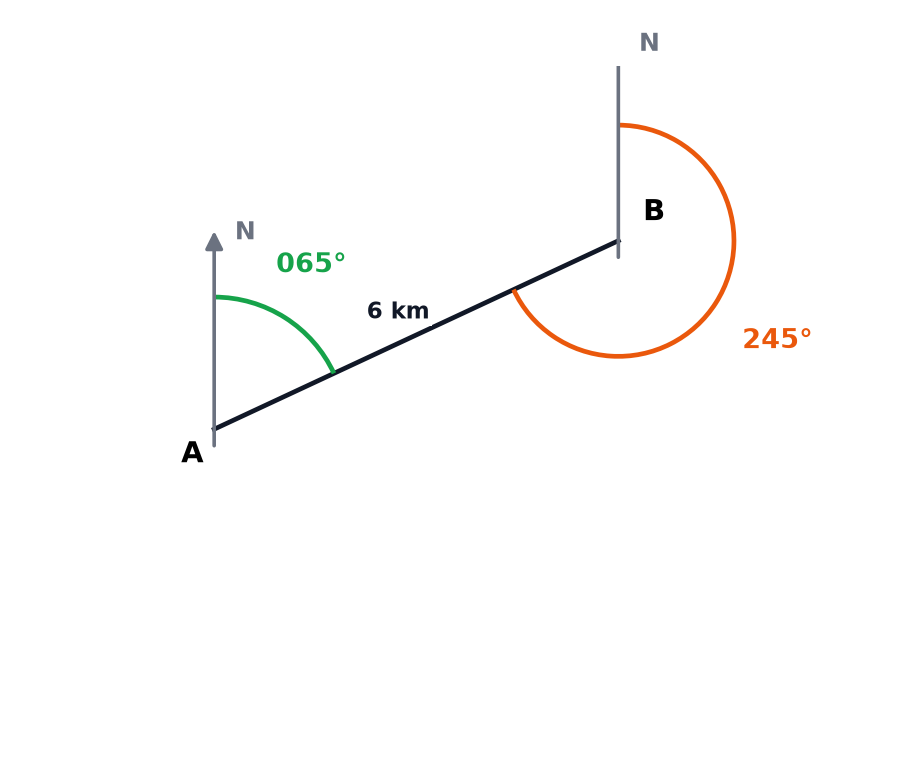
The bearing of \(B\) from \(A\) is \(065^\circ\), measured clockwise from the north line at \(A\). The bearing of \(A\) from \(B\) is measured from the north line at \(B\), and it is \(065^\circ + 180^\circ = 245^\circ\).
Back bearings
- Add 180 If the bearing is less than \(180^\circ\), add \(180^\circ\) to get the bearing back.
- Subtract 180 If the bearing is more than \(180^\circ\), subtract \(180^\circ\).
- Why it works The two north lines are parallel, so the angles between the north line and the path add up to \(180^\circ\) on a straight line.
- Check \(065 + 180 = 245\), which is between 180 and 360, so it is a sensible bearing.
Finding a bearing back
The bearing of \(B\) from \(A\) is \(130^\circ\). Work out the bearing of \(A\) from \(B\).
Show the solutionHide the solution
- 1 Add 180 \(130 + 180 = 310\).
- 2 Reason The north lines at \(A\) and \(B\) are parallel, so the angles on the line \(AB\) add to \(180^\circ\) and the clockwise angle at \(B\) is \(180^\circ + 130^\circ\).
- 3 Check 310 is less than 360 and more than 180, as it should be for a direction back to the north-west.
- 4 Write \(310^\circ\).
Answer\(310^\circ\)
Scale drawings and map scales
A scale tells you how a length on the drawing is related to the real length.
-
Ratio scale
1 : 50 000 means 1 cm on the map is 50 000 cm, which is 500 m, on the ground.
-
Words scale
1 cm to 2 km means 1 cm on the drawing stands for 2 km.
-
To find the real length
Multiply the drawing length by the scale.
-
To draw a length
Divide the real length by the scale.
Using a scale
A map has a scale of 1 : 25 000. Two towns are 6 cm apart on the map. Work out the real distance in kilometres.
Show the solutionHide the solution
- 1 Real length in cm \(6 \times 25\,000 = 150\,000\) cm.
- 2 Change to metres \(150\,000 \div 100 = 1500\) m.
- 3 Change to kilometres \(1500 \div 1000 = 1.5\) km.
- 4 Check 1 cm on the map is 250 m, so 6 cm is 1500 m.
Answer1.5 km
Plans and elevations
A plan is the view from above, and an elevation is the view from the front or the side.
-
Plan
Look straight down, so you see the top of the solid.
-
Front elevation
Look from the front, so you see the width and the height.
-
Side elevation
Look from the side, so you see the depth and the height.
-
Hidden edges
Edges you cannot see are drawn as dashed lines, and an edge in the view is a solid line.
Plan and elevation of a prism
A triangular prism lies on a rectangular face. Each triangular end has a base of 4 cm and a height of 3 cm, and the prism is 6 cm long. Describe the plan, the elevation from one end and the elevation from the side.
Show the solutionHide the solution
- 1 Plan Looking down, you see a rectangle, the base width 4 cm by the length 6 cm.
- 2 Elevation from the end Looking along the length, you see the triangle, with base 4 cm and height 3 cm.
- 3 Elevation from the side The side view is a rectangle 6 cm long and 3 cm high.
- 4 Check The same measurements appear in the plan and the elevations.
AnswerThe plan is a rectangle 4 cm by 6 cm, the elevation from the end is a triangle with base 4 cm and height 3 cm, and the elevation from the side is a rectangle 6 cm by 3 cm
Test yourself
-
1
How are bearings measured?
Show answerHide answer
Clockwise from north, with three figures.
-
2
What is the bearing of east?
Show answerHide answer
090.
-
3
How do you find a back bearing less than 180?
Show answerHide answer
Add 180.
-
4
What does a scale of 1 : 1000 mean?
Show answerHide answer
1 cm on the drawing is 1000 cm, or 10 m, in real life.
-
5
What is the view from above called?
Show answerHide answer
The plan.
Exam technique: bearings and views
Measure carefully and give reasons.
-
Draw the north line
At the start point of the journey, even if the question does not.
-
Say why
"The north lines are parallel, so the angles on a straight line add to \(180^\circ\)" is the reason.
-
Check the units
Convert the scale to metres or kilometres before answering.
-
Draw a sketch
A rough sketch helps with a bearing problem.
Summary and exam focus
- A bearing is an angle clockwise from north, written with three figures.
- A back bearing differs by \(180^\circ\), by adding or subtracting.
- A scale gives the real length for a length on the drawing, so multiply to find a real length.
- A plan is the view from above, and an elevation is a view from the front or the side.
Exam focus
The bearing of \(B\) from \(A\) is \(072^\circ\). Work out the bearing of \(A\) from \(B\). (2 marks) (2 marks)
Add \(180^\circ\), since \(072\) is less than \(180\): \(072 + 180 = 252\). Write the answer as \(252^\circ\). Giving the reason, that the north lines are parallel, helps if the answer is wrong.
Key terms
The words this lesson expects you to use. Each one is linked from the first place it appears above.
- Bearing
- A direction given as an angle measured clockwise from north.
- Three-figure bearing
- A bearing written with three figures, such as 045.
- North line
- A line pointing north, from which a bearing is measured.
- Back bearing
- The bearing of the start point from the end point.
- Scale
- The ratio between a length on a drawing and the real length.
- Plan
- A view of a solid from above.
- Elevation
- A view of a solid from the front or the side.
- Scale drawing
- A drawing in which lengths are in proportion to real lengths.
Questions and answers
15 questions set on this lesson, with the mark schemes and model answers open.
Write down the three-figure bearing of (a) west, (b) north-east. [2 marks]
Mark scheme — 2 marks available
- (a) \(270^\circ\) — B1
- (b) \(045^\circ\) — B1
Model answer
(a) \(270^\circ\). (b) North-east is halfway between north and east, \(045^\circ\).
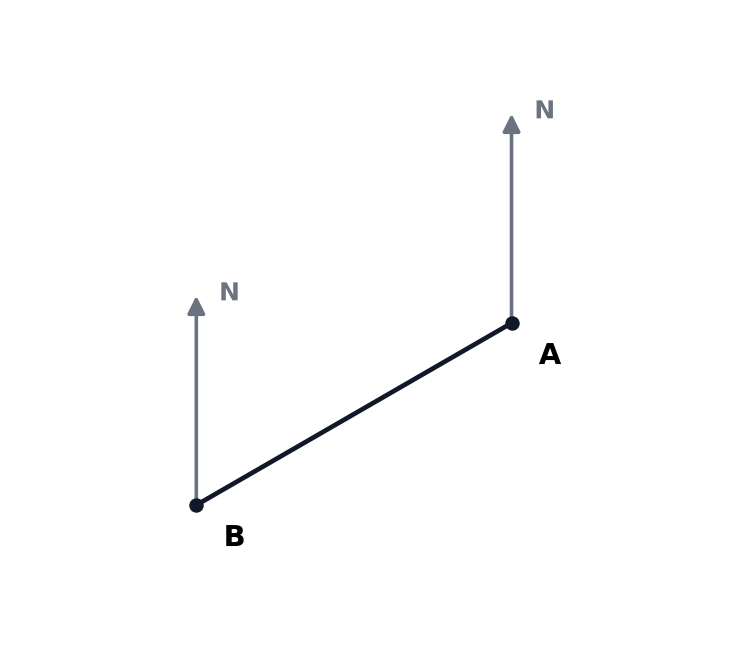
The diagram shows two points \(A\) and \(B\). On a map, \(AB\) is 4 cm and the scale is 1 : 50 000. The bearing of \(B\) from \(A\) is \(240^\circ\). (a) Calculate the bearing of \(A\) from \(B\). [2 marks] (b) Calculate the real distance \(AB\) in kilometres. [2 marks]
Mark scheme — 4 marks available
- (a) \(240 - 180\) — M1
- (a) \(060^\circ\) — A1
- (b) \(4 \times 50\,000\) — M1
- (b) 2 km — A1
Model answer
(a) The bearing is more than \(180^\circ\), so subtract: \(240 - 180 = 60\), written \(060^\circ\). (b) \(4 \times 50\,000 = 200\,000\) cm \(= 2\) km.
The bearing of \(B\) from \(A\) is \(250^\circ\). Calculate the bearing of \(A\) from \(B\). [2 marks]
Mark scheme — 2 marks available
- \(250 - 180\) — M1
- \(070^\circ\) — A1
Model answer
\(250 - 180 = 70\), so the bearing is \(070^\circ\).
A plan is drawn with a scale of 1 : 200. [3 marks] (a) A wall is 6 cm long on the plan. Calculate its real length in metres. [2 marks] (b) A room is 8 m long. Calculate its length on the plan. [1 mark]
Mark scheme — 3 marks available
- (a) \(6 \times 200\) — M1
- (a) 12 m — A1
- (b) 4 cm — B1
Model answer
(a) \(6 \times 200 = 1200\) cm \(= 12\) m. (b) \(8\) m \(= 800\) cm, and \(800 \div 200 = 4\) cm.
A triangular prism has a base of 6 cm and a height of 4 cm in its triangular face, and the prism is 10 cm long. It lies on a rectangular face. Write down the dimensions of (a) its plan, (b) its elevation from the end, (c) its elevation from the side. [3 marks]
Mark scheme — 3 marks available
- (a) A rectangle 6 cm by 10 cm — B1
- (b) A triangle with base 6 cm and height 4 cm — B1
- (c) A rectangle 10 cm by 4 cm — B1
Model answer
(a) The plan is a rectangle 6 cm by 10 cm. (b) The elevation from the end is the triangle, with base 6 cm and height 4 cm. (c) The elevation from the side is a rectangle 10 cm by 4 cm.
\(B\) is on a bearing of \(090^\circ\) from \(A\), and \(AB = 8\) km. \(C\) is on a bearing of \(180^\circ\) from \(B\), and \(BC = 6\) km. (a) Calculate the length \(AC\). [2 marks] (b) Write down the bearing of \(A\) from \(B\). [1 mark] (c) Write down the angle \(ABC\). [1 mark]
Mark scheme — 4 marks available
- (a) \(8^2 + 6^2\) — M1
- (a) 10 km — A1
- (b) \(270^\circ\) — B1
- (c) \(90^\circ\) — B1
Model answer
(a) Angle \(ABC = 90^\circ\), so \(AC^2 = 8^2 + 6^2 = 100\) and \(AC = 10\) km. (b) \(090 + 180 = 270^\circ\). (c) The bearing of \(A\) from \(B\) is \(270^\circ\) and the bearing of \(C\) from \(B\) is \(180^\circ\), so angle \(ABC = 270 - 180 = 90^\circ\).
What is the bearing of east?
Why: North is 000, east is 090, south is 180 and west is 270.
What is the bearing of south?
Why: South is half a turn from north.
The bearing of \(B\) from \(A\) is \(130^\circ\). What is the bearing of \(A\) from \(B\)?
Why: Add \(180^\circ\): \(130 + 180 = 310\).
The bearing of \(B\) from \(A\) is \(072^\circ\). What is the bearing of \(A\) from \(B\)?
Why: Add \(180^\circ\): \(072 + 180 = 252\).
The bearing of \(B\) from \(A\) is \(250^\circ\). What is the bearing of \(A\) from \(B\)?
Why: Subtract \(180^\circ\): \(250 - 180 = 70\), written as 070.
From where, and in which direction, is a bearing measured?
Why: Bearings are measured clockwise from north.
A map has a scale of \(1 : 25\,000\). Two towns are 6 cm apart on the map. What is the real distance?
Why: \(6 \times 25\,000 = 150\,000\) cm \(= 1.5\) km.
A plan has a scale of \(1 : 1000\). A length of 5 cm on the plan is how long in real life?
Why: \(5 \times 1000 = 5000\) cm \(= 50\) m.
What is the plan of a solid?
Why: A plan is a view looking straight down.