Maths · Vectors, Constructions and Loci
Viewing as
Teaching this? The teacher view opens every answer and mark scheme.
Column Vectors and Vector Arithmetic
Writing vectors as columns, adding, subtracting and multiplying them, and spotting parallel vectors.
Learning Objectives
- 1Write a vector as a column vector, and read one from a diagram.
- 2Add and subtract vectors, and multiply a vector by a number.
- 3Recognise parallel vectors, and draw vector sums and differences.
- 4Find the length of a column vector using Pythagoras' theorem (Higher tier).
Journeys with a size and a direction
A vector describes a movement, with a size and a direction, such as 3 right and 2 up. You have already used vectors to describe translations, and this lesson gives them their own rules. Vectors can be added, subtracted and multiplied by numbers, and the exam asks for each of these both with column vectors and with diagrams. On the non-calculator paper the numbers are small, so the marks go to careful signs and to showing the method, and a vector must always be written as a vector, with an arrow or underline, or as a letter in bold in print.
Writing vectors
A vector can be named by its end points or by a single letter.
-
Column vector
\(\begin{pmatrix} 3 \\ 2 \end{pmatrix}\) means 3 to the right and 2 up. The top number is the horizontal move, and the bottom number is the vertical move.
-
Naming
\(\overrightarrow{AB}\) is the vector from \(A\) to \(B\). A single letter such as \(\mathbf{a}\) is printed in bold, and written by hand with a line underneath.
-
Reversing
\(\overrightarrow{BA} = -\overrightarrow{AB}\), so the column vector has both signs changed.
-
Equal vectors
Two vectors are equal if they have the same size and direction, wherever they are drawn.
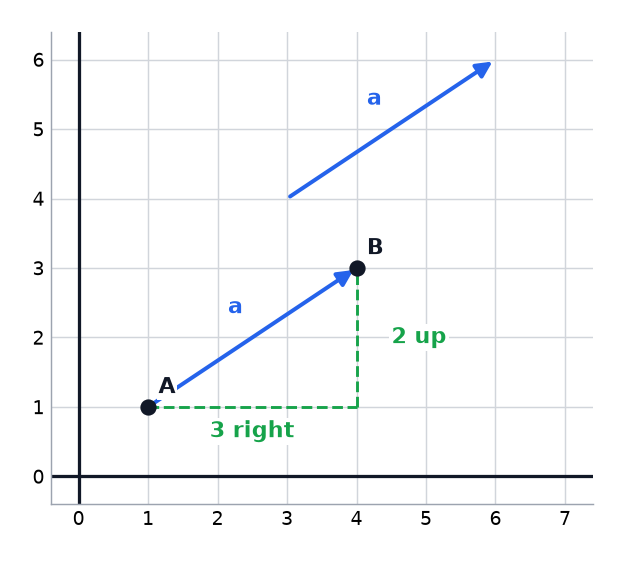
A vector on a grid
The arrow from \(A\) to \(B\) goes 3 to the right and 2 up, so \(\overrightarrow{AB} = \begin{pmatrix} 3 \\ 2 \end{pmatrix}\). The second arrow starts somewhere else but has the same size and direction, so it is the same vector.
Reading a vector
- Count across first 3 to the right gives the top number, 3.
- Then count up or down 2 up gives the bottom number, 2.
- Direction matters The arrow from \(B\) to \(A\) is \(\begin{pmatrix} -3 \\ -2 \end{pmatrix}\).
- From coordinates Subtract the start from the end: \((4, 3) - (1, 1) = (3, 2)\).
Finding a vector from coordinates
The point \(A\) is \((2, 5)\) and the point \(B\) is \((6, 2)\). Write \(\overrightarrow{AB}\) and \(\overrightarrow{BA}\) as column vectors.
Show the solutionHide the solution
- 1 Horizontal move \(6 - 2 = 4\).
- 2 Vertical move \(2 - 5 = -3\), so \(\overrightarrow{AB} = \begin{pmatrix} 4 \\ -3 \end{pmatrix}\).
- 3 Reverse it \(\overrightarrow{BA} = -\overrightarrow{AB}\), so change both signs.
- 4 Check on a sketch From \(A\) to \(B\) goes 4 right and 3 down.
Answer\(\overrightarrow{AB} = \begin{pmatrix} 4 \\ -3 \end{pmatrix}\) and \(\overrightarrow{BA} = \begin{pmatrix} -4 \\ 3 \end{pmatrix}\)
Adding, subtracting and multiplying
Do each row on its own, adding or subtracting the top numbers and then the bottom numbers.
-
Adding
\(\begin{pmatrix} 3 \\ 2 \end{pmatrix} + \begin{pmatrix} 1 \\ 4 \end{pmatrix} = \begin{pmatrix} 4 \\ 6 \end{pmatrix}\).
-
Subtracting
\(\begin{pmatrix} 3 \\ 2 \end{pmatrix} - \begin{pmatrix} 1 \\ 4 \end{pmatrix} = \begin{pmatrix} 2 \\ -2 \end{pmatrix}\).
-
Multiplying by a number
\(3 \begin{pmatrix} 2 \\ -1 \end{pmatrix} = \begin{pmatrix} 6 \\ -3 \end{pmatrix}\). Both numbers are multiplied.
-
Combining
\(2\mathbf{a} + 3\mathbf{b}\) is found by working out \(2\mathbf{a}\) and \(3\mathbf{b}\) first, then adding.
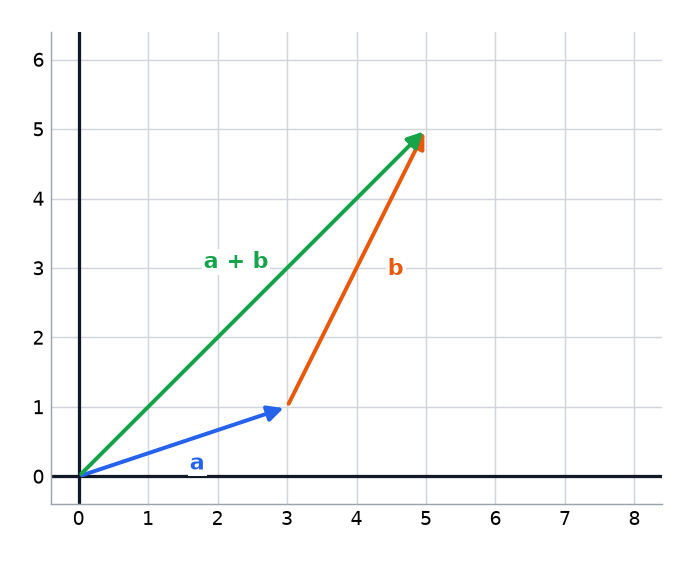
Adding vectors end to end
The vector \(\mathbf{a} = \begin{pmatrix} 3 \\ 1 \end{pmatrix}\) goes first, then \(\mathbf{b} = \begin{pmatrix} 2 \\ 4 \end{pmatrix}\). The single vector from the start to the finish is \(\mathbf{a} + \mathbf{b} = \begin{pmatrix} 5 \\ 5 \end{pmatrix}\).
The triangle rule
- Place end to end Start the second vector where the first one ends.
- The sum The sum goes from the start of the first vector to the end of the second.
- Same as the columns \(3 + 2 = 5\) and \(1 + 4 = 5\).
- Subtracting \(\mathbf{a} - \mathbf{b}\) is \(\mathbf{a} + (-\mathbf{b})\), so reverse \(\mathbf{b}\) and then add.
Working with column vectors
\(\mathbf{p} = \begin{pmatrix} 2 \\ 3 \end{pmatrix}\) and \(\mathbf{q} = \begin{pmatrix} -1 \\ 4 \end{pmatrix}\). Work out \(2\mathbf{p} - \mathbf{q}\).
Show the solutionHide the solution
- 1 Multiply \(2\mathbf{p} = \begin{pmatrix} 4 \\ 6 \end{pmatrix}\).
- 2 Subtract the top numbers \(4 - (-1) = 5\).
- 3 Subtract the bottom numbers \(6 - 4 = 2\).
- 4 Write the answer \(2\mathbf{p} - \mathbf{q} = \begin{pmatrix} 5 \\ 2 \end{pmatrix}\).
Answer\(\begin{pmatrix} 5 \\ 2 \end{pmatrix}\)
Parallel vectors and the length of a vector
Parallel vectors are multiples of each other.
-
Parallel
\(\begin{pmatrix} 2 \\ 3 \end{pmatrix}\) and \(\begin{pmatrix} 6 \\ 9 \end{pmatrix}\) are parallel, because the second is 3 times the first. A negative multiple points the other way.
-
Same size
If \(\mathbf{b} = 2\mathbf{a}\), then \(\mathbf{b}\) is twice as long as \(\mathbf{a}\).
-
Length (Higher tier)
The length of \(\begin{pmatrix} 3 \\ 4 \end{pmatrix}\) is \(\sqrt{3^2 + 4^2} = 5\), using Pythagoras.
-
Write the length with bars
The length of \(\mathbf{a}\) is written \(|\mathbf{a}|\).
Test yourself
-
1
What does \(\begin{pmatrix} -2 \\ 5 \end{pmatrix}\) mean?
Show answerHide answer
2 left and 5 up.
-
2
What is \(\overrightarrow{BA}\) if \(\overrightarrow{AB} = \begin{pmatrix} 4 \\ -3 \end{pmatrix}\)?
Show answerHide answer
\(\begin{pmatrix} -4 \\ 3 \end{pmatrix}\).
-
3
What is \(\begin{pmatrix} 3 \\ 2 \end{pmatrix} + \begin{pmatrix} 1 \\ 4 \end{pmatrix}\)?
Show answerHide answer
\(\begin{pmatrix} 4 \\ 6 \end{pmatrix}\).
-
4
Are \(\begin{pmatrix} 1 \\ 2 \end{pmatrix}\) and \(\begin{pmatrix} 3 \\ 6 \end{pmatrix}\) parallel?
Show answerHide answer
Yes, the second is 3 times the first.
-
5
What is \(3 \begin{pmatrix} 2 \\ -1 \end{pmatrix}\)?
Show answerHide answer
\(\begin{pmatrix} 6 \\ -3 \end{pmatrix}\).
Exam technique: vectors
Show the working, and keep the signs straight.
-
Write vectors as vectors
Use an arrow, an underline or the column form, not just letters.
-
Work out the top and bottom rows separately
It avoids mixing up the signs.
-
Draw it
A quick sketch with arrows end to end shows whether an answer is sensible.
-
Do not forget the minus
\(\overrightarrow{BA}\) is not the same as \(\overrightarrow{AB}\).
Summary and exam focus
- A column vector shows the horizontal move over the vertical move, with right and up positive.
- Vectors are added and subtracted row by row, and a number multiplies both rows.
- Parallel vectors are multiples of each other.
- The length of \(\begin{pmatrix} x \\ y \end{pmatrix}\) is \(\sqrt{x^2 + y^2}\) (Higher tier).
Exam focus
\(\mathbf{a} = \begin{pmatrix} 3 \\ -2 \end{pmatrix}\) and \(\mathbf{b} = \begin{pmatrix} 1 \\ 4 \end{pmatrix}\). Work out \(\mathbf{a} + 2\mathbf{b}\). (2 marks) (2 marks)
First find \(2\mathbf{b} = \begin{pmatrix} 2 \\ 8 \end{pmatrix}\), then add: \(\begin{pmatrix} 3 + 2 \\ -2 + 8 \end{pmatrix} = \begin{pmatrix} 5 \\ 6 \end{pmatrix}\). Showing \(2\mathbf{b}\) earns the method mark.
Key terms
The words this lesson expects you to use. Each one is linked from the first place it appears above.
- Vector
- A quantity with a size and a direction.
- Column vector
- A vector written with the horizontal move above the vertical move.
- Scalar
- An ordinary number, such as 3, used to multiply a vector.
- Parallel
- Pointing in the same or opposite direction, with one vector a multiple of the other.
- Resultant
- The single vector that has the same effect as a combination of vectors.
- Magnitude
- The length of a vector.
- Displacement
- A change in position, with a direction.
- Opposite vector
- A vector of the same length in the opposite direction.
- Triangle rule
- Vectors added end to end give a resultant from the start to the finish.
You've finished the notes
Check your understanding
Test yourself while it is fresh. Start with the flashcards, then try the exam questions.
Something here looks wrong?
Tell us what and we will go and look. It goes to whoever writes these pages, nobody else, and we do not ask who you are — so there is nothing to sign and nothing comes back to you.