Viewing as
Teacher view: planning notes, the answers to every question, and the teacher copies of the files.
Maths · Algebra
Formulae
A formula is a rule linking several quantities. Substituting puts numbers in; changing the subject rearranges the rule so it works out a different quantity - using exactly the same balancing as solving an equation.
Teacher resources
The teacher copies: slides with the questions built in, the answers, and anything else attached to this lesson for whoever is teaching it.
- Formulae - Teacher Slides.pptx Teacher The lesson slides with the teacher's notes on each slide, and every question and mark scheme built in. Built from the lesson script on 28 September 2026. View
- Formulae - Teacher Notes.docx Teacher The complete notes with the teacher's notes and every model answer in full. Built from the lesson script on 28 September 2026. View
Student handouts
The same files the students see, to print or hand out.
Last Lesson and Before
Answer each one, then check.
-
1
If \(x = 3\), what is \(2x + 5\)?
Show answerHide answer
\(11\)
-
2
If \(y = -2\), what is \(y^2\)?
Show answerHide answer
\(4\)
-
3
What is \((-2)^3\)?
Show answerHide answer
\(-8\)
-
4
Last lesson: solve \(3x - 4 = 11\).
Show answerHide answer
\(x = 5\)
-
5
Last lesson: solve \(2(x + 3) = 14\).
Show answerHide answer
\(x = 4\)
Learning Objectives
- 1Tell the difference between an expression, an equation, a formula and an identity.
- 2Substitute positive and negative numbers into formulae.
- 3Write a formula from a description.
- 4Change the subject of a formula.
- 5Change the subject when the subject is squared or appears twice. (Higher)
Four Words, Four Meanings
-
Expression
Terms with no equals sign: \(3x + 2\). It cannot be solved.
-
Equation
Two expressions that are equal for particular values: \(3x + 2 = 11\) is only true when \(x = 3\).
-
Formula
A rule linking quantities, each with its own letter: \(v = u + at\), \(A = \pi r^2\).
-
Identity
Two expressions equal for EVERY value of the letter, written with \(\equiv\): \(2(x + 3) \equiv 2x + 6\).
Substituting into a Formula
Replace each letter with its value, then follow the order of operations.
-
Use brackets
Put negative numbers in brackets: if \(a = -2\), then \(a^2 = (-2)^2 = 4\).
-
Powers first
In \(\frac{1}{2}at^2\), square \(t\) before multiplying.
-
Show the substitution
Write the formula with the numbers in before working it out: it earns the method mark.
-
Units
Give the answer in the right units if the question has them.
Substituting Negative Numbers
\(s = ut + \frac{1}{2}at^2\). Work out \(s\) when \(u = 3\), \(t = 4\) and \(a = -2\).
Show the solutionHide the solution
- 1 Substitute \(s = 3 \times 4 + \frac{1}{2} \times (-2) \times 4^2\)
- 2 Powers first \(4^2 = 16\)
- 3 Multiply \(3 \times 4 = 12\) and \(\frac{1}{2} \times (-2) \times 16 = -16\)
- 4 Add \(12 + (-16) = -4\)
Answer\(s = -4\)
The Area of a Trapezium
The area of a trapezium is \(A = \frac{1}{2}(a + b)h\), where \(a\) and \(b\) are the parallel sides and \(h\) is the perpendicular height. With \(a = 5\) cm, \(b = 9\) cm and \(h = 4\) cm: \(A = \frac{1}{2} \times (5 + 9) \times 4 = \frac{1}{2} \times 14 \times 4 = 28\) cm².
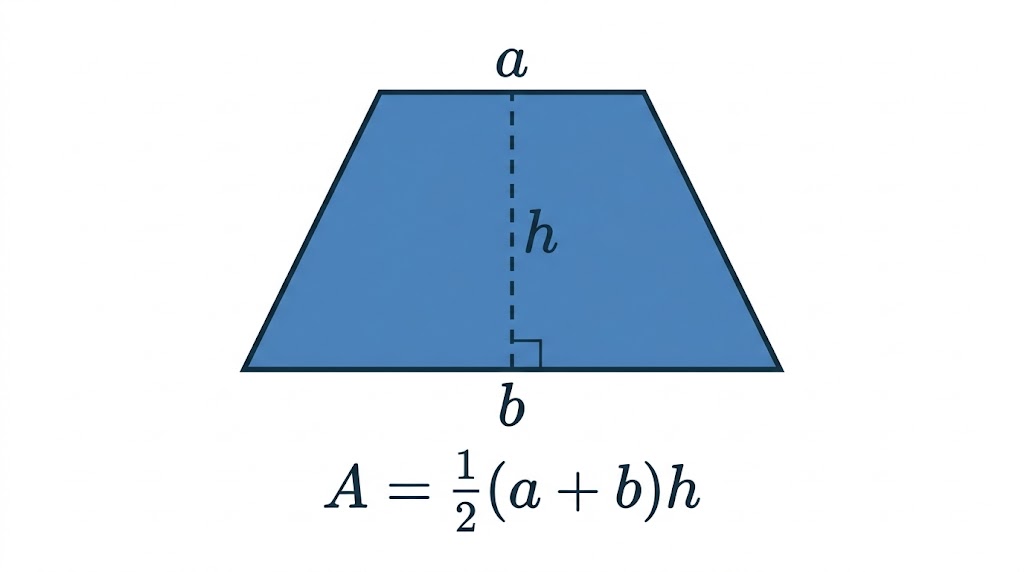
\(A = \frac{1}{2}(a + b)h\): add the parallel sides, halve, multiply by the height.
What Is the Subject?
The subject of a formula is the letter on its own on one side: in \(v = u + at\), the subject is \(v\).
-
The idea
Rearrange the formula so a different letter is on its own.
-
The method
Exactly like solving an equation: undo what has been done to the new subject, in reverse order, doing the same to both sides.
-
Why
To find \(a\) when you know \(v\), \(u\) and \(t\), it is quicker to rearrange once than to solve a new equation every time.
Changing the Subject
Make \(t\) the subject of \(v = u + at\).
Show the solutionHide the solution
- 1 Subtract \(u\) from both sides \(v - u = at\)
- 2 Divide both sides by \(a\) \(\dfrac{v - u}{a} = t\)
- 3 Write the subject on the left \(t = \dfrac{v - u}{a}\)
Answer\(t = \dfrac{v - u}{a}\)
Rearranging the Trapezium Formula
Make \(h\) the subject of \(A = \frac{1}{2}(a + b)h\).
Show the solutionHide the solution
- 1 Multiply both sides by 2 \(2A = (a + b)h\)
- 2 Divide both sides by \((a + b)\) \(\dfrac{2A}{a + b} = h\)
Answer\(h = \dfrac{2A}{a + b}\)
The Subject Is Squared
Make \(r\) the subject of \(A = \pi r^2\).
Show the solutionHide the solution
- 1 Divide both sides by \(\pi\) \(\dfrac{A}{\pi} = r^2\)
- 2 Square root both sides \(\sqrt{\dfrac{A}{\pi}} = r\)
Answer\(r = \sqrt{\dfrac{A}{\pi}}\)
The Subject Appears Twice
Make \(x\) the subject of \(y = \dfrac{x + 2}{x - 3}\).
Show the solutionHide the solution
- 1 Multiply both sides by \((x - 3)\) \(y(x - 3) = x + 2\)
- 2 Expand \(xy - 3y = x + 2\)
- 3 Collect the \(x\) terms on one side \(xy - x = 3y + 2\)
- 4 Factorise out \(x\) \(x(y - 1) = 3y + 2\)
- 5 Divide by \((y - 1)\) \(x = \dfrac{3y + 2}{y - 1}\)
Answer\(x = \dfrac{3y + 2}{y - 1}\)
Case study
Celsius and Fahrenheit
The Fahrenheit temperature scale, still used in the USA, is linked to Celsius by the formula \(F = 1.8C + 32\). Rearranging it gives \(C = \dfrac{F - 32}{1.8}\), so a weather forecast of 77 °F becomes \(\dfrac{77 - 32}{1.8} = 25\) °C. There is one temperature that reads the same on both scales: solve \(C = 1.8C + 32\) and you get \(C = -40\). So −40 °C and −40 °F are exactly the same temperature.
Rearrange It
Make the letter in brackets the subject. (a) \(P = 4s\) (\(s\)) (b) \(y = mx + c\) (\(x\)) (c) \(C = 2\pi r\) (\(r\)) (d) \(V = IR\) (\(I\)) (e) \(A = \frac{1}{2}bh\) (\(b\)). Higher: (f) \(E = \frac{1}{2}mv^2\) (\(v\)) (g) \(a(x - 2) = x + 5\) (\(x\)).
1. Undo operations in reverse order.
2. Do the same to both sides.
3. Higher: collect the subject, then factorise.
A good answer shows: (a) \(s = \dfrac{P}{4}\) (b) \(x = \dfrac{y - c}{m}\) (c) \(r = \dfrac{C}{2\pi}\) (d) \(I = \dfrac{V}{R}\) (e) \(b = \dfrac{2A}{h}\) (f) \(v = \sqrt{\dfrac{2E}{m}}\) (g) \(ax - 2a = x + 5\), so \(ax - x = 5 + 2a\), \(x(a - 1) = 5 + 2a\) and \(x = \dfrac{5 + 2a}{a - 1}\)
Can I...?
- 1Tell a formula from an equation, expression and identity.
- 2Substitute positive numbers into a formula.
- 3Substitute negative numbers into a formula.
- 4Write a formula from words.
- 5Change the subject in one step.
- 6Change the subject in two or more steps.
- 7Change the subject when it is squared. (Higher)
- 8Change the subject when it appears twice. (Higher)
Summary & Exam Focus
- Expression: no equals sign. Equation: true for some values. Formula: links quantities. Identity: true for all values.
- Substitute: numbers in, brackets round negatives, powers first.
- Change the subject: undo operations in reverse order, doing the same to both sides.
- (Higher) Subject twice: collect those terms, factorise, then divide.
Exam focus
Make \(t\) the subject of the formula \(v = u + at\) (2 marks) (2 marks)
Write the substitution before calculating, and put negative numbers in brackets. Most lost marks on substitution come from squaring a negative number without brackets.
Key terms
The vocabulary this lesson expects you to use. Each one is linked from the first place it appears above.
- Formula
- A rule linking two or more quantities, written with letters.
- Substitute
- Replace the letters in a formula with numbers.
- Subject
- The letter on its own on one side of a formula.
- Change the subject
- Rearrange a formula so a different letter is the subject.
- Identity
- Two expressions that are equal for every value of the letters, written with \(\equiv\).
Questions and answers
9 questions set on this lesson, with the mark schemes and model answers open.
\(v = u + at\). Work out the value of \(v\) when \(u = 12\), \(a = -3\) and \(t = 5\).
Mark scheme — 2 marks available
- \(12 + (-3) \times 5\), or \(-15\) seen — M1
- \(-3\) — A1
Model answer
\(v = 12 + (-3) \times 5 = 12 - 15 = -3\)
Make \(t\) the subject of the formula \(v = u + at\)
Mark scheme — 2 marks available
- \(v - u = at\), or a correct first step — M1
- \(t = \dfrac{v - u}{a}\) — A1
Model answer
\(v - u = at\), so \(t = \dfrac{v - u}{a}\)
Show that \((x + 3)^2 - 9 \equiv x(x + 6)\)
Mark scheme — 2 marks available
- \((x + 3)^2\) expanded to \(x^2 + 6x + 9\) — M1
- Correctly simplified to \(x(x + 6)\), or both sides shown equal to \(x^2 + 6x\) — A1
Model answer
\((x + 3)^2 - 9 = x^2 + 6x + 9 - 9 = x^2 + 6x = x(x + 6)\)
Make \(a\) the subject of \(3(a - 2) = ab + 5\)
Mark scheme — 4 marks available
- Expands the bracket: \(3a - 6\) — M1
- Collects the \(a\) terms on one side: \(3a - ab = 11\) — M1
- Factorises: \(a(3 - b) = 11\) — M1
- \(a = \dfrac{11}{3 - b}\) — A1
Model answer
\(3a - 6 = ab + 5\), so \(3a - ab = 11\), \(a(3 - b) = 11\) and \(a = \dfrac{11}{3 - b}\).
\(s = ut + \frac{1}{2}at^2\). Work out the value of \(s\) when \(u = 15\), \(a = -9.8\) and \(t = 2\).
Mark scheme — 2 marks available
- \(15 \times 2 + \frac{1}{2} \times (-9.8) \times 2^2\), or 30 and \(-19.6\) seen — M1
- \(10.4\) — A1
Model answer
\(s = 15 \times 2 + \frac{1}{2} \times (-9.8) \times 2^2 = 30 - 19.6 = 10.4\)
The volume of a sphere is \(V = \frac{4}{3}\pi r^3\). Make \(r\) the subject of the formula.
Mark scheme — 2 marks available
- \(r^3 = \dfrac{3V}{4\pi}\) — M1
- \(r = \sqrt[3]{\dfrac{3V}{4\pi}}\) — A1
Model answer
\(3V = 4\pi r^3\), so \(r^3 = \dfrac{3V}{4\pi}\) and \(r = \sqrt[3]{\dfrac{3V}{4\pi}}\).
\(P = 2l + 2w\). What is \(P\) when \(l = 6\) and \(w = 4\)?
Why: \(P = 2 \times 6 + 2 \times 4 = 12 + 8 = 20\).
Make \(x\) the subject of \(y = 3x - 4\).
Why: Add 4: \(y + 4 = 3x\). Divide by 3: \(x = \dfrac{y + 4}{3}\).
Which of these is an identity?
Why: \(2(x + 3)\) and \(2x + 6\) are equal for every value of \(x\).