Viewing as
Teaching this? The teacher view adds 2 files, the mark schemes and the model answers.
Maths · Angles and trigonometry
Pythagoras' theorem 1
In a right-angled triangle, the square on the longest side equals the sum of the squares on the other two. Use it to find any missing side - and to check whether a triangle is right-angled.
Before We Start
Answer each one, then check.
-
1
Work out \(13^2\).
Show answerHide answer
169
-
2
Work out \(\sqrt{144}\).
Show answerHide answer
12
-
3
Round 7.2111 to 1 decimal place.
Show answerHide answer
7.2
-
4
Solve \(x^2 = 81\) (positive answer).
Show answerHide answer
\(x = 9\)
Learning Objectives
- 1Identify the hypotenuse of a right-angled triangle.
- 2Use Pythagoras' theorem to find the hypotenuse.
- 3Use Pythagoras' theorem to find a shorter side.
- 4Decide whether a triangle is right-angled.
The Squares on the Sides
The hypotenuse is the longest side, opposite the right angle. Pythagoras' theorem says the area of the square on the hypotenuse equals the areas of the other two squares added together: \(a^2 + b^2 = c^2\).
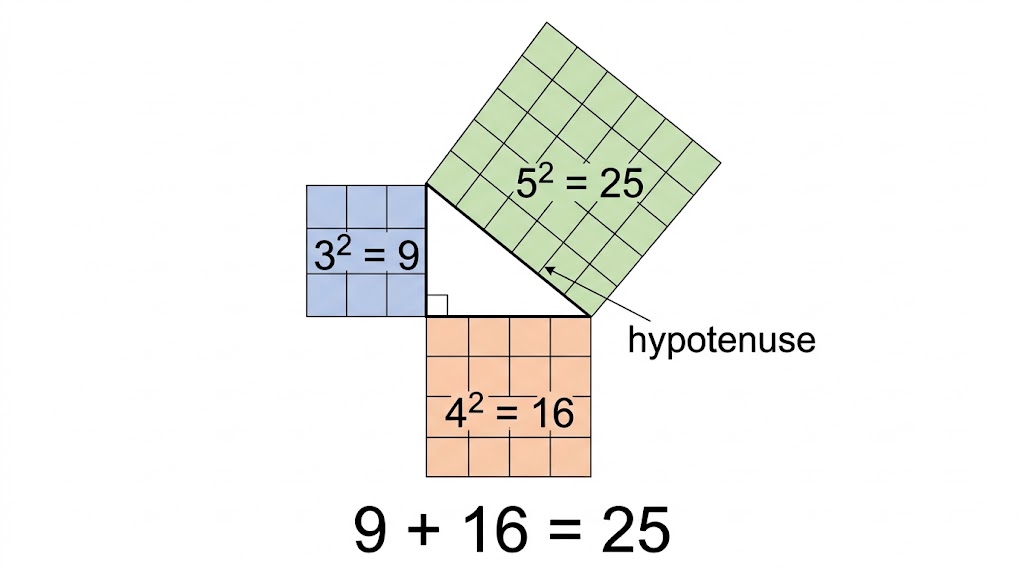
\(3^2 + 4^2 = 5^2\): the two smaller squares fill the biggest one.
The Theorem
\(a^2 + b^2 = c^2\), where \(c\) is the hypotenuse. It works ONLY in right-angled triangles.
-
Find the hypotenuse
Square the two shorter sides, ADD, then square root.
-
Find a shorter side
Square the hypotenuse and the known side, SUBTRACT, then square root.
-
Sense check
The hypotenuse is always the longest side. If your "shorter side" is longer than the hypotenuse, you added when you should have subtracted.
-
Exact answers
On the non-calculator paper, leave an answer like \(\sqrt{89}\) as a surd unless told to round.
Finding the Hypotenuse
A right-angled triangle has shorter sides 8 cm and 5 cm. Work out the length of the hypotenuse. Give your answer to 1 decimal place.
Show the solutionHide the solution
- 1 Write the theorem \(c^2 = 8^2 + 5^2\)
- 2 Square and add \(c^2 = 64 + 25 = 89\)
- 3 Square root \(c = \sqrt{89} = 9.433\ldots\)
Answer9.4 cm
Finding a Shorter Side
A right-angled triangle has hypotenuse 13 cm and one side 7 cm. Work out the length of the other side, to 1 decimal place.
Show the solutionHide the solution
- 1 Write the theorem with the hypotenuse on its own \(a^2 + 7^2 = 13^2\)
- 2 Subtract \(a^2 = 169 - 49 = 120\)
- 3 Square root \(a = \sqrt{120} = 10.954\ldots\)
- 4 Check: shorter than 13 Yes
Answer11.0 cm
Is It Right-Angled?
The theorem also works backwards.
-
The test
Square the three sides. If the two smaller squares add up to the largest square, the triangle is right-angled.
-
Example
5, 12, 13: \(25 + 144 = 169 = 13^2\), so it is right-angled.
-
Counter-example
9, 12, 16: \(81 + 144 = 225\), but \(16^2 = 256\), so it is NOT right-angled.
-
Pythagorean triples
Whole-number sides that fit: 3, 4, 5; 5, 12, 13; 8, 15, 17; 7, 24, 25 - and any multiple, such as 6, 8, 10.
Case study
Plimpton 322
Pythagoras lived around 500 BC, but the idea is much older. A Babylonian clay tablet called Plimpton 322, written about 1800 BC and now in a library in New York, lists fifteen rows of numbers written in base 60. Read correctly, each row gives the sides of a right-angled triangle with whole-number (or simple) sides - including triples as large as 12 709, 13 500 and 18 541. Nobody knows exactly how the Babylonians found them, but they clearly understood the rule more than a thousand years before the Greeks proved it.
Triple Hunt
(a) Show that 8, 15, 17 is a Pythagorean triple. (b) Multiply 3, 4, 5 by 2, 3 and 10 and check that each result is a triple. (c) Find the missing number in the triple 20, 21, ?. (d) Explain why no triple can have all three numbers odd.
1. Square each number.
2. Add the two smaller squares.
3. Compare with the largest.
A good answer shows: (a) \(64 + 225 = 289 = 17^2\). (b) 6, 8, 10; 9, 12, 15; 30, 40, 50 all work. (c) \(400 + 441 = 841\), so 29. (d) Odd squared is odd, and odd + odd = even, so the third square would be even - and then the third number would be even.
Can I...?
- 1Identify the hypotenuse.
- 2Find the hypotenuse.
- 3Find a shorter side.
- 4Give an answer to a sensible accuracy.
- 5Leave an answer as a surd.
- 6Decide whether a triangle is right-angled.
Summary & Exam Focus
- \(a^2 + b^2 = c^2\), with \(c\) the hypotenuse, opposite the right angle.
- Longest side: square, add, square root.
- Shorter side: square, subtract, square root.
- Converse: if \(a^2 + b^2 = c^2\), the triangle is right-angled.
Exam focus
A ladder 5 m long leans against a vertical wall. The foot of the ladder is 1.8 m from the wall on horizontal ground. How far up the wall does the ladder reach? Give your answer to 2 decimal places. (3 marks) (3 marks)
Draw and label a sketch, and mark the hypotenuse first. Then decide: finding the hypotenuse means add, finding a shorter side means subtract.
Key terms
The vocabulary this lesson expects you to use. Each one is linked from the first place it appears above.
- Hypotenuse
- The longest side of a right-angled triangle, opposite the right angle.
- Pythagoras' theorem
- In a right-angled triangle, \(a^2 + b^2 = c^2\), where \(c\) is the hypotenuse.
- Pythagorean triple
- Three whole numbers that fit the theorem, such as 3, 4, 5.
- Surd
- A square root that cannot be written exactly as a fraction, such as \(\sqrt{2}\).
Practice questions
Have a go at each one before you open its answer.
-
Question 1 Non-calculator 2 marks
A right-angled triangle has shorter sides of 7 cm and 24 cm. Work out the length of the hypotenuse.
Show answerHide answer
Model answer
\(7^2 + 24^2 = 49 + 576 = 625\), \(\sqrt{625} = 25\) cm
Mark scheme
- \(7^2 + 24^2\) — M1
- 25 cm — A1
-
Question 2 Calculator 3 marks
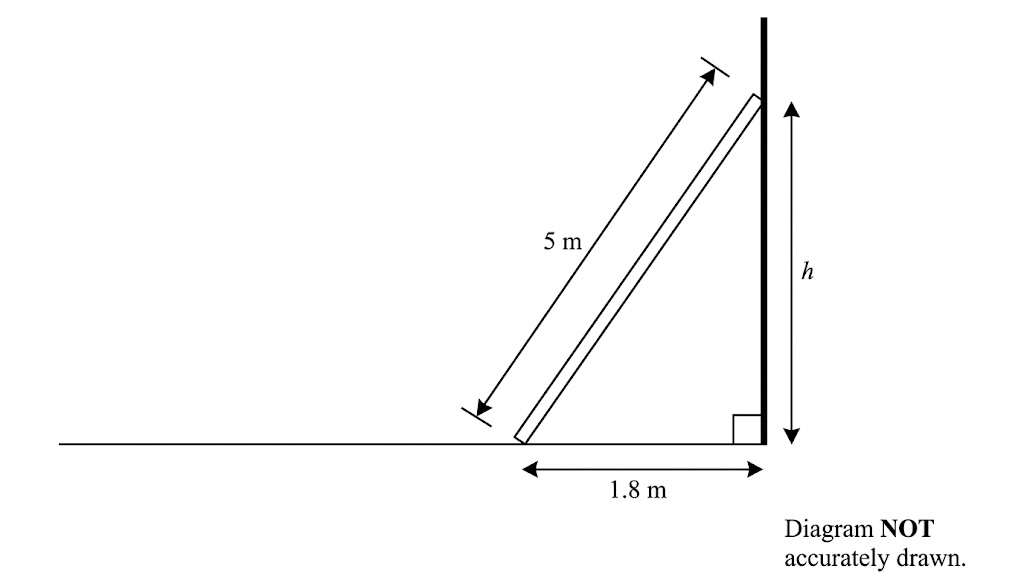
A ladder 5 m long leans against a vertical wall. The foot of the ladder is on horizontal ground, 1.8 m from the wall. How far up the wall does the ladder reach? Give your answer to 2 decimal places.
Show answerHide answer
Model answer
\(h^2 = 5^2 - 1.8^2 = 25 - 3.24 = 21.76\), so \(h = \sqrt{21.76} = 4.6647\ldots = 4.66\) m
Mark scheme
- \(5^2 - 1.8^2\) — M1
- \(\sqrt{21.76}\) — M1
- 4.66 — A1
-
Question 3 Non-calculator 2 marks
A triangle has sides of 9 cm, 12 cm and 16 cm. Is it a right-angled triangle? Show how you decide.
Show answerHide answer
Model answer
\(9^2 + 12^2 = 81 + 144 = 225\). \(16^2 = 256\). \(225 \ne 256\), so it is not right-angled.
Mark scheme
- \(9^2 + 12^2 = 225\) and \(16^2 = 256\) — M1
- Not right-angled, with the comparison — C1
-
Question 4 Non-calculator 3 marks
A rectangular field is 20 m long and 15 m wide. Jo walks diagonally across it, from one corner to the opposite corner. Tom walks along two sides. How much further does Tom walk than Jo?
Show answerHide answer
Model answer
Jo: \(\sqrt{20^2 + 15^2} = \sqrt{400 + 225} = \sqrt{625} = 25\) m. Tom: \(20 + 15 = 35\) m. Tom walks \(35 - 25 = 10\) m further.
Mark scheme
- \(20^2 + 15^2\) — P1
- 25 m — P1
- 10 m — A1
Quick check
-
Which side of a right-angled triangle is the hypotenuse?
Show answerHide answer
A: The side opposite the right angle
The hypotenuse is opposite the right angle, and it is always the longest side.
-
A right-angled triangle has hypotenuse 10 cm and one side 6 cm. How long is the third side?
Show answerHide answer
C: 8 cm
\(10^2 - 6^2 = 100 - 36 = 64\), and \(\sqrt{64} = 8\).
-
Which of these is a Pythagorean triple?
Show answerHide answer
D: 9, 40, 41
\(9^2 + 40^2 = 81 + 1600 = 1681 = 41^2\).
Downloads
Free to keep, print and annotate.
- Pythagoras theorem 1.pptx Built from the lesson script on 29 September 2026. View
- Pythagoras theorem 1 - Completed Notes.docx The full notes for the lesson, to revise from. Built from the lesson script on 29 September 2026. View
- Pythagoras theorem 1 - Exam Questions.docx Built from the lesson script on 29 September 2026. View
Something here looks wrong?
Tell us what and we will go and look. It goes to whoever writes these pages, nobody else, and we do not ask who you are — so there is nothing to sign and nothing comes back to you.