Viewing as
Teacher view: planning notes, the answers to every question, and the teacher copies of the files.
Maths · Angles and trigonometry
Trigonometry 1
Sine, cosine and tangent link the angles of a right-angled triangle to its sides. Label the sides, choose the right ratio, and you can find any missing side.
Teacher resources
The teacher copies: slides with the questions built in, the answers, and anything else attached to this lesson for whoever is teaching it.
- Trigonometry 1 - Teacher Slides.pptx Teacher The lesson slides with the teacher's notes on each slide, and every question and mark scheme built in. Built from the lesson script on 29 September 2026. View
- Trigonometry 1 - Teacher Notes.docx Teacher The complete notes with the teacher's notes and every model answer in full. Built from the lesson script on 29 September 2026. View
Student handouts
The same files the students see, to print or hand out.
- Trigonometry 1.pptx Built from the lesson script on 29 September 2026. View
- Trigonometry 1 - Completed Notes.docx The full notes for the lesson, to revise from. Built from the lesson script on 29 September 2026. View
- Trigonometry 1 - Exam Questions.docx Built from the lesson script on 29 September 2026. View
Last Lesson and Before
Answer each one, then check.
-
1
Last lesson: how far apart are \((0, 0)\) and \((6, 8)\)?
Show answerHide answer
10
-
2
Solve \(\frac{x}{4} = 3\).
Show answerHide answer
\(x = 12\)
-
3
Solve \(\frac{12}{x} = 3\).
Show answerHide answer
\(x = 4\)
-
4
Round 6.8829 to 3 significant figures.
Show answerHide answer
6.88
Learning Objectives
- 1Label the hypotenuse, opposite and adjacent sides from a given angle.
- 2Know the sine, cosine and tangent ratios.
- 3Choose the right ratio for a problem.
- 4Find a missing side of a right-angled triangle.
Naming the Sides
The hypotenuse is opposite the right angle. The opposite side is across from the angle \(\theta\). The adjacent side is next to \(\theta\) and is not the hypotenuse. Move the angle and the opposite and adjacent sides swap.
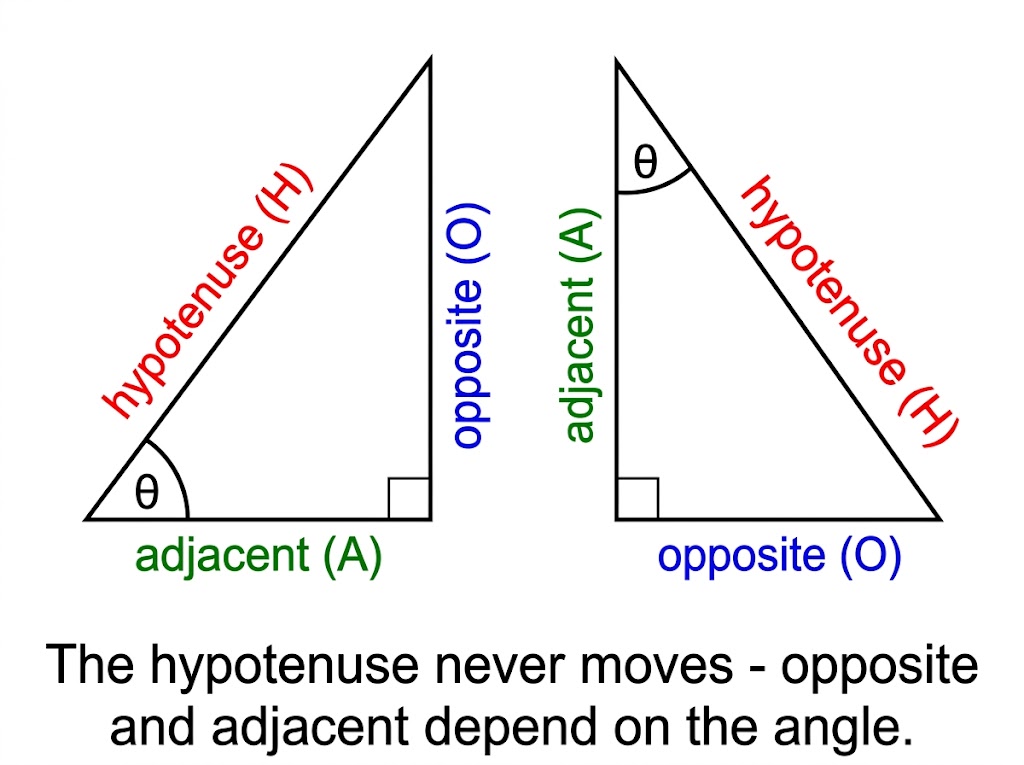
Label from the angle you are using.
SOH CAH TOA
\(\theta\) is the Greek letter theta, often used for an angle.
-
Sine
Formula: \(\sin\theta = \dfrac{\text{opp}}{\text{hyp}}\). Uses: Opposite and hypotenuse
-
Cosine
Formula: \(\cos\theta = \dfrac{\text{adj}}{\text{hyp}}\). Uses: Adjacent and hypotenuse
-
Tangent
Formula: \(\tan\theta = \dfrac{\text{opp}}{\text{adj}}\). Uses: Opposite and adjacent
Finding a Missing Side
The same five steps every time.
-
1
Label
Label the sides O, A and H from the given angle.
-
2
Choose
Tick the side you know and the side you want. The two letters pick the ratio: O and H - sine; A and H - cosine; O and A - tangent.
-
3
Write
Write the ratio with the numbers in, e.g. \(\sin 35^\circ = \dfrac{x}{12}\).
-
4
Rearrange
If \(x\) is on top, multiply. If \(x\) is on the bottom, swap \(x\) and the trig value.
-
5
Calculate
Check your calculator is in degrees (D on the screen), then round.
The Unknown on Top
A right-angled triangle has hypotenuse 15 cm. Angle \(\theta = 42^\circ\). Work out the side opposite \(\theta\), to 1 decimal place.
Show the solutionHide the solution
- 1 Known: H = 15. Wanted: O. O and H means sine \(\sin 42^\circ = \dfrac{x}{15}\)
- 2 Multiply both sides by 15 \(x = 15 \sin 42^\circ\)
- 3 Calculate \(x = 10.036\ldots\)
Answer10.0 cm
Using Tangent
A right-angled triangle has an angle of \(55^\circ\). The side adjacent to it is 8 cm. Work out the side opposite the \(55^\circ\) angle, to 1 decimal place.
Show the solutionHide the solution
- 1 Known: A = 8. Wanted: O. O and A means tangent \(\tan 55^\circ = \dfrac{x}{8}\)
- 2 Multiply by 8 \(x = 8 \tan 55^\circ\)
- 3 Calculate \(x = 11.425\ldots\)
Answer11.4 cm
The Unknown on the Bottom
A right-angled triangle has an angle of \(23^\circ\). The side opposite it is 6 cm. Work out the hypotenuse, to 1 decimal place.
Show the solutionHide the solution
- 1 Known: O = 6. Wanted: H. O and H means sine \(\sin 23^\circ = \dfrac{6}{x}\)
- 2 \(x\) is on the bottom, so swap \(x\) and \(\sin 23^\circ\) \(x = \dfrac{6}{\sin 23^\circ}\)
- 3 Calculate \(x = 15.355\ldots\)
- 4 Check: the hypotenuse is the longest side \(15.4 > 6\)
Answer15.4 cm
Trig Relay
In pairs. For each triangle, one partner labels the sides and chooses the ratio; the other writes the equation and calculates. Swap roles each time. (a) H = 10, angle \(50^\circ\), find A. (b) A = 14, angle \(36^\circ\), find O. (c) A = 25, angle \(20^\circ\), find H. (d) H = 3, angle \(12^\circ\), find O.
1. Label O, A, H.
2. Choose the ratio.
3. Rearrange and calculate.
A good answer shows: (a) \(10\cos 50^\circ = 6.43\) (b) \(14\tan 36^\circ = 10.17\) (c) \(\dfrac{25}{\cos 20^\circ} = 26.60\) (d) \(3\sin 12^\circ = 0.62\), all to 2 decimal places.
Can I...?
- 1Label the hypotenuse, opposite and adjacent sides.
- 2Recall SOH CAH TOA.
- 3Choose the right ratio.
- 4Find a side when it is on the top of the fraction.
- 5Find a side when it is on the bottom of the fraction.
- 6Check my calculator is in degrees.
Summary & Exam Focus
- Label from the angle: hypotenuse, opposite, adjacent.
- SOH CAH TOA picks the ratio.
- \(x\) on top: multiply. \(x\) on the bottom: divide.
- Degree mode, then round at the end.
Exam focus
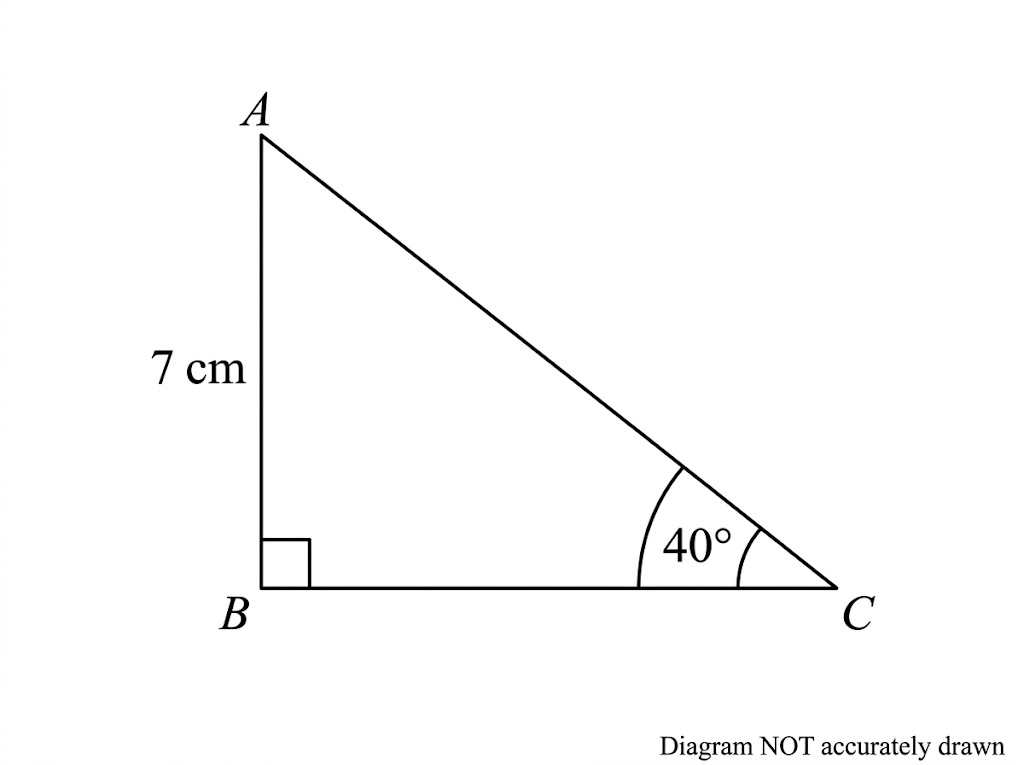
Triangle ABC is right-angled at B. AB = 7 cm and angle ACB = \(40^\circ\). Work out the length of BC. Give your answer to 3 significant figures. (3 marks) (3 marks)
Write the ratio with the numbers in before you rearrange - it is usually worth a method mark on its own, even if the calculator step goes wrong.
Key terms
The vocabulary this lesson expects you to use. Each one is linked from the first place it appears above.
- Hypotenuse
- The side opposite the right angle; the longest side.
- Opposite
- The side across from the angle being used.
- Adjacent
- The side next to the angle being used, which is not the hypotenuse.
- Sine (sin)
- \(\sin\theta = \frac{\text{opp}}{\text{hyp}}\).
- Cosine (cos)
- \(\cos\theta = \frac{\text{adj}}{\text{hyp}}\).
- Tangent (tan)
- \(\tan\theta = \frac{\text{opp}}{\text{adj}}\).
Questions and answers
7 questions set on this lesson, with the mark schemes and model answers open.
A right-angled triangle has hypotenuse 12 cm. One of its angles is \(35^\circ\). Work out the length of the side opposite the \(35^\circ\) angle. Give your answer to 3 significant figures.
Mark scheme — 2 marks available
- \(\sin 35^\circ = \dfrac{x}{12}\) — M1
- 6.88 — A1
Model answer
\(x = 12 \sin 35^\circ = 6.882\ldots = 6.88\) cm
Triangle ABC is right-angled at B. AB = 7 cm and angle ACB = \(40^\circ\). Work out the length of BC. Give your answer to 3 significant figures.
Mark scheme — 3 marks available
- \(\tan 40^\circ = \dfrac{7}{BC}\) — M1
- \(BC = \dfrac{7}{\tan 40^\circ}\) — M1
- 8.34 — A1
Model answer
From angle C, AB is opposite and BC is adjacent. \(\tan 40^\circ = \dfrac{7}{BC}\), so \(BC = \dfrac{7}{\tan 40^\circ} = 8.342\ldots = 8.34\) cm
A right-angled triangle has an angle of \(28^\circ\). The side adjacent to this angle is 9 cm. Work out the length of the hypotenuse. Give your answer to 1 decimal place.
Mark scheme — 3 marks available
- \(\cos 28^\circ = \dfrac{9}{h}\) — M1
- \(h = \dfrac{9}{\cos 28^\circ}\) — M1
- 10.2 — A1
Model answer
\(\cos 28^\circ = \dfrac{9}{h}\), so \(h = \dfrac{9}{\cos 28^\circ} = 10.193\ldots = 10.2\) cm
Wheelchair ramps must not be too steep. The rules say a ramp must rise no more than 1 m for every 12 m along the ground. A ramp rises at an angle of \(5^\circ\) along 14 m of horizontal ground. Does it meet the rule? Show your working.
Mark scheme — 3 marks available
- \(14 \tan 5^\circ\) — M1
- 1.22 and 1.17 (or an equivalent comparison, e.g. \(\tan 5^\circ = 0.087 > \frac{1}{12} = 0.083\)) — M1
- No, with correct figures — C1
Model answer
Rise \(= 14 \tan 5^\circ = 1.224\ldots\) m. The rule allows \(14 \div 12 = 1.166\ldots\) m. \(1.22 > 1.17\), so the ramp does not meet the rule.
In a right-angled triangle you know the adjacent side and want the opposite side. Which ratio do you use?
Why: Opposite and adjacent: TOA, so tangent.
\(\cos 60^\circ = \dfrac{x}{10}\). What is \(x\)?
Why: \(x = 10\cos 60^\circ = 10 \times 0.5 = 5\).
\(\sin 30^\circ = \dfrac{4}{x}\). What is \(x\)?
Why: \(x = \dfrac{4}{\sin 30^\circ} = \dfrac{4}{0.5} = 8\).