Viewing as
Teacher view: planning notes, the answers to every question, and the teacher copies of the files.
Maths · Area and volume
Cylinders and spheres
Work out the volume and surface area of cylinders, spheres and hemispheres, and solve problems that combine solids.
Teacher resources
The teacher copies: slides with the questions built in, the answers, and anything else attached to this lesson for whoever is teaching it.
- Cylinders and spheres - Teacher Slides.pptx Teacher The lesson slides with the teacher's notes on each slide, and every question and mark scheme built in. Built from the lesson script on 30 September 2026. View
- Cylinders and spheres - Teacher Notes.docx Teacher The complete notes with the teacher's notes and every model answer in full. Built from the lesson script on 30 September 2026. View
Student handouts
The same files the students see, to print or hand out.
- Cylinders and spheres.pptx Built from the lesson script on 30 September 2026. View
- Cylinders and spheres - Completed Notes.docx The full notes for the lesson, to revise from. Built from the lesson script on 30 September 2026. View
- Cylinders and spheres - Exam Questions.docx Built from the lesson script on 30 September 2026. View
Warm-up
Answer each one, then check.
-
1
What is the area of a circle with radius 4, in terms of \(\pi\)?
Show answerHide answer
\(16\pi\)
-
2
What is the circumference of a circle with diameter 10, in terms of \(\pi\)?
Show answerHide answer
\(10\pi\)
-
3
Work out \(5^3\).
Show answerHide answer
125
-
4
What is the volume of a prism?
Show answerHide answer
Cross-sectional area times length
-
5
Round 3.979 to 2 decimal places.
Show answerHide answer
3.98
Learning Objectives
- 1Find the volume and surface area of a cylinder.
- 2Find the volume and surface area of a sphere.
- 3Find the volume and surface area of a hemisphere.
- 4Solve problems that combine cylinders and hemispheres.
Cylinder, Sphere and Hemisphere
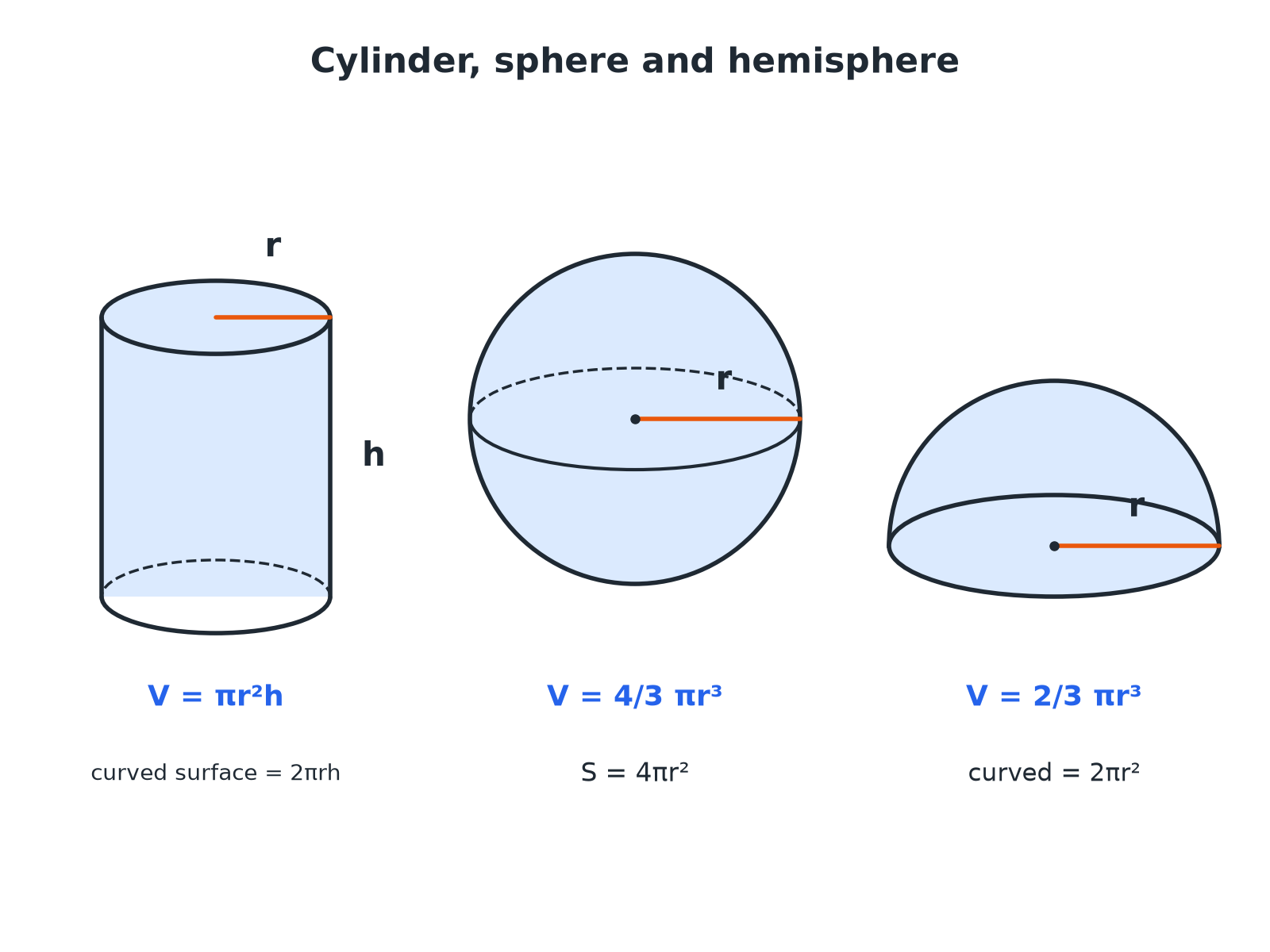
A cylinder is a prism with a circular cross-section.
Formulae
The sphere formulae are given on the Edexcel formulae sheet, but you must know the cylinder ones.
-
Cylinder
Volume: \(\pi r^2 h\). Surface area: \(2\pi r^2 + 2\pi r h\)
-
Sphere
Volume: \(\dfrac{4}{3}\pi r^3\). Surface area: \(4\pi r^2\)
-
Hemisphere
Volume: \(\dfrac{2}{3}\pi r^3\). Surface area: \(3\pi r^2\)
A Cylinder
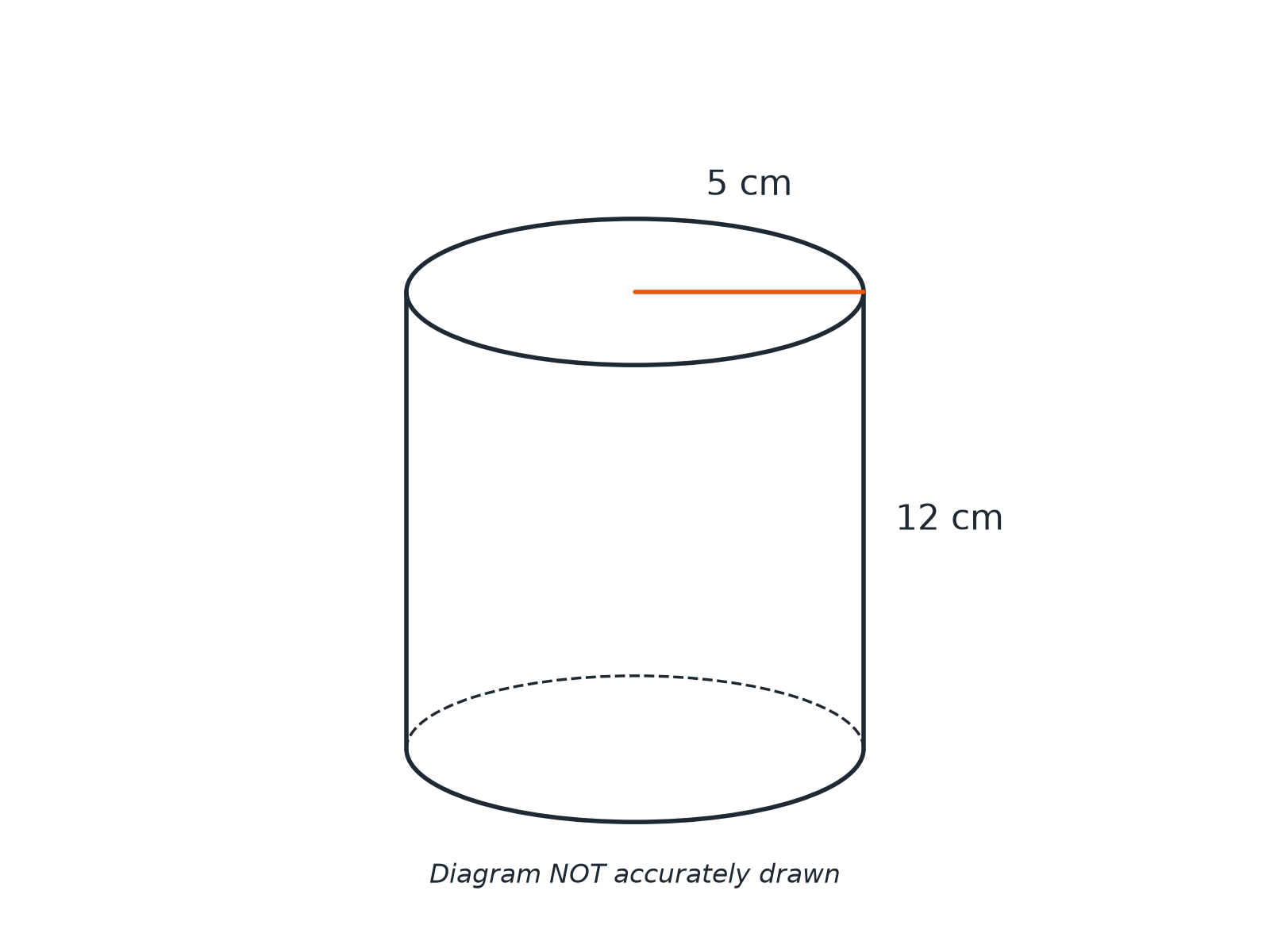
A cylinder has radius 5 cm and height 12 cm. Find its volume and total surface area, in terms of \(\pi\) and to 1 decimal place.
Show the solutionHide the solution
- 1 Volume \(= \pi r^2 h\) \(\pi \times 25 \times 12 = 300\pi\)
- 2 As a decimal \(942.5\) cm³
- 3 Curved surface \(= 2\pi r h\) \(2\pi \times 5 \times 12 = 120\pi\)
- 4 Two circular ends \(= 2\pi r^2\) \(2\pi \times 25 = 50\pi\)
- 5 Total surface area \(170\pi = 534.1\) cm²
AnswerVolume \(300\pi\) cm³ (942.5) and surface area \(170\pi\) cm² (534.1).
A Sphere
A sphere has radius 6 cm. Find its volume and surface area, in terms of \(\pi\).
Show the solutionHide the solution
- 1 Volume \(= \dfrac{4}{3}\pi r^3\) \(\dfrac{4}{3} \times \pi \times 216 = 288\pi\)
- 2 Surface area \(= 4\pi r^2\) \(4 \times \pi \times 36 = 144\pi\)
AnswerVolume \(288\pi\) cm³ and surface area \(144\pi\) cm².
A Hemisphere
A solid hemisphere has radius 3 cm. Find its volume in terms of \(\pi\).
Show the solutionHide the solution
- 1 A hemisphere is half a sphere \(\dfrac{1}{2} \times \dfrac{4}{3}\pi r^3 = \dfrac{2}{3}\pi r^3\)
- 2 Substitute \(r = 3\) \(\dfrac{2}{3} \times \pi \times 27\)
- 3 Work out \(18\pi\)
Answer\(18\pi\) cm³
Finding the Height
A cylinder has volume 200 cm³ and radius 4 cm. Find its height to 2 decimal places.
Show the solutionHide the solution
- 1 \(\pi r^2 h = 200\) \(\pi \times 16 \times h = 200\)
- 2 Divide by \(16\pi\) \(h = \dfrac{200}{16\pi}\)
- 3 Calculate \(3.979...\)
Answer3.98 cm
Combined Solids
Add the volumes; for surface area, do not count the joined faces.
-
A capsule
A cylinder with a hemisphere at each end: total volume \(= \pi r^2 h + \dfrac{4}{3}\pi r^3\).
-
A hemisphere on top
Surface area is the cylinder's curved surface and one end, plus the hemisphere's curved surface \(2\pi r^2\).
-
Watch the radius
The radius of the hemisphere is the radius of the cylinder.
Tennis Ball Tube
Three tennis balls of radius 3.3 cm fit exactly in a cylindrical tube. Find the volume of the tube, the volume of the three balls, and the percentage of the tube filled with balls.
1. Find the height of the tube.
2. Work out both volumes.
3. Divide and convert to a percentage.
A good answer shows: The tube has radius 3.3 and height 19.8: \(\pi \times 3.3^2 \times 19.8 = 677.4\) cm³. The balls: \(3 \times \dfrac{4}{3}\pi \times 3.3^3 = 4\pi \times 35.937 = 451.6\) cm³. Percentage \(= 451.6 \div 677.4 = 66.7\%\), exactly two thirds.
Can I...?
- 1Find the volume of a cylinder.
- 2Find the surface area of a cylinder.
- 3Find the volume of a sphere.
- 4Find the surface area of a sphere.
- 5Find the volume of a hemisphere.
- 6Work backwards to find a radius or height.
- 7Solve problems with combined solids.
- 8Give answers in terms of \(\pi\).
Summary & Exam Focus
- Cylinder volume \(\pi r^2 h\); curved surface \(2\pi r h\).
- Sphere volume \(\dfrac{4}{3}\pi r^3\); surface \(4\pi r^2\).
- Hemisphere volume \(\dfrac{2}{3}\pi r^3\).
- For combined solids, add volumes and take care with joined faces.
Exam focus
A cylinder has radius 5 cm and height 12 cm. Work out the volume of the cylinder. Give your answer correct to 3 significant figures. (2 marks) (2 marks)
Cylinder volume is the area of the circle times the height: \(\pi r^2 h\). Check that you have the radius, not the diameter.
Key terms
The vocabulary this lesson expects you to use. Each one is linked from the first place it appears above.
- Cylinder
- A prism with a circle as its cross-section.
- Sphere
- A perfectly round 3D shape, like a ball.
- Hemisphere
- Half a sphere.
- Curved surface area
- The area of the curved part only, not the flat ends.
- Volume
- The amount of space inside a solid.
- In terms of \(\pi\)
- Leaving \(\pi\) in the answer.
Questions and answers
12 questions set on this lesson, with the mark schemes and model answers open.
The diagram shows a cylinder with radius 5 cm and height 12 cm. Work out the volume of the cylinder. Give your answer correct to 3 significant figures.
Mark scheme — 2 marks available
- \(\pi \times 5^2 \times 12\) — M1
- 942 — A1
Model answer
\(\pi \times 5^2 \times 12 = 300\pi = 942\) cm³.
Work out the total surface area of the cylinder in the last question. Give your answer correct to 3 significant figures.
Mark scheme — 3 marks available
- \(2\pi r^2\) — M1
- \(2\pi r h\) — M1
- 534 — A1
Model answer
\(2\pi \times 5^2 + 2\pi \times 5 \times 12 = 50\pi + 120\pi = 170\pi = 534\) cm².
A sphere has a radius of 6 cm. Work out the volume of the sphere. Give your answer correct to 3 significant figures.
Mark scheme — 2 marks available
- \(\dfrac{4}{3}\pi \times 6^3\) — M1
- 905 — A1
Model answer
\(\dfrac{4}{3}\pi \times 6^3 = 288\pi = 905\) cm³.
Work out the surface area of the sphere in the last question. Give your answer correct to 3 significant figures.
Mark scheme — 2 marks available
- \(4\pi \times 6^2\) — M1
- 452 — A1
Model answer
\(4\pi \times 6^2 = 144\pi = 452\) cm².
A cylinder has a volume of 200 cm³ and a radius of 4 cm. Work out the height of the cylinder. Give your answer correct to 2 decimal places.
Mark scheme — 3 marks available
- \(\pi \times 4^2 \times h = 200\) — M1
- \(\dfrac{200}{16\pi}\) — M1
- 3.98 — A1
Model answer
\(\pi \times 4^2 \times h = 200\), so \(h = \dfrac{200}{16\pi} = 3.98\) cm.
A solid hemisphere has a radius of 3 cm. Work out the volume of the hemisphere. Give your answer in terms of \(\pi\).
Mark scheme — 2 marks available
- \(\dfrac{2}{3}\pi \times 27\) or half of \(\dfrac{4}{3}\pi \times 27\) — M1
- \(18\pi\) — A1
Model answer
\(\dfrac{2}{3}\pi \times 3^3 = 18\pi\) cm³.
Which formula gives the volume of a cylinder?
Why: The area of the circle times the height: \(\pi r^2 h\).
A cylinder has radius 2 cm and height 5 cm. What is its volume in terms of \(\pi\)?
Why: \(\pi \times 4 \times 5 = 20\pi\).
A sphere has radius 3 cm. What is its volume in terms of \(\pi\)?
Why: \(\dfrac{4}{3}\pi \times 27 = 36\pi\).
The curved surface area of a cylinder is...
Why: Unroll it to a rectangle: circumference \(2\pi r\) times height \(h\).
What is the volume of a hemisphere compared with the sphere of the same radius?
Why: A hemisphere is half a sphere.
A sphere's radius doubles. What happens to its volume?
Why: Volume is proportional to \(r^3\), so it multiplies by \(2^3 = 8\).