Viewing as
Teacher view: planning notes, the answers to every question, and the teacher copies of the files.
Maths · Equations and inequalities
Solving quadratic equations 1
Solve quadratic equations by factorising, including the difference of two squares and equations that need rearranging first.
Teacher resources
The teacher copies: slides with the questions built in, the answers, and anything else attached to this lesson for whoever is teaching it.
- Solving quadratic equations 1 - Teacher Slides.pptx Teacher The lesson slides with the teacher's notes on each slide, and every question and mark scheme built in. Built from the lesson script on 30 September 2026. View
- Solving quadratic equations 1 - Teacher Notes.docx Teacher The complete notes with the teacher's notes and every model answer in full. Built from the lesson script on 30 September 2026. View
Student handouts
The same files the students see, to print or hand out.
- Solving quadratic equations 1.pptx Built from the lesson script on 30 September 2026. View
- Solving quadratic equations 1 - Completed Notes.docx The full notes for the lesson, to revise from. Built from the lesson script on 30 September 2026. View
- Solving quadratic equations 1 - Exam Questions.docx Built from the lesson script on 30 September 2026. View
Warm-up
Answer each one, then check.
-
1
Factorise \(x^2 + 5x + 6\).
Show answerHide answer
\((x + 2)(x + 3)\)
-
2
Factorise \(x^2 - 9\).
Show answerHide answer
\((x - 3)(x + 3)\)
-
3
Solve \(x - 4 = 0\).
Show answerHide answer
\(x = 4\)
-
4
Expand \((x + 2)(x + 3)\).
Show answerHide answer
\(x^2 + 5x + 6\)
-
5
What is the product of \(0\) and any number?
Show answerHide answer
0
Learning Objectives
- 1Solve \(x^2 + bx + c = 0\) by factorising.
- 2Solve equations of the form \(x^2 - a^2 = 0\).
- 3Rearrange to zero before factorising.
- 4Solve problems that lead to quadratic equations.
THE NULL FACTOR LAW
If two things multiply to give zero, at least one of them must be zero.
So \((x - 2)(x - 3) = 0\) means \(x = 2\) or \(x = 3\).
Roots on a Graph
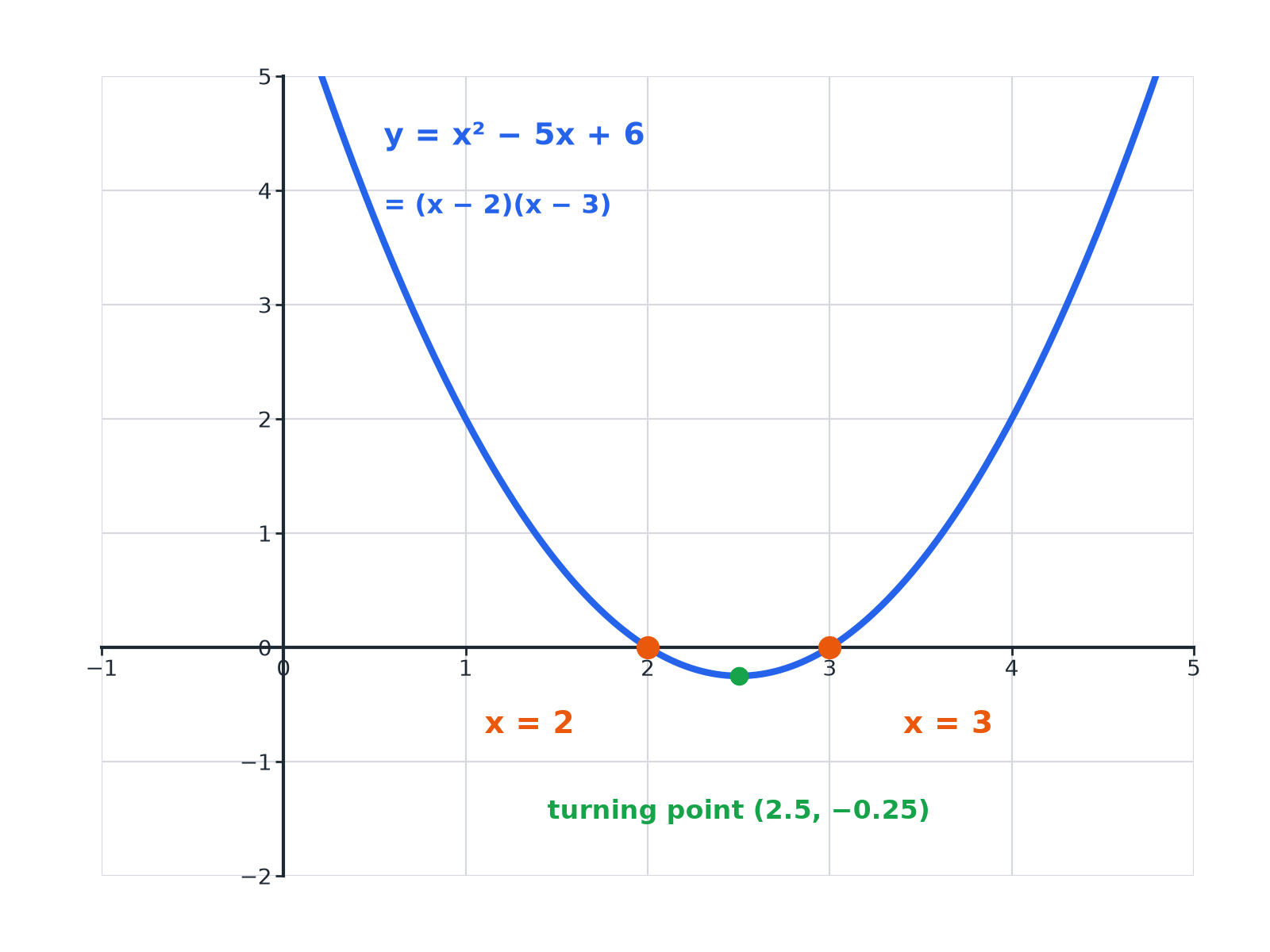
The solutions of the equation are where the graph crosses the x-axis.
Solving by Factorising
Always get zero on one side first.
-
1
Rearrange
Write the equation as \(ax^2 + bx + c = 0\)
-
2
Factorise
Find two numbers that multiply to \(c\) and add to \(b\)
-
3
Set each bracket to zero
Use the null factor law
-
4
Solve
Two solutions, or one repeated solution
A Standard Quadratic
Solve \(x^2 + 5x + 6 = 0\).
Show the solutionHide the solution
- 1 Two numbers with product 6 and sum 5 2 and 3
- 2 Factorise \((x + 2)(x + 3) = 0\)
- 3 Set each bracket to zero \(x + 2 = 0\) or \(x + 3 = 0\)
Answer\(x = -2\) or \(x = -3\)
With Negative Numbers
Solve \(x^2 - 2x - 15 = 0\).
Show the solutionHide the solution
- 1 Product \(-15\), sum \(-2\) \(-5\) and \(3\)
- 2 Factorise \((x - 5)(x + 3) = 0\)
- 3 Solve \(x = 5\) or \(x = -3\)
Answer\(x = 5\) or \(x = -3\)
Special Cases
-
Difference of two squares
\(x^2 - 49 = 0\) factorises as \((x - 7)(x + 7)\), so \(x = 7\) or \(x = -7\).
-
No constant term
\(x^2 - 7x = 0\) factorises as \(x(x - 7)\), so \(x = 0\) or \(x = 7\).
-
A perfect square
\(x^2 - 6x + 9 = 0\) is \((x - 3)^2\), so there is one solution, \(x = 3\).
-
Do not divide by x
Dividing \(x^2 = 7x\) by \(x\) loses the solution \(x = 0\).
Rearranging First
Solve \(x^2 = 3x + 10\).
Show the solutionHide the solution
- 1 Move everything to one side \(x^2 - 3x - 10 = 0\)
- 2 Factorise \((x - 5)(x + 2) = 0\)
- 3 Solve \(x = 5\) or \(x = -2\)
Answer\(x = 5\) or \(x = -2\)
A Rectangle Problem
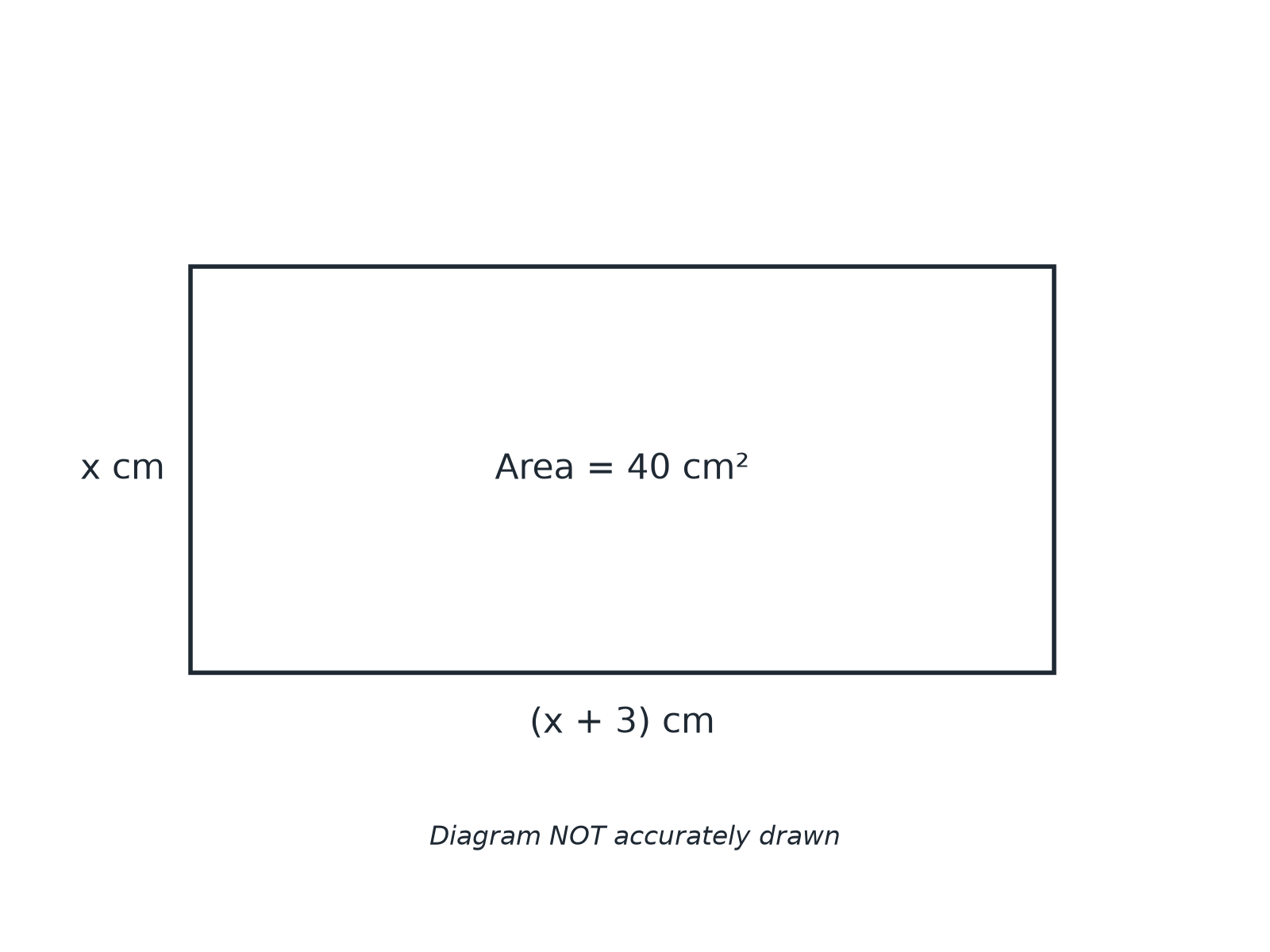
A rectangle has length \((x + 3)\) cm and width \(x\) cm. Its area is 40 cm². Find \(x\), and the dimensions.
Show the solutionHide the solution
- 1 Area equation \(x(x + 3) = 40\)
- 2 Expand and rearrange \(x^2 + 3x - 40 = 0\)
- 3 Factorise \((x + 8)(x - 5) = 0\)
- 4 A length cannot be negative \(x = 5\), and \(x = -8\) is rejected
Answer\(x = 5\); the rectangle is 8 cm by 5 cm.
Solve and Check
Solve each equation by factorising, then substitute your answers back to check. (a) \(x^2 - 8x + 15 = 0\) (b) \(x^2 + 4x = 0\) (c) \(x^2 - 25 = 0\) (d) \(x^2 = 2x + 24\).
1. Rearrange to zero.
2. Factorise.
3. Check by substituting.
A good answer shows: (a) \((x - 3)(x - 5) = 0\): \(x = 3\) or 5. (b) \(x(x + 4) = 0\): \(x = 0\) or \(-4\). (c) \((x - 5)(x + 5) = 0\): \(x = \pm 5\). (d) \(x^2 - 2x - 24 = 0\), \((x - 6)(x + 4) = 0\): \(x = 6\) or \(-4\).
Can I...?
- 1Factorise \(x^2 + bx + c\).
- 2Use the null factor law.
- 3Solve a difference of two squares.
- 4Solve an equation with no constant term.
- 5Rearrange to zero first.
- 6Reject impossible solutions.
- 7Form a quadratic from a problem.
- 8Check by substituting.
Summary & Exam Focus
- Make the equation equal zero before factorising.
- Set each bracket to zero.
- Difference of two squares: \(x^2 - a^2 = (x - a)(x + a)\).
- Check solutions make sense in context.
Exam focus
A rectangle has length \((x + 3)\) cm and width \(x\) cm. The area of the rectangle is 40 cm². Work out the value of \(x\). (4 marks) (4 marks)
Form the equation, rearrange to zero, factorise, and reject any negative length.
Key terms
The vocabulary this lesson expects you to use. Each one is linked from the first place it appears above.
- Quadratic equation
- An equation whose highest power is \(x^2\).
- Root
- A solution of an equation; where a graph crosses the x-axis.
- Factorise
- Write as a product of brackets.
- Null factor law
- If \(ab = 0\), then \(a = 0\) or \(b = 0\).
- Difference of two squares
- \(a^2 - b^2 = (a - b)(a + b)\).
- Perfect square
- A quadratic that is a bracket squared.
Questions and answers
12 questions set on this lesson, with the mark schemes and model answers open.
Solve \(x^2 + 5x + 6 = 0\).
Mark scheme — 3 marks available
- Correct factorisation — M1
- One solution — A1
- Both solutions — A1
Model answer
\((x + 2)(x + 3) = 0\), so \(x = -2\) or \(x = -3\).
Solve \(x^2 - 2x - 15 = 0\).
Mark scheme — 3 marks available
- Correct factorisation — M1
- One solution — A1
- Both solutions — A1
Model answer
\((x - 5)(x + 3) = 0\), so \(x = 5\) or \(x = -3\).
Solve \(x^2 - 49 = 0\).
Mark scheme — 2 marks available
- Factorising or \(x^2 = 49\) — M1
- \(x = 7\) and \(x = -7\) — A1
Model answer
\((x - 7)(x + 7) = 0\), so \(x = 7\) or \(x = -7\).
Solve \(x^2 - 7x = 0\).
Mark scheme — 2 marks available
- \(x(x - 7)\) — M1
- \(x = 0\) and \(x = 7\) — A1
Model answer
\(x(x - 7) = 0\), so \(x = 0\) or \(x = 7\).
Solve \(x^2 = 3x + 10\).
Mark scheme — 3 marks available
- Rearranging to zero — M1
- Correct factorisation — M1
- \(x = 5\) and \(x = -2\) — A1
Model answer
\(x^2 - 3x - 10 = 0\), so \((x - 5)(x + 2) = 0\) and \(x = 5\) or \(x = -2\).
The diagram shows a rectangle. The length is \((x + 3)\) cm and the width is \(x\) cm. The area of the rectangle is 40 cm². Work out the value of \(x\).
Mark scheme — 4 marks available
- Forming the equation — M1
- Rearranging to zero — M1
- Factorising — M1
- \(x = 5\) — A1
Model answer
\(x(x + 3) = 40\), so \(x^2 + 3x - 40 = 0\) and \((x + 8)(x - 5) = 0\). \(x = 5\), since a length cannot be negative.
Solve \((x - 2)(x - 3) = 0\).
Why: Set each bracket to zero: \(x = 2\) or \(x = 3\).
Factorise \(x^2 - 5x + 6\).
Why: Numbers with product 6 and sum \(-5\): \(-2\) and \(-3\).
Solve \(x^2 = 16\).
Why: \(x = 4\) or \(x = -4\).
Solve \(x^2 + 3x = 0\).
Why: \(x(x + 3) = 0\), so \(x = 0\) or \(x = -3\).
A quadratic graph crosses the x-axis at \(x = -1\) and \(x = 4\). Which is its equation?
Why: \(y = (x + 1)(x - 4) = x^2 - 3x - 4\).
Why should you not divide both sides of \(x^2 = 5x\) by \(x\)?
Why: You lose the solution \(x = 0\). Rearrange and factorise instead: \(x(x - 5) = 0\).