Viewing as
Teaching this? The teacher view adds 2 files, the mark schemes and the model answers.
Maths · Fractions, ratio and percentages
Fractions
Adding, subtracting, multiplying and dividing fractions and mixed numbers, finding fractions of amounts, and working back to the whole - the fraction skills every other topic leans on.
Before We Start
Answer each one, then check.
-
1
Simplify \(\frac{12}{18}\).
Show answerHide answer
\(\frac{2}{3}\)
-
2
What is the lowest common multiple of 4 and 6?
Show answerHide answer
12
-
3
Work out \(\frac{3}{4}\) of 20.
Show answerHide answer
15
-
4
Write \(2\frac{1}{3}\) as an improper fraction.
Show answerHide answer
\(\frac{7}{3}\)
Learning Objectives
- 1Add and subtract fractions and mixed numbers.
- 2Multiply and divide fractions and mixed numbers.
- 3Find a fraction of an amount, and write one quantity as a fraction of another.
- 4Find the whole amount when you know a fraction of it.
Equivalent Fractions and Mixed Numbers
Multiplying or dividing the top and bottom by the same number gives an equivalent fraction.
-
Simplify
Divide the top and bottom by their HCF: \(\frac{12}{18} = \frac{2}{3}\) (dividing by 6).
-
Mixed to improper
\(2\frac{1}{3} = \frac{2 \times 3 + 1}{3} = \frac{7}{3}\).
-
Improper to mixed
\(\frac{17}{5} = 3\frac{2}{5}\), because \(17 \div 5 = 3\) remainder 2.
-
Always finish simply
Give answers in their simplest form, as a mixed number if the question uses them.
Adding and Subtracting
Fractions can only be added or subtracted when their denominators are the same.
-
Common denominator
Use the lowest common multiple of the denominators: for \(\frac{1}{4} + \frac{1}{6}\), use 12.
-
Change each fraction
\(\frac{1}{4} = \frac{3}{12}\) and \(\frac{1}{6} = \frac{2}{12}\), so the answer is \(\frac{5}{12}\).
-
Mixed numbers
Change them to improper fractions first - it avoids borrowing mistakes.
-
Never add the bottoms
\(\frac{1}{4} + \frac{1}{6}\) is NOT \(\frac{2}{10}\).
Adding Mixed Numbers
Work out \(2\frac{3}{4} + 1\frac{5}{6}\)
Show the solutionHide the solution
- 1 Change to improper fractions \(\dfrac{11}{4} + \dfrac{11}{6}\)
- 2 Common denominator: the LCM of 4 and 6 is 12 \(\dfrac{33}{12} + \dfrac{22}{12}\)
- 3 Add the numerators \(\dfrac{55}{12}\)
- 4 Change back to a mixed number \(55 \div 12 = 4\) remainder 7
Answer\(4\dfrac{7}{12}\)
Subtracting Mixed Numbers
Work out \(3\frac{1}{5} - 1\frac{2}{3}\)
Show the solutionHide the solution
- 1 Change to improper fractions \(\dfrac{16}{5} - \dfrac{5}{3}\)
- 2 Common denominator 15 \(\dfrac{48}{15} - \dfrac{25}{15}\)
- 3 Subtract the numerators \(\dfrac{23}{15}\)
- 4 Change back \(1\dfrac{8}{15}\)
Answer\(1\dfrac{8}{15}\)
Multiplying and Dividing
No common denominator is needed - but mixed numbers must be made improper first.
-
Multiply
Multiply the tops and multiply the bottoms: \(\frac{2}{3} \times \frac{3}{4} = \frac{6}{12} = \frac{1}{2}\).
-
Cancel first
Divide a top and a bottom by a common factor before multiplying to keep numbers small.
-
Reciprocal
Flip a fraction to get its reciprocal: the reciprocal of \(\frac{4}{5}\) is \(\frac{5}{4}\).
-
Divide
Dividing by a fraction is the same as multiplying by its reciprocal: keep, flip, change.
Why Multiplying Fractions Works
"Of" means multiply. Take \(\frac{3}{4}\) of the square, then \(\frac{2}{3}\) of that, and the overlap is 6 of the 12 small rectangles - exactly \(\frac{2}{3} \times \frac{3}{4} = \frac{6}{12} = \frac{1}{2}\).
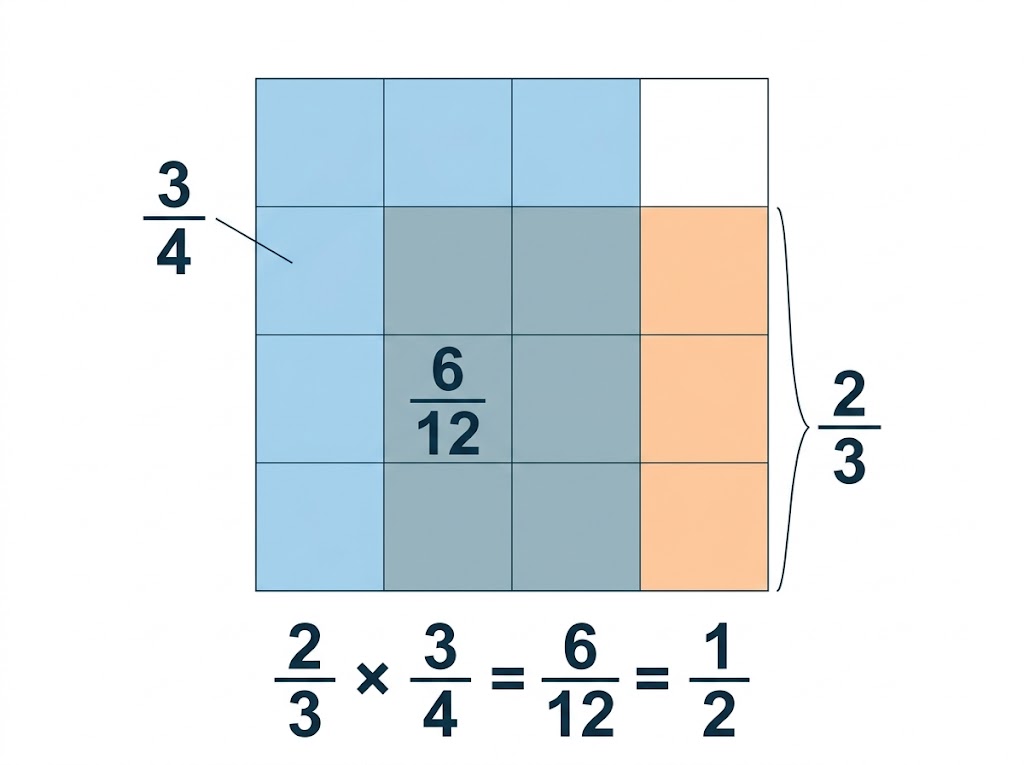
\(\frac{2}{3}\) of \(\frac{3}{4}\) covers 6 of the 12 small rectangles: \(\frac{1}{2}\).
Multiplying Mixed Numbers
Work out \(2\frac{1}{4} \times 1\frac{1}{3}\)
Show the solutionHide the solution
- 1 Change to improper fractions \(\dfrac{9}{4} \times \dfrac{4}{3}\)
- 2 Cancel: the 4s cancel, and 9 and 3 share a factor of 3 \(\dfrac{3}{1} \times \dfrac{1}{1}\)
- 3 Multiply \(3\)
Answer\(3\)
Dividing Mixed Numbers
Work out \(3\frac{1}{3} \div 1\frac{1}{4}\)
Show the solutionHide the solution
- 1 Change to improper fractions \(\dfrac{10}{3} \div \dfrac{5}{4}\)
- 2 Keep, flip, change \(\dfrac{10}{3} \times \dfrac{4}{5}\)
- 3 Multiply \(\dfrac{40}{15} = \dfrac{8}{3}\)
- 4 Change back \(2\dfrac{2}{3}\)
Answer\(2\dfrac{2}{3}\)
Fractions of Amounts
Divide by the bottom, multiply by the top.
-
A fraction of an amount
\(\frac{3}{5}\) of 40: \(40 \div 5 = 8\), \(8 \times 3 = 24\).
-
One amount as a fraction of another
15 out of 40 is \(\frac{15}{40} = \frac{3}{8}\). Make sure both are in the same units first.
-
Finding the whole
If \(\frac{3}{5}\) of a number is 24, then \(\frac{1}{5}\) is 8, so the whole is \(5 \times 8 = 40\).
-
The rest
If \(\frac{2}{5}\) is spent, \(1 - \frac{2}{5} = \frac{3}{5}\) is left.
Fraction Target
Using each of the digits 1, 2, 3 and 4 once, make two fractions \(\frac{a}{b}\) and \(\frac{c}{d}\) whose sum is as close to 1 as possible. Then find the pair whose product is as small as possible.
1. Try several combinations.
2. Work out each sum exactly.
3. Explain why your best answer is best.
A good answer shows: Closest sum to 1: \(\frac{1}{4} + \frac{2}{3} = \frac{11}{12}\) (or \(\frac{1}{3} + \frac{2}{4} = \frac{5}{6}\), further away). Smallest product: \(\frac{1}{3} \times \frac{2}{4} = \frac{1}{6}\) or \(\frac{1}{4} \times \frac{2}{3} = \frac{1}{6}\).
Can I...?
- 1Simplify fractions.
- 2Convert between mixed numbers and improper fractions.
- 3Add and subtract fractions.
- 4Add and subtract mixed numbers.
- 5Multiply fractions and mixed numbers.
- 6Divide fractions and mixed numbers.
- 7Find a fraction of an amount.
- 8Find the whole from a fraction of it.
Summary & Exam Focus
- Add and subtract: common denominator first; mixed numbers become improper.
- Multiply: tops times tops, bottoms times bottoms; cancel first.
- Divide: keep, flip, change.
- Fraction of an amount: divide by the bottom, multiply by the top.
Exam focus
Work out \(1\frac{3}{4} \div 2\frac{1}{3}\). Give your answer in its simplest form. (3 marks) (3 marks)
Show every step - the improper fractions, the flipped fraction, the multiplication. On the non-calculator paper each step can earn a method mark.
Key terms
The vocabulary this lesson expects you to use. Each one is linked from the first place it appears above.
- Numerator
- The top number of a fraction.
- Denominator
- The bottom number of a fraction.
- Improper fraction
- A fraction whose numerator is bigger than its denominator, e.g. \(\frac{7}{3}\).
- Mixed number
- A whole number and a fraction, e.g. \(2\frac{1}{3}\).
- Reciprocal
- 1 divided by a number; for a fraction, the fraction flipped.
- Common denominator
- A denominator shared by two fractions, so they can be added or subtracted.
Practice questions
Have a go at each one before you open its answer.
-
Question 1 Non-calculator 2 marks
Work out \(\dfrac{2}{3} + \dfrac{1}{4}\)
Show answerHide answer
Model answer
\(\dfrac{8}{12} + \dfrac{3}{12} = \dfrac{11}{12}\)
Mark scheme
- Both fractions written with a common denominator — M1
- \(\frac{11}{12}\) — A1
-
Question 2 Non-calculator 2 marks
Work out \(2\frac{1}{2} \times 1\frac{3}{5}\)
Show answerHide answer
Model answer
\(\dfrac{5}{2} \times \dfrac{8}{5} = \dfrac{40}{10} = 4\)
Mark scheme
- Both written as improper fractions: \(\frac{5}{2}\) and \(\frac{8}{5}\) — M1
- \(4\) — A1
-
Question 3 Non-calculator 3 marks
Work out \(1\frac{3}{4} \div 2\frac{1}{3}\). Give your answer in its simplest form.
Show answerHide answer
Model answer
\(\dfrac{7}{4} \div \dfrac{7}{3} = \dfrac{7}{4} \times \dfrac{3}{7} = \dfrac{21}{28} = \dfrac{3}{4}\)
Mark scheme
- Both written as improper fractions — M1
- Multiplying by the reciprocal: \(\frac{7}{4} \times \frac{3}{7}\) — M1
- \(\frac{3}{4}\) — A1
-
Question 4 Non-calculator 3 marks
Sam spends \(\frac{2}{5}\) of his wages on rent and \(\frac{1}{4}\) on food. He saves the rest. His wages are £1200. How much does he save?
Show answerHide answer
Model answer
Fraction spent: \(\frac{2}{5} + \frac{1}{4} = \frac{8}{20} + \frac{5}{20} = \frac{13}{20}\). Fraction saved: \(\frac{7}{20}\). \(\frac{7}{20} \times 1200 = 420\). He saves £420.
Mark scheme
- \(\frac{13}{20}\) or \(\frac{7}{20}\), or £480 and £300 found — P1
- \(\frac{7}{20} \times 1200\) or \(1200 - 780\) — P1
- £420 — A1
Quick check
-
What is \(\frac{1}{3} + \frac{1}{4}\)?
Show answerHide answer
C: \(\frac{7}{12}\)
Common denominator 12: \(\frac{4}{12} + \frac{3}{12} = \frac{7}{12}\).
-
What is \(\frac{3}{4} \div \frac{1}{2}\)?
Show answerHide answer
A: \(1\frac{1}{2}\)
Keep, flip, change: \(\frac{3}{4} \times \frac{2}{1} = \frac{6}{4} = 1\frac{1}{2}\).
-
\(\frac{3}{5}\) of a number is 36. What is the number?
Show answerHide answer
D: 60
\(\frac{1}{5}\) is \(36 \div 3 = 12\), so the number is \(5 \times 12 = 60\).
Downloads
Free to keep, print and annotate.
Something here looks wrong?
Tell us what and we will go and look. It goes to whoever writes these pages, nobody else, and we do not ask who you are — so there is nothing to sign and nothing comes back to you.