Viewing as
Teacher view: planning notes, the answers to every question, and the teacher copies of the files.
Maths · Graphs
Cubic and reciprocal graphs
Plotting cubic graphs such as \(y = x^3 - 4x\) and reciprocal graphs such as \(y = \dfrac{12}{x}\), and recognising linear, quadratic, cubic and reciprocal graphs by their shape.
Teacher resources
The teacher copies: slides with the questions built in, the answers, and anything else attached to this lesson for whoever is teaching it.
- Cubic and reciprocal graphs - Teacher Slides.pptx Teacher The lesson slides with the teacher's notes on each slide, and every question and mark scheme built in. Built from the lesson script on 29 September 2026. View
- Cubic and reciprocal graphs - Teacher Notes.docx Teacher The complete notes with the teacher's notes and every model answer in full. Built from the lesson script on 29 September 2026. View
Student handouts
The same files the students see, to print or hand out.
- Cubic and reciprocal graphs.pptx Built from the lesson script on 29 September 2026. View
- Cubic and reciprocal graphs - Completed Notes.docx The full notes for the lesson, to revise from. Built from the lesson script on 29 September 2026. View
- Cubic and reciprocal graphs - Exam Questions.docx Built from the lesson script on 29 September 2026. View
Last Lesson and Before
Answer each one, then check.
-
1
Work out \((-2)^3\).
Show answerHide answer
\(-8\)
-
2
Last lesson: what shape is the graph of \(y = x^2\)?
Show answerHide answer
A U-shaped parabola
-
3
Work out \(12 \div 0.5\).
Show answerHide answer
24
-
4
What is the reciprocal of 3?
Show answerHide answer
\(\frac{1}{3}\)
Learning Objectives
- 1Complete a table of values for a cubic and plot its graph.
- 2Complete a table of values for a reciprocal and plot its graph.
- 3Recognise and sketch linear, quadratic, cubic and reciprocal graphs.
- 4Use a graph to solve equations.
Cubic Graphs
A cubic has an \(x^3\) term and no higher power.
-
\(y = x^3\)
Passes through the origin: \((-2, -8)\), \((-1, -1)\), \((0, 0)\), \((1, 1)\), \((2, 8)\).
-
S-shape
Positive \(x^3\): rises from bottom left to top right. Negative \(x^3\): falls from top left to bottom right.
-
Up to three roots
\(y = x^3 - 4x = x(x - 2)(x + 2)\) crosses the \(x\)-axis at \(-2\), 0 and 2.
-
Cube negatives carefully
\((-3)^3 = -27\), so \(x^3 - 4x\) at \(x = -3\) is \(-27 + 12 = -15\).
A Table of Values for y = x³ − 4x
-
\(-3\)
\(x^3\): \(-27\). \(-4x\): 12. y: \(-15\)
-
\(-2\)
\(x^3\): \(-8\). \(-4x\): 8. y: 0
-
\(-1\)
\(x^3\): \(-1\). \(-4x\): 4. y: 3
-
0
\(x^3\): 0. \(-4x\): 0. y: 0
-
1
\(x^3\): 1. \(-4x\): \(-4\). y: \(-3\)
-
2
\(x^3\): 8. \(-4x\): \(-8\). y: 0
-
3
\(x^3\): 27. \(-4x\): \(-12\). y: 15
Reciprocal Graphs
A reciprocal graph has the form \(y = \dfrac{k}{x}\).
-
No value at \(x = 0\)
You cannot divide by 0, so there is no point on the \(y\)-axis.
-
Two separate branches
For positive \(k\), one branch is in the top right and one in the bottom left.
-
Asymptotes
The curve gets closer and closer to both axes but never touches them.
-
Negative \(k\)
The branches are in the top left and bottom right instead.
Plotting y = 12/x
Complete a table of values for \(y = \dfrac{12}{x}\) for \(x = 1, 2, 3, 4, 6, 12\), and describe the graph.
Show the solutionHide the solution
- 1 Divide 12 by each value \(12, 6, 4, 3, 2, 1\)
- 2 Plot and join with a smooth curve It falls steeply, then levels off
- 3 Negative values \(x = -1\) gives \(-12\), \(x = -2\) gives \(-6\): the same shape, upside down, in the bottom left
Answer\(y = 12, 6, 4, 3, 2, 1\). The curve never touches either axis.
Four Graph Shapes
Know these four shapes by sight. The highest power of \(x\) tells you which: power 1 is a straight line, power 2 a parabola, power 3 an S-shaped cubic, and \(x\) on the bottom of a fraction a reciprocal with two branches.
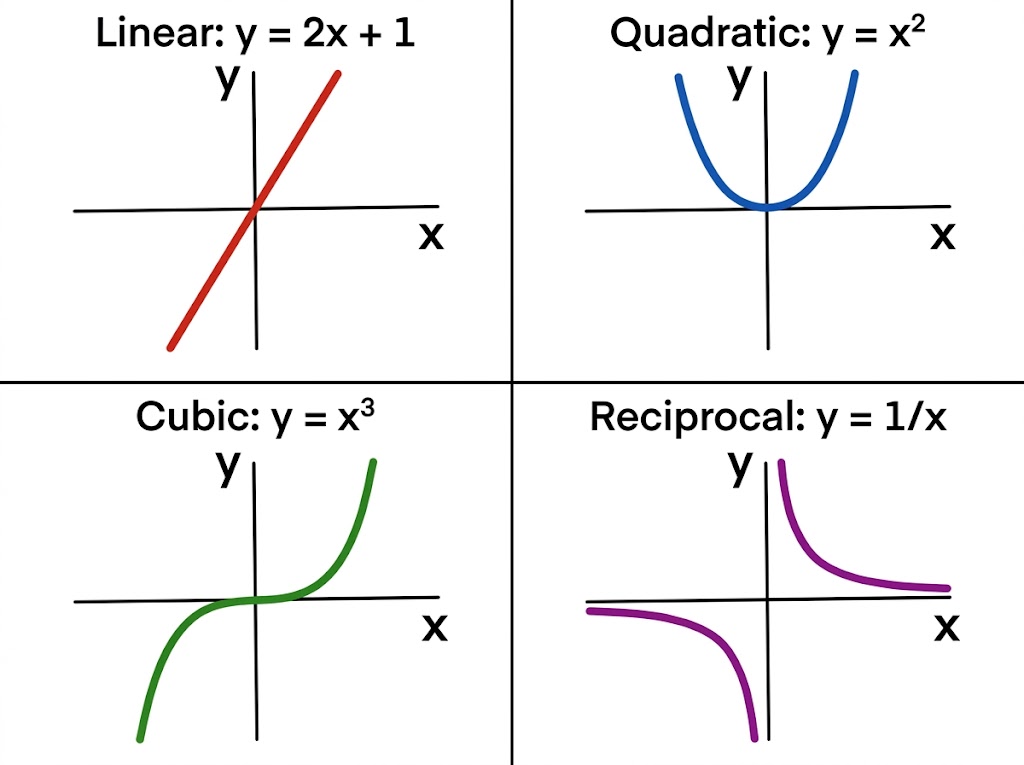
Linear, quadratic, cubic and reciprocal.
Match the Equation to the Graph
-
\(y = 3 - 2x\)
Straight line sloping down
-
\(y = x^2 - 1\)
U-shaped parabola
-
\(y = -x^2 + 4\)
∩-shaped parabola
-
\(y = x^3 + 1\)
S-shaped curve rising to the right
-
\(y = \dfrac{5}{x}\)
Two branches, top right and bottom left
-
\(y = -\dfrac{5}{x}\)
Two branches, top left and bottom right
Graph Sketch Race
Your teacher calls out an equation. Sketch its graph on a mini-whiteboard in 20 seconds: \(y = 4\), \(y = x^3\), \(y = -x^2\), \(y = \frac{2}{x}\), \(y = 2x - 3\), \(y = -x^3\), \(x = -1\), \(y = x^2 + 2\), \(y = -\frac{3}{x}\).
1. Decide the type from the highest power.
2. Decide the direction from the sign.
3. Mark any intercepts.
A good answer shows: Horizontal line; S-shape rising; ∩-shape through the origin; branches top-right and bottom-left; straight line through \((0, -3)\), gradient 2; S-shape falling; vertical line; U-shape with minimum \((0, 2)\); branches top-left and bottom-right.
Can I...?
- 1Complete a table of values for a cubic.
- 2Plot a cubic graph.
- 3Complete a table of values for a reciprocal graph.
- 4Plot a reciprocal graph.
- 5Recognise linear, quadratic, cubic and reciprocal graphs.
- 6Explain why \(y = \frac{k}{x}\) has no point at \(x = 0\).
Summary & Exam Focus
- Cubic: S-shaped, up to three roots.
- Reciprocal \(y = \frac{k}{x}\): two branches, never touching the axes.
- The highest power of \(x\) tells you the type of graph.
Exam focus
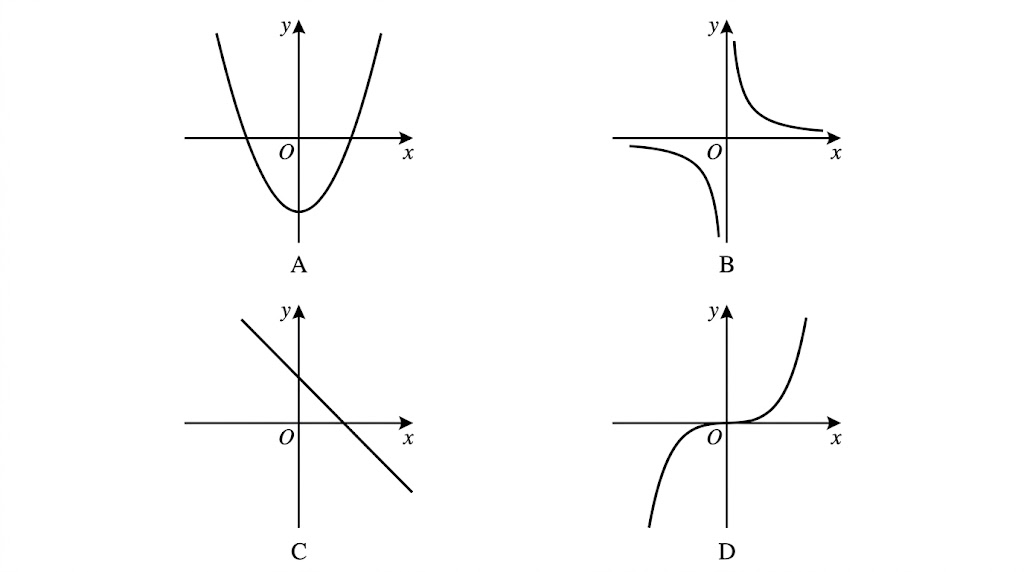
Match each equation to one of the graphs A, B, C and D: \(y = 3 - 2x\), \(y = x^2 - 1\), \(y = x^3\), \(y = \dfrac{5}{x}\). (2 marks) (2 marks)
In a matching question, start with the equations you are surest of - the straight line and the reciprocal are usually easiest - and eliminate.
Key terms
The vocabulary this lesson expects you to use. Each one is linked from the first place it appears above.
- Cubic
- An expression whose highest power of \(x\) is \(x^3\).
- Reciprocal graph
- A graph of the form \(y = \frac{k}{x}\).
- Asymptote
- A line that a curve gets closer and closer to but never touches.
- Root
- An \(x\)-value where a graph crosses the \(x\)-axis.
Questions and answers
7 questions set on this lesson, with the mark schemes and model answers open.
Complete the table of values for \(y = x^3 - 4x\) for \(x = -3, -2, -1, 0, 1, 2, 3\).
Mark scheme — 2 marks available
- At least 4 correct values — B1
- All 7 correct — B1
Model answer
\(y = -15, 0, 3, 0, -3, 0, 15\)
Here are four graphs, A, B, C and D. Match each equation to its graph: \(y = 3 - 2x\), \(y = x^2 - 1\), \(y = x^3\), \(y = \dfrac{5}{x}\).
Mark scheme — 2 marks available
- 2 correct matches — B1
- All 4 correct — B1
Model answer
\(y = 3 - 2x\) - C. \(y = x^2 - 1\) - A. \(y = x^3\) - D. \(y = \frac{5}{x}\) - B.
(a) Complete the table of values for \(y = \dfrac{12}{x}\) for \(x = 1, 2, 3, 4, 6, 12\). (b) Explain why the graph of \(y = \dfrac{12}{x}\) never crosses the \(y\)-axis.
Mark scheme — 3 marks available
- (a) At least 4 correct — B1
- (a) All correct — B1
- (b) Division by 0 is impossible, or \(x\) cannot be 0 — C1
Model answer
(a) \(12, 6, 4, 3, 2, 1\) (b) On the \(y\)-axis \(x = 0\), and you cannot divide 12 by 0, so there is no point with \(x = 0\).
Write down the three values of \(x\) where the graph of \(y = x^3 - 4x\) crosses the \(x\)-axis. Show how you know.
Mark scheme — 2 marks available
- A correct method, e.g. factorising or a table — M1
- \(-2\), 0 and 2 — A1
Model answer
\(x^3 - 4x = x(x^2 - 4) = x(x - 2)(x + 2)\). So \(x = 0\), 2 or \(-2\). (Or: the table gives \(y = 0\) at these values.)
What shape is the graph of \(y = x^3\)?
Why: A positive cubic is S-shaped, rising from bottom left to top right.
What is \(y\) when \(x = -2\) on \(y = x^3 + 5\)?
Why: \((-2)^3 + 5 = -8 + 5 = -3\).
Which graph has asymptotes along both axes?
Why: A reciprocal graph gets closer to both axes but never touches them.