Viewing as
Teacher view: planning notes, the answers to every question, and the teacher copies of the files.
Maths · Graphs
Linear graphs
Straight-line graphs from a table of values, the gradient as "change in y over change in x", and reading the gradient and y-intercept straight from \(y = mx + c\).
Teacher resources
The teacher copies: slides with the questions built in, the answers, and anything else attached to this lesson for whoever is teaching it.
- Linear graphs - Teacher Slides.pptx Teacher The lesson slides with the teacher's notes on each slide, and every question and mark scheme built in. Built from the lesson script on 29 September 2026. View
- Linear graphs - Teacher Notes.docx Teacher The complete notes with the teacher's notes and every model answer in full. Built from the lesson script on 29 September 2026. View
Student handouts
The same files the students see, to print or hand out.
- Linear graphs.pptx Built from the lesson script on 29 September 2026. View
- Linear graphs - Completed Notes.docx The full notes for the lesson, to revise from. Built from the lesson script on 29 September 2026. View
- Linear graphs - Exam Questions.docx Built from the lesson script on 29 September 2026. View
Before We Start
Answer each one, then check.
-
1
Work out \(3 \times (-2) + 1\).
Show answerHide answer
\(-5\)
-
2
Which axis is horizontal?
Show answerHide answer
The \(x\)-axis
-
3
Write down the coordinates of the origin.
Show answerHide answer
\((0, 0)\)
-
4
Rearrange \(y - 4 = 2x\) to make \(y\) the subject.
Show answerHide answer
\(y = 2x + 4\)
Learning Objectives
- 1Draw a straight-line graph from a table of values.
- 2Recognise lines of the form \(x = a\) and \(y = b\).
- 3Work out the gradient of a line.
- 4Use \(y = mx + c\) to find the gradient and \(y\)-intercept.
Tables of Values
To draw \(y = 2x + 1\), work out \(y\) for a few values of \(x\), plot the points and join them with a ruler.
-
Substitute
When \(x = -2\), \(y = 2 \times (-2) + 1 = -3\).
-
Three points at least
Two points fix a line; a third catches a mistake.
-
Straight line
If the points are not in a straight line, check your table.
-
Across the grid
Draw the line through all the points, from edge to edge of the given range.
A Table of Values for y = 2x + 1
-
\(-2\)
Working: \(2 \times (-2) + 1\). y: \(-3\)
-
\(-1\)
Working: \(2 \times (-1) + 1\). y: \(-1\)
-
0
Working: \(2 \times 0 + 1\). y: 1
-
1
Working: \(2 \times 1 + 1\). y: 3
-
2
Working: \(2 \times 2 + 1\). y: 5
-
3
Working: \(2 \times 3 + 1\). y: 7
Horizontal and Vertical Lines
Some lines have only one letter in their equation.
-
\(y = b\)
A horizontal line: every point on it has \(y\)-coordinate \(b\). The \(x\)-axis is \(y = 0\).
-
\(x = a\)
A vertical line: every point on it has \(x\)-coordinate \(a\). The \(y\)-axis is \(x = 0\).
-
\(y = x\)
A diagonal line through the origin, where both coordinates are equal.
-
\(y = -x\)
The other diagonal through the origin.
Gradient and Intercept
The gradient measures steepness: how much \(y\) goes up for every 1 across. Draw a triangle under the line and work out \(\dfrac{\text{change in } y}{\text{change in } x} = \dfrac{4}{2} = 2\). The \(y\)-intercept is where the line crosses the \(y\)-axis.
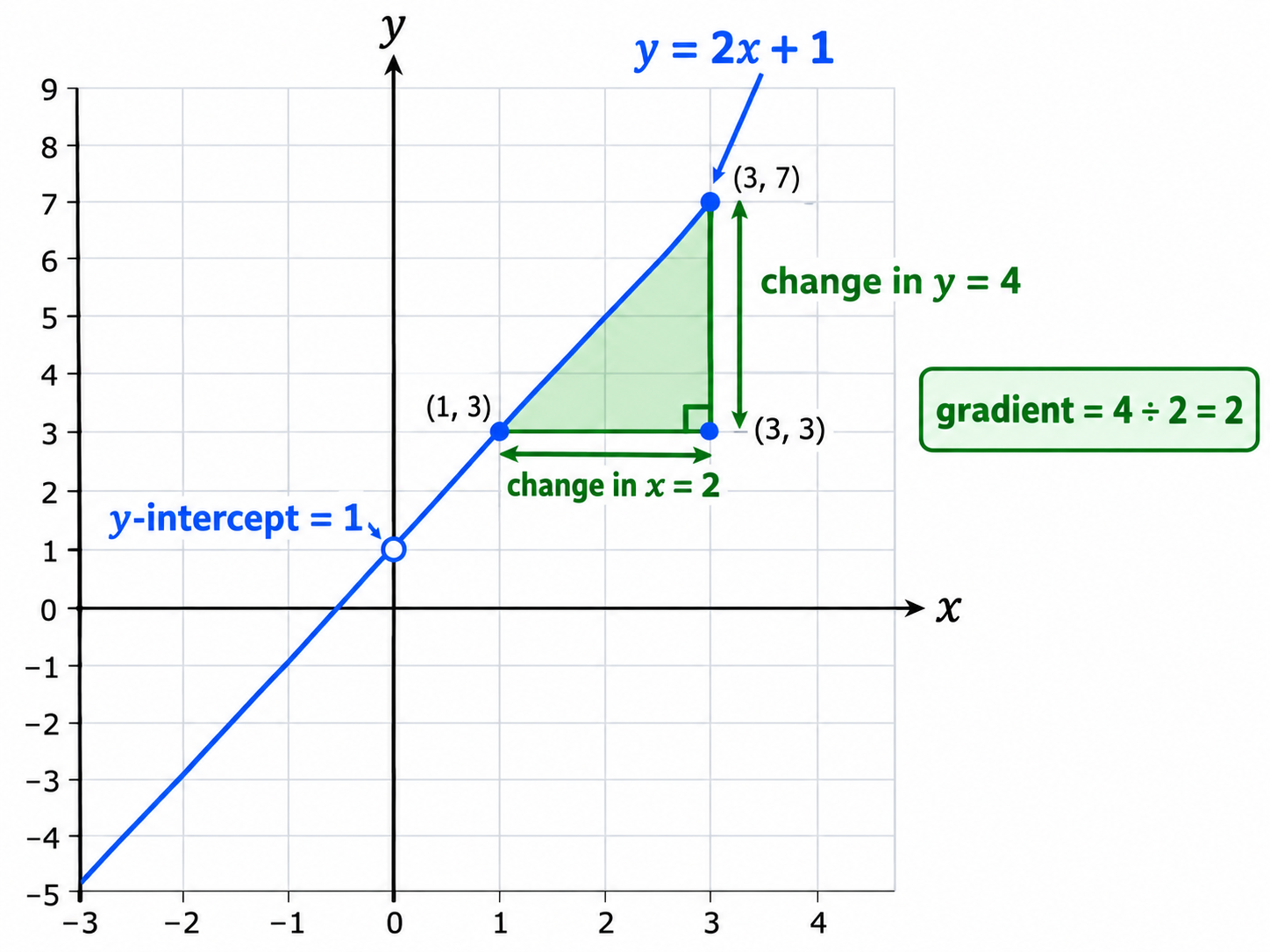
\(y = 2x + 1\): gradient 2, \(y\)-intercept 1.
Gradient
Gradient \(= \dfrac{\text{change in } y}{\text{change in } x}\).
-
Positive
The line goes up from left to right.
-
Negative
The line goes down from left to right.
-
Zero
A horizontal line has gradient 0.
-
From two points
Between \((x_1, y_1)\) and \((x_2, y_2)\), gradient \(= \dfrac{y_2 - y_1}{x_2 - x_1}\).
Gradient from Two Points
Work out the gradient of the line through \((1, 3)\) and \((4, 12)\).
Show the solutionHide the solution
- 1 Change in \(y\) \(12 - 3 = 9\)
- 2 Change in \(x\) \(4 - 1 = 3\)
- 3 Divide \(9 \div 3 = 3\)
AnswerGradient 3
y = mx + c
When the equation is written as \(y = mx + c\), you can read the line straight off it.
-
\(m\)
The gradient - the number in front of \(x\).
-
\(c\)
The \(y\)-intercept: the line crosses the \(y\)-axis at \((0, c)\).
-
Rearrange first
\(y\) must be on its own: \(2y = 4x + 6\) becomes \(y = 2x + 3\).
-
Order doesn't matter
\(y = 5 - 3x\) has gradient \(-3\) and \(y\)-intercept 5.
Finding the Equation from a Graph
A straight line crosses the \(y\)-axis at \((0, -2)\) and passes through \((3, 4)\). Find its equation.
Show the solutionHide the solution
- 1 \(y\)-intercept \(c = -2\)
- 2 Gradient \(\dfrac{4 - (-2)}{3 - 0} = \dfrac{6}{3} = 2\)
- 3 Write \(y = mx + c\) \(y = 2x - 2\)
Answer\(y = 2x - 2\)
Line Match-Up
Sort these six equations into pairs that share something - same gradient, same intercept or both: \(y = 3x + 2\), \(y = 2 - x\), \(y = 3x - 5\), \(2y = 6x + 4\), \(y = -x + 7\), \(y = 2x + 2\). Then sketch each line.
1. Rearrange into \(y = mx + c\) first.
2. Write down \(m\) and \(c\) for each.
3. Group them.
A good answer shows: \(y = 3x + 2\) and \(2y = 6x + 4\) are the same line (gradient 3, intercept 2). \(y = 3x - 5\) is parallel to them. \(y = 2 - x\) and \(y = -x + 7\) are parallel (gradient \(-1\)). \(y = 2x + 2\), \(y = 3x + 2\) and \(y = 2 - x\) share intercept 2.
Can I...?
- 1Complete a table of values.
- 2Plot and draw a straight-line graph.
- 3Recognise \(x = a\), \(y = b\), \(y = x\) and \(y = -x\).
- 4Find the gradient from a graph.
- 5Find the gradient between two points.
- 6Read \(m\) and \(c\) from \(y = mx + c\).
- 7Rearrange an equation into \(y = mx + c\).
- 8Find the equation of a line from its graph.
Summary & Exam Focus
- Gradient \(= \dfrac{\text{change in } y}{\text{change in } x}\).
- \(y = mx + c\): \(m\) is the gradient, \(c\) the \(y\)-intercept.
- \(x = a\) is vertical; \(y = b\) is horizontal.
Exam focus
The graph shows a straight line. Find the equation of the line. (3 marks) (3 marks)
For the gradient, choose two points where the line crosses grid lines exactly, and check the sign: a line going down to the right has a negative gradient.
Key terms
The vocabulary this lesson expects you to use. Each one is linked from the first place it appears above.
- Linear
- Making a straight line when plotted.
- Gradient
- The steepness of a line: change in \(y\) divided by change in \(x\).
- \(y\)-intercept
- Where a line crosses the \(y\)-axis.
- Coordinates
- A pair \((x, y)\) giving a point's position.
- Origin
- The point \((0, 0)\) where the axes cross.
Questions and answers
7 questions set on this lesson, with the mark schemes and model answers open.
Complete the table of values for \(y = 3x - 2\) for \(x = -1, 0, 1, 2, 3\).
Mark scheme — 2 marks available
- At least 3 correct values — B1
- All 5 correct — B1
Model answer
\(y = -5, -2, 1, 4, 7\)
Work out the gradient of the straight line that passes through the points \((-1, 2)\) and \((3, 10)\).
Mark scheme — 2 marks available
- \(\dfrac{10 - 2}{3 - (-1)}\) — M1
- 2 — A1
Model answer
\(\dfrac{10 - 2}{3 - (-1)} = \dfrac{8}{4} = 2\)
The graph shows a straight line. Find the equation of the line.
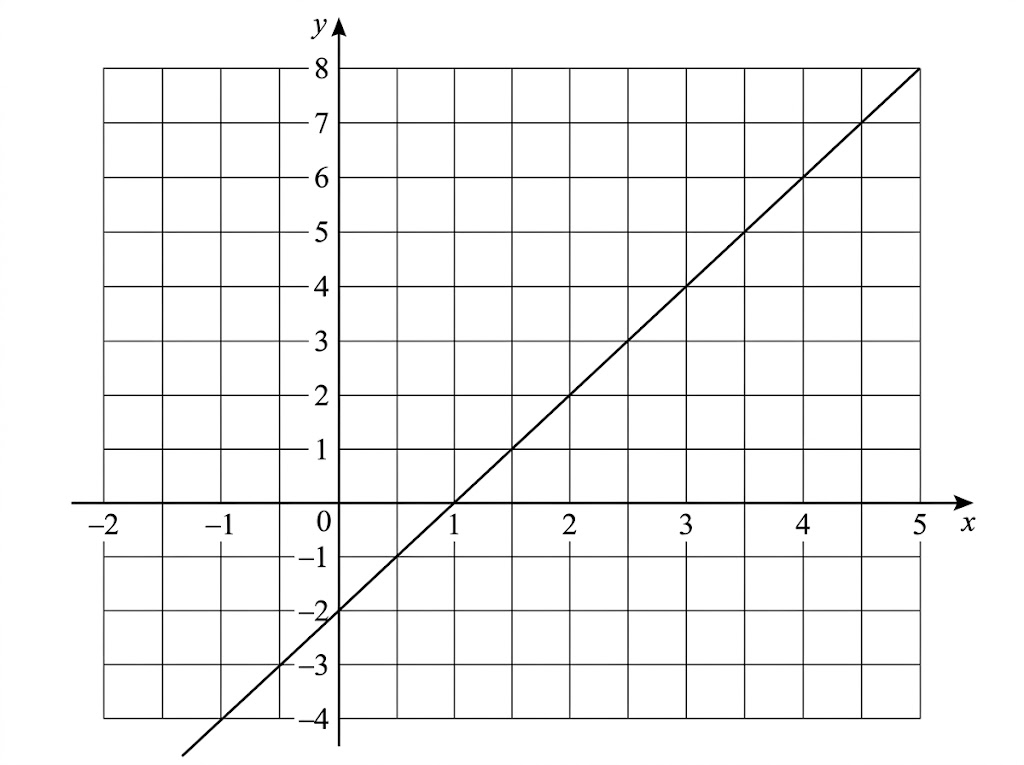
Mark scheme — 3 marks available
- Gradient 2 — M1
- \(y\)-intercept \(-2\) — M1
- \(y = 2x - 2\) — A1
Model answer
The line crosses the \(y\)-axis at \(-2\). Gradient \(= \dfrac{4 - (-2)}{3 - 0} = 2\). \(y = 2x - 2\)
Does the point \((3, 7)\) lie on the line \(y = 4x - 5\)? Give a reason for your answer.
Mark scheme — 2 marks available
- \(4 \times 3 - 5\) — M1
- Yes, with 7 shown — C1
Model answer
When \(x = 3\), \(y = 4 \times 3 - 5 = 7\). Yes, the point lies on the line.
What is the gradient of \(y = 5x - 3\)?
Why: In \(y = mx + c\), the gradient is \(m\), the number in front of \(x\).
Which line is vertical?
Why: Every point on \(x = 4\) has \(x\)-coordinate 4, so it is a vertical line.
What is the \(y\)-intercept of \(3y = 6x - 9\)?
Why: Divide by 3: \(y = 2x - 3\).