Viewing as
Teaching this? The teacher view adds 2 files, the mark schemes and the model answers.
Maths · Probability
Mutually exclusive events
Use the addition rule for mutually exclusive events, find the probability of an event not happening, and complete probability tables.
Warm-up
Answer each one, then check.
-
1
What is the probability of an impossible event?
Show answerHide answer
0
-
2
What is the probability of a certain event?
Show answerHide answer
1
-
3
Work out \(1 - 0.35\).
Show answerHide answer
0.65
-
4
Simplify \(\dfrac{10}{25}\).
Show answerHide answer
\(\dfrac{2}{5}\)
-
5
Work out \(\dfrac{3}{10} + \dfrac{2}{10}\).
Show answerHide answer
\(\dfrac{1}{2}\)
Learning Objectives
- 1Use the probability scale from 0 to 1.
- 2Recognise mutually exclusive events.
- 3Use \(P(A \text{ or } B) = P(A) + P(B)\) for mutually exclusive events.
- 4Use \(P(\text{not } A) = 1 - P(A)\) and complete probability tables.
The Probability Scale
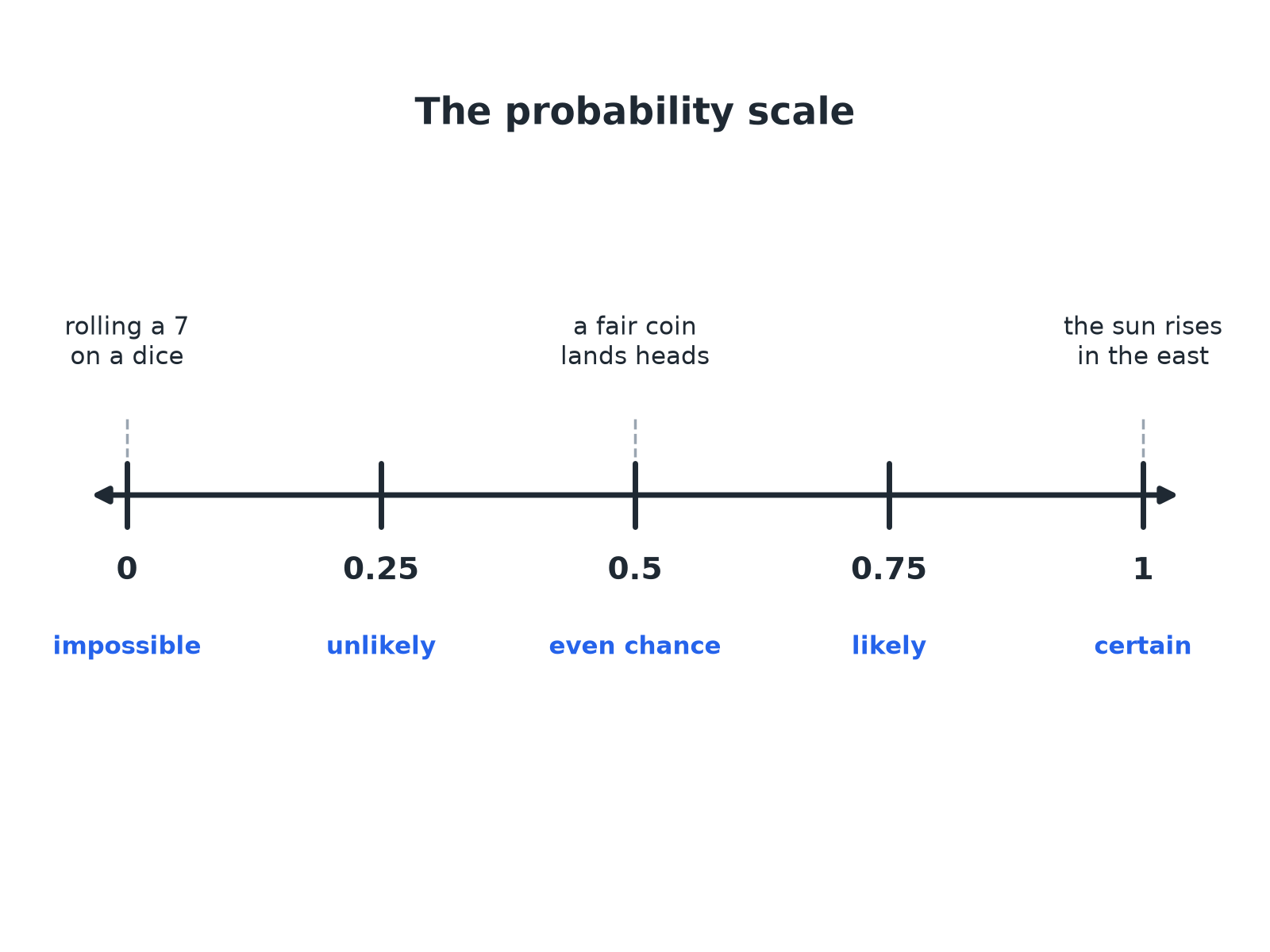
Every probability lies between 0 and 1.
Key Facts
-
Range
Every probability is between 0 and 1, including 0 and 1.
-
Total
The probabilities of all the possible outcomes add up to 1.
-
Not happening
\(P(\text{not } A) = 1 - P(A)\).
-
Mutually exclusive
Events that cannot both happen at the same time, such as rolling a 2 and rolling a 5 on one dice.
THE ADDITION RULE
For mutually exclusive events, \(P(A \text{ or } B) = P(A) + P(B)\).
This only works when A and B cannot happen together.
Finding a Missing Probability
A biased spinner has probabilities: red 0.3, blue 0.5, green \(x\). Find \(x\), and \(P(\text{red or blue})\).
Show the solutionHide the solution
- 1 The probabilities add up to 1 \(0.3 + 0.5 + x = 1\)
- 2 Solve \(x = 0.2\)
- 3 Red and blue are mutually exclusive, so add \(0.3 + 0.5 = 0.8\)
Answer\(x = 0.2\) and \(P(\text{red or blue}) = 0.8\).
A Probability Table
A four-sided spinner has \(P(1) = 0.1\), \(P(2) = 0.25\), \(P(3) = x\) and \(P(4) = 0.3\). Find \(x\) and \(P(\text{not } 4)\).
Show the solutionHide the solution
- 1 Probabilities add up to 1 \(0.1 + 0.25 + x + 0.3 = 1\)
- 2 Solve \(0.65 + x = 1\), so \(x = 0.35\)
- 3 Not 4 \(1 - 0.3 = 0.7\)
Answer\(x = 0.35\) and \(P(\text{not } 4) = 0.7\).
Counters in a Bag
A bag has 5 red, 3 blue and 2 green counters. One counter is taken at random. Find the probability that it is red or green.
Show the solutionHide the solution
- 1 Total counters \(5 + 3 + 2 = 10\)
- 2 Red and green cannot both be taken Mutually exclusive
- 3 Add the probabilities \(\dfrac{5}{10} + \dfrac{2}{10} = \dfrac{7}{10}\)
Answer\(\dfrac{7}{10}\)
Not Mutually Exclusive
\(P(A) = 0.5\), \(P(B) = 0.4\) and \(P(A \text{ and } B) = 0.2\). Find \(P(A \text{ or } B)\).
Show the solutionHide the solution
- 1 Adding counts the overlap twice \(0.5 + 0.4 = 0.9\)
- 2 Subtract the overlap once \(0.9 - 0.2\)
- 3 Work it out \(0.7\)
Answer\(P(A \text{ or } B) = 0.7\)
Complete the Table
A biased dice has probabilities: 1: 0.1, 2: 0.15, 3: 0.2, 4: 0.25, 5: \(x\), 6: \(2x\). Find \(x\), then find the probability of an even number and the probability of not rolling a 6.
1. Use "add to 1".
2. Add for "or".
3. Subtract from 1 for "not".
A good answer shows: \(0.1 + 0.15 + 0.2 + 0.25 + 3x = 1\), so \(3x = 0.3\) and \(x = 0.1\). \(P(6) = 0.2\). Even: \(0.15 + 0.25 + 0.2 = 0.6\). Not 6: \(0.8\).
Can I...?
- 1Place an event on the probability scale.
- 2Use "add up to 1" to find a missing probability.
- 3Use \(1 - P(A)\).
- 4Recognise mutually exclusive events.
- 5Add probabilities for "or".
- 6Complete a probability table.
- 7Work with counters in a bag.
- 8Use \(P(A) + P(B) - P(A \text{ and } B)\) (Higher).
Summary & Exam Focus
- All the probabilities add up to 1.
- \(P(\text{not } A) = 1 - P(A)\).
- Mutually exclusive: \(P(A \text{ or } B) = P(A) + P(B)\).
- Higher: subtract the overlap when events can both happen.
Exam focus
A bag has 5 red, 3 blue and 2 green counters. A counter is taken at random. Work out the probability that it is red or green. (2 marks) (2 marks)
Red and green cannot both happen, so add the two probabilities. The total number of counters is the denominator.
Key terms
The vocabulary this lesson expects you to use. Each one is linked from the first place it appears above.
- Mutually exclusive
- Events that cannot happen at the same time.
- Probability scale
- A line from 0 (impossible) to 1 (certain).
- Complement
- The event "not A", with probability \(1 - P(A)\).
- Exhaustive
- A set of events that covers every possible outcome.
- Biased
- Not fair; outcomes are not equally likely.
- Random
- Every item has the same chance of being chosen.
Practice questions
Have a go at each one before you open its answer.
-
Question 1 Non-calculator 2 marks
A biased spinner lands on red with probability 0.3, on blue with probability 0.5, and otherwise on green. Work out the probability that the spinner lands on green.
Show answerHide answer
Model answer
\(1 - 0.3 - 0.5 = 0.2\).
Mark scheme
- \(1 - 0.3 - 0.5\) — M1
- 0.2 — A1
-
Question 2 Non-calculator 2 marks
The probability that it rains tomorrow is 0.35. Work out the probability that it does not rain tomorrow.
Show answerHide answer
Model answer
\(1 - 0.35 = 0.65\).
Mark scheme
- \(1 - 0.35\) — M1
- 0.65 — A1
-
Question 3 Non-calculator 3 marks
A four-sided spinner is biased. The probability of each score is shown: score 1: 0.1, score 2: 0.25, score 3: \(x\), score 4: 0.3. Work out the value of \(x\), and the probability of scoring 2 or 4.
Show answerHide answer
Model answer
\(0.1 + 0.25 + x + 0.3 = 1\), so \(x = 0.35\). \(P(2 \text{ or } 4) = 0.25 + 0.3 = 0.55\).
Mark scheme
- Probabilities sum to 1 — M1
- \(x = 0.35\) — A1
- 0.55 — A1
-
Question 4 Non-calculator 2 marks
A bag has 5 red counters, 3 blue counters and 2 green counters. One counter is taken at random. Work out the probability that it is red or green.
Show answerHide answer
Model answer
\(\dfrac{5}{10} + \dfrac{2}{10} = \dfrac{7}{10}\).
Mark scheme
- Red and green probabilities added — M1
- \(\dfrac{7}{10}\) — A1
-
Question 5 Non-calculator 3 marks
In a class of 30 students, 12 play football, 9 play tennis and 5 play both. Explain why the events "plays football" and "plays tennis" are not mutually exclusive.
Show answerHide answer
Model answer
Five students play both, so the two events can happen at the same time, and they are not mutually exclusive.
Mark scheme
- Reference to the 5 who play both — M1
- Both events can happen together — C1
- A clear conclusion — C1
-
Question 6 Non-calculator 3 marks
\(A\) and \(B\) are two events. \(P(A) = 0.5\), \(P(B) = 0.4\) and \(P(A \text{ and } B) = 0.2\). Work out \(P(A \text{ or } B)\).
Show answerHide answer
Model answer
\(P(A \text{ or } B) = 0.5 + 0.4 - 0.2 = 0.7\).
Mark scheme
- \(0.5 + 0.4\) — M1
- Subtracting the overlap — M1
- 0.7 — A1
Quick check
-
What is the probability of an impossible event?
Show answerHide answer
A: 0
An impossible event has probability 0.
-
\(P(\text{win}) = 0.3\). What is \(P(\text{not win})\)?
Show answerHide answer
C: 0.7
\(1 - 0.3 = 0.7\).
-
Which pair of events is mutually exclusive?
Show answerHide answer
B: Rolling a 2 and rolling a 5
You cannot roll a 2 and a 5 on one dice at the same time.
-
\(P(A) = 0.2\) and \(P(B) = 0.5\), and A and B are mutually exclusive. What is \(P(A \text{ or } B)\)?
Show answerHide answer
D: 0.7
\(0.2 + 0.5 = 0.7\).
-
The probabilities of a spinner are 0.2, 0.3 and \(x\). What is \(x\)?
Show answerHide answer
C: 0.5
\(1 - 0.5 = 0.5\).
-
\(P(A) = 0.5\), \(P(B) = 0.4\), \(P(A \text{ and } B) = 0.2\). What is \(P(A \text{ or } B)\)?
Show answerHide answer
A: 0.7
\(0.5 + 0.4 - 0.2 = 0.7\).
Downloads
Free to keep, print and annotate.
- Mutually exclusive events.pptx Built from the lesson script on 30 September 2026. View
- Mutually exclusive events - Completed Notes.docx The full notes for the lesson, to revise from. Built from the lesson script on 30 September 2026. View
- Mutually exclusive events - Exam Questions.docx Built from the lesson script on 30 September 2026. View
Something here looks wrong?
Tell us what and we will go and look. It goes to whoever writes these pages, nobody else, and we do not ask who you are — so there is nothing to sign and nothing comes back to you.