Viewing as
Teaching this? The teacher view adds 2 files, the mark schemes and the model answers.
Maths · More trigonometry
Solving problems in 3D
Use Pythagoras and trigonometry in cuboids and pyramids, find the length of a 3D diagonal, and find the angle between a line and a plane.
Warm-up
Answer each one, then check.
-
1
What is Pythagoras' theorem?
Show answerHide answer
\(a^2 + b^2 = c^2\)
-
2
What is \(\tan \theta\) in a right-angled triangle?
Show answerHide answer
\(\text{opposite} \div \text{adjacent}\)
-
3
What is a diagonal?
Show answerHide answer
A line joining two corners that are not next to each other
-
4
What is the volume of a cuboid?
Show answerHide answer
\(l \times w \times h\)
-
5
Work out \(\sqrt{169}\).
Show answerHide answer
\(13\)
Learning Objectives
- 1Find the length of a diagonal of a cuboid.
- 2Find the height of a pyramid or a slant edge using Pythagoras.
- 3Find the angle between a line and a plane.
- 4Draw the right-angled triangle you need out of a 3D shape.
3D PROBLEMS
To solve a 3D problem, find a right-angled triangle inside the shape, draw it separately, then use Pythagoras or trigonometry.
Sketch the flat triangle with its lengths and angle, and work in that triangle.
A Diagonal in a Cuboid
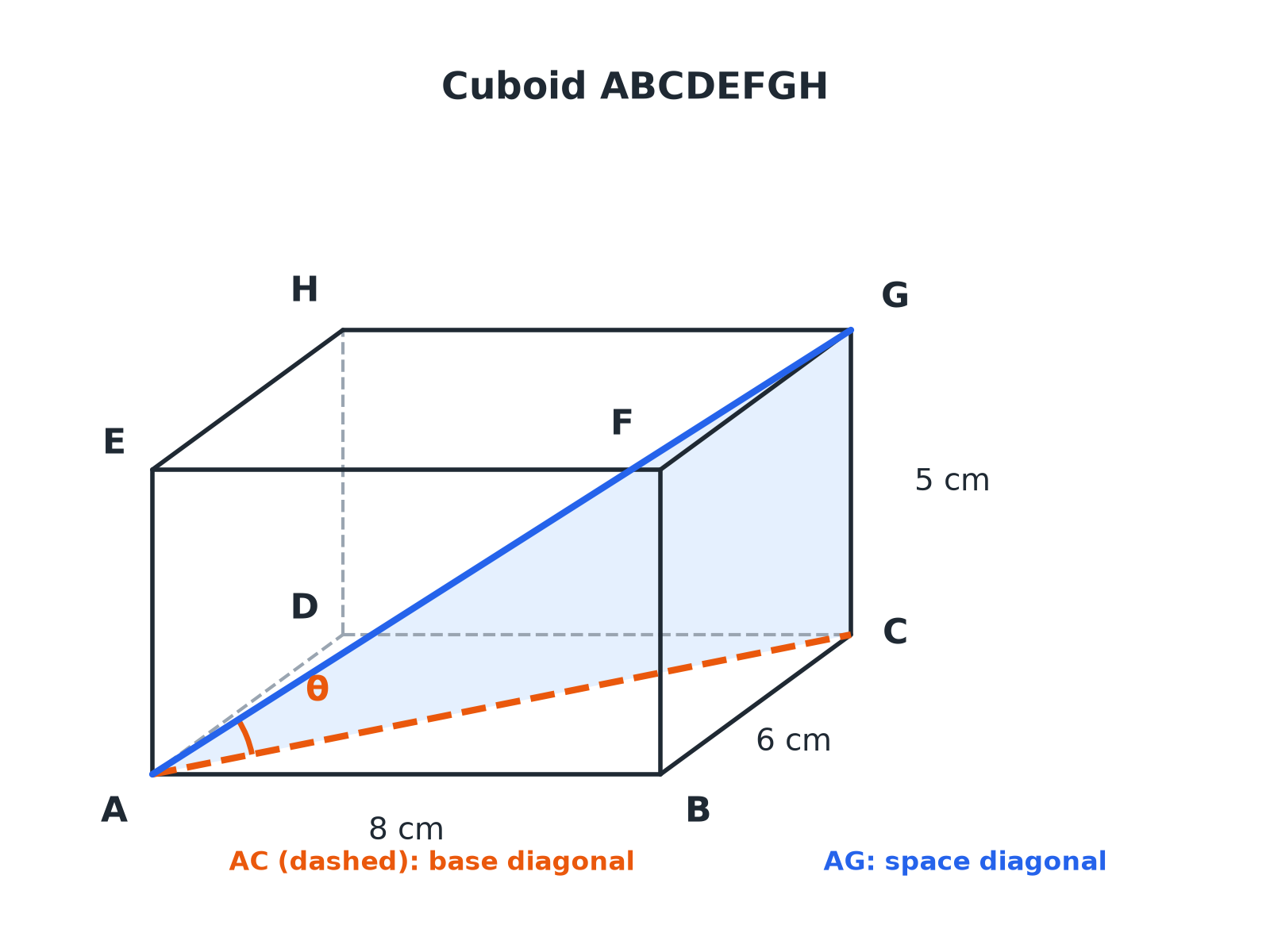
Triangle ACG is right-angled at C. Find AC first, then AG.
Diagonal of a Cuboid
Two steps, both using Pythagoras.
-
1
Base diagonal
\(AC^2 = l^2 + w^2\)
-
2
Space diagonal
\(AG^2 = AC^2 + h^2 = l^2 + w^2 + h^2\)
-
3
Angle with the base
\(\tan \theta = \dfrac{h}{AC}\)
-
4
Draw it
Sketch triangle ACG separately with its right angle at C
Space Diagonal of a Cuboid
A cuboid measures 12 cm by 4 cm by 3 cm. Find the length of its longest diagonal.
Show the solutionHide the solution
- 1 Formula \(d^2 = 12^2 + 4^2 + 3^2\)
- 2 Add up \(d^2 = 144 + 16 + 9 = 169\)
- 3 Square root \(d = 13\)
AnswerThe longest diagonal is 13 cm.
Angle Between a Line and a Plane
A cuboid \(ABCDEFGH\) has \(AB = 8\) cm, \(BC = 6\) cm and \(CG = 5\) cm. Find the angle between \(AG\) and the base \(ABCD\).
Show the solutionHide the solution
- 1 Base diagonal \(AC = \sqrt{8^2 + 6^2} = 10\)
- 2 Right-angled triangle ACG \(\tan \theta = \dfrac{CG}{AC} = \dfrac{5}{10}\)
- 3 Inverse tangent \(\theta = \tan^{-1}(0.5) = 26.6^\circ\)
AnswerThe angle between \(AG\) and the base is \(26.6^\circ\) (1 d.p.).
A Square-Based Pyramid
A pyramid has a square base of side 8 cm and a vertical height of 10 cm. The apex is directly above the centre of the base. Find the length of a sloping edge.
Show the solutionHide the solution
- 1 Half the base diagonal \(\dfrac{\sqrt{8^2 + 8^2}}{2} = \dfrac{\sqrt{128}}{2} = 5.657\)
- 2 Triangle with the height \(\text{edge}^2 = 10^2 + 5.657^2 = 132\)
- 3 Square root \(\text{edge} = 11.5\)
AnswerThe sloping edge is 11.5 cm (3 s.f.).
The Angle Between a Line and a Plane
Always use the right angle.
-
Drop a perpendicular
From the top of the line straight down to the plane.
-
Join to the base
Draw the line from the foot of the perpendicular to the bottom of the original line.
-
The angle
This is the angle between the line and the plane, and the triangle formed has a right angle.
-
Then
Use sin, cos or tan as usual.
Find the Triangle
A cuboid is 9 cm long, 12 cm wide and 8 cm high. (a) Find the base diagonal. (b) Find the space diagonal. (c) Find the angle between the space diagonal and the base.
1. Work in the base first.
2. Then use the height.
A good answer shows: (a) \(\sqrt{9^2 + 12^2} = 15\) cm. (b) \(\sqrt{15^2 + 8^2} = 17\) cm. (c) \(\tan^{-1}(8 \div 15) = 28.1^\circ\).
Can I...?
- 1Draw a right-angled triangle from a 3D shape.
- 2Find a base diagonal.
- 3Find a space diagonal.
- 4Use Pythagoras twice.
- 5Find a pyramid slant edge.
- 6Find an angle between a line and a plane.
- 7Use tangent, sine or cosine.
- 8Give sensible accuracy.
Summary & Exam Focus
- Space diagonal: \(d^2 = l^2 + w^2 + h^2\).
- Angle with the base: \(\tan \theta = \dfrac{\text{height}}{\text{base diagonal}}\).
- Pyramid: use half the base diagonal with the height.
- Always sketch the triangle you are using.
Exam focus
\(ABCDEFGH\) is a cuboid with \(AB = 8\) cm, \(BC = 6\) cm and \(CG = 5\) cm. Work out the angle between \(AG\) and the base \(ABCD\). Give your answer correct to 1 decimal place. (4 marks) (4 marks)
Find the base diagonal first, then draw the right-angled triangle with the height.
Key terms
The vocabulary this lesson expects you to use. Each one is linked from the first place it appears above.
- Cuboid
- A 3D shape with six rectangular faces.
- Space diagonal
- A diagonal joining opposite corners through the inside of a cuboid.
- Plane
- A flat surface, such as the base.
- Apex
- The top point of a pyramid.
- Slant edge
- An edge from the apex to a base corner.
- Angle of elevation
- The angle looking up from horizontal.
Practice questions
Have a go at each one before you open its answer.
-
Question 1 Work out 3 marks
A cuboid is 12 cm long, 4 cm wide and 3 cm high. Work out the length of the longest diagonal of the cuboid.
Show answerHide answer
Model answer
\(\sqrt{12^2 + 4^2 + 3^2} = \sqrt{169} = 13\) cm
Mark scheme
- \(12^2 + 4^2 + 3^2\) — M1
- 169 — A1
- 13 — A1
-
Question 2 Work out 4 marks
\(ABCDEFGH\) is a cuboid with \(AB = 8\) cm, \(BC = 6\) cm and \(CG = 5\) cm. Work out the size of the angle between \(AG\) and the base \(ABCD\). Give your answer correct to 1 decimal place.
Show answerHide answer
Model answer
\(AC = \sqrt{8^2 + 6^2} = 10\); \(\tan \theta = \dfrac{5}{10}\), so \(\theta = 26.6^\circ\)
Mark scheme
- \(AC = \sqrt{8^2 + 6^2}\) — M1
- \(AC = 10\) — A1
- \(\tan \theta = \dfrac{5}{10}\) — M1
- 26.6 — A1
-
Question 3 Work out 3 marks
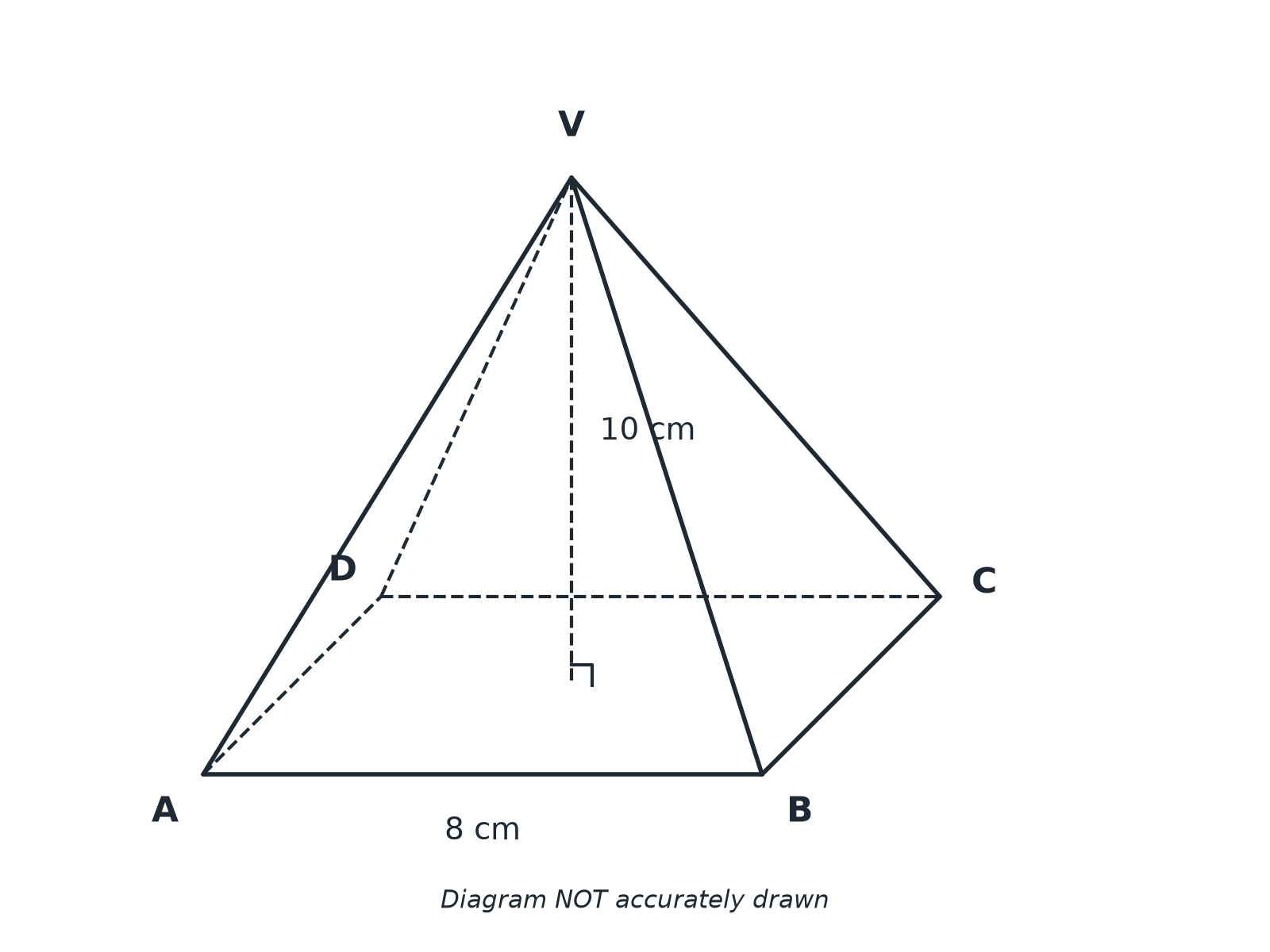
The diagram shows a pyramid with a square base of side 8 cm. The vertical height of the pyramid is 10 cm and the apex \(V\) is directly above the centre of the base. Work out the length of the sloping edge \(VA\). Give your answer correct to 3 significant figures.
Show answerHide answer
Model answer
Half the base diagonal \(= \dfrac{\sqrt{8^2 + 8^2}}{2} = 5.657\); \(VA = \sqrt{10^2 + 5.657^2} = 11.5\) cm
Mark scheme
- Half diagonal \(5.657\) — M1
- \(10^2 + 5.657^2\) — M1
- 11.5 — A1
-
Question 4 Work out 4 marks
A pyramid has a square base of side 8 cm and a vertical height of 10 cm. The apex is directly above the centre of the base. Work out the angle between a sloping edge and the base. Give your answer correct to 1 decimal place.
Show answerHide answer
Model answer
\(\tan \theta = \dfrac{10}{5.657}\), so \(\theta = 60.5^\circ\)
Mark scheme
- Half diagonal \(5.657\) — M1
- \(\tan \theta = \dfrac{10}{5.657}\) — M1
- Correct angle expression — A1
- 60.5 — A1
-
Question 5 Work out 3 marks
\(AB\) is a vertical pole, 9 m tall, standing on level ground at \(B\). Points \(C\) and \(D\) are on the ground with \(BC = 12\) m, \(CD = 5\) m and angle \(BCD = 90^\circ\). Work out the angle of elevation of \(A\) from \(D\). Give your answer correct to 1 decimal place.
Show answerHide answer
Model answer
\(BD = \sqrt{12^2 + 5^2} = 13\); \(\tan \theta = \dfrac{9}{13}\); \(\theta = 34.7^\circ\)
Mark scheme
- \(BD = 13\) — M1
- \(\tan \theta = \dfrac{9}{13}\) — M1
- 34.7 — A1
-
Question 6 Explain 2 marks
Explain how to find the angle between a line and a plane.
Show answerHide answer
Model answer
Draw the perpendicular from one end of the line down to the plane. The angle between the line and its projection on the plane (in the right-angled triangle formed) is the angle required.
Mark scheme
- Perpendicular to the plane — M1
- Angle in the right-angled triangle — C1
Quick check
-
The space diagonal of a cuboid is found using...
Show answerHide answer
C: \(\sqrt{l^2 + w^2 + h^2}\)
Add the squares of length, width and height, then take the square root.
-
A cuboid is 3 by 4 by 12. The longest diagonal is...
Show answerHide answer
B: 13
\(\sqrt{9 + 16 + 144} = 13\).
-
In a pyramid, the triangle used to find a slant edge contains...
Show answerHide answer
A: The height and half the base diagonal
The vertical height and half the base diagonal.
-
To find the angle between a line and the ground, you use a triangle with a...
Show answerHide answer
D: Right angle at the plane
A right angle where the perpendicular meets the plane.
-
A base is 6 cm by 8 cm. Its diagonal is...
Show answerHide answer
C: 10
\(\sqrt{36 + 64} = 10\).
-
For a pole of height \(h\) and a point at distance \(d\) on the ground, \(\tan\) of the angle of elevation is...
Show answerHide answer
B: \(h \div d\)
Opposite over adjacent: height over distance.
Downloads
Free to keep, print and annotate.
- Solving problems in 3D.pptx Built from the lesson script on 30 September 2026. View
- Solving problems in 3D - Completed Notes.docx The full notes for the lesson, to revise from. Built from the lesson script on 30 September 2026. View
- Solving problems in 3D - Exam Questions.docx Built from the lesson script on 30 September 2026. View
Something here looks wrong?
Tell us what and we will go and look. It goes to whoever writes these pages, nobody else, and we do not ask who you are — so there is nothing to sign and nothing comes back to you.