Viewing as
Teaching this? The teacher view adds 2 files, the mark schemes and the model answers.
Maths · More trigonometry
The cosine rule and 2D trigonometric problems
Use the cosine rule to find a side or an angle when the sine rule cannot be used, and choose the right method in 2D problems including bearings.
Warm-up
Answer each one, then check.
-
1
What is \(\cos 60^\circ\)?
Show answerHide answer
\(0.5\)
-
2
What is Pythagoras' theorem?
Show answerHide answer
\(a^2 + b^2 = c^2\)
-
3
What is the sine rule?
Show answerHide answer
\(\frac{a}{\sin A} = \frac{b}{\sin B}\)
-
4
What is a bearing?
Show answerHide answer
An angle measured clockwise from north, with three figures
-
5
What is \(\cos^{-1}(0.5)\)?
Show answerHide answer
\(60^\circ\)
Learning Objectives
- 1Use the cosine rule to find a missing side.
- 2Rearrange the cosine rule to find a missing angle.
- 3Decide between the sine rule, cosine rule and right-angled trigonometry.
- 4Solve 2D problems, including bearings.
COSINE RULE
The cosine rule links three sides and one angle: it is Pythagoras with a correction.
\(a^2 = b^2 + c^2 - 2bc\cos A\). To find an angle: \(\cos A = \dfrac{b^2 + c^2 - a^2}{2bc}\).
The Cosine Rule
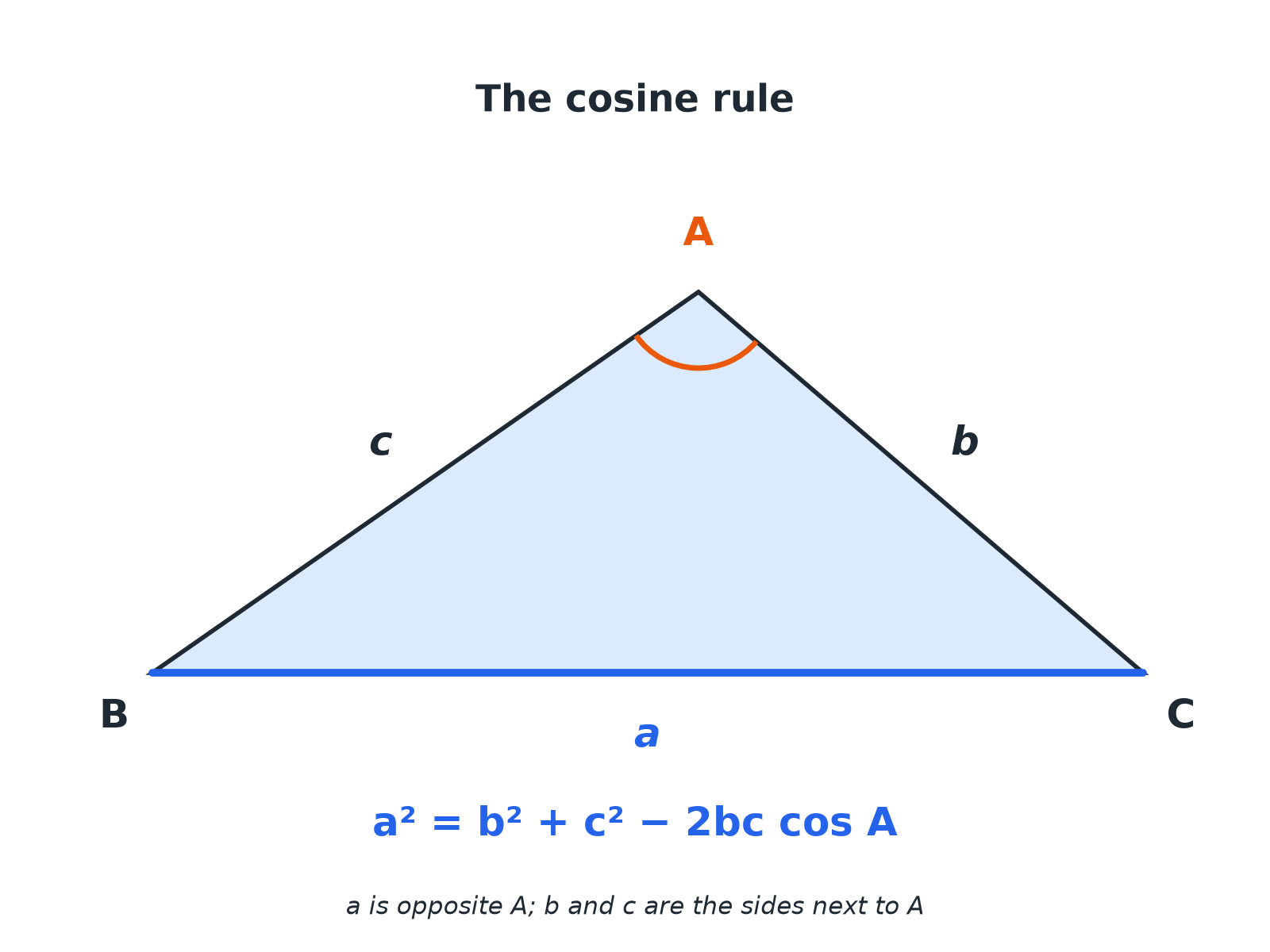
The angle in the formula is opposite the side you are finding.
Which Rule?
Use the SINE rule when...
- You have two angles and a side.
- You have two sides and an angle not between them.
- You have a matching pair (a side and its opposite angle).
Use the COSINE rule when...
- You have two sides and the angle between them.
- You have all three sides.
- You do not have a matching pair.
Cosine Rule: Finding a Side
In triangle ABC, \(b = 7\) cm, \(c = 9\) cm and angle \(A = 60^\circ\). Find \(a\).
Show the solutionHide the solution
- 1 Write the rule \(a^2 = b^2 + c^2 - 2bc\cos A\)
- 2 Substitute \(a^2 = 7^2 + 9^2 - 2 \times 7 \times 9 \times \cos 60^\circ\)
- 3 Work out \(a^2 = 49 + 81 - 63 = 67\)
- 4 Square root \(a = 8.19\)
Answer\(a = 8.19\) cm (3 s.f.)
Cosine Rule: Finding an Angle
A triangle has sides 5 cm, 7 cm and 9 cm. Find the largest angle.
Show the solutionHide the solution
- 1 Largest angle is opposite 9 \(a = 9\), \(b = 5\), \(c = 7\)
- 2 Rearranged rule \(\cos A = \dfrac{5^2 + 7^2 - 9^2}{2 \times 5 \times 7}\)
- 3 Work out \(\cos A = \dfrac{-7}{70} = -0.1\)
- 4 Inverse cosine \(A = 95.7^\circ\)
AnswerLargest angle \(= 95.7^\circ\) (1 d.p.)
A Bearings Problem
A ship sails 12 km on a bearing of \(040^\circ\) and then 9 km on a bearing of \(130^\circ\). How far is it from its starting point?
Show the solutionHide the solution
- 1 Angle between the two legs \(130^\circ - 40^\circ = 90^\circ\)
- 2 Right-angled triangle Use Pythagoras
- 3 Work out \(12^2 + 9^2 = 144 + 81 = 225\)
- 4 Square root \(\sqrt{225} = 15\)
AnswerThe ship is 15 km from its start.
Common Slips
Avoid these.
-
Subtracting before multiplying
Work out \(2bc\cos A\) as a whole first, then subtract.
-
Wrong angle
The angle in the formula is opposite the side on the left-hand side.
-
Rounding early
Keep the full value until the final step.
-
Angle over 90
A negative cosine means the angle is obtuse; this is fine.
Which Rule and Why?
For each triangle, state which rule you would use first. (a) \(a = 6\), \(b = 8\), \(C = 50^\circ\), find \(c\). (b) \(a = 5\), \(b = 7\), \(c = 9\), find \(A\). (c) \(A = 40^\circ\), \(B = 70^\circ\), \(a = 8\), find \(b\). (d) \(a = 9\), \(b = 12\), \(A = 30^\circ\), find \(B\).
1. Check for a side with its opposite angle.
2. If there is none, use the cosine rule.
A good answer shows: (a) Cosine rule (two sides and the included angle). (b) Cosine rule (three sides). (c) Sine rule. (d) Sine rule.
Can I...?
- 1Write the cosine rule.
- 2Find a missing side.
- 3Rearrange to find an angle.
- 4Identify the largest angle.
- 5Choose sine or cosine rule.
- 6Solve a bearings problem.
- 7Avoid rounding too early.
- 8Check with a sketch.
Summary & Exam Focus
- \(a^2 = b^2 + c^2 - 2bc\cos A\).
- \(\cos A = \dfrac{b^2 + c^2 - a^2}{2bc}\).
- Use cosine rule for SAS and SSS, sine rule when you have a matching pair.
- Bearings: measure clockwise from north.
Exam focus
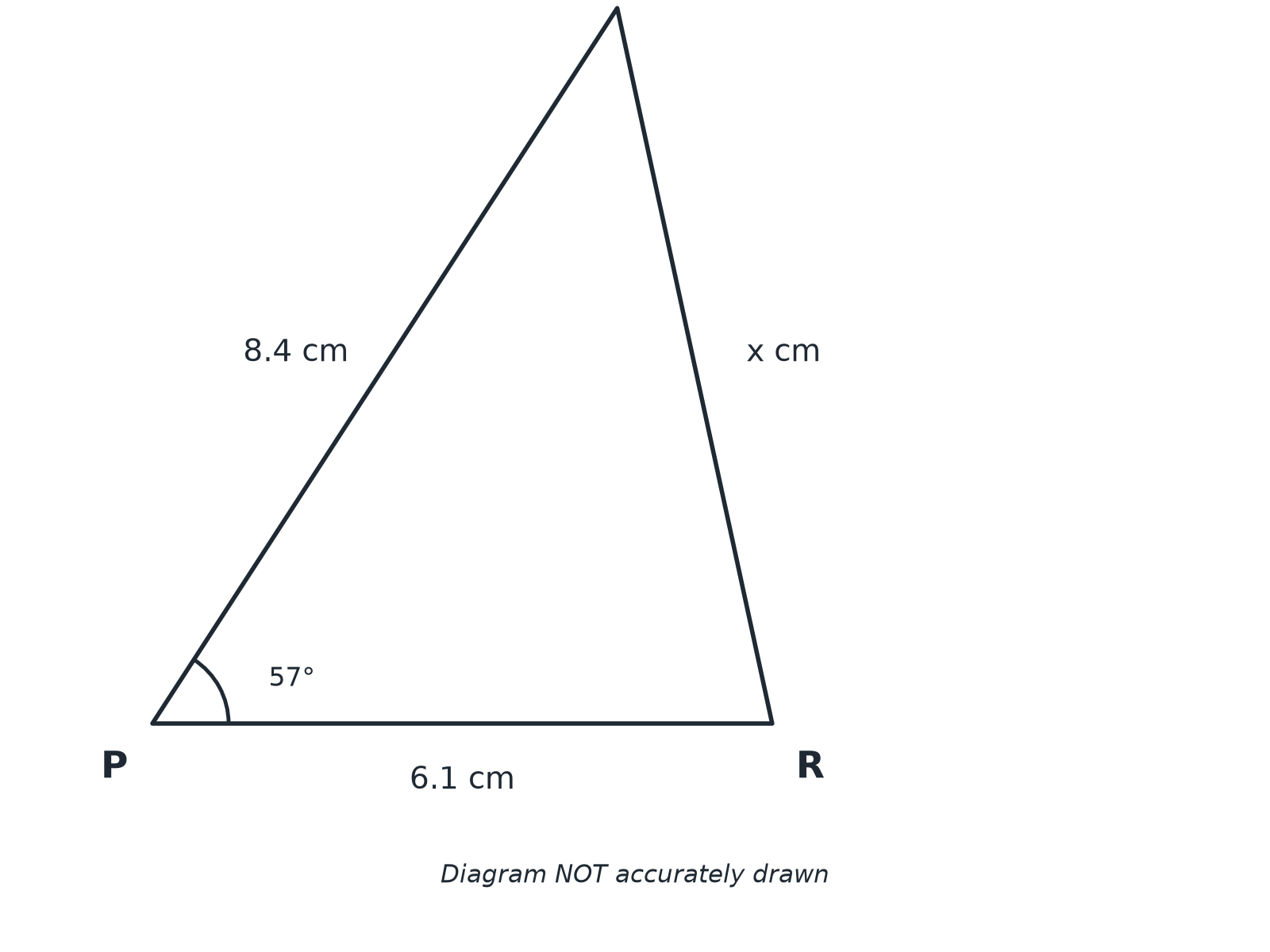
In triangle PQR, \(PQ = 8.4\) cm, \(PR = 6.1\) cm and angle \(QPR = 57^\circ\). Work out the length of \(QR\). Give your answer correct to 3 significant figures. (3 marks) (3 marks)
Write the rule first, substitute, then use your calculator in one go.
Key terms
The vocabulary this lesson expects you to use. Each one is linked from the first place it appears above.
- Cosine rule
- \(a^2 = b^2 + c^2 - 2bc\cos A\).
- Bearing
- A direction measured clockwise from north as three figures.
- Included angle
- The angle between two given sides.
- Obtuse
- An angle between \(90^\circ\) and \(180^\circ\).
- Largest angle
- The angle opposite the longest side.
- Rearrange
- Change the subject of a formula.
Practice questions
Have a go at each one before you open its answer.
-
Question 1 Work out 3 marks
In triangle PQR, \(PQ = 8.4\) cm, \(PR = 6.1\) cm and angle \(QPR = 57^\circ\). Work out the length of \(QR\). Give your answer correct to 3 significant figures.
Show answerHide answer
Model answer
\(QR^2 = 8.4^2 + 6.1^2 - 2 \times 8.4 \times 6.1 \times \cos 57^\circ = 51.95\), so \(QR = 7.21\) cm
Mark scheme
- \(8.4^2 + 6.1^2 - 2 \times 8.4 \times 6.1 \times \cos 57^\circ\) — M1
- 51.9... — A1
- 7.21 — A1
-
Question 2 Work out 3 marks
In triangle ABC, \(AB = 8\) cm, \(AC = 6\) cm and angle \(BAC = 40^\circ\). Work out the length of \(BC\). Give your answer correct to 3 significant figures.
Show answerHide answer
Model answer
\(BC^2 = 6^2 + 8^2 - 2 \times 6 \times 8 \times \cos 40^\circ = 26.46\), so \(BC = 5.14\) cm
Mark scheme
- \(6^2 + 8^2 - 2 \times 6 \times 8 \times \cos 40^\circ\) — M1
- 26.4... — A1
- 5.14 — A1
-
Question 3 Work out 3 marks
A triangle has sides of length 6 cm, 8 cm and 11 cm. Work out the size of the largest angle. Give your answer correct to 1 decimal place.
Show answerHide answer
Model answer
\(\cos A = \dfrac{6^2 + 8^2 - 11^2}{2 \times 6 \times 8} = -0.21875\), so \(A = 102.6^\circ\)
Mark scheme
- \(\dfrac{6^2 + 8^2 - 11^2}{2 \times 6 \times 8}\) — M1
- \(-0.21875\) — A1
- 102.6 — A1
-
Question 4 Work out 3 marks
A ship sails 12 km on a bearing of \(040^\circ\). It then sails 9 km on a bearing of \(130^\circ\). Work out the distance of the ship from its starting point.
Show answerHide answer
Model answer
The angle between the two legs is \(130^\circ - 40^\circ = 90^\circ\), so the distance is \(\sqrt{12^2 + 9^2} = \sqrt{225} = 15\) km.
Mark scheme
- Right angle identified — M1
- \(12^2 + 9^2 = 225\) — M1
- 15 — A1
-
Question 5 Work out 3 marks
A triangle has sides of length 7 cm, 8 cm and 9 cm. Work out the size of the smallest angle. Give your answer correct to 1 decimal place.
Show answerHide answer
Model answer
\(\cos A = \dfrac{8^2 + 9^2 - 7^2}{2 \times 8 \times 9} = 0.6667\), so \(A = 48.2^\circ\)
Mark scheme
- \(\dfrac{8^2 + 9^2 - 7^2}{2 \times 8 \times 9}\) — M1
- 0.666... — A1
- 48.2 — A1
-
Question 6 Explain 2 marks
In triangle ABC, you are given \(a\), \(c\) and angle \(B\). Which rule would you use to find \(b\), the sine rule or the cosine rule? Give a reason.
Show answerHide answer
Model answer
The cosine rule, because two sides and the angle between them are known and there is no matching side and angle pair.
Mark scheme
- Cosine rule — B1
- Two sides and the included angle — B1
Quick check
-
The cosine rule is...
Show answerHide answer
B: \(a^2 = b^2 + c^2 - 2bc\cos A\)
\(a^2 = b^2 + c^2 - 2bc\cos A\).
-
When two sides and the angle between them are known, use the...
Show answerHide answer
C: Cosine rule
Cosine rule finds the third side.
-
A triangle has sides 5, 7 and 9. To find the largest angle, use...
Show answerHide answer
A: The cosine rule
Three sides given: cosine rule, with the angle opposite 9.
-
If \(\cos A\) is negative, angle \(A\) is...
Show answerHide answer
D: Obtuse
Cosine is negative for angles between 90 and 180 degrees.
-
Bearings are measured...
Show answerHide answer
B: Clockwise from north
Clockwise from north, with three figures.
-
When \(A = 90^\circ\), the cosine rule becomes...
Show answerHide answer
C: \(a^2 = b^2 + c^2\)
\(\cos 90^\circ = 0\), so \(a^2 = b^2 + c^2\): Pythagoras.
Downloads
Free to keep, print and annotate.
- The cosine rule and 2D trigonometric problems.pptx Built from the lesson script on 30 September 2026. View
- The cosine rule and 2D trigonometric problems - Completed Notes.docx The full notes for the lesson, to revise from. Built from the lesson script on 30 September 2026. View
- The cosine rule and 2D trigonometric problems - Exam Questions.docx Built from the lesson script on 30 September 2026. View
Something here looks wrong?
Tell us what and we will go and look. It goes to whoever writes these pages, nobody else, and we do not ask who you are — so there is nothing to sign and nothing comes back to you.