Viewing as
Teacher view: planning notes, the answers to every question, and the teacher copies of the files.
Maths · Similarity and congruence
Congruence
Recognise congruent shapes, use the four conditions for congruent triangles, and use congruence to find missing lengths and angles.
Teacher resources
The teacher copies: slides with the questions built in, the answers, and anything else attached to this lesson for whoever is teaching it.
- Congruence - Teacher Slides.pptx Teacher The lesson slides with the teacher's notes on each slide, and every question and mark scheme built in. Built from the lesson script on 30 September 2026. View
- Congruence - Teacher Notes.docx Teacher The complete notes with the teacher's notes and every model answer in full. Built from the lesson script on 30 September 2026. View
Student handouts
The same files the students see, to print or hand out.
Warm-up
Answer each one, then check.
-
1
What do the angles in a triangle add up to?
Show answerHide answer
\(180^\circ\)
-
2
What does isosceles mean?
Show answerHide answer
Two equal sides
-
3
What is a right-angled triangle's longest side called?
Show answerHide answer
The hypotenuse
-
4
Do reflections keep the size of a shape?
Show answerHide answer
Yes
-
5
What do the angles on a straight line add up to?
Show answerHide answer
\(180^\circ\)
Learning Objectives
- 1Explain what congruent means.
- 2Use SSS, SAS, ASA and RHS to show triangles are congruent.
- 3Explain why AAA and SSA do not prove congruence.
- 4Use congruence to find missing sides and angles.
CONGRUENT
Two shapes are congruent if they are exactly the same shape and size.
One can be moved onto the other by a rotation, a reflection, a translation, or a combination.
The Four Congruence Conditions
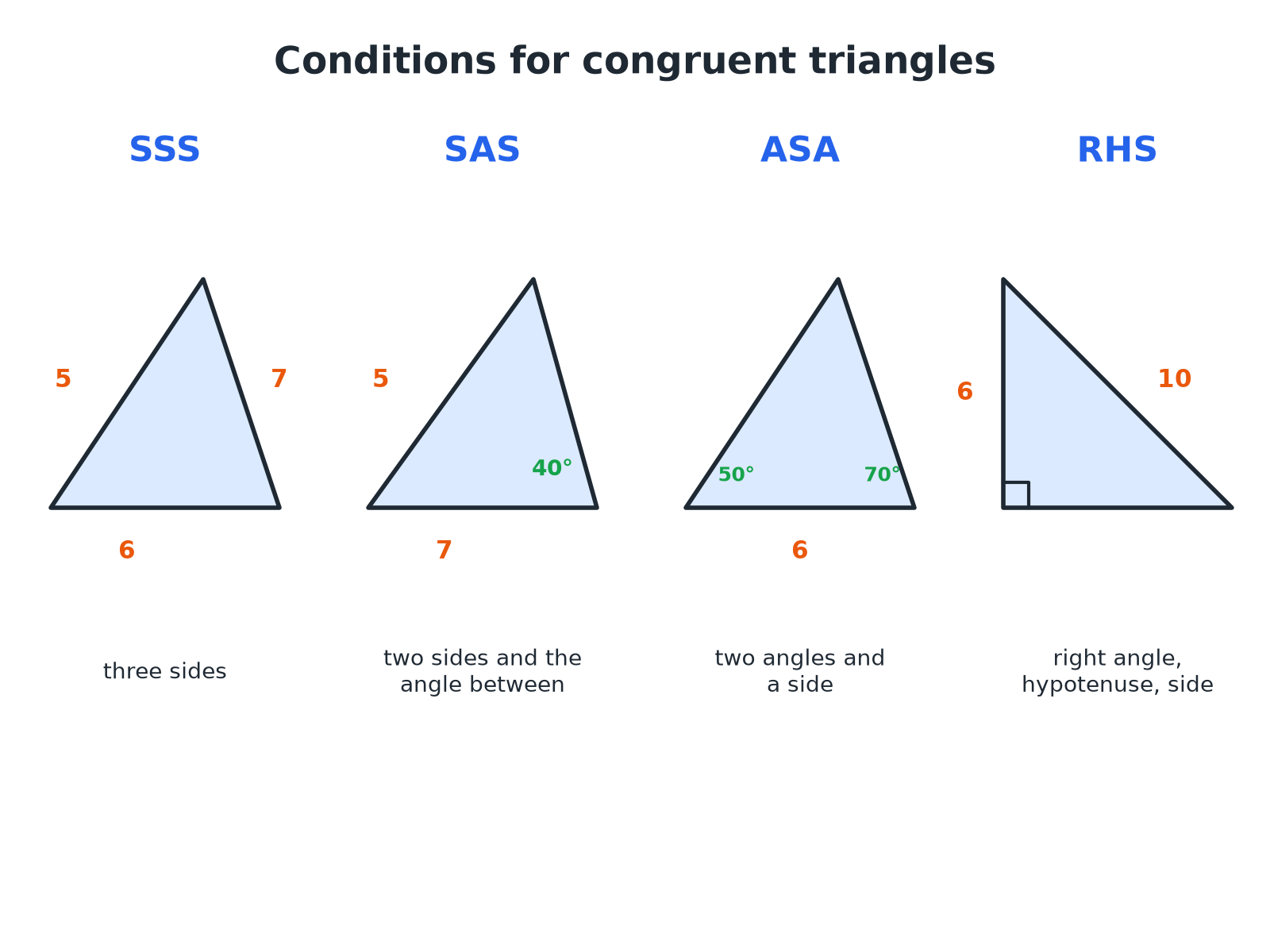
If two triangles satisfy any one of these, they are congruent.
The Four Conditions
Learn the letters and what they mean.
-
SSS
Means: All three sides equal. Example: 5, 6, 7 and 5, 6, 7
-
SAS
Means: Two sides and the included angle equal. Example: 5, \(40^\circ\), 7 and 5, \(40^\circ\), 7
-
ASA
Means: Two angles and a corresponding side equal. Example: \(50^\circ\), 6, \(70^\circ\)
-
RHS
Means: Right angle, hypotenuse and one other side equal. Example: Right angle, 10, 6
Proving Two Triangles Congruent
Triangle ABC has \(AB = 5\) cm, \(BC = 7\) cm and angle \(ABC = 50^\circ\). Triangle PQR has \(PQ = 5\) cm, \(QR = 7\) cm and angle \(PQR = 50^\circ\). Are the triangles congruent?
Show the solutionHide the solution
- 1 Two pairs of equal sides \(AB = PQ\) and \(BC = QR\)
- 2 The angle between them is equal too Angle \(B\) = angle \(Q = 50^\circ\)
- 3 Two sides and the included angle SAS
AnswerYes, the triangles are congruent by SAS.
Conditions That Do NOT Work
-
AAA
Three equal angles give similar triangles, but they can be different sizes.
-
SSA
Two sides and a non-included angle can give two different triangles.
-
Only sides
Two sides alone are not enough.
-
Angles not between the sides
If the angle is not between the two sides, it is not SAS.
Using Congruence to Find a Length
Triangles ABC and DEF are congruent by SSS, with A matching D, B matching E and C matching F. \(AB = 6\) cm, \(BC = 8\) cm, \(DF = 10\) cm. Find \(AC\) and \(DE\).
Show the solutionHide the solution
- 1 Corresponding sides are equal \(AB = DE\), \(BC = EF\), \(AC = DF\)
- 2 Find AC \(AC = DF = 10\) cm
- 3 Find DE \(DE = AB = 6\) cm
Answer\(AC = 10\) cm and \(DE = 6\) cm.
Writing the Reason
A congruence answer needs three things.
-
The equal parts
Write which sides or angles are equal, with the reason for each.
-
The condition
State SSS, SAS, ASA or RHS.
-
The conclusion
"So triangle ABC is congruent to triangle DEF."
Congruent or Not?
Decide which pairs of triangles are congruent and name the condition. (a) 4, 5, 6 and 6, 4, 5 (b) sides 5 and 8 with an angle of \(30^\circ\) between them, and sides 5 and 8 with an angle of \(40^\circ\) between them (c) angles \(40^\circ\), \(60^\circ\), \(80^\circ\) in both triangles, but one has a side of 3 cm and the other a side of 6 cm.
1. Match the equal parts.
2. Name the condition.
A good answer shows: (a) Congruent by SSS. (b) Not congruent: the included angles differ. (c) Not congruent: AAA does not prove congruence; the sides are different sizes, so the triangles are similar.
Can I...?
- 1Say what congruent means.
- 2Recall SSS, SAS, ASA and RHS.
- 3Decide whether two triangles are congruent.
- 4Explain why AAA is not enough.
- 5Explain why SSA is not enough.
- 6Find corresponding sides and angles.
- 7Use congruence to find a length.
- 8Write a clear reason.
Summary & Exam Focus
- Congruent means identical in shape and size.
- Conditions: SSS, SAS, ASA (or AAS), RHS.
- AAA and SSA do not prove congruence.
- Always give the condition as your reason.
Exam focus
Triangle ABC has \(AB = 6\) cm, \(AC = 8\) cm and angle \(A = 50^\circ\). Triangle PQR has \(PQ = 6\) cm, \(PR = 8\) cm and angle \(P = 50^\circ\). Show that the two triangles are congruent. (3 marks) (3 marks)
Name the pairs of equal parts and check the angle is between the two sides. Then state SAS.
Key terms
The vocabulary this lesson expects you to use. Each one is linked from the first place it appears above.
- Congruent
- Exactly the same shape and size.
- Corresponding
- In matching positions in two shapes.
- Included angle
- The angle between two given sides.
- Hypotenuse
- The longest side of a right-angled triangle.
- SSS, SAS, ASA, RHS
- The four conditions for congruent triangles.
- Similar
- The same shape but a different size.
Questions and answers
12 questions set on this lesson, with the mark schemes and model answers open.
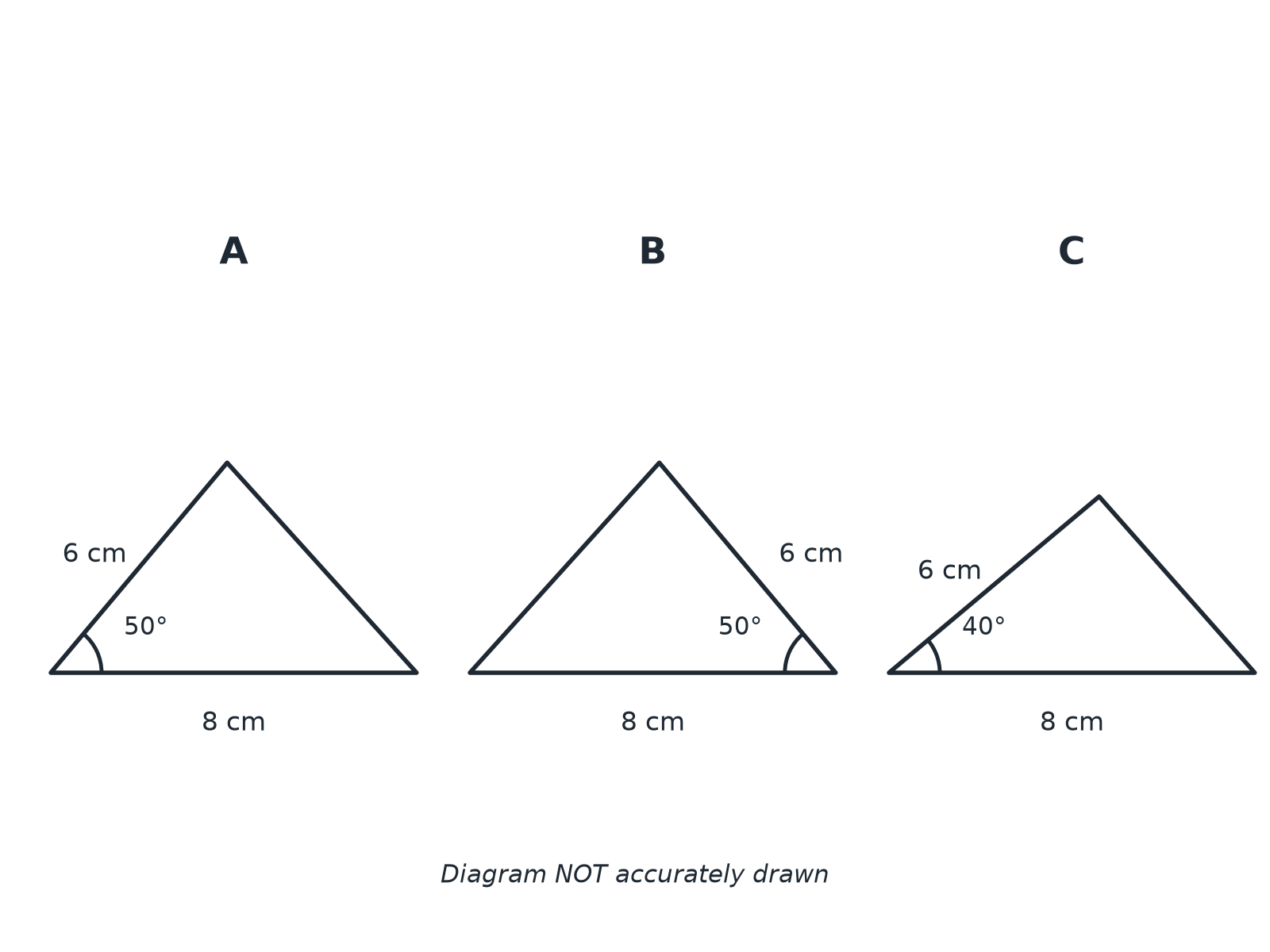
The diagram shows three triangles A, B and C. Two of the triangles are congruent. Write down which two, and give a reason.
Mark scheme — 3 marks available
- A and B — B1
- Two sides and the included angle equal — M1
- SAS — A1
Model answer
Triangles A and B are congruent by SAS: two sides (6 cm and 8 cm) and the included angle \(50^\circ\) are equal.
Triangle ABC has \(AB = 5\) cm, \(BC = 7\) cm and angle \(ABC = 50^\circ\). Triangle PQR has \(PQ = 5\) cm, \(QR = 7\) cm and angle \(PQR = 50^\circ\). Show that triangle ABC is congruent to triangle PQR.
Mark scheme — 3 marks available
- Equal sides stated — M1
- Equal included angle stated — M1
- SAS and conclusion — A1
Model answer
\(AB = PQ = 5\) cm, \(BC = QR = 7\) cm, and angle \(ABC\) = angle \(PQR = 50^\circ\). Two sides and the included angle are equal, so the triangles are congruent by SAS.
Two triangles both have angles of \(40^\circ\), \(60^\circ\) and \(80^\circ\). Ben says they must be congruent. Explain why Ben is not necessarily correct.
Mark scheme — 2 marks available
- AAA is not a congruence condition — M1
- The triangles could be different sizes — C1
Model answer
Equal angles (AAA) do not prove congruence. The triangles could be different sizes, so they are similar but not necessarily congruent.
Triangles ABC and DEF are congruent, with A matching D, B matching E and C matching F. \(AB = 6\) cm, \(BC = 8\) cm and \(DF = 10\) cm. Write down the length of \(AC\).
Mark scheme — 2 marks available
- Corresponding sides identified — M1
- 10 — A1
Model answer
\(AC = DF = 10\) cm, because AC and DF are corresponding sides.
Triangle ABC is right-angled at B, with hypotenuse \(AC = 10\) cm and \(AB = 6\) cm. Triangle PQR is right-angled at Q, with hypotenuse \(PR = 10\) cm and \(PQ = 6\) cm. Explain why the triangles are congruent.
Mark scheme — 3 marks available
- Right angle in each — B1
- Hypotenuse and one other side equal — M1
- RHS — A1
Model answer
Each triangle has a right angle, a hypotenuse of 10 cm and another side of 6 cm. This is RHS, so the triangles are congruent.
Triangle ABC has sides 4 cm, 5 cm and 6 cm. Triangle DEF has sides 6 cm, 4 cm and 5 cm. Are the triangles congruent? Give a reason.
Mark scheme — 2 marks available
- Yes — B1
- SSS — B1
Model answer
Yes, all three sides are equal (SSS).
What does congruent mean?
Why: The same shape and the same size.
Which is a condition for congruent triangles?
Why: SAS, with the angle between the two sides.
Two triangles have the same three angles. Are they definitely congruent?
Why: No: they could be different sizes, so they may only be similar.
In the condition RHS, R stands for...
Why: A right angle.
Triangles are congruent by SSS. If \(AB = DE = 5\), what else do you know?
Why: The other two pairs of corresponding sides are equal, and so are all the angles.
For SAS, the angle must be...
Why: Between the two given sides.