Viewing as
Teacher view: planning notes, the answers to every question, and the teacher copies of the files.
Maths · Similarity and congruence
Similarity
Recognise similar shapes, find scale factors and missing lengths, and use equal angles to show triangles are similar.
Teacher resources
The teacher copies: slides with the questions built in, the answers, and anything else attached to this lesson for whoever is teaching it.
- Similarity - Teacher Slides.pptx Teacher The lesson slides with the teacher's notes on each slide, and every question and mark scheme built in. Built from the lesson script on 30 September 2026. View
- Similarity - Teacher Notes.docx Teacher The complete notes with the teacher's notes and every model answer in full. Built from the lesson script on 30 September 2026. View
Student handouts
The same files the students see, to print or hand out.
Warm-up
Answer each one, then check.
-
1
What is the scale factor from 4 cm to 10 cm?
Show answerHide answer
2.5
-
2
Write \(3:5\) as a fraction of the total.
Show answerHide answer
\(\dfrac{3}{8}\) and \(\dfrac{5}{8}\)
-
3
Work out \(9 \times 1.5\).
Show answerHide answer
13.5
-
4
What does congruent mean?
Show answerHide answer
Same shape and size
-
5
What do the angles in a triangle add up to?
Show answerHide answer
\(180^\circ\)
Learning Objectives
- 1Explain what similar means.
- 2Find scale factors between similar shapes.
- 3Find missing lengths in similar shapes.
- 4Show that two triangles are similar using equal angles.
SIMILAR
Two shapes are similar if they have the same shape but not necessarily the same size: their angles are equal and their lengths are in the same ratio.
The scale factor is the ratio of corresponding lengths.
Similar Triangles
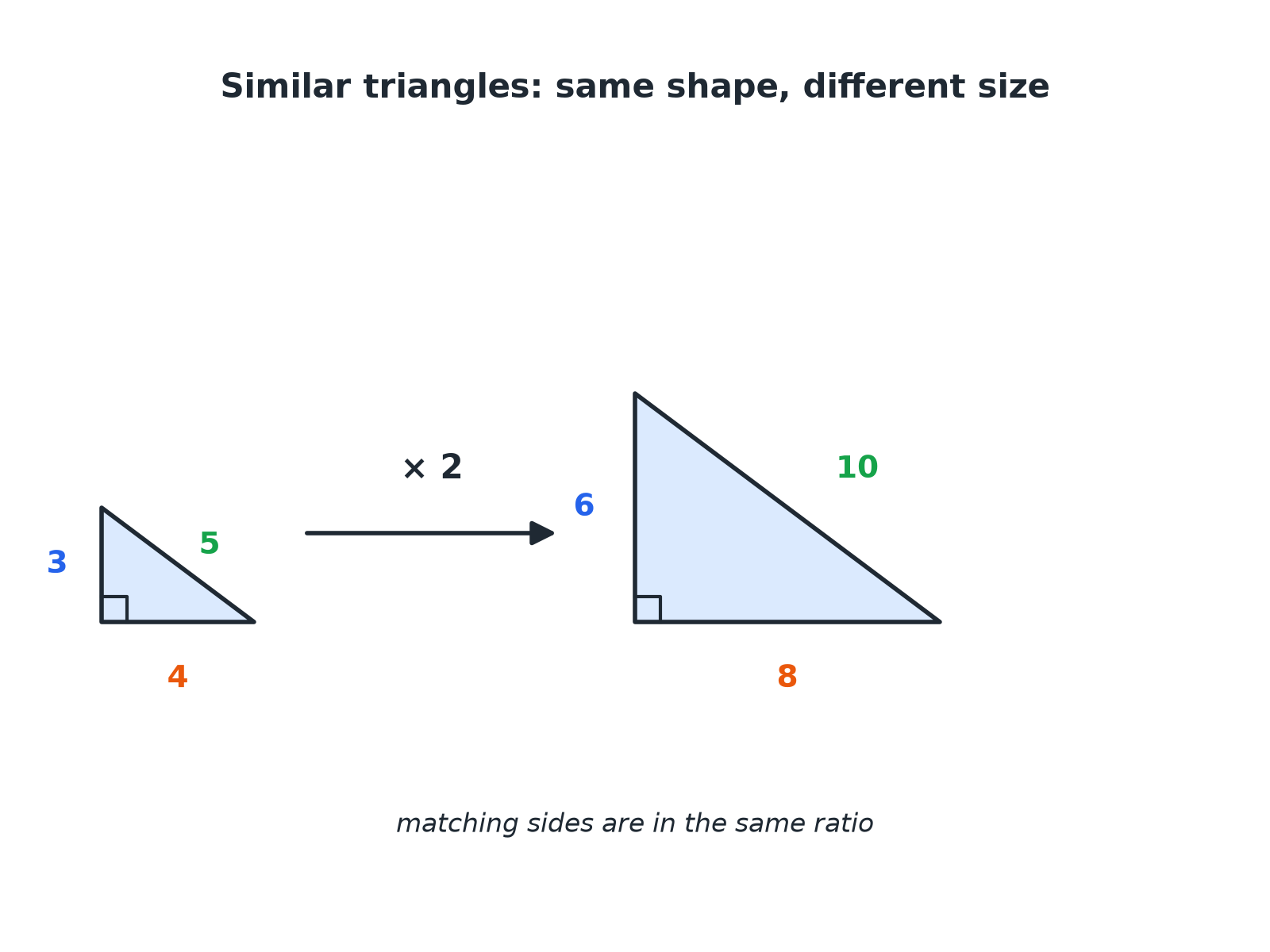
Every side is multiplied by the same scale factor.
Facts About Similar Shapes
-
Angles
All corresponding angles are equal.
-
Lengths
All corresponding lengths are in the same ratio.
-
Scale factor
The number you multiply by to go from one shape to the other.
-
Congruent is a special case
A scale factor of 1.
Finding a Missing Length
Use the scale factor.
-
1
Match the corresponding sides
Find a pair where both lengths are known
-
2
Work out the scale factor
Larger \(\div\) smaller
-
3
Multiply or divide
Depending on the direction you go
-
4
Check
The answer should look sensible
A Missing Side
Triangles ABC and DEF are similar. \(AB = 6\) cm, \(BC = 10\) cm and \(AC = 8\) cm. \(DE = 9\) cm. Find \(EF\) and \(DF\).
Show the solutionHide the solution
- 1 Scale factor \(\dfrac{DE}{AB} = \dfrac{9}{6} = 1.5\)
- 2 \(EF\) corresponds to \(BC\) \(10 \times 1.5 = 15\)
- 3 \(DF\) corresponds to \(AC\) \(8 \times 1.5 = 12\)
Answer\(EF = 15\) cm and \(DF = 12\) cm.
Similar Rectangles
Rectangle A is 4 cm by 6 cm. Rectangle B is similar to A and 10 cm long on its shorter side. Find the other side of B.
Show the solutionHide the solution
- 1 Scale factor \(10 \div 4 = 2.5\)
- 2 Other side \(6 \times 2.5\)
Answer15 cm
Showing Triangles Are Similar
In triangle PQR, angle \(P = 50^\circ\) and angle \(Q = 60^\circ\). In triangle XYZ, angle \(X = 50^\circ\) and angle \(Z = 70^\circ\). Show that the triangles are similar.
Show the solutionHide the solution
- 1 Find angle R \(180 - 50 - 60 = 70^\circ\)
- 2 Find angle Y \(180 - 50 - 70 = 60^\circ\)
- 3 All three angles match \(50^\circ\), \(60^\circ\), \(70^\circ\)
AnswerThe triangles have equal angles, so they are similar.
Similar or Congruent?
Similar
- Same shape, possibly different size.
- Equal angles, sides in the same ratio.
- Scale factor may be any number.
Congruent
- Same shape and same size.
- Equal angles and equal sides.
- Scale factor 1.
Photo Enlargement
A photograph is 12 cm by 8 cm. It is enlarged to fit a frame that is 30 cm wide. Find the height of the enlargement and the scale factor. Then say whether a 30 cm by 18 cm frame would suit the photograph.
1. Find the scale factor.
2. Apply it to the other side.
3. Compare ratios.
A good answer shows: Scale factor \(30 \div 12 = 2.5\), so the height is \(8 \times 2.5 = 20\) cm. A 30 by 18 frame is not similar to 12 by 8, because \(18 \div 8 = 2.25 \ne 2.5\), so the picture would be distorted.
Can I...?
- 1Say what similar means.
- 2Find a scale factor.
- 3Find a missing length.
- 4Use scale factors greater than 1.
- 5Use scale factors less than 1.
- 6Show triangles are similar by angles.
- 7Identify corresponding sides.
- 8Explain the difference from congruent.
Summary & Exam Focus
- Similar shapes have equal angles and proportional sides.
- Scale factor \(=\) new length \(\div\) old length.
- Match corresponding sides carefully.
- Two equal angles are enough to show triangles are similar.
Exam focus
Triangles ABC and DEF are similar. \(AB = 6\) cm, \(BC = 10\) cm, \(DE = 9\) cm. Work out the length of \(EF\). (3 marks) (3 marks)
Find the scale factor from a pair of sides you know, then use it on the side you need. Make sure the sides really correspond.
Key terms
The vocabulary this lesson expects you to use. Each one is linked from the first place it appears above.
- Similar
- The same shape but a different size.
- Scale factor
- The multiplier that takes one length to the corresponding length.
- Corresponding sides
- Sides in matching positions.
- Ratio
- A comparison of two quantities.
- Enlargement
- A transformation that produces similar shapes.
- Equiangular
- Having equal angles.
Questions and answers
12 questions set on this lesson, with the mark schemes and model answers open.
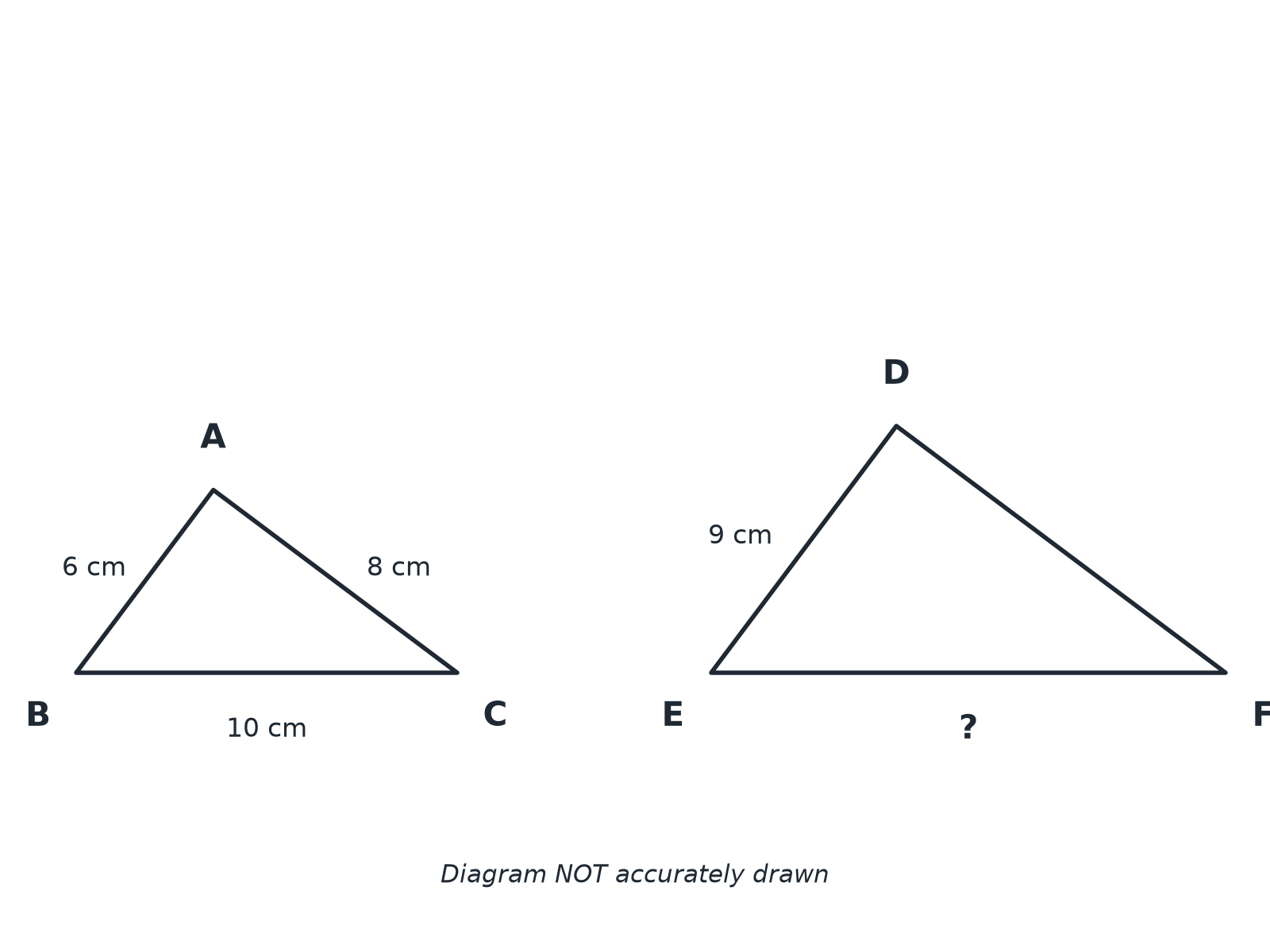
The diagram shows two similar triangles, ABC and DEF. \(AB = 6\) cm, \(BC = 10\) cm, \(AC = 8\) cm and \(DE = 9\) cm. Work out the length of \(EF\).
Mark scheme — 3 marks available
- Scale factor 1.5 — M1
- \(10 \times 1.5\) — M1
- 15 — A1
Model answer
The scale factor is \(\dfrac{9}{6} = 1.5\). \(EF = 10 \times 1.5 = 15\) cm.
For the triangles in the last question, work out the length of \(DF\).
Mark scheme — 2 marks available
- \(8 \times 1.5\) — M1
- 12 — A1
Model answer
\(DF = 8 \times 1.5 = 12\) cm.
Rectangle A is 4 cm by 6 cm. Rectangle B is similar to rectangle A. The shorter side of rectangle B is 10 cm. Work out the length of the longer side of rectangle B.
Mark scheme — 3 marks available
- Scale factor 2.5 — M1
- \(6 \times 2.5\) — M1
- 15 — A1
Model answer
The scale factor is \(10 \div 4 = 2.5\). The longer side is \(6 \times 2.5 = 15\) cm.
In triangle PQR, angle \(P = 50^\circ\) and angle \(Q = 60^\circ\). In triangle XYZ, angle \(X = 50^\circ\) and angle \(Z = 70^\circ\). Show that triangles PQR and XYZ are similar.
Mark scheme — 3 marks available
- Finding a third angle — M1
- Finding the other third angle — M1
- All angles equal, so similar — C1
Model answer
Angle \(R = 180 - 50 - 60 = 70^\circ\) and angle \(Y = 180 - 50 - 70 = 60^\circ\). Both triangles have angles \(50^\circ\), \(60^\circ\) and \(70^\circ\), so they are similar.
A photograph is 12 cm by 8 cm. It is enlarged so that its width is 30 cm. Work out the height of the enlarged photograph.
Mark scheme — 2 marks available
- \(30 \div 12\) — M1
- 20 — A1
Model answer
The scale factor is \(30 \div 12 = 2.5\). The height is \(8 \times 2.5 = 20\) cm.
Are a 3 cm by 5 cm rectangle and a 9 cm by 14 cm rectangle similar? Give a reason.
Mark scheme — 2 marks available
- Comparing the ratios — M1
- Not similar with a reason — C1
Model answer
\(9 \div 3 = 3\) but \(14 \div 5 = 2.8\). The scale factors are different, so the rectangles are not similar.
Two similar shapes have a scale factor of 3. A side of 4 cm becomes...
Why: \(4 \times 3 = 12\) cm.
What is always equal in similar shapes?
Why: The corresponding angles.
Triangle A has sides 3, 4, 5 and triangle B has sides 6, 8, 10. What is the scale factor?
Why: \(6 \div 3 = 2\).
Two triangles each have angles 40° and 60°. Are they similar?
Why: The third angle in each is 80°, so all angles match.
A model is made to scale 1:20. A real length of 5 m is how long on the model?
Why: \(500 \div 20 = 25\) cm.
Similar rectangles have short sides 4 and 10. If the long side of the first is 6, the long side of the second is...
Why: Scale factor 2.5, so \(6 \times 2.5 = 15\).