Viewing as
Teaching this? The teacher view adds 2 files, the mark schemes and the model answers.
Physics · Particle model of matter
Density of materials
Use \(\rho = m \div V\), explain differences in density using the particle model, and describe how to find the density of regular and irregular solids and liquids (Required Practical 5).
Warm-up
Answer each one, then check.
-
1
What is the unit of mass in physics calculations?
Show answerHide answer
Kilograms (kg)
-
2
How do you find the volume of a cuboid?
Show answerHide answer
length \(\times\) width \(\times\) height
-
3
Convert 1 cm³ to m³.
Show answerHide answer
\(1 \times 10^{-6}\) m³
-
4
What are the three states of matter?
Show answerHide answer
Solid, liquid and gas
-
5
What does displacement mean when finding volume?
Show answerHide answer
The volume of water pushed out or the rise in water level
Learning Objectives
DENSITY
density \(=\) mass \(\div\) volume \(\rho = \dfrac{m}{V}\)
Density is in kilograms per metre cubed (kg/m³), mass in kilograms (kg) and volume in metres cubed (m³). Mass is conserved when a substance changes state.
Solids, Liquids and Gases
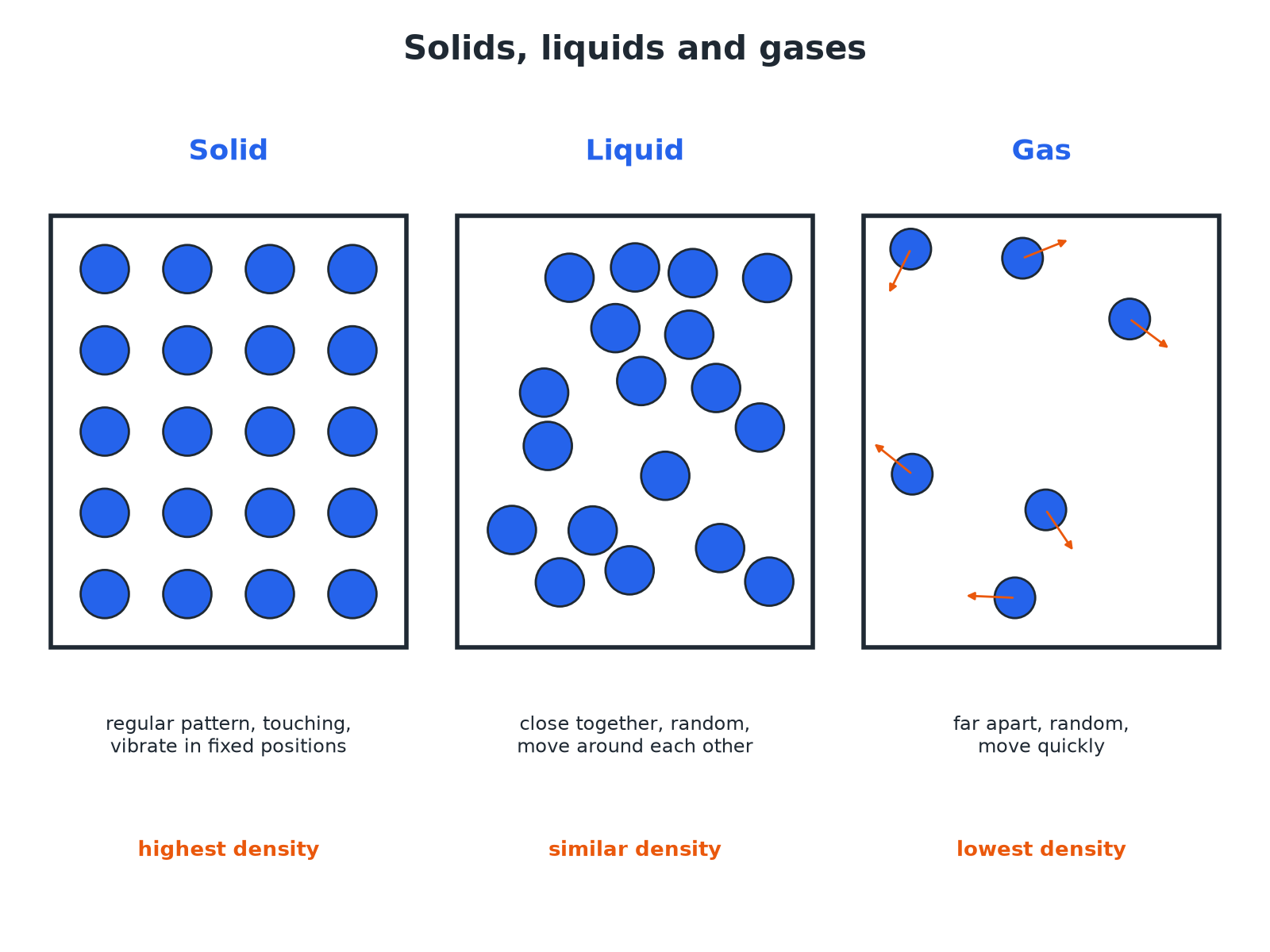
In a solid or liquid the particles are close, so the density is high.
Required Practical 5: Measuring Density
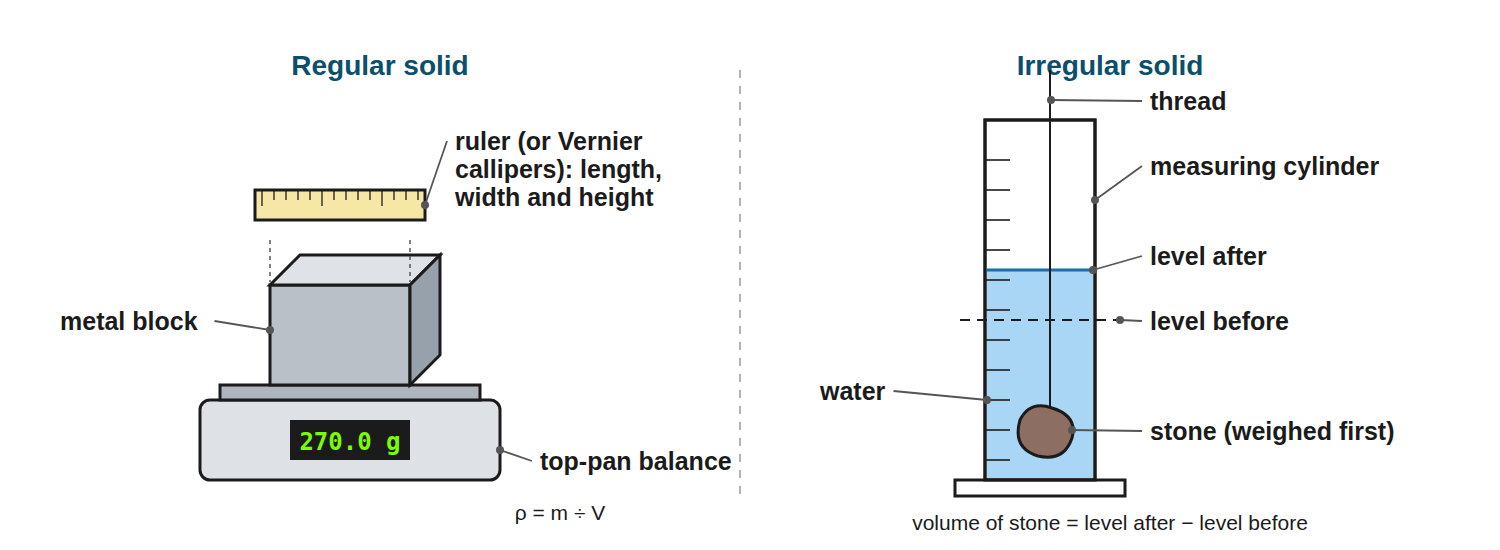
Mass with a balance; volume from dimensions or by displacement.
Why the Densities Differ
-
Solids
Particles are packed closely in a regular arrangement: high density.
-
Liquids
Particles are close but randomly arranged: similar to solids, usually slightly lower.
-
Gases
Particles are far apart: very low density.
-
Mass is conserved
When a substance changes state the number of particles is unchanged, so the mass stays the same.
Required Practical 5: Method
Find the density of a solid or liquid.
-
1
Mass
Measure the mass on a balance (for a liquid, subtract the container's mass).
-
2
Regular solid: volume
Measure length, width and height with a ruler or micrometer and use \(V = l \times w \times h\).
-
3
Irregular solid: volume
Lower it into water in a measuring cylinder, or a displacement can; the volume is the rise in water level (or the volume collected).
-
4
Liquid: volume
Read it from a measuring cylinder at eye level.
-
5
Calculate
\(\rho = m \div V\); repeat and find a mean.
Density of a Block
A metal block has a mass of 0.60 kg and a volume of 0.00020 m³. Calculate its density.
Show the solutionHide the solution
- 1 Write the equation \(\rho = m \div V\)
- 2 Substitute \(\rho = 0.60 \div 0.00020\)
- 3 Answer \(\rho = 3000\) kg/m³
Answer3000 kg/m³
Unit Conversion
A cube of side 4.0 cm has a mass of 512 g. Calculate the density in kg/m³.
Show the solutionHide the solution
- 1 Volume \(4.0^3 = 64\) cm³ \(= 64 \times 10^{-6}\) m³
- 2 Mass \(512\) g \(= 0.512\) kg
- 3 Density \(0.512 \div (64 \times 10^{-6}) = 8000\) kg/m³
Answer8000 kg/m³ (or 8.0 g/cm³)
Irregular Solid by Displacement
A stone of mass 45 g is lowered into a measuring cylinder. The water level rises from 50 cm³ to 68 cm³. Calculate the density in g/cm³.
Show the solutionHide the solution
- 1 Volume of stone \(68 - 50 = 18\) cm³
- 2 Density \(45 \div 18 = 2.5\) g/cm³
Answer2.5 g/cm³ (2500 kg/m³)
Watch Out
Common mistakes.
-
Units
Convert cm³ to m³ (× 10⁻⁶) and g to kg (÷ 1000) before using kg/m³.
-
Reading volume
Read the bottom of the meniscus at eye level.
-
Mass conserved
Density changes with volume, not with mass, when a substance changes state.
Which Floats?
Water has a density of 1000 kg/m³. A block has a mass of 0.80 kg and a volume of 0.0010 m³. Calculate its density and say if it floats.
1. Calculate the density.
2. Compare with water.
A good answer shows: Density \(= 0.80 \div 0.0010 = 800\) kg/m³. This is less than 1000 kg/m³, so it floats.
Can I...?
- 1Recall the equation for density.
- 2Use correct units.
- 3Convert cm³ to m³.
- 4Explain density using particles.
- 5Describe measuring density of a regular solid.
- 6Describe measuring density of an irregular solid.
- 7Read a measuring cylinder.
- 8Say why mass is conserved.
Summary & Exam Focus
- \(\rho = m \div V\).
- Solids and liquids have close particles: high density; gases: far apart, low density.
- Mass is conserved in changes of state.
- Volume of an irregular object: use displacement.
Exam focus
A metal block has a mass of 0.60 kg and a volume of 0.00020 m³. Calculate its density. (2 marks) (2 marks)
Substitute and include kg/m³.
Key terms
The vocabulary this lesson expects you to use. Each one is linked from the first place it appears above.
- Density
- Mass per unit volume of a material.
- Displacement
- The volume of water moved aside by an object placed in it.
- Meniscus
- The curved surface of a liquid in a tube.
- Regular
- A solid with a shape whose volume can be worked out from its dimensions.
- Particle model
- A model in which matter is made of tiny moving particles.
- Conserved
- Stays the same in total.
Practice questions
Have a go at each one before you open its answer.
-
Question 1 Calculate 2 marks
A block of metal has a mass of 0.60 kg and a volume of 0.00020 m³. Calculate the density of the metal. Use the equation: density = mass ÷ volume
Show answerHide answer
Model answer
\(0.60 \div 0.00020 = 3000\) kg/m³
Mark scheme
- Correct substitution — 1 mark
- 3000 kg/m³ — 1 mark
-
Question 2 Calculate 4 marks
A cube has sides of length 4.0 cm and a mass of 512 g. Calculate the density of the cube in kg/m³.
Show answerHide answer
Model answer
\(V = 64\) cm³ = \(6.4 \times 10^{-5}\) m³; \(m = 0.512\) kg; \(\rho = 0.512 \div 6.4 \times 10^{-5} = 8000\) kg/m³
Mark scheme
- Volume = 64 cm³ — 1 mark
- Converts to m³ and kg — 1 mark
- Correct substitution — 1 mark
- 8000 kg/m³ — 1 mark
-
Question 3 Use the diagram 3 marks
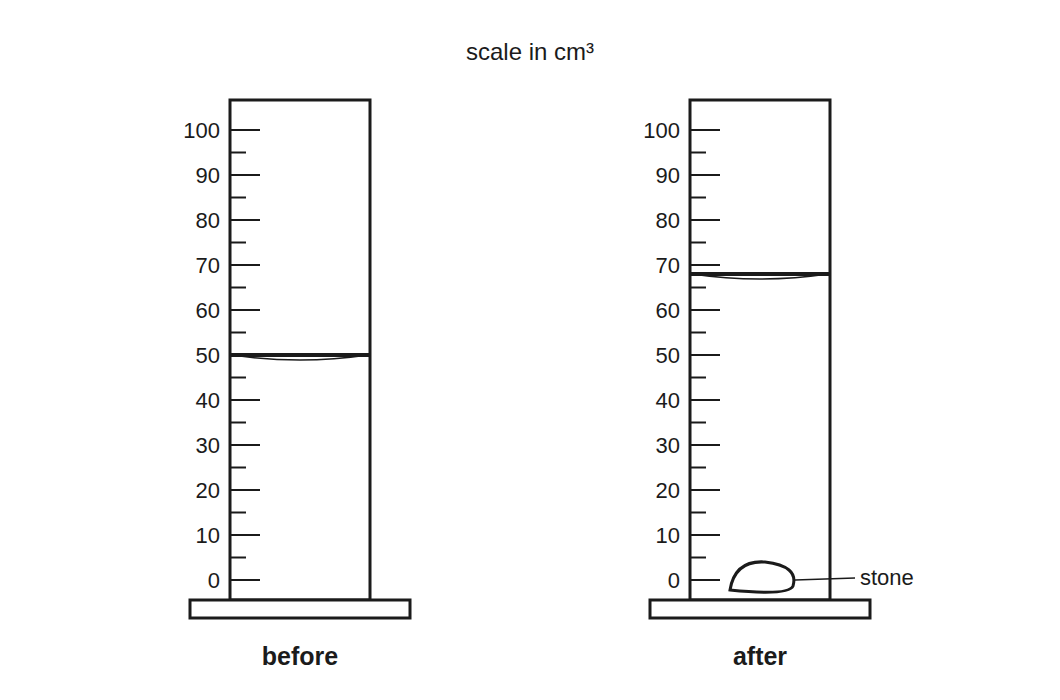
A student measures the volume of a stone using a measuring cylinder. The mass of the stone is 45 g. Use the diagram to calculate the density of the stone in g/cm³.
Show answerHide answer
Model answer
Volume \(= 68 - 50 = 18\) cm³; \(\rho = 45 \div 18 = 2.5\) g/cm³
Mark scheme
- Volume of stone = 18 cm³ — 1 mark
- Correct substitution — 1 mark
- 2.5 g/cm³ — 1 mark
-
Question 4 Explain 3 marks
Explain, in terms of particles, why the density of a gas is much lower than the density of a solid.
Show answerHide answer
Model answer
In a gas the particles are far apart, but in a solid they are packed closely together. The same mass of material occupies a much greater volume in a gas, so the density is lower.
Mark scheme
- Particles far apart in a gas — 1 mark
- Close together in a solid — 1 mark
- More volume for the same mass so lower density — 1 mark
-
Question 5 Describe 6 marks
Describe how to determine the density of an irregularly shaped solid, such as a stone. Your answer should include the apparatus, the measurements and the calculation.
Show answerHide answer
Model answer
See levels-of-response scheme.
Mark scheme
- Level 3 (5 to 6 marks): a complete method with a balance to measure mass, a measuring cylinder or displacement can with water, the volume from the change in water level, the calculation of density = mass ÷ volume and a repeat or precaution — 5 to 6 marks
- Level 2 (3 to 4 marks): a method covering mass and volume but with some detail missing — 3 to 4 marks
- Level 1 (1 to 2 marks): simple statements about measuring mass or volume — 1 to 2 marks
-
Question 6 Explain 2 marks
1.0 kg of ice melts. Explain what happens to the mass and to the density.
Show answerHide answer
Model answer
The mass stays at 1.0 kg because mass is conserved. The density increases because the volume decreases as ice becomes water.
Mark scheme
- Mass stays the same (conserved) — 1 mark
- Density changes because the volume changes — 1 mark
Quick check
-
The equation for density is...
Show answerHide answer
B: \(\rho = m \div V\)
Mass divided by volume.
-
A material has mass 20 kg and volume 4 m³. The density is...
Show answerHide answer
C: 5 kg/m³
20 ÷ 4 = 5.
-
In which state are the particles furthest apart?
Show answerHide answer
D: Gas
The particles in a gas are far apart.
-
The volume of an irregular solid is found by...
Show answerHide answer
A: displacement
The rise in water level equals its volume.
-
When a liquid boils, the mass...
Show answerHide answer
B: stays the same
Mass is conserved in a change of state.
Downloads
Free to keep, print and annotate.
- Density of materials.pptx Built from the lesson script on 30 September 2026. View
- Density of materials - Completed Notes.docx The full notes for the lesson, to revise from. Built from the lesson script on 30 September 2026. View
- Density of materials - Exam Questions.docx Built from the lesson script on 30 September 2026. View
Something here looks wrong?
Tell us what and we will go and look. It goes to whoever writes these pages, nobody else, and we do not ask who you are — so there is nothing to sign and nothing comes back to you.