Viewing as
Teacher view: planning notes, the answers to every question, and the teacher copies of the files.
Physics · Particle model of matter
Increasing the pressure of a gas
Explain how doing work on a gas increases its internal energy and temperature, for example in a bicycle pump (Higher tier only).
Teacher resources
The teacher copies: slides with the questions built in, the answers, and anything else attached to this lesson for whoever is teaching it.
- Increasing the pressure of a gas - Teacher Slides.pptx Teacher The lesson slides with the teacher's notes on each slide, and every question and mark scheme built in. Built from the lesson script on 30 September 2026. View
- Increasing the pressure of a gas - Teacher Notes.docx Teacher The complete notes with the teacher's notes and every model answer in full. Built from the lesson script on 30 September 2026. View
Student handouts
The same files the students see, to print or hand out.
- Increasing the pressure of a gas.pptx Built from the lesson script on 30 September 2026. View
- Increasing the pressure of a gas - Completed Notes.docx The full notes for the lesson, to revise from. Built from the lesson script on 30 September 2026. View
- Increasing the pressure of a gas - Exam Questions.docx Built from the lesson script on 30 September 2026. View
Warm-up
Answer each one, then check.
-
1
What is work done?
Show answerHide answer
Energy transferred by a force
-
2
What is internal energy?
Show answerHide answer
Total kinetic and potential energy of the particles
-
3
What is the link between temperature and particle energy?
Show answerHide answer
Higher temperature means more kinetic energy
-
4
What happens to gas pressure when volume decreases?
Show answerHide answer
It increases
-
5
What is a force?
Show answerHide answer
A push or a pull
Learning Objectives
- 1Define work as the transfer of energy by a force.
- 2Explain that doing work on a gas increases its internal energy.
- 3Explain why the temperature of a gas rises when it is compressed, for example in a bicycle pump.
WORK ON A GAS (HIGHER TIER)
Work is the transfer of energy by a force. Doing work on a gas increases the internal energy of the gas and can cause its temperature to rise.
This is why a bicycle pump gets warm when used.
A Bicycle Pump
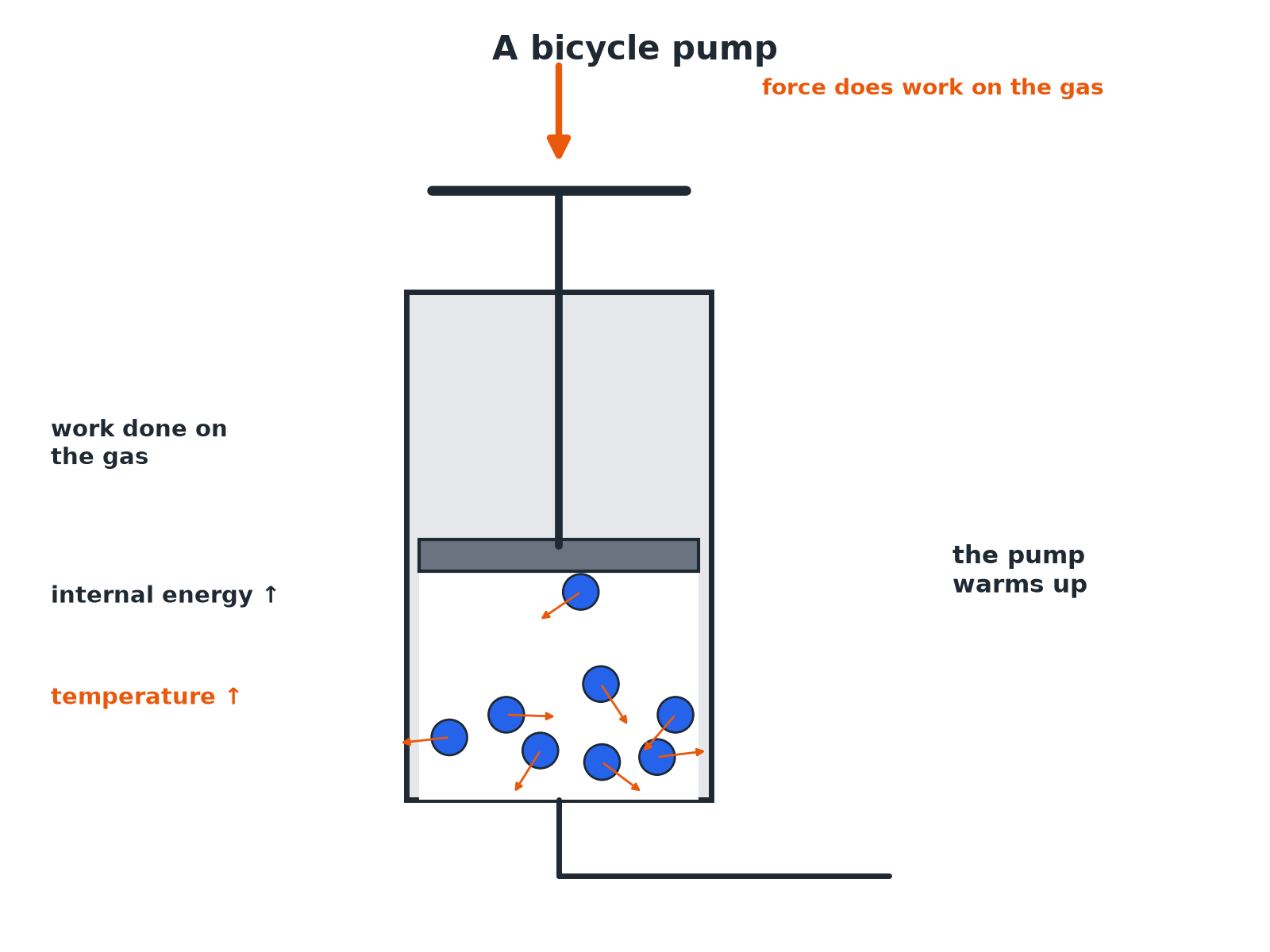
Work done becomes internal energy.
Why the Gas Warms
A chain of ideas.
-
1
Push the piston
You apply a force that moves the piston: work is done on the gas.
-
2
Energy transferred
The energy is transferred to the gas particles.
-
3
Kinetic energy increases
The particles move faster.
-
4
Temperature rises
The average kinetic energy of the gas increases.
Bicycle Pump
Explain why the barrel of a bicycle pump gets hot when the pump is used to inflate a tyre.
Show the solutionHide the solution
- 1 Work done The force on the piston does work on the air inside
- 2 Internal energy The internal energy of the air increases as the energy is transferred to its molecules
- 3 Temperature The temperature of the air rises, and thermal energy is transferred to the barrel
AnswerWork is done on the air, increasing its internal energy and temperature, which warms the pump.
Exam Points
How to score the marks.
-
Say 'work is done'
Name the force and the energy transfer.
-
Link to internal energy
Increase in internal energy of the gas.
-
Link to temperature
Average kinetic energy of the molecules increases, so temperature rises.
Warm Pump
You pump up a tyre and the base of the pump gets warm. Explain why using the ideas of work and internal energy.
1. Say what is being done to the gas.
2. Link to temperature.
A good answer shows: Work is done on the air by the force pushing the piston. This increases the internal energy of the air (kinetic energy of the molecules), so the temperature increases and the pump warms.
Can I...?
- 1Define work.
- 2Explain work on a gas.
- 3Link work to internal energy.
- 4Link internal energy to temperature.
- 5Use the bicycle pump example.
- 6Write a clear chain of reasoning.
- 7Use the correct terms.
- 8Explain warming.
Summary & Exam Focus
- Work is energy transferred by a force.
- Work done on a gas increases its internal energy.
- The temperature of the gas increases.
- Example: a bicycle pump.
Exam focus
Explain why the air in a bicycle pump gets hotter when the pump is used. (3 marks) (3 marks)
Work is done; internal energy rises; temperature rises.
Key terms
The vocabulary this lesson expects you to use. Each one is linked from the first place it appears above.
- Work
- Energy transferred by a force.
- Internal energy
- Total kinetic and potential energy of particles.
- Compression
- Squashing a gas into a smaller volume.
- Molecule
- A group of atoms bonded together.
- Enclosed gas
- A gas trapped in a container.
- Temperature
- A measure of average kinetic energy.
Questions and answers
10 questions set on this lesson, with the mark schemes and model answers open.
A student uses a bicycle pump to inflate a tyre and notices that the pump becomes warm. Explain why.
Mark scheme — 3 marks available
- Work is done on the gas — 1 mark
- Internal energy of the gas increases — 1 mark
- Temperature rises — 1 mark
Model answer
Work is done on the air by the force on the piston. This transfers energy to the air, so the internal energy of the air increases and the temperature rises, warming the pump.
What is meant by work done?
Mark scheme — 2 marks available
- Transfer of energy — 1 mark
- By a force — 1 mark
Model answer
The transfer of energy by a force.
A gas in a sealed syringe is compressed quickly by pushing in the plunger. Explain, using the particle model, why the temperature of the gas rises.
Mark scheme — 4 marks available
- Work is done on the gas — 1 mark
- Energy transferred to the particles — 1 mark
- Average kinetic energy increases — 1 mark
- So the temperature rises — 1 mark
Model answer
The force on the plunger does work on the gas. Energy is transferred to the gas particles, so the average kinetic energy of the particles increases. The temperature of the gas depends on the average kinetic energy, so the temperature rises.
Explain why a gas compressed slowly and allowed to cool would not stay hot.
Mark scheme — 2 marks available
- Energy transferred to the surroundings — 1 mark
- Internal energy or temperature decreases — 1 mark
Model answer
The energy is transferred by heating to the surroundings, so the internal energy and temperature of the gas decrease.
Describe the energy changes when a gas is compressed by a piston and then allowed to expand pushing the piston out.
Mark scheme — 3 marks available
- Work done on the gas: internal energy increases — 1 mark
- Gas does work on the piston when expanding — 1 mark
- Internal energy decreases — 1 mark
Model answer
When compressed, work is done on the gas so its internal energy increases. When it expands and does work on the piston, its internal energy decreases and it cools.
Work done on a gas increases its...
Why: Energy is transferred to the gas.
Compressing a gas quickly makes its temperature...
Why: Its internal energy rises.
Work is the transfer of energy by a...
Why: Force times distance.
A bicycle pump warms up because work is done on the...
Why: The air is compressed.
Temperature rise means the particles' average...
Why: Faster molecules.