Viewing as
Teacher view: planning notes, the answers to every question, and the teacher copies of the files.
Physics · Forces
Moments, levers and gears
Use \(M = Fd\), the principle of moments for balanced objects, and explain how levers and gears transmit rotational effects.
Teacher resources
The teacher copies: slides with the questions built in, the answers, and anything else attached to this lesson for whoever is teaching it.
- Moments levers and gears - Teacher Slides.pptx Teacher The lesson slides with the teacher's notes on each slide, and every question and mark scheme built in. Built from the lesson script on 30 September 2026. View
- Moments levers and gears - Teacher Notes.docx Teacher The complete notes with the teacher's notes and every model answer in full. Built from the lesson script on 30 September 2026. View
Student handouts
The same files the students see, to print or hand out.
- Moments levers and gears.pptx Built from the lesson script on 30 September 2026. View
- Moments levers and gears - Completed Notes.docx The full notes for the lesson, to revise from. Built from the lesson script on 30 September 2026. View
- Moments levers and gears - Exam Questions.docx Built from the lesson script on 30 September 2026. View
Warm-up
Answer each one, then check.
-
1
What is a pivot?
Show answerHide answer
The point about which something turns
-
2
What is the unit of force?
Show answerHide answer
Newton
-
3
What is clockwise?
Show answerHide answer
The direction the hands of a clock turn
-
4
What is the unit of distance?
Show answerHide answer
Metre
-
5
Give an example of a lever.
Show answerHide answer
A seesaw, crowbar or spanner
Learning Objectives
MOMENTS
moment of a force \(=\) force \(\times\) perpendicular distance from the pivot \(M = Fd\)
The turning effect of a force is called its moment, in newton-metres (Nm). If an object is balanced, the total clockwise moment about a pivot equals the total anticlockwise moment.
A Balanced Beam
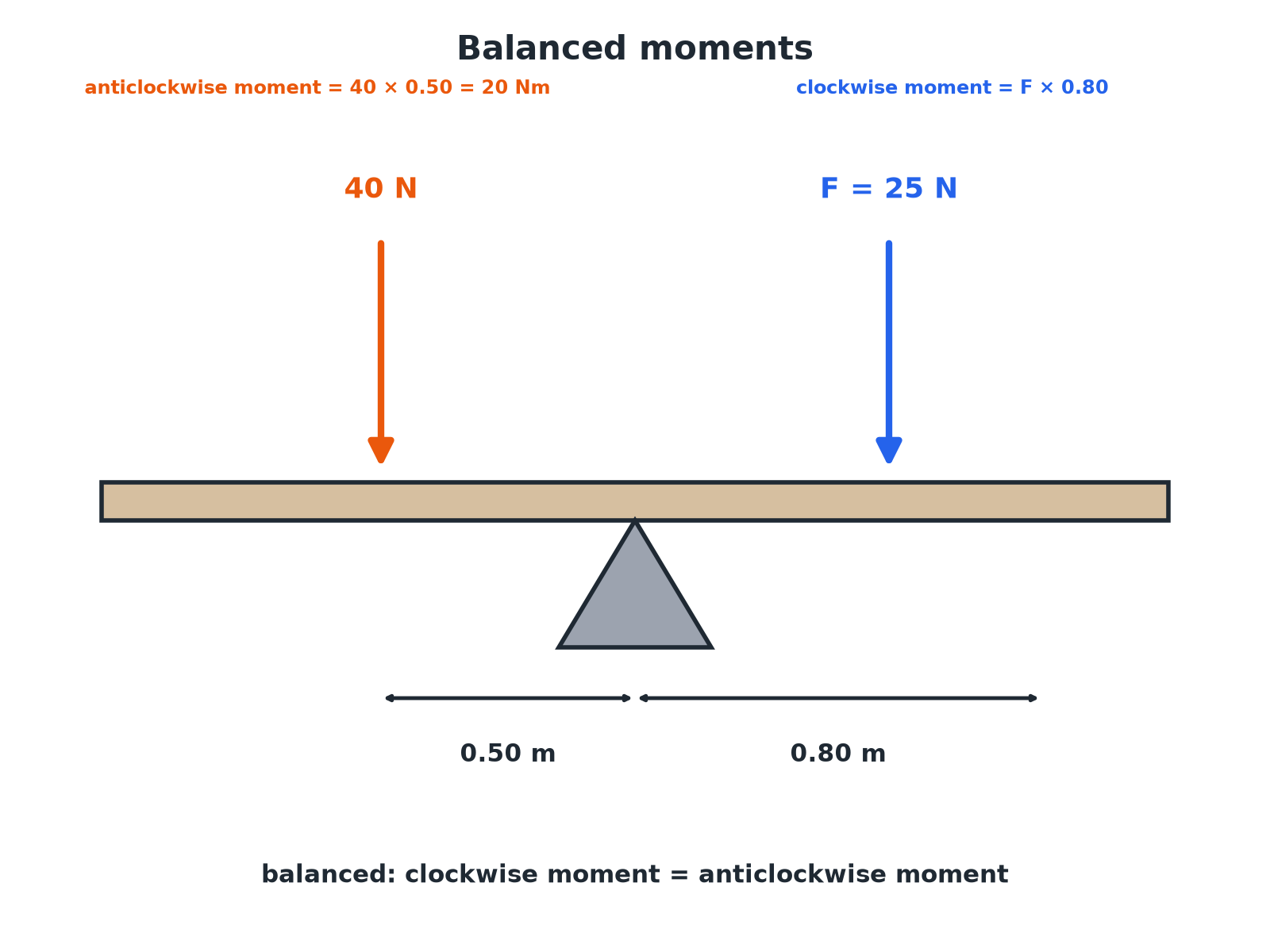
Clockwise moments equal anticlockwise moments when balanced.
Calculating a Moment
A force of 30 N acts 1.5 m from a pivot at right angles. Calculate the moment.
Show the solutionHide the solution
- 1 Write the equation \(M = Fd\)
- 2 Substitute \(M = 30 \times 1.5\)
- 3 Answer \(M = 45\) Nm
Answer45 Nm
A Balanced Seesaw
A 40 N child sits 0.50 m from the pivot of a balanced beam. Another force F acts on the other side 0.80 m from the pivot. Calculate F.
Show the solutionHide the solution
- 1 Anticlockwise moment \(40 \times 0.50 = 20\) Nm
- 2 Balanced \(F \times 0.80 = 20\)
- 3 Rearrange \(F = 20 \div 0.80\)
- 4 Answer \(F = 25\) N
Answer25 N
Gears
A gear with 20 teeth drives a gear with 40 teeth. Describe how the second gear turns compared with the first.
Show the solutionHide the solution
- 1 Direction It turns in the opposite direction
- 2 Speed The larger gear turns more slowly (half the speed)
- 3 Turning effect The larger gear has a greater turning effect (moment)
AnswerIt turns the opposite way at half the speed with a larger moment.
Levers and Gears
Transmitting turning effects.
-
Lever
A rigid bar that turns about a pivot; a longer distance from the pivot means a smaller force is needed.
-
Examples
A crowbar, spanner, wheelbarrow, scissors.
-
Gears
Toothed wheels that mesh to transfer rotation.
-
Gear ratio
A large gear driven by a small gear turns slower but with a greater moment.
Balance the Beam
A beam is balanced. A 60 N weight is 0.40 m to the left of the pivot. Where must a 30 N weight be placed on the right?
1. Find the anticlockwise moment.
2. Equal the clockwise moment.
A good answer shows: Clockwise = anticlockwise: 30 × d = 60 × 0.40 = 24, so d = 0.80 m.
Can I...?
- 1Recall M = Fd.
- 2Use perpendicular distance.
- 3State the principle of moments.
- 4Find an unknown force.
- 5Find an unknown distance.
- 6Explain levers.
- 7Explain gears.
- 8Use Nm.
Summary & Exam Focus
- \(M = Fd\).
- Balanced: total clockwise moment = total anticlockwise moment.
- Levers: a longer distance from the pivot gives a greater moment.
- Gears: change direction, speed and turning effect.
Exam focus
A force of 30 N acts 1.5 m from a pivot. Calculate the moment. (2 marks) (2 marks)
Multiply force by distance and give Nm.
Key terms
The vocabulary this lesson expects you to use. Each one is linked from the first place it appears above.
- Moment
- The turning effect of a force, in newton-metres.
- Pivot
- The point about which an object turns.
- Clockwise
- In the direction of a clock's hands.
- Anticlockwise
- Opposite to the hands of a clock.
- Lever
- A bar that can turn about a pivot.
- Gear
- A toothed wheel that transmits rotation.
Questions and answers
10 questions set on this lesson, with the mark schemes and model answers open.
A force of 30 N is applied at a distance of 1.5 m from a pivot. The force acts at right angles. Calculate the moment of the force. Use the equation: moment = force × distance
Mark scheme — 2 marks available
- Correct substitution — 1 mark
- 45 Nm — 1 mark
Model answer
\(30 \times 1.5 = 45\) Nm
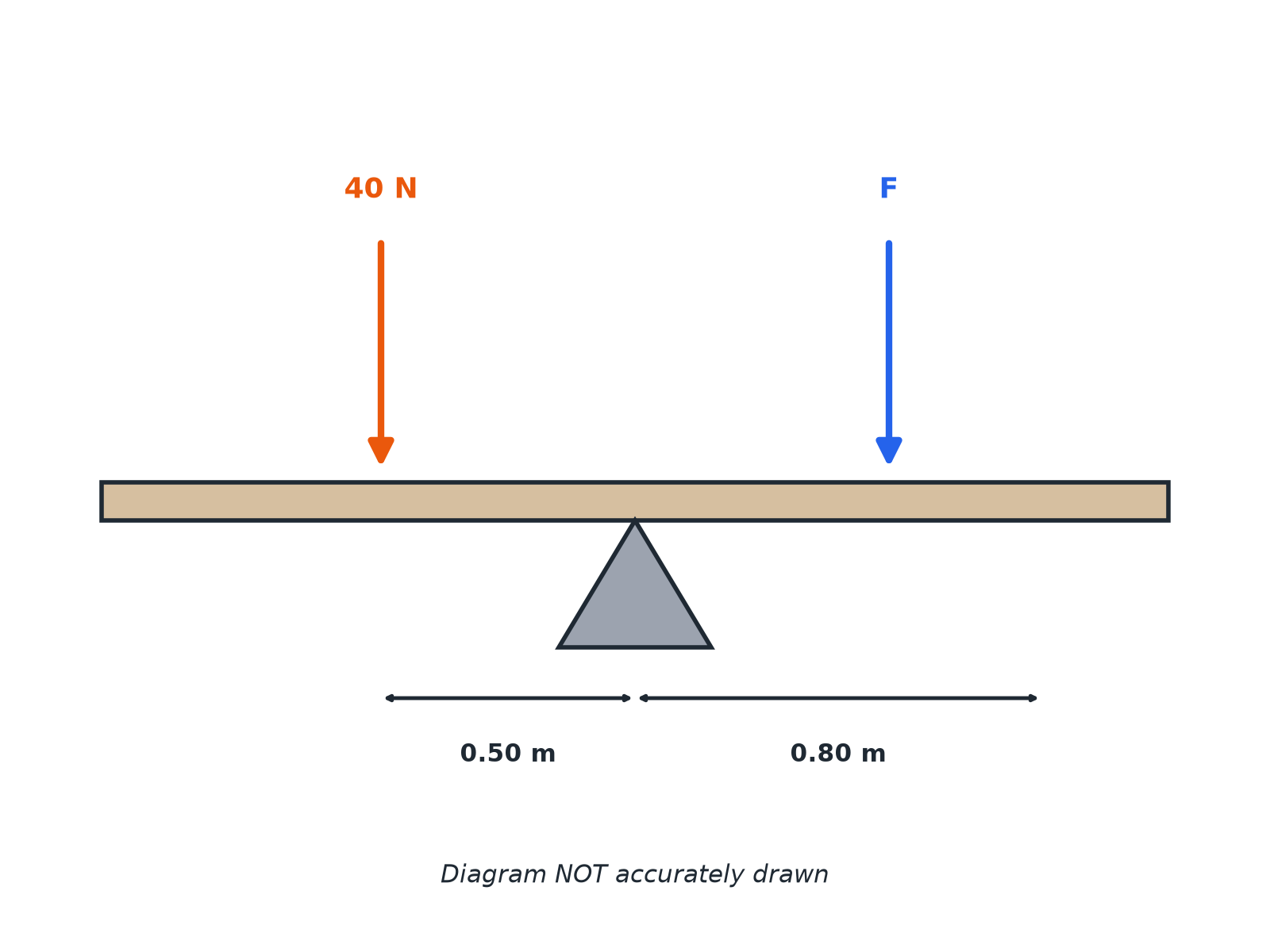
The diagram shows a uniform beam balanced on a pivot. A 40 N force acts 0.50 m to the left of the pivot. Calculate the force F.
Mark scheme — 3 marks available
- Anticlockwise moment 20 Nm — 1 mark
- Equates moments — 1 mark
- 25 N — 1 mark
Model answer
Anticlockwise moment \(= 40 \times 0.50 = 20\) Nm. \(F \times 0.80 = 20\), so \(F = 25\) N
A spanner is used to undo a nut. Explain why a longer spanner makes it easier.
Mark scheme — 2 marks available
- Moment = force × distance — 1 mark
- Greater distance means smaller force needed — 1 mark
Model answer
The moment is force × distance, so a longer spanner gives a bigger moment for the same force, or needs a smaller force.
A gear with 20 teeth is driven by a motor. It meshes with a gear with 40 teeth. Explain how the larger gear turns compared with the smaller gear.
Mark scheme — 3 marks available
- Opposite direction — 1 mark
- Slower (half the speed) — 1 mark
- Greater moment — 1 mark
Model answer
The larger gear turns in the opposite direction, at half the speed, and has a larger turning effect (moment).
A 60 N weight is 0.40 m to the left of a pivot on a balanced beam. A 30 N weight is on the right. Calculate its distance from the pivot.
Mark scheme — 4 marks available
- Anticlockwise moment 24 Nm — 1 mark
- Balanced moments — 1 mark
- Correct rearrangement — 1 mark
- 0.80 m — 1 mark
Model answer
Anticlockwise \(= 60 \times 0.40 = 24\) Nm; \(30 \times d = 24\); \(d = 0.80\) m
The unit of a moment is...
Why: Force times distance.
A balanced object has...
Why: The principle of moments.
A 20 N force at 3 m from a pivot has a moment of...
Why: 20 × 3.
The distance in M = Fd is...
Why: It is measured at right angles to the force.
A large gear driven by a small gear turns...
Why: Fewer turns but a bigger moment.