Viewing as
Teacher view: planning notes, the answers to every question, and the teacher copies of the files.
Physics · Magnetism and electromagnetism
Electric motors
Explain how a d.c. electric motor works using the motor effect and the split-ring commutator (Higher tier only; Physics only).
Teacher resources
The teacher copies: slides with the questions built in, the answers, and anything else attached to this lesson for whoever is teaching it.
- Electric motors - Teacher Slides.pptx Teacher The lesson slides with the teacher's notes on each slide, and every question and mark scheme built in. Built from the lesson script on 30 September 2026. View
- Electric motors - Teacher Notes.docx Teacher The complete notes with the teacher's notes and every model answer in full. Built from the lesson script on 30 September 2026. View
Student handouts
The same files the students see, to print or hand out.
- Electric motors.pptx Built from the lesson script on 30 September 2026. View
- Electric motors - Completed Notes.docx The full notes for the lesson, to revise from. Built from the lesson script on 30 September 2026. View
- Electric motors - Exam Questions.docx Built from the lesson script on 30 September 2026. View
Warm-up
Answer each one, then check.
-
1
What is the motor effect?
Show answerHide answer
The force on a current-carrying wire in a magnetic field
-
2
What does a motor transfer energy to?
Show answerHide answer
Kinetic energy store
-
3
What does the left-hand rule give?
Show answerHide answer
The direction of the force
-
4
What is a commutator?
Show answerHide answer
A part that reverses the current each half turn
-
5
What are brushes?
Show answerHide answer
Carbon contacts touching the commutator
Learning Objectives
- 1Describe how a coil of wire in a magnetic field rotates.
- 2Explain the role of the split-ring commutator.
- 3Explain how to increase the speed of a motor.
- 4Explain why the forces on the two sides of the coil are in opposite directions.
THE D.C. MOTOR
A current-carrying coil in a magnetic field experiences forces on its two long sides that act in opposite directions, so it rotates. The split-ring commutator reverses the current every half turn to keep it turning in the same direction.
The forces are opposite because the current flows in opposite directions along the two sides of the coil.
A d.c. Motor
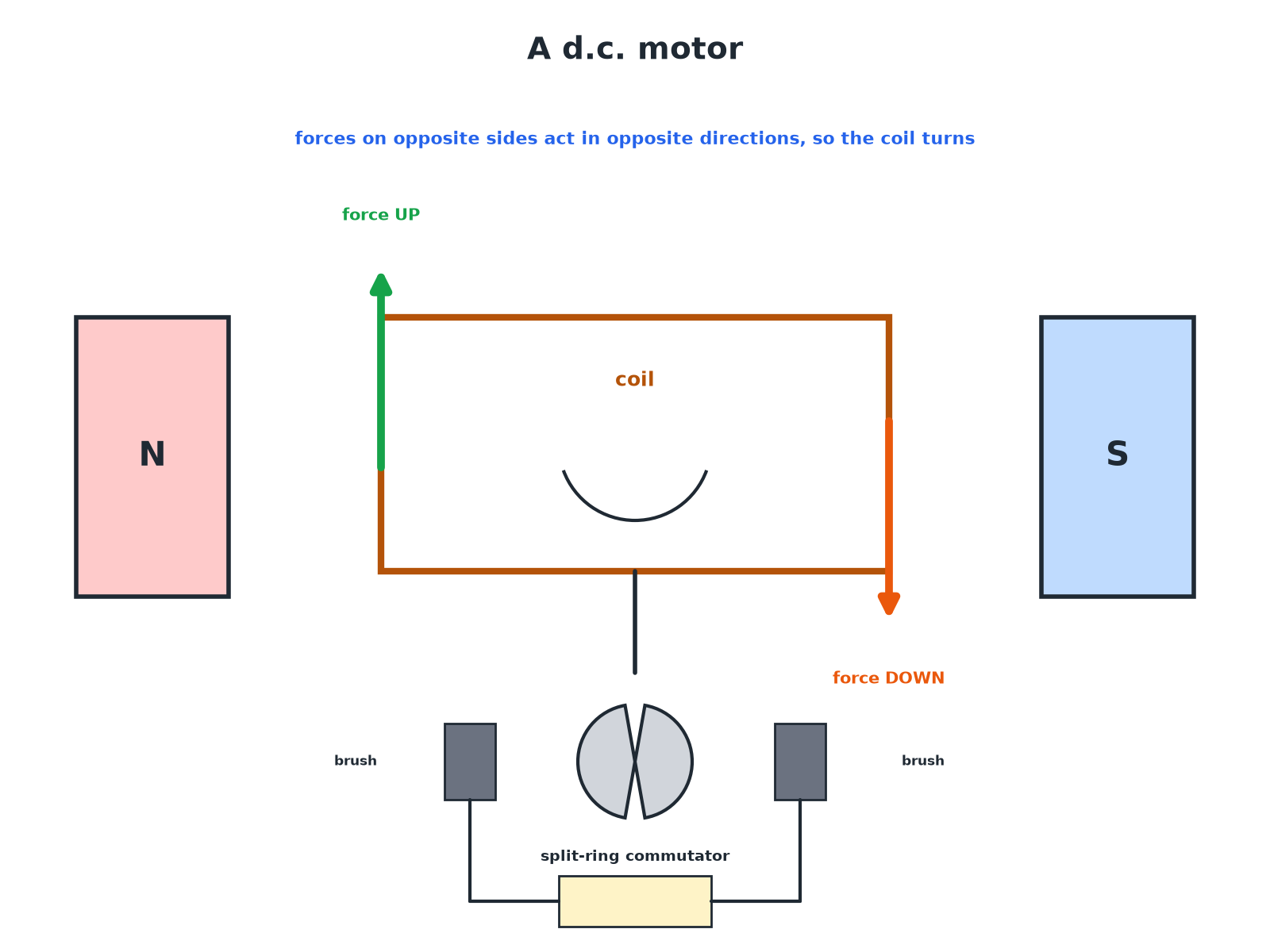
The two sides of the coil feel opposite forces.
How a d.c. Motor Turns
Follow the steps.
-
1
Current flows
Through the coil via the brushes and commutator.
-
2
Forces act
One side of the coil is pushed up, the other down (motor effect).
-
3
The coil rotates
The opposite forces turn the coil.
-
4
The commutator swaps
The split ring reverses the current each half turn.
-
5
Rotation continues
The forces always turn the coil the same way.
Increasing the Speed
Ways to make a motor faster.
-
Increase the current
Why it works: Larger force on the coil
-
Stronger magnets
Why it works: Larger magnetic flux density
-
More turns on the coil
Why it works: Larger total force
-
Reverse the battery
Why it works: Motor spins the other way
Why the Commutator Matters
Explain what would happen without the split-ring commutator.
Show the solutionHide the solution
- 1 Half a turn The coil would turn to the vertical position
- 2 Without a commutator The forces would then turn it back
- 3 Result The coil would only oscillate and stop
AnswerThe coil would not rotate continuously.
Motor Build
Explain each part of a model motor: coil, magnets, commutator, brushes, battery. What happens if you reverse the battery?
1. Use the left-hand rule for each side.
A good answer shows: The motor spins in the opposite direction.
Can I...?
- 1Name the parts.
- 2Explain the forces on the coil.
- 3Explain the commutator.
- 4Describe rotation.
- 5Increase the speed.
- 6Reverse the direction.
- 7Say why opposite forces.
- 8Link to the motor effect.
Summary & Exam Focus
- Coil in a field feels opposite forces on opposite sides.
- The split ring swaps the current direction each half turn.
- This keeps the coil rotating the same way.
- A larger current or stronger field makes it faster.
Exam focus
Describe the job of the split-ring commutator. (2 marks) (2 marks)
It reverses the current every half turn.
Key terms
The vocabulary this lesson expects you to use. Each one is linked from the first place it appears above.
- d.c. motor
- A motor that uses direct current to make a coil rotate in a magnetic field.
- Commutator
- A split ring that reverses the current each half turn.
- Brushes
- Carbon contacts that touch the commutator.
- Coil
- A loop of wire that turns in the magnetic field.
- Rotation
- Turning about an axis.
- Motor effect
- The force on a current-carrying wire in a magnetic field.
Questions and answers
10 questions set on this lesson, with the mark schemes and model answers open.
State two ways of increasing the speed of rotation of a d.c. motor.
Mark scheme — 2 marks available
- One way — 1 mark
- Another way — 1 mark
Model answer
Increase the current. Use stronger magnets. Use more turns. (any two)
Explain why the coil in a d.c. motor turns when a current flows through it.
Mark scheme — 3 marks available
- Coil in a field carrying a current experiences forces — 1 mark
- Current in opposite directions in the two sides — 1 mark
- Opposite forces turn the coil — 1 mark
Model answer
The current in the coil is at right angles to the magnetic field so each long side of the coil experiences a force. The current in the two sides is in opposite directions, so the forces are in opposite directions and turn the coil.
Explain the purpose of the split-ring commutator in a d.c. motor.
Mark scheme — 3 marks available
- Reverses the current — 1 mark
- Every half turn — 1 mark
- Keeps the coil turning the same way — 1 mark
Model answer
It reverses the direction of the current in the coil every half turn so that the forces keep turning the coil in the same direction, giving continuous rotation.
The battery in a d.c. motor is connected the other way round. Describe and explain the effect.
Mark scheme — 2 marks available
- Turns in the opposite direction — 1 mark
- Current (forces) reversed — 1 mark
Model answer
The current in the coil is reversed, so the forces are reversed and the motor turns in the opposite direction.
A motor rotates slowly. Explain two changes that would make it rotate faster.
Mark scheme — 4 marks available
- Increase the current — 1 mark
- Larger force — 1 mark
- Stronger magnets or more turns — 1 mark
- Larger force or flux density — 1 mark
Model answer
Increase the current, which increases the force on the coil. Use stronger magnets, which increases the magnetic flux density so the force is larger. More turns also increase the force.
The part that reverses the current each half turn is the...
Why: Split ring.
The forces on the two sides of a motor coil are...
Why: Current is opposite.
Brushes are usually made of...
Why: Conducting and slippery.
A stronger magnet makes a motor...
Why: Bigger force.
Reversing the battery makes the motor...
Why: Forces reverse.