Viewing as
Teacher view: planning notes, the answers to every question, and the teacher copies of the files.
Physics · Magnetism and electromagnetism
Loudspeakers and headphones
Explain how loudspeakers and headphones use the motor effect to convert alternating current into sound (Higher tier only; Physics only).
Teacher resources
The teacher copies: slides with the questions built in, the answers, and anything else attached to this lesson for whoever is teaching it.
- Loudspeakers and headphones - Teacher Slides.pptx Teacher The lesson slides with the teacher's notes on each slide, and every question and mark scheme built in. Built from the lesson script on 30 September 2026. View
- Loudspeakers and headphones - Teacher Notes.docx Teacher The complete notes with the teacher's notes and every model answer in full. Built from the lesson script on 30 September 2026. View
Student handouts
The same files the students see, to print or hand out.
- Loudspeakers and headphones.pptx Built from the lesson script on 30 September 2026. View
- Loudspeakers and headphones - Completed Notes.docx The full notes for the lesson, to revise from. Built from the lesson script on 30 September 2026. View
- Loudspeakers and headphones - Exam Questions.docx Built from the lesson script on 30 September 2026. View
Warm-up
Answer each one, then check.
-
1
What is sound?
Show answerHide answer
A longitudinal wave
-
2
What is frequency?
Show answerHide answer
Number of waves per second
-
3
What is a.c.?
Show answerHide answer
-
4
What is the motor effect?
Show answerHide answer
Force on a current-carrying wire in a magnetic field
-
5
What is a diaphragm?
Show answerHide answer
A thin flexible cone or membrane
Learning Objectives
- 1Describe the structure of a moving-coil loudspeaker.
- 2Explain how a loudspeaker converts electrical signals into sound.
- 3Explain how the frequency and loudness of the sound depend on the a.c.
LOUDSPEAKERS
In a loudspeaker an alternating current flows through a coil in a magnetic field. The motor effect makes the coil, and the cone attached to it, move back and forth at the same frequency as the current, producing sound waves.
Loudspeakers and headphones use the motor effect; microphones (next lessons) use the generator effect.
A Loudspeaker
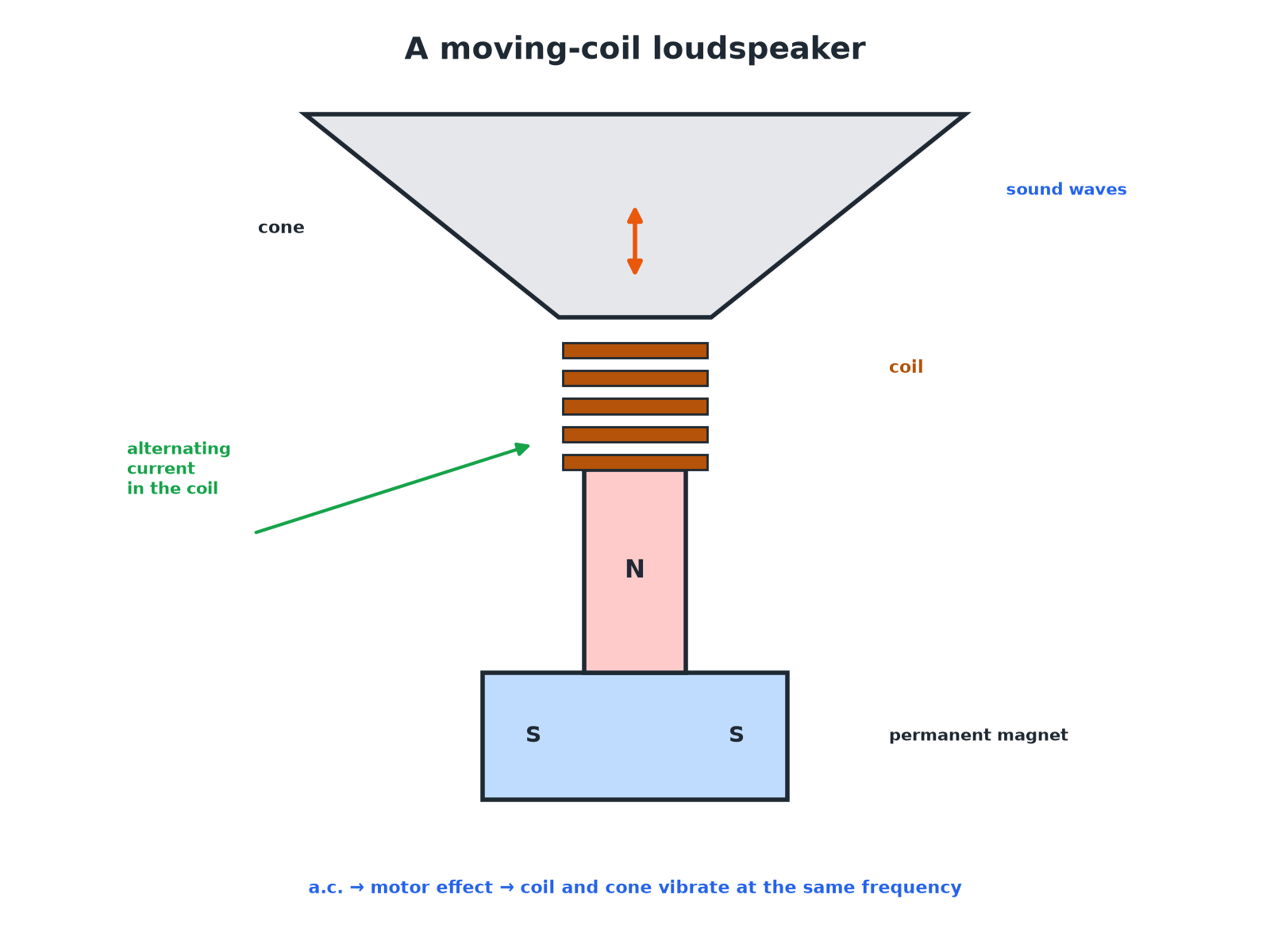
The cone moves at the frequency of the current.
How a Loudspeaker Makes Sound
Follow the steps.
-
1
a.c. flows
An alternating current from the amplifier flows through the coil.
-
2
The coil is in a field
The permanent magnet provides a magnetic field.
-
3
Motor effect
A force acts on the coil, changing direction as the current changes direction.
-
4
The cone vibrates
The coil moves the cone back and forth at the same frequency.
-
5
Sound waves
The vibrating cone makes longitudinal sound waves in the air.
Changing the Sound
What controls the sound?
-
Higher frequency a.c.
Sound: Higher pitch
-
Larger a.c. amplitude
Sound: Louder sound (larger force, greater vibration)
-
Zero current
Sound: No sound
Headphones
Explain how headphones work in the same way.
Show the solutionHide the solution
- 1 Small coil A small coil and magnet inside
- 2 a.c. signal Changing current moves the coil
- 3 Diaphragm A small diaphragm vibrates and creates sound
AnswerHeadphones are tiny loudspeakers.
Speaker Soak
Write a chain of events from the amplifier to the sound reaching your ear. Then explain why the cone vibrates at the same frequency as the current.
1. Follow the chain.
A good answer shows: a.c. → coil → motor effect → cone vibrates → sound. The force reverses each time the current reverses.
Can I...?
- 1State the parts.
- 2Name the effect used.
- 3Explain the coil movement.
- 4Explain the cone.
- 5Link frequency and pitch.
- 6Link amplitude and loudness.
- 7Describe headphones.
- 8Give the energy transfer.
Summary & Exam Focus
- Alternating current flows through a coil near a magnet.
- The motor effect gives a force that changes direction with the current.
- The coil and cone vibrate at the same frequency.
- The cone makes sound waves in the air.
Exam focus
Explain why the cone in a loudspeaker vibrates. (3 marks) (3 marks)
Alternating current in the coil, motor effect.
Key terms
The vocabulary this lesson expects you to use. Each one is linked from the first place it appears above.
- Loudspeaker
- A device that uses the motor effect to convert electrical signals into sound.
- Cone
- The part of the loudspeaker that vibrates to make sound.
- Alternating current
- A current that repeatedly changes direction.
- Frequency
- The number of vibrations each second.
- Amplitude
- The size of the vibration.
- Diaphragm
- A thin vibrating membrane.
Questions and answers
10 questions set on this lesson, with the mark schemes and model answers open.
What type of current flows through the coil of a loudspeaker? Describe how the cone moves.
Mark scheme — 2 marks available
- Alternating current — 1 mark
- Cone vibrates back and forth — 1 mark
Model answer
An alternating current. The cone moves back and forth (vibrates).
Explain how a loudspeaker produces sound.
Mark scheme — 4 marks available
- a.c. in a coil in a magnetic field — 1 mark
- Motor effect force — 1 mark
- Force changes direction so cone vibrates — 1 mark
- Sound waves produced — 1 mark
Model answer
An alternating current flows in the coil, which is in the field of a permanent magnet. The motor effect gives a force on the coil that reverses as the current reverses. The coil and cone vibrate at the frequency of the current. The cone produces longitudinal sound waves.
The frequency of the alternating current is increased. State the effect on the sound.
Mark scheme — 2 marks available
- Higher pitch / higher frequency — 1 mark
- Cone vibrates faster — 1 mark
Model answer
The pitch of the sound rises because the cone vibrates faster.
The amplitude of the current is increased. State the effect on the sound and explain.
Mark scheme — 2 marks available
- Louder — 1 mark
- Larger force or larger vibration — 1 mark
Model answer
The sound is louder because a larger current gives a larger force so the cone vibrates with a larger amplitude.
Explain why the current in a loudspeaker must be alternating rather than direct.
Mark scheme — 3 marks available
- d.c. gives a steady force in one direction — 1 mark
- Cone only moves once/stays displaced — 1 mark
- a.c. reverses the force so the cone vibrates — 1 mark
Model answer
A direct current would give a force in one direction, so the cone would only move once and stay there. An alternating current reverses the force so the cone moves back and forth and produces sound.
A loudspeaker uses the...
Why: Force on a coil in a field.
The current in a loudspeaker coil is...
Why: It reverses.
Higher frequency current gives a sound of...
Why: Faster vibrations.
The vibrating cone produces...
Why: Sound.
Larger current amplitude gives a...
Why: Bigger force.