Viewing as
Teaching this? The teacher view adds 2 files, the mark schemes and the model answers.
Physics · Waves
Lenses
Describe how convex and concave lenses form images, construct ray diagrams, and use \(\text{magnification} = \text{image height} \div \text{object height}\) (Physics only).
Warm-up
Answer each one, then check.
-
1
What is refraction?
Show answerHide answer
A change of direction caused by a change in speed
-
2
What is a ray?
Show answerHide answer
A line showing the path of light
-
3
What is an image?
Show answerHide answer
What you see when light from an object is focused
-
4
What is magnification?
Show answerHide answer
How many times bigger an image is than the object
-
5
Give an example of a lens use.
Show answerHide answer
Glasses, cameras or magnifying glasses
Learning Objectives
- 1Describe how a lens forms an image by refracting light.
- 2Define principal focus and focal length for a convex lens.
- 3Construct ray diagrams for convex and concave lenses.
- 4Distinguish real and virtual images and calculate magnification.
LENSES
A lens forms an image by refracting light. A convex lens brings parallel rays together at the principal focus; a concave lens spreads them out.
Magnification has no units: image height and object height must be in the same units (mm or cm). The magnification equation is given on the Physics equation sheet.
A Convex Lens
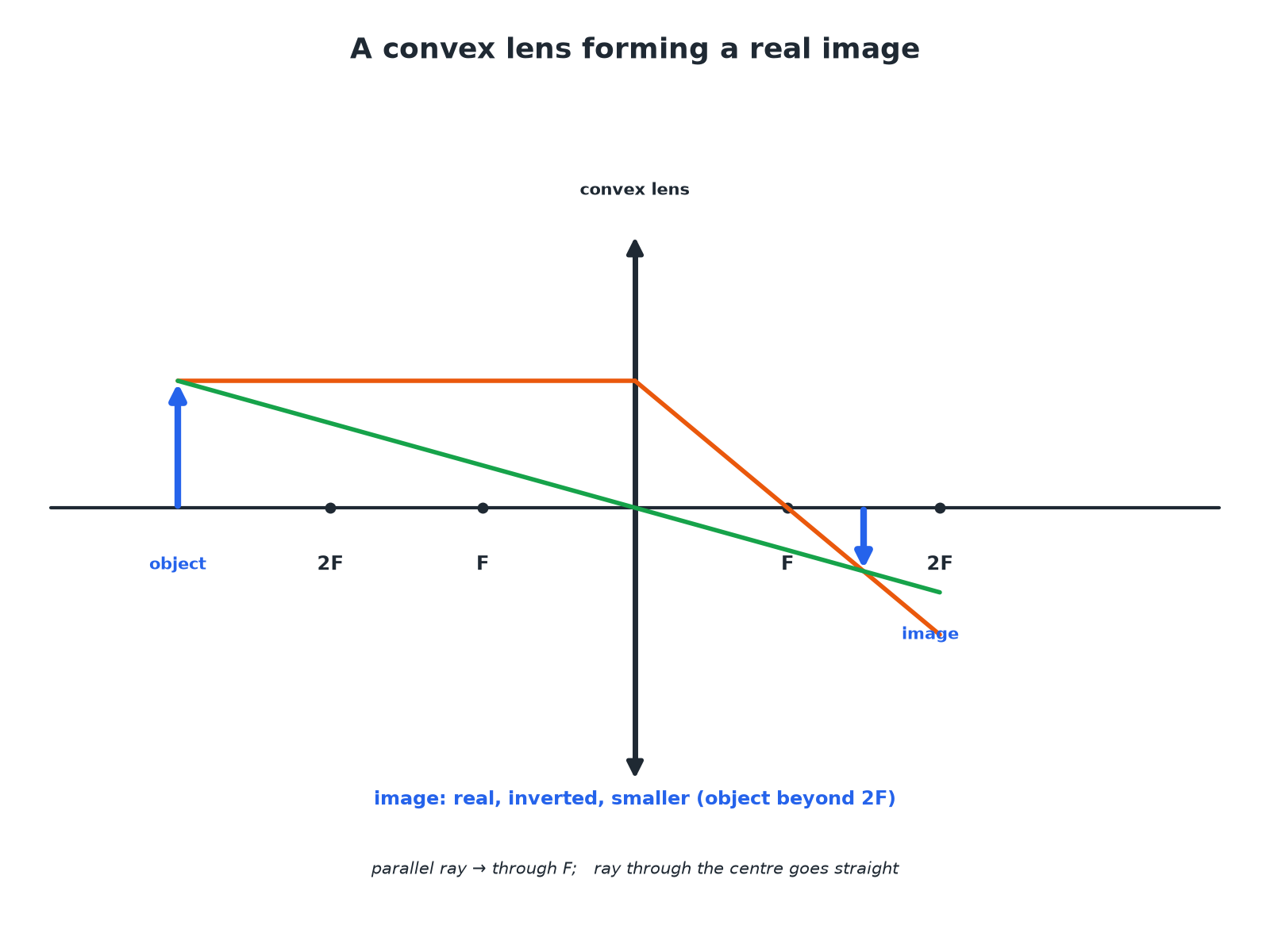
Two rays are enough to find the image position.
A Concave Lens
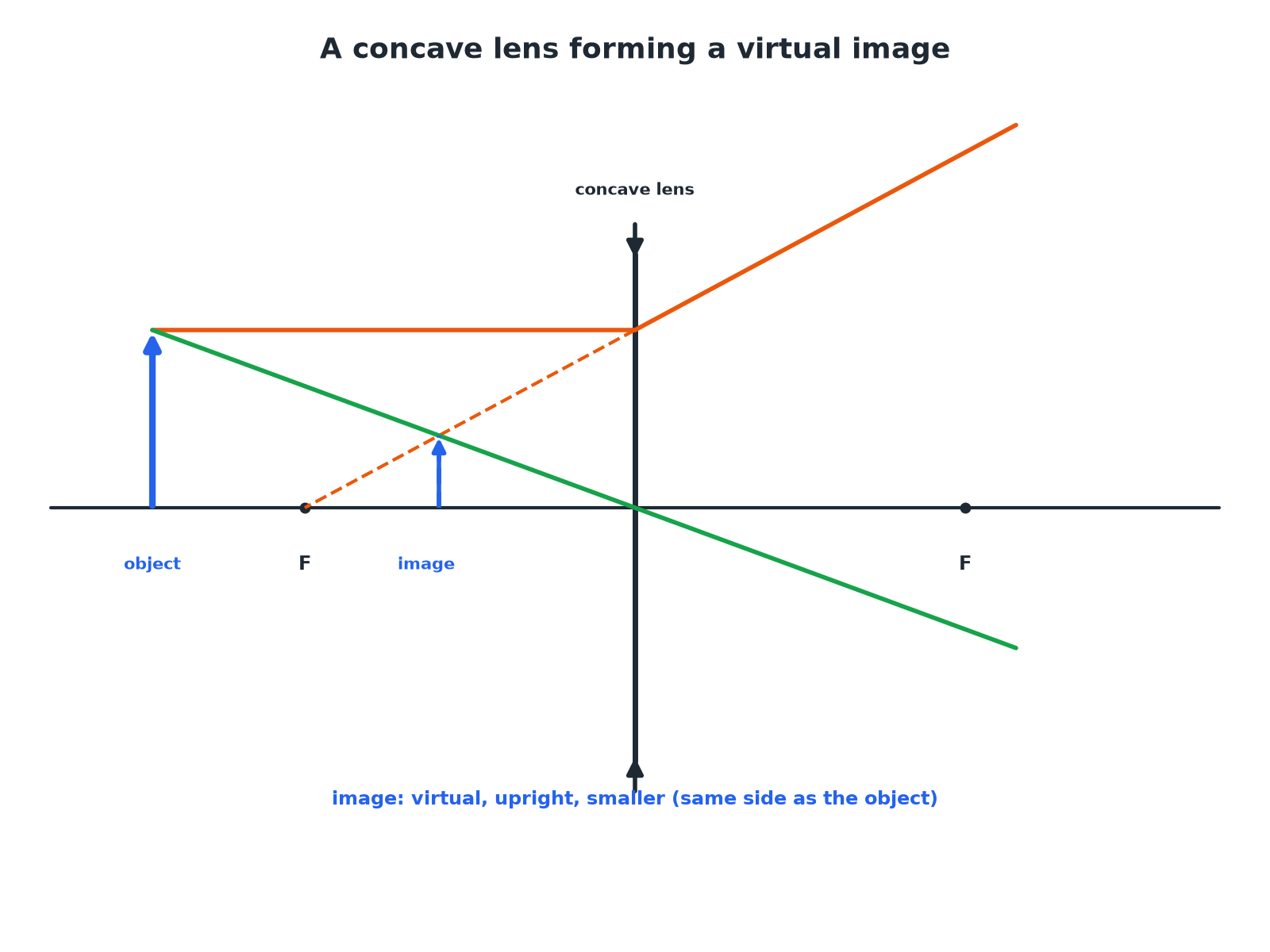
Rays spread out, so the image is virtual.
Convex and Concave Lenses
Compare them.
-
Effect on parallel rays
Convex (converging): Brings them together at the principal focus. Concave (diverging): Spreads them out
-
Image
Convex (converging): Real or virtual. Concave (diverging): Always virtual
-
Symbol
Convex (converging): Vertical line with outward arrowheads. Concave (diverging): Vertical line with inward arrowheads
-
Uses
Convex (converging): Magnifying glass, camera, projector. Concave (diverging): Correcting short sight
Magnification
An object is 2.0 cm high. The image formed by a lens is 6.0 cm high. Calculate the magnification.
Show the solutionHide the solution
- 1 Write the equation \(\text{magnification} = \dfrac{\text{image height}}{\text{object height}}\)
- 2 Substitute \(\dfrac{6.0}{2.0}\)
- 3 Answer 3.0 (no units)
AnswerMagnification = 3.0
Finding the Image Height
A lens has a magnification of 5. The object is 4 mm high. Calculate the image height.
Show the solutionHide the solution
- 1 Rearrange \(\text{image height} = \text{magnification} \times \text{object height}\)
- 2 Substitute \(5 \times 4\)
- 3 Answer 20 mm
Answer20 mm
Real or Virtual?
Explain the difference between a real image and a virtual image.
Show the solutionHide the solution
- 1 Real Light rays actually meet at the image; it can be shown on a screen
- 2 Virtual Rays only appear to come from the image; it cannot be shown on a screen
AnswerA real image can be projected onto a screen; a virtual image cannot.
Drawing Tips
Get full marks.
-
Use a ruler
Draw straight rays with arrowheads.
-
Two rays
One parallel to the axis (through F after a convex lens), one through the centre (undeviated).
-
Mark F
Mark the principal focus on both sides.
-
Virtual images
Draw the rays as dashed lines behind the lens.
Lens Sums
An object of height 3.0 cm gives an image of height 1.2 cm. Calculate the magnification. Is the image bigger or smaller than the object?
1. Use image ÷ object.
2. Compare with 1.
A good answer shows: Magnification = 1.2 ÷ 3.0 = 0.40. The image is smaller (diminished).
Can I...?
- 1Define convex and concave.
- 2Define principal focus.
- 3Define focal length.
- 4Draw a convex lens ray diagram.
- 5Draw a concave lens ray diagram.
- 6Define real and virtual images.
- 7Calculate magnification.
- 8Give a use of each lens.
Summary & Exam Focus
- Convex: converging; concave: diverging.
- Convex images can be real or virtual; concave always virtual.
- Magnification = image height ÷ object height (no units).
- Two rays to locate the image.
Exam focus
An object is 2.0 cm high. The image is 6.0 cm high. Calculate the magnification. (2 marks) (2 marks)
Image height divided by object height.
Key terms
The vocabulary this lesson expects you to use. Each one is linked from the first place it appears above.
- Convex lens
- A lens that brings parallel rays to a focus.
- Concave lens
- A lens that spreads parallel rays out.
- Principal focus
- The point where parallel rays meet after a convex lens.
- Focal length
- The distance from the lens to the principal focus.
- Real image
- An image formed where light rays actually meet.
- Virtual image
- An image formed where rays appear to come from.
Practice questions
Have a go at each one before you open its answer.
-
Question 1 Calculate 2 marks
An object is 2.0 cm high. A lens produces an image that is 6.0 cm high. Calculate the magnification. Use the equation: magnification = image height ÷ object height
Show answerHide answer
Model answer
\(6.0 \div 2.0 = 3.0\)
Mark scheme
- Correct substitution — 1 mark
- 3.0 (no units) — 1 mark
-
Question 2 Complete the diagram 4 marks
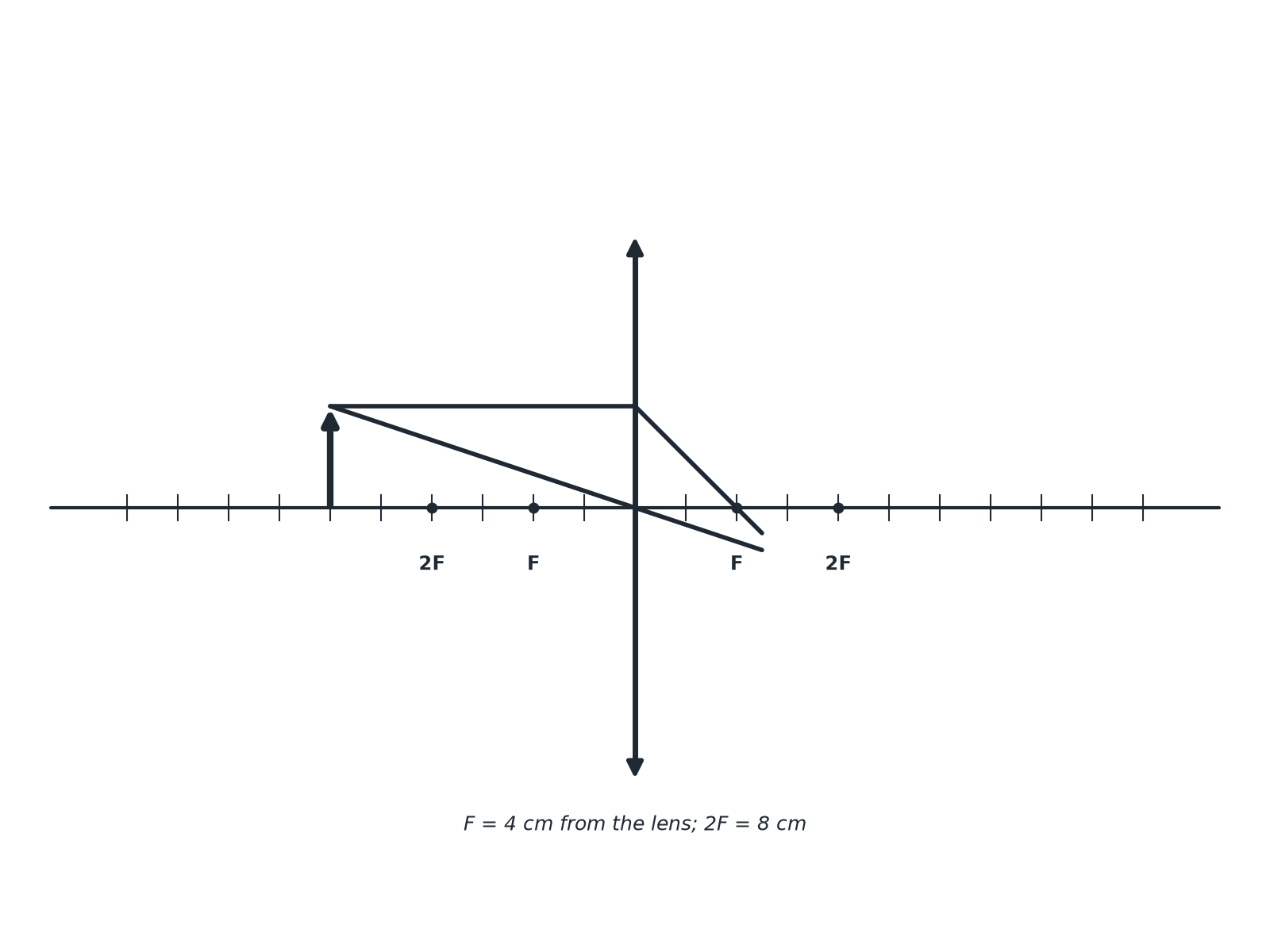
The diagram shows an object in front of a convex lens. Two rays have been drawn. Complete the ray diagram to find the position of the image and draw the image. Describe the image.
Show answerHide answer
Model answer
The two rays cross beyond the lens; the image is drawn from the axis to the crossing point. The image is real, inverted and smaller.
Mark scheme
- Rays continue to cross — 1 mark
- Image drawn from the axis to the intersection — 1 mark
- Real and inverted — 1 mark
- Smaller than the object — 1 mark
-
Question 3 Explain 2 marks
Explain the difference between a real image and a virtual image.
Show answerHide answer
Model answer
A real image is formed where light rays actually meet and can be projected onto a screen. A virtual image is where the rays only appear to come from, and cannot be shown on a screen.
Mark scheme
- Real: rays meet, on a screen — 1 mark
- Virtual: rays appear to come from, not on a screen — 1 mark
-
Question 4 Describe 3 marks
State what happens to parallel rays of light when they pass through (a) a convex lens (b) a concave lens.
Show answerHide answer
Model answer
(a) They are brought together at the principal focus. (b) They are spread out (diverge) as though they came from the principal focus on the same side.
Mark scheme
- Convex: converge at a point — 1 mark
- Concave: diverge — 1 mark
- Principal focus mentioned — 1 mark
-
Question 5 Calculate 3 marks
A lens forms an image 20 mm high. The magnification is 5. Calculate the height of the object.
Show answerHide answer
Model answer
Object height = 20 ÷ 5 = 4.0 mm.
Mark scheme
- Rearranges the equation — 1 mark
- Correct substitution — 1 mark
- 4.0 mm — 1 mark
Quick check
-
A convex lens brings parallel rays...
Show answerHide answer
C: together
It converges them.
-
The image from a concave lens is always...
Show answerHide answer
D: virtual
Rays spread out.
-
The distance from the lens to the principal focus is the...
Show answerHide answer
A: focal length
The focal length.
-
Magnification has...
Show answerHide answer
B: no units
It is a ratio.
-
A real image can be...
Show answerHide answer
C: shown on a screen
Rays actually meet.
Downloads
Free to keep, print and annotate.
Something here looks wrong?
Tell us what and we will go and look. It goes to whoever writes these pages, nobody else, and we do not ask who you are — so there is nothing to sign and nothing comes back to you.