Viewing as
Teacher view: planning notes, the answers to every question, and the teacher copies of the files.
Physics · Waves
Properties and hazards of electromagnetic waves
Describe how electromagnetic waves are produced and absorbed, and the hazards of ultraviolet, X-rays and gamma rays, including radiation dose.
Teacher resources
The teacher copies: slides with the questions built in, the answers, and anything else attached to this lesson for whoever is teaching it.
- Properties and hazards of electromagnetic waves - Teacher Slides.pptx Teacher The lesson slides with the teacher's notes on each slide, and every question and mark scheme built in. Built from the lesson script on 30 September 2026. View
- Properties and hazards of electromagnetic waves - Teacher Notes.docx Teacher The complete notes with the teacher's notes and every model answer in full. Built from the lesson script on 30 September 2026. View
Student handouts
The same files the students see, to print or hand out.
- Properties and hazards of electromagnetic waves.pptx Built from the lesson script on 30 September 2026. View
- Properties and hazards of electromagnetic waves - Completed Notes.docx The full notes for the lesson, to revise from. Built from the lesson script on 30 September 2026. View
- Properties and hazards of electromagnetic waves - Exam Questions.docx Built from the lesson script on 30 September 2026. View
Warm-up
Answer each one, then check.
-
1
What is ionising radiation?
Show answerHide answer
Radiation that can remove electrons from atoms
-
2
What is an alternating current?
Show answerHide answer
A current that changes direction repeatedly
-
3
Where do gamma rays come from?
Show answerHide answer
The nucleus of an atom
-
4
What is a mutation?
Show answerHide answer
A change in the DNA of a cell
-
5
What is radiation dose measured in?
Show answerHide answer
Sieverts (Sv)
Learning Objectives
- 1Explain that changes in atoms and nuclei can produce and absorb electromagnetic waves.
- 2Explain how radio waves are produced and detected (Higher tier).
- 3Describe the hazardous effects of ultraviolet, X-rays and gamma rays.
- 4Use data on radiation dose to draw conclusions about risk.
PRODUCTION AND HAZARDS
Changes in atoms and in the nuclei of atoms can result in electromagnetic waves being generated or absorbed over a wide frequency range. Gamma rays originate from changes in the nucleus.
Ultraviolet, X-rays and gamma rays can have hazardous effects on body tissue. The effects depend on the type of radiation and the size of the dose.
Radio Waves: Producing and Detecting (Higher)
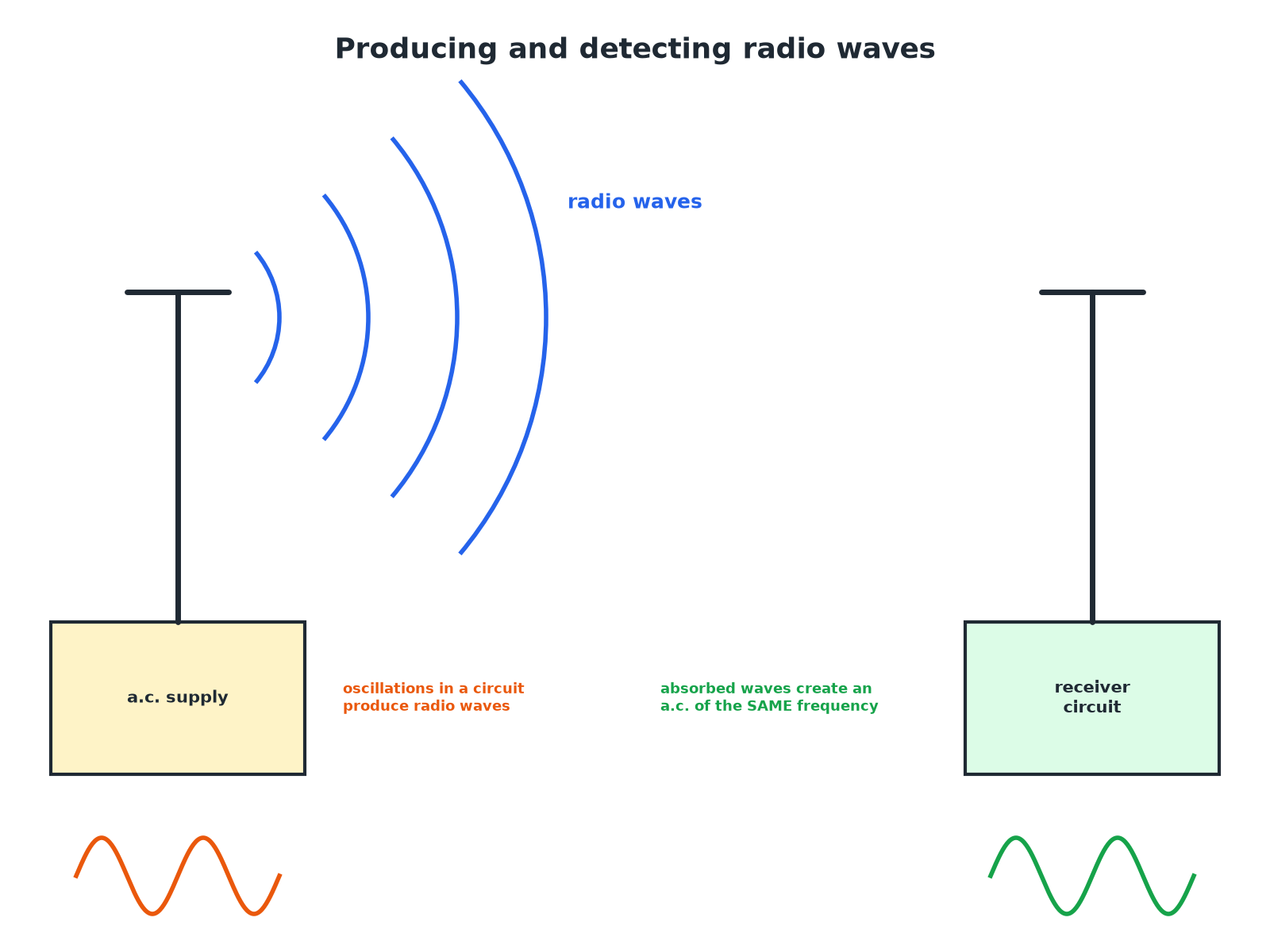
The received current has the same frequency as the wave.
Hazards of Electromagnetic Waves
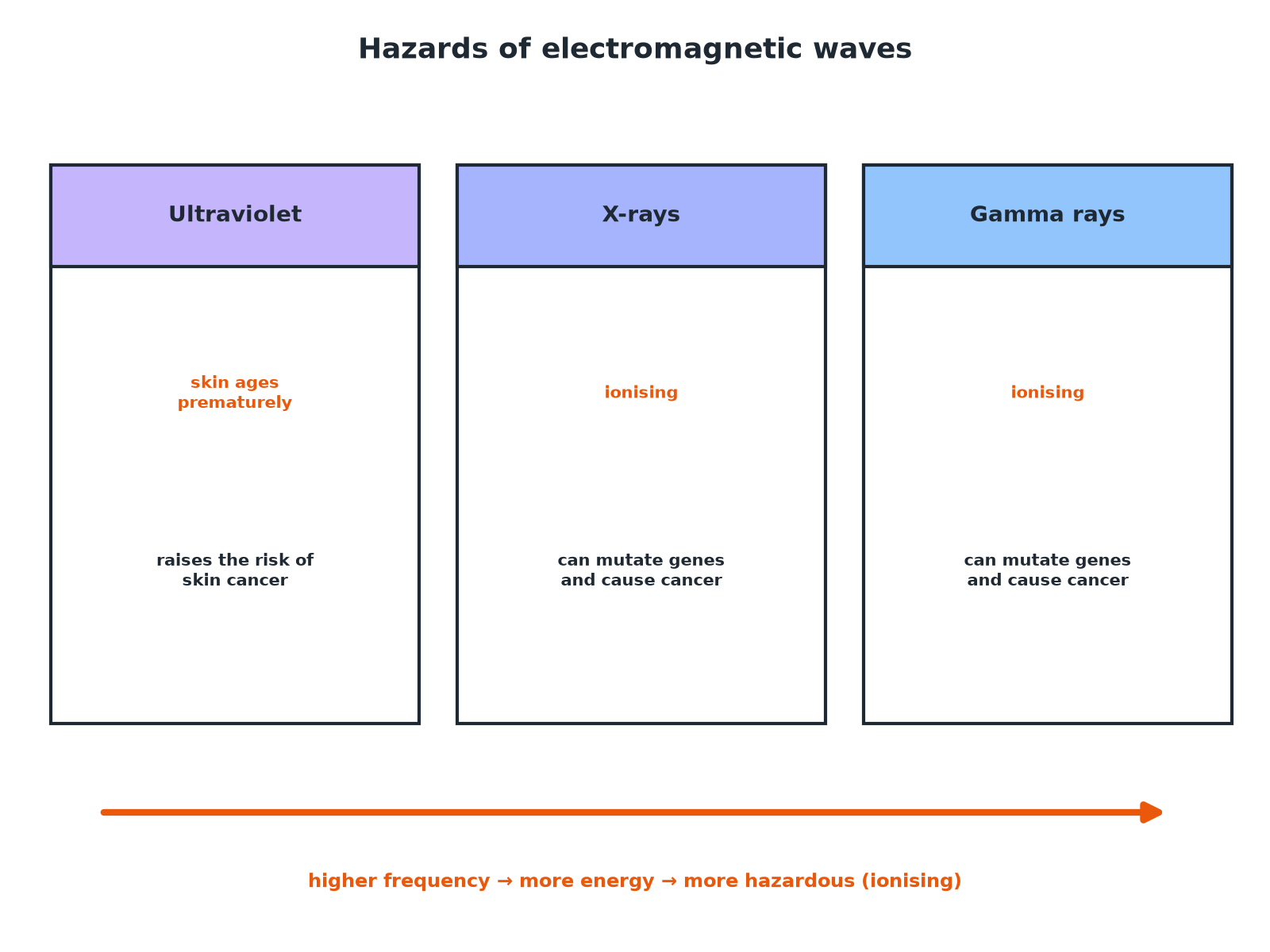
Higher frequency waves carry more energy and can ionise.
Hazards
Learn the effects.
-
Ultraviolet
Hazardous effect: Premature skin ageing; increased risk of skin cancer; eye damage
-
X-rays
Hazardous effect: Ionising: can mutate genes and cause cancer
-
Gamma rays
Hazardous effect: Ionising: can mutate genes and cause cancer
Producing Radio Waves (Higher)
Explain how radio waves are produced and how they can be detected.
Show the solutionHide the solution
- 1 Transmitter Oscillations (an alternating current) in an electrical circuit produce radio waves
- 2 Receiver When radio waves are absorbed by an aerial, they create an alternating current in the circuit
- 3 Frequency The current has the same frequency as the radio wave
AnswerAn alternating current produces radio waves; absorbed waves produce an alternating current of the same frequency.
Risk and Dose
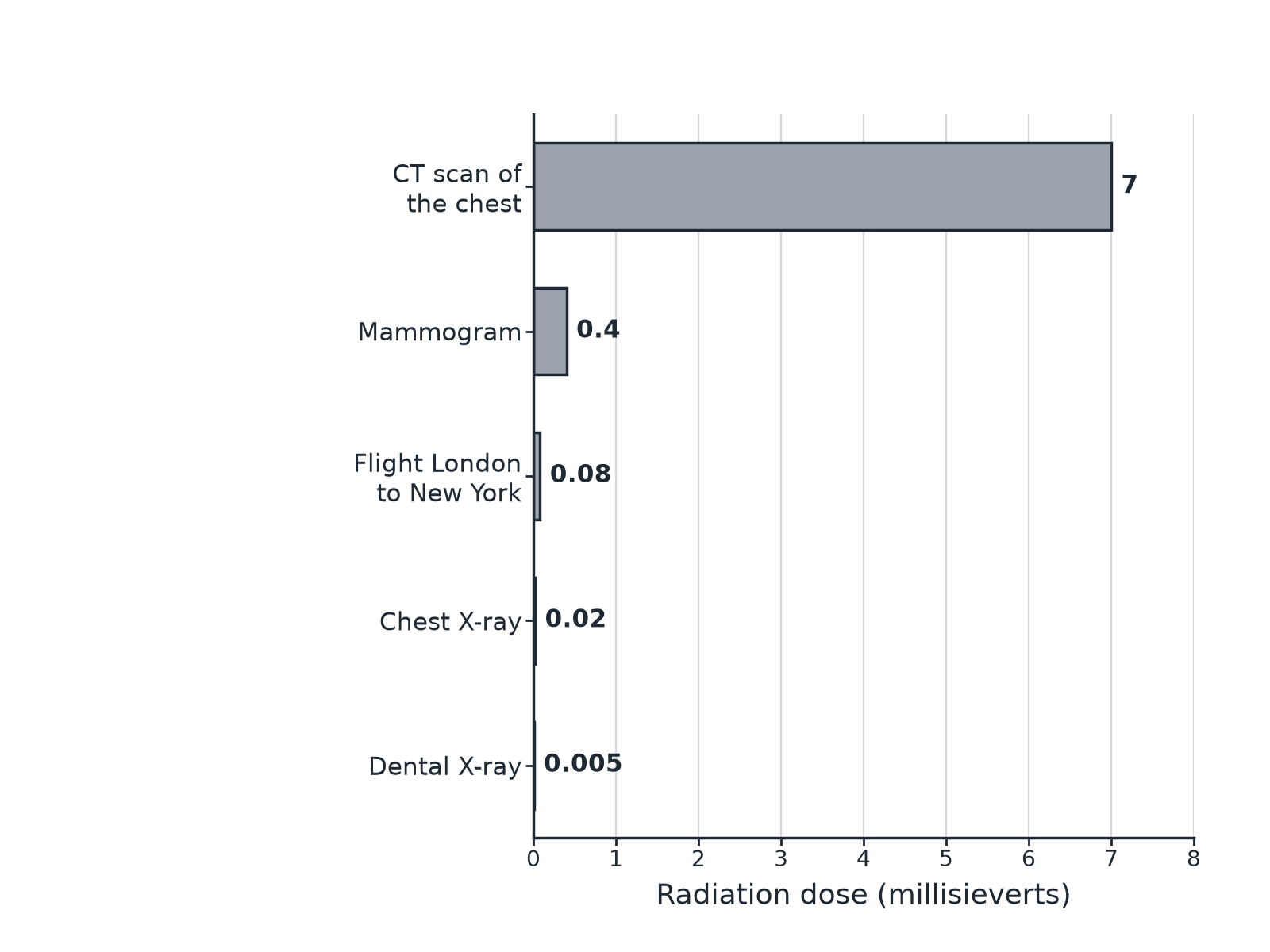
A chest X-ray gives a dose of 0.02 mSv and a CT scan of the chest gives 7 mSv. Compare the doses.
Show the solutionHide the solution
- 1 Ratio \(7 \div 0.02 = 350\)
- 2 Comparison The CT scan gives 350 times the dose
AnswerThe CT scan gives a dose 350 times greater, so a greater risk.
Sources of EM Waves
Explain where gamma rays come from.
Show the solutionHide the solution
- 1 Nucleus An unstable nucleus changes to become more stable
- 2 Emission It emits gamma radiation
- 3 Atoms Changes in electron energy levels produce other parts of the spectrum
AnswerGamma rays are emitted by changes in the nucleus of an atom.
Dose
Radiation dose units.
-
Sievert
Dose is measured in sieverts (Sv); 1000 mSv = 1 Sv.
-
What it shows
A measure of the risk of harm from exposure.
-
Depends on
The type of radiation and the size of the dose.
-
No need to recall
You do not need to recall the unit of dose.
Compare the Doses
A dental X-ray gives 0.005 mSv and a flight from London to New York gives about 0.08 mSv. Calculate how many dental X-rays have the same dose as the flight. Do you think the risk is large?
1. Divide the doses.
2. Comment on the size.
A good answer shows: 0.08 ÷ 0.005 = 16 dental X-rays. Both doses are very small, so the risk is small.
Can I...?
- 1Explain how gamma rays are produced.
- 2Explain how radio waves are produced.
- 3Explain how radio waves are detected.
- 4Name hazards of UV.
- 5Name hazards of X-rays.
- 6Define radiation dose.
- 7Compare doses.
- 8Draw conclusions from data.
Summary & Exam Focus
- UV: premature ageing and skin cancer.
- X-rays and gamma rays: ionising; can mutate genes and cause cancer.
- Radio waves produced by oscillations in circuits (Higher).
- Dose measured in sieverts.
Exam focus
State one hazard of exposure to ultraviolet radiation. (1 mark) (1 marks)
Skin cancer or premature skin ageing.
Key terms
The vocabulary this lesson expects you to use. Each one is linked from the first place it appears above.
- Ionising radiation
- Radiation that can remove electrons from atoms.
- Radiation dose
- A measure of the risk of harm from exposure to radiation.
- Sievert
- The unit of radiation dose.
- Millisievert
- One thousandth of a sievert.
- Mutation
- A change in the genes of a cell.
- Aerial
- A device that transmits or receives radio waves.
Questions and answers
10 questions set on this lesson, with the mark schemes and model answers open.
Give two hazards of exposure to ultraviolet radiation.
Mark scheme — 2 marks available
- First hazard — 1 mark
- Second hazard — 1 mark
Model answer
Any two from: premature skin ageing; increased risk of skin cancer; damage to the eyes.
X-rays and gamma rays are described as ionising radiation. Explain why they are a hazard to human health.
Mark scheme — 3 marks available
- Ionising: remove electrons — 1 mark
- Damage or mutate genes or cells — 1 mark
- Can cause cancer — 1 mark
Model answer
They can remove electrons from atoms and damage or mutate the genes in cells, which can lead to cancer.
The chart shows the radiation dose a patient receives from different medical procedures. (a) Which procedure gives the greatest dose? (b) Calculate how many times greater the dose from a chest CT scan is than from a chest X-ray. (c) Suggest why a doctor might still use a CT scan.
Mark scheme — 4 marks available
- Chest CT scan — 1 mark
- 7 ÷ 0.02 — 1 mark
- 350 times — 1 mark
- Benefit outweighs risk or more information — 1 mark
Model answer
(a) CT scan of the chest. (b) 7 ÷ 0.02 = 350 times. (c) It gives more detailed information, so the benefit of diagnosis outweighs the small increase in risk.
Explain how radio waves are produced in a transmitter and how they can be detected by a receiver.
Mark scheme — 3 marks available
- Oscillations in a circuit produce radio waves — 1 mark
- Waves absorbed by the aerial — 1 mark
- Produces an alternating current of the same frequency — 1 mark
Model answer
An alternating current (oscillations) in the transmitter circuit produces radio waves of the same frequency. When the radio waves are absorbed by the receiver's aerial they create an alternating current with the same frequency as the wave.
State where gamma rays originate.
Mark scheme — 1 mark available
- The nucleus — 1 mark
Model answer
From changes in the nucleus of an atom.
A hazard of ultraviolet is...
Why: UV can damage skin cells.
Gamma rays come from...
Why: Changes in the nucleus.
X-rays are...
Why: They can ionise atoms.
Radio waves are produced by...
Why: An alternating current.
A dose of 1000 mSv is...
Why: 1000 milli = 1.