Viewing as
Teacher view: planning notes, the answers to every question, and the teacher copies of the files.
Physics · Waves
Reflection of waves
Describe reflection, absorption and transmission at a boundary, and construct ray diagrams for reflection using the law of reflection (Required Practical 9, part 1; Physics only).
Teacher resources
The teacher copies: slides with the questions built in, the answers, and anything else attached to this lesson for whoever is teaching it.
- Reflection of waves - Teacher Slides.pptx Teacher The lesson slides with the teacher's notes on each slide, and every question and mark scheme built in. Built from the lesson script on 1 October 2026. View
- Reflection of waves - Teacher Notes.docx Teacher The complete notes with the teacher's notes and every model answer in full. Built from the lesson script on 1 October 2026. View
Student handouts
The same files the students see, to print or hand out.
- Reflection of waves.pptx Built from the lesson script on 1 October 2026. View
- Reflection of waves - Completed Notes.docx The full notes for the lesson, to revise from. Built from the lesson script on 1 October 2026. View
- Reflection of waves - Exam Questions.docx Built from the lesson script on 1 October 2026. View
Warm-up
Answer each one, then check.
-
1
What is a ray?
Show answerHide answer
A straight line showing the path of light
-
2
What is a mirror?
Show answerHide answer
A smooth shiny surface that reflects light
-
3
What is a normal?
Show answerHide answer
A line at right angles to a surface
-
4
What is an angle?
Show answerHide answer
A measure of turn, in degrees
-
5
Name a material that light passes through.
Show answerHide answer
Glass or water
Learning Objectives
- 1Describe reflection, absorption and transmission of waves at a boundary.
- 2State and apply the law of reflection.
- 3Construct ray diagrams showing reflection at a surface.
- 4Describe how to investigate the reflection of light by different surfaces.
REFLECTION
Waves can be reflected, absorbed or transmitted at the boundary between two materials. The angle of incidence equals the angle of reflection.
Angles are measured between the ray and the normal, a line at right angles to the surface at the point where the ray strikes it.
The Law of Reflection
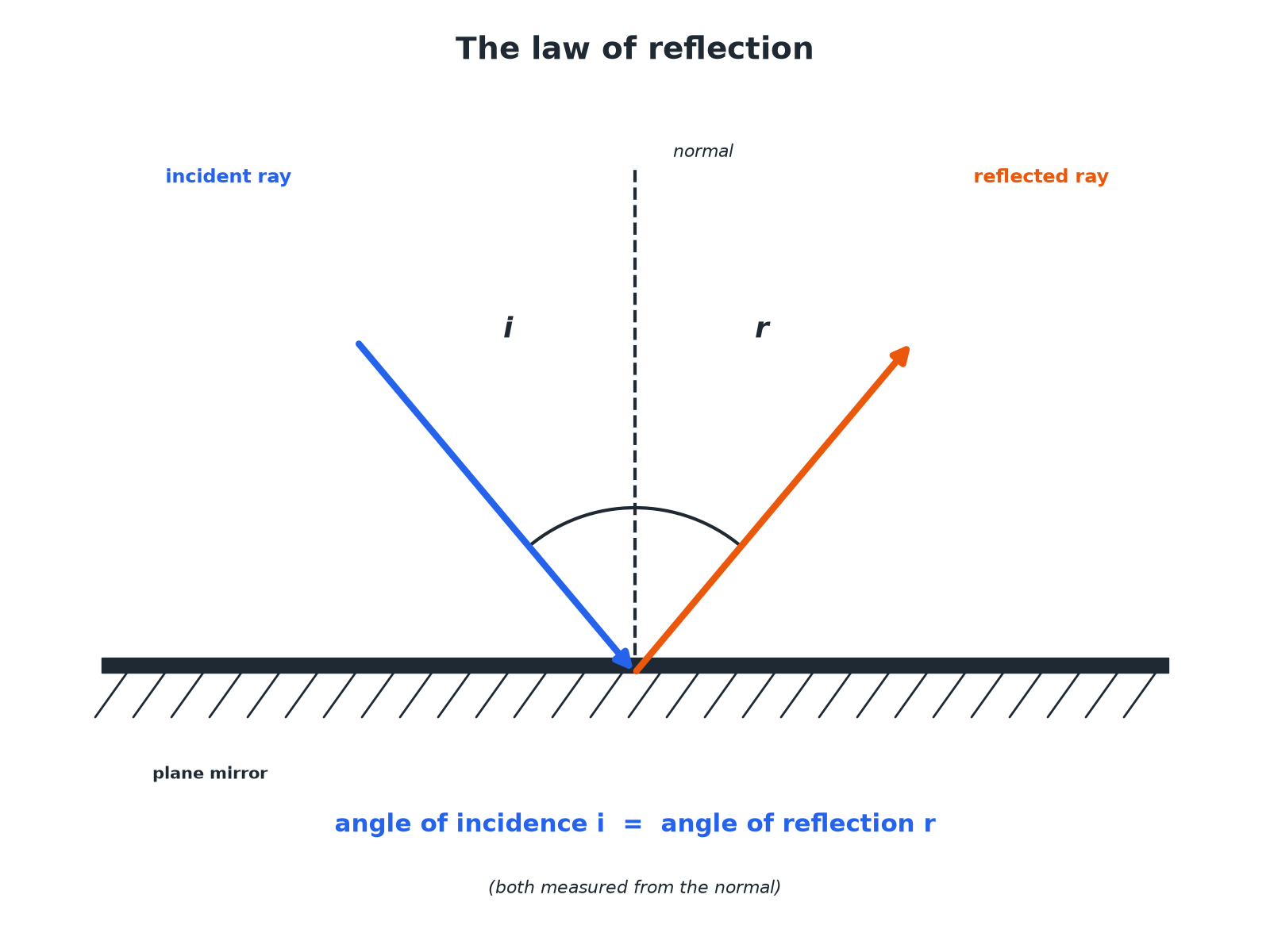
Measure both angles from the normal.
Required Practical 9: Reflection with a Ray Box
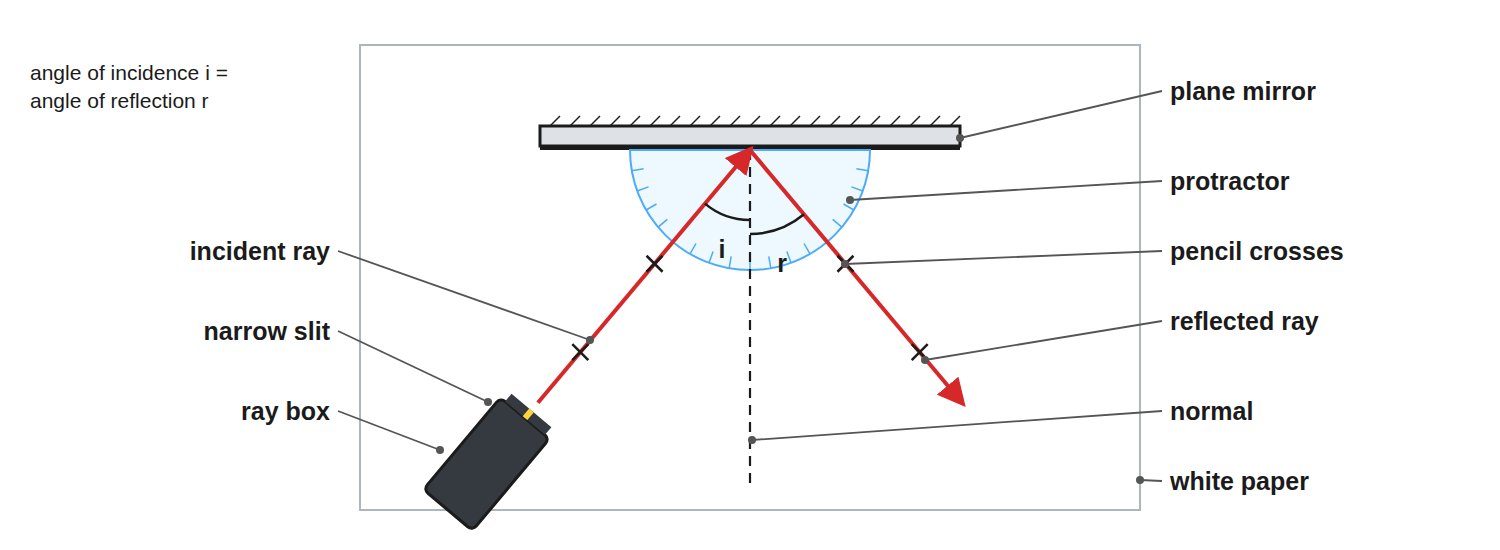
Draw the normal, then measure both angles from it.
How to Draw a Reflection Ray Diagram
Follow the steps.
-
1
Draw the mirror
A straight line.
-
2
Draw the normal
A dashed line at 90° to the mirror at the point of incidence.
-
3
Draw the incident ray
Toward the point, with an arrow.
-
4
Measure the angle of incidence
Between the ray and the normal.
-
5
Draw the reflected ray
At the same angle on the other side of the normal, with an arrow.
What Happens at a Boundary
Waves can do three things.
-
Reflection
What it means: The wave bounces off the surface. Example: Light from a mirror; an echo
-
Absorption
What it means: The wave's energy is transferred to the material. Example: Black paper absorbs light and warms up
-
Transmission
What it means: The wave passes through the material. Example: Light passing through glass
Finding Angles
A ray strikes a plane mirror so that the angle between the ray and the mirror surface is 50°. Find the angle of reflection.
Show the solutionHide the solution
- 1 Angle to the normal \(90^\circ - 50^\circ = 40^\circ\)
- 2 Law of reflection Angle of reflection = angle of incidence
Answer\(40^\circ\), measured from the normal.
Practical Tips
Get accurate results.
-
Narrow beam
Use a single slit so the ray is thin.
-
Mark the ray
Put a cross on the ray at two points and draw a line through them.
-
Repeat
Measure for several angles of incidence.
-
Conclusion
The angle of incidence equals the angle of reflection.
Reflection, Absorption or Transmission?
Which one happens depends on the wavelength and the material.
-
Glass and light
Glass transmits most visible light, reflects a little (you see a faint reflection in a window) and absorbs very little.
-
Wavelength matters
The same material can behave differently for different waves. Glass transmits visible light but absorbs much of the ultraviolet.
-
Sound
Hard, smooth walls reflect sound and cause echoes; soft materials like curtains and foam absorb it, which is why concert halls use them.
Images in a Plane Mirror
Properties of the image
- Virtual: it cannot be put on a screen.
- Upright, the same way up as the object.
- The same size as the object.
- Laterally inverted: left and right are swapped.
Where it appears
- The same distance behind the mirror as the object is in front.
- On a line through the object at right angles to the mirror.
- Found by extending reflected rays backwards as dashed lines.
Case study
Periscopes
A periscope uses two plane mirrors, each at 45°. Light from an object hits the top mirror at 45° to the normal and reflects straight down the tube. The bottom mirror reflects it at 45° again, out to the viewer's eye. It lets someone see over a wall or out of a submarine.
Reflect It
A ray hits a mirror at an angle of incidence of 35°. Draw a ray diagram. State the angle between the reflected ray and the mirror surface.
1. Draw the normal first.
2. Mirror the angle.
A good answer shows: The angle of reflection is 35°. The angle to the mirror is 90° − 35° = 55°.
Can I...?
- 1Define reflection.
- 2Define absorption and transmission.
- 3State the law of reflection.
- 4Draw a normal.
- 5Measure angles from the normal.
- 6Draw a reflected ray.
- 7Describe the practical.
- 8Find an angle to the mirror.
Summary & Exam Focus
- Angle of incidence = angle of reflection.
- Angles measured from the normal.
- Reflection, absorption, transmission.
- Use a ray box, mirror and protractor.
- A plane mirror image is virtual, upright and the same size.
Exam focus
State the law of reflection. (1 mark) (1 marks)
Write the full rule: angle of incidence = angle of reflection. Then remember both angles are measured to the normal, not to the mirror surface.
Key terms
The vocabulary this lesson expects you to use. Each one is linked from the first place it appears above.
- Reflection
- When a wave bounces off a surface.
- Absorption
- When a wave's energy is taken in by a material.
- Transmission
- When a wave passes through a material.
- Normal
- A line at right angles to a surface.
- Angle of incidence
- The angle between the incident ray and the normal.
- Angle of reflection
- The angle between the reflected ray and the normal.
- Plane mirror
- A flat mirror.
- Incident ray
- The ray travelling towards a surface.
- Ray box
- A lamp with a slit that produces a narrow beam of light.
Questions and answers
13 questions set on this lesson, with the mark schemes and model answers open.
State what happens to a wave when it is reflected, absorbed and transmitted at the boundary between two materials.
Mark scheme — 2 marks available
- Reflected — 1 mark
- Absorbed or transmitted explained — 1 mark
Model answer
Reflected: the wave bounces off. Absorbed: the energy is taken in by the material. Transmitted: the wave passes through.
The diagram shows a ray of light striking a plane mirror. Complete the diagram to show the reflected ray. Label the angle of incidence and the angle of reflection.
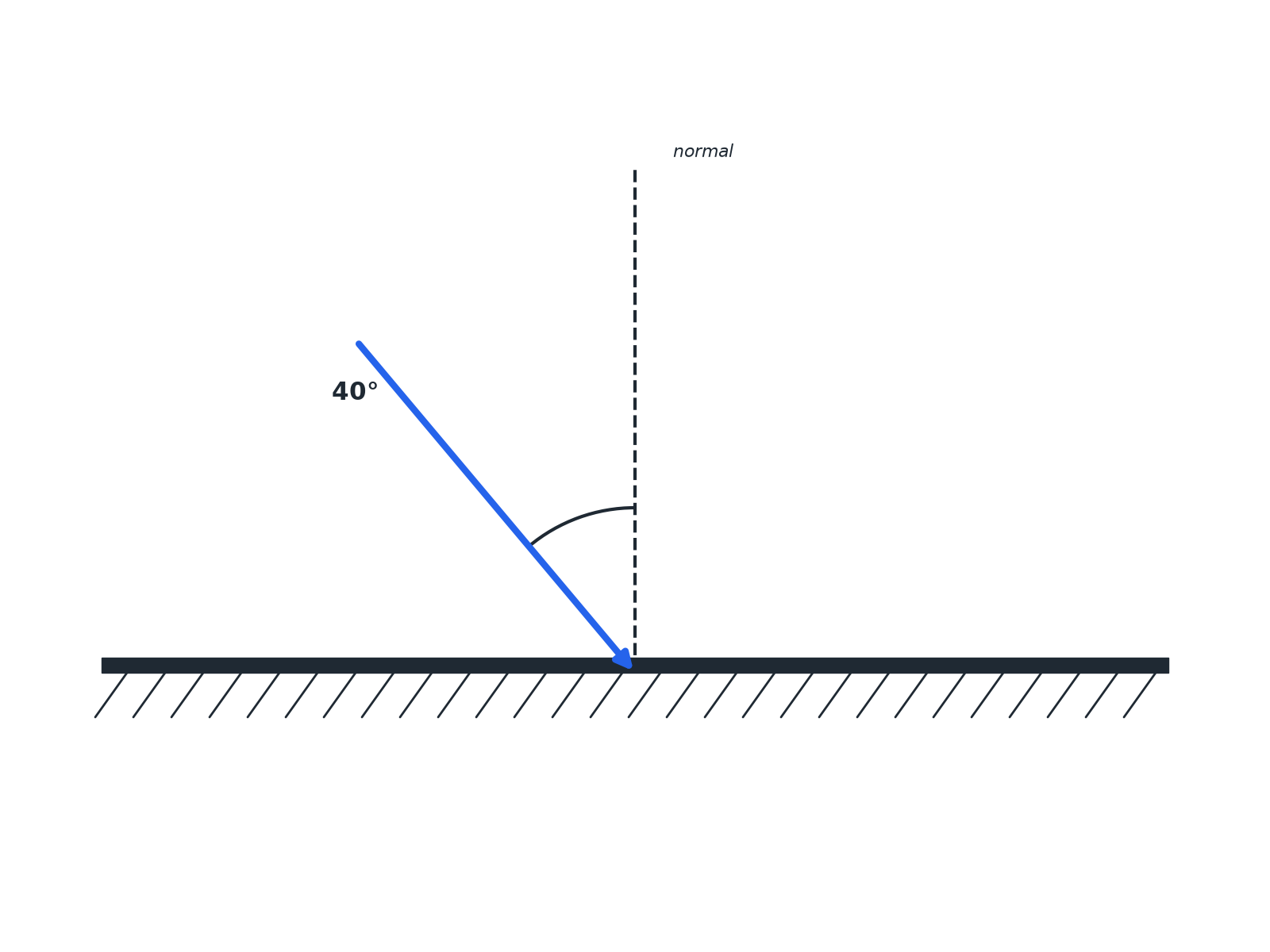
Mark scheme — 3 marks available
- Normal drawn or used — 1 mark
- Reflected ray at 40° on the far side of the normal — 1 mark
- Angles labelled — 1 mark
Model answer
A reflected ray drawn from the point of incidence at 40° to the normal on the other side, with an arrow; both angles labelled i and r.
A ray of light hits a plane mirror. The angle between the ray and the surface of the mirror is 50°. Calculate the angle of reflection.
Mark scheme — 2 marks available
- 90 − 50 = 40 — 1 mark
- 40° (angle of reflection = angle of incidence) — 1 mark
Model answer
Angle of incidence = 90° − 50° = 40°, so the angle of reflection is 40°.
Describe how you would investigate the law of reflection using a ray box and a plane mirror. Your answer should include the measurements you would take and the result you would expect.
Mark scheme — 5 marks available
- Ray box with a narrow beam at a mirror on paper — 1 mark
- Normal drawn — 1 mark
- Rays marked and angles measured from the normal — 1 mark
- Repeat for different angles — 1 mark
- Angle of incidence equals angle of reflection — 1 mark
Model answer
Shine a narrow ray onto a plane mirror placed on paper. Draw round the mirror and draw the normal. Mark the incident and reflected rays with crosses and draw the lines. Measure the angle of incidence and the angle of reflection from the normal with a protractor. Repeat for several angles. The angles should be equal.
Explain why a black surface gets hot in sunlight.
Mark scheme — 2 marks available
- Absorbs the radiation — 1 mark
- Energy transferred to thermal store — 1 mark
Model answer
It absorbs most of the light, so the energy of the wave is transferred to the thermal energy store of the surface.
A ray hits a mirror at 25° to the mirror surface. What is the angle of reflection?
Why: The angle to the normal is 90 − 25 = 65°, so the angle of reflection is 65°.
Why do concert halls hang soft curtains on the walls?
Why: Soft materials absorb sound, reducing echoes.
An image in a plane mirror is...
Why: Light does not actually come from behind the mirror, so the image is virtual; it is upright and the same size.
When a wave bounces off a surface it is...
Why: Reflection.
The normal is a line at...
Why: It is perpendicular.
If the angle of incidence is 30° the angle of reflection is...
Why: They are equal.
A wave passing through glass is...
Why: It passes through.
Angles in reflection are measured from the...
Why: That is the convention.