Viewing as
Teaching this? The teacher view adds 2 files, the mark schemes and the model answers.
Physics · Waves
Sound waves and hearing
Describe how sound waves cause vibrations in solids and in the ear, and explain why human hearing is limited to a range of frequencies (Physics only, Higher tier).
Warm-up
Answer each one, then check.
-
1
What type of wave is sound?
Show answerHide answer
Longitudinal
-
2
What is frequency?
Show answerHide answer
Waves per second
-
3
What does a vibration do?
Show answerHide answer
Moves back and forth
-
4
Name part of the ear.
Show answerHide answer
-
5
What is ultrasound?
Show answerHide answer
Sound above 20 kHz
Learning Objectives
- 1Describe how sound waves can be converted to vibrations in solids, and vice versa.
- 2Describe how the ear drum and other parts of the ear convert sound into the sensation of sound.
- 3Explain why the conversion only works over a limited frequency range.
- 4State the range of normal human hearing: 20 Hz to 20 kHz.
SOUND AND HEARING
Sound waves can travel through solids causing vibrations in the solid. In the ear, sound waves make the ear drum and other parts vibrate, giving the sensation of sound.
The range of normal human hearing is from 20 Hz to 20 kHz.
How the Ear Works
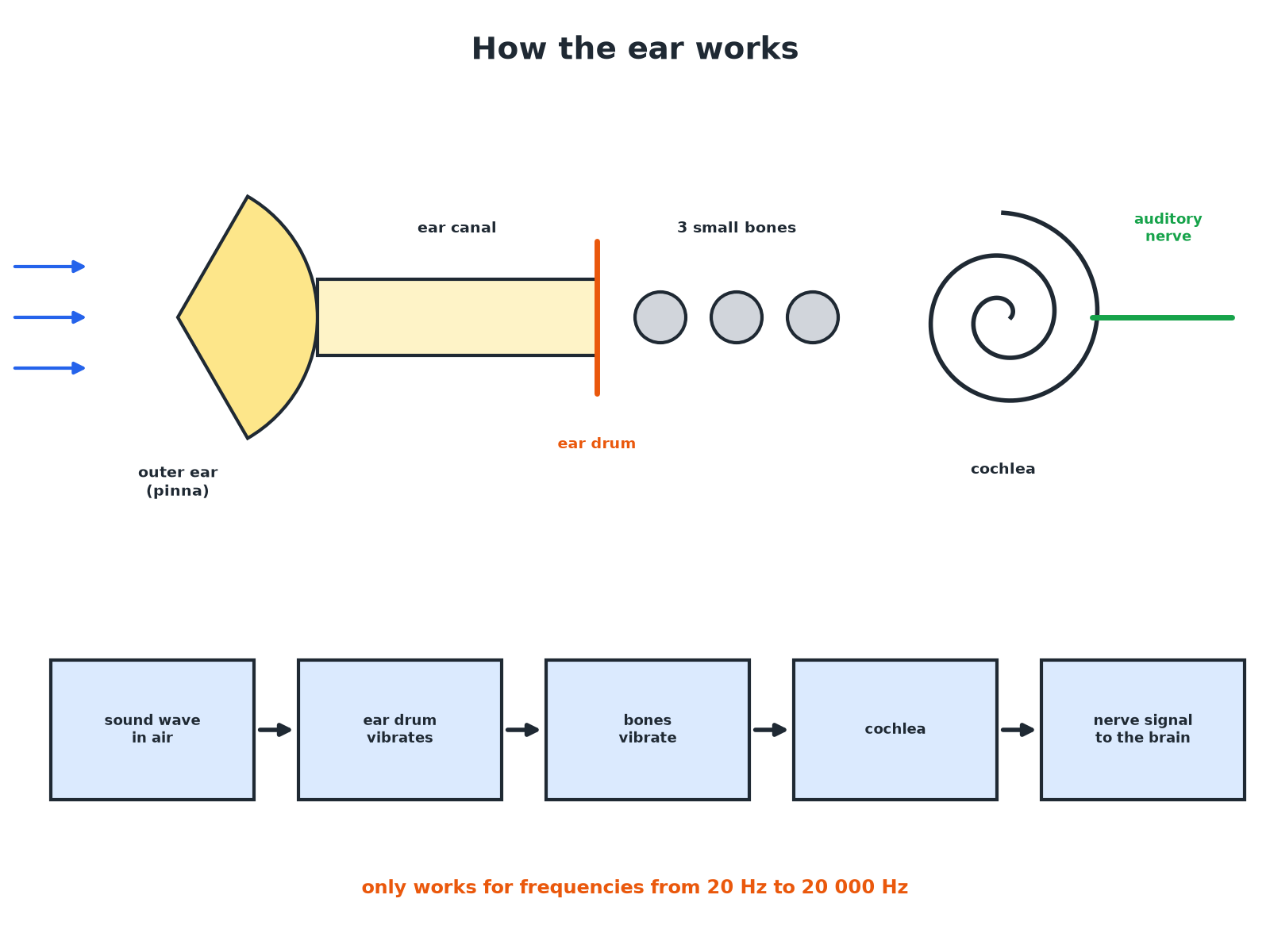
Each part transfers the vibrations.
Sound to Vibration
Describe how sound waves cause the sensation of hearing.
Show the solutionHide the solution
- 1 Sound wave Compressions and rarefactions reach the ear drum
- 2 Ear drum Vibrates at the same frequency as the wave
- 3 Small bones Pass the vibrations to the cochlea
- 4 Cochlea Converts the vibrations to electrical signals sent to the brain
AnswerSound waves make the ear drum vibrate; the vibrations are passed on and converted to nerve impulses.
Limited Range
Explain why humans cannot hear sounds above 20 kHz.
Show the solutionHide the solution
- 1 Structure The ear drum and bones can only vibrate at limited frequencies
- 2 High frequency Too fast for them to follow
- 3 Result No sensation of sound
AnswerThe parts of the ear cannot vibrate fast enough; the range of hearing is limited.
Other Conversions
Give an example of sound waves being converted to vibrations in a solid.
Show the solutionHide the solution
- 1 Sound hits a surface A wall or window vibrates slightly
- 2 Microphone The diaphragm vibrates
- 3 Loudspeaker A cone vibrates to make sound waves
AnswerA sound wave makes a solid vibrate; a vibrating solid makes sound waves.
Key Facts
Learn these numbers.
-
Hearing range
About 20 Hz to 20 kHz for humans (20 000 Hz).
-
Infrasound
Below 20 Hz.
-
Ultrasound
Above 20 kHz.
-
Age
The upper limit falls with age.
Hearing Range
Convert 20 kHz to Hz. A dog whistle produces a sound of 25 kHz. Can a human hear it? Explain.
1. Compare with 20 Hz to 20 kHz.
A good answer shows: 20 kHz = 20 000 Hz. 25 kHz is above the upper limit, so a human cannot hear it (but a dog can).
Can I...?
- 1Describe the ear drum.
- 2Describe the route in the ear.
- 3State the hearing range.
- 4Explain the limited range.
- 5Give examples of conversion.
- 6Define ultrasound.
- 7Define infrasound.
- 8Convert kHz to Hz.
Summary & Exam Focus
- Hearing range 20 Hz to 20 kHz.
- Ear drum vibrates, then bones, then cochlea.
- Only works over a limited frequency range.
- Ultrasound is above 20 kHz.
Exam focus
State the range of normal human hearing. (1 mark) (1 marks)
20 Hz to 20 kHz.
Key terms
The vocabulary this lesson expects you to use. Each one is linked from the first place it appears above.
- Ear drum
- A thin membrane in the ear that vibrates with sound.
- Cochlea
- A coiled part of the inner ear that turns vibrations into signals.
- Frequency range
- The span of frequencies a device or ear can respond to.
- Infrasound
- Sound below 20 Hz.
- Ultrasound
- Sound above 20 kHz.
- Vibration
- A repeated back-and-forth movement.
Practice questions
Have a go at each one before you open its answer.
-
Question 1 State 1 mark
State the range of frequencies of normal human hearing.
Show answerHide answer
Model answer
20 Hz to 20 kHz (20 000 Hz).
Mark scheme
- 20 Hz to 20 kHz — 1 mark
-
Question 2 Describe 3 marks
Describe how sound waves in air are converted into the sensation of sound in the ear.
Show answerHide answer
Model answer
The sound waves make the ear drum vibrate. The vibrations are passed through small bones to the cochlea, which converts them to electrical signals sent by the nerve to the brain.
Mark scheme
- Ear drum vibrates — 1 mark
- Vibrations passed on through the bones — 1 mark
- Converted to signals to the brain — 1 mark
-
Question 3 Explain 3 marks
Explain why humans cannot hear sounds with a frequency of 30 kHz.
Show answerHide answer
Model answer
The ear drum and the other parts of the ear can only vibrate over a limited range of frequencies. A frequency of 30 kHz is above the upper limit of 20 kHz, so they do not respond.
Mark scheme
- Ear parts vibrate only over a limited range — 1 mark
- 30 kHz is above 20 kHz — 1 mark
- So no sensation of sound — 1 mark
-
Question 4 Describe 2 marks
A loudspeaker converts electrical signals to sound waves. Describe what happens to the cone.
Show answerHide answer
Model answer
The cone vibrates, making the air vibrate and creating sound waves.
Mark scheme
- Cone vibrates — 1 mark
- Produces sound waves in the air — 1 mark
-
Question 5 Calculate 2 marks
A dog can hear a sound of 40 kHz. Convert 40 kHz to hertz and state whether a human could hear it.
Show answerHide answer
Model answer
40 000 Hz; no, it is above 20 kHz.
Mark scheme
- 40 000 Hz — 1 mark
- No, above the human limit — 1 mark
Quick check
-
The lowest frequency humans hear is about...
Show answerHide answer
B: 20 Hz
20 Hz.
-
The highest frequency humans hear is about...
Show answerHide answer
C: 20 kHz
20 000 Hz.
-
Sound makes the ear drum...
Show answerHide answer
D: vibrate
It moves with the wave.
-
Sound above 20 kHz is called...
Show answerHide answer
A: ultrasound
Above human hearing.
-
Hearing is limited because the ear parts...
Show answerHide answer
B: can only vibrate over a limited range
They cannot follow very fast vibrations.
Downloads
Free to keep, print and annotate.
- Sound waves and hearing.pptx Built from the lesson script on 30 September 2026. View
- Sound waves and hearing - Completed Notes.docx The full notes for the lesson, to revise from. Built from the lesson script on 30 September 2026. View
- Sound waves and hearing - Exam Questions.docx Built from the lesson script on 30 September 2026. View
Something here looks wrong?
Tell us what and we will go and look. It goes to whoever writes these pages, nobody else, and we do not ask who you are — so there is nothing to sign and nothing comes back to you.